


- Home
- >
News

In a swim spa, algae typically manifests in two forms: The logical approach is as follows: 1.First, use a brush to scrub the walls, floor, and corners. 2.Allow the adhered algae to detach from the surfaces. 3.Then, use a vacuum cleaner to remove the dislodged algae and debris.
Yes, it is absolutely mandatory—and critically important. When performing shock disinfection on a swim spa, the role of the filtration system extends far beyond the simple task of "filtering out impurities". If the filtration system is not running, the effectiveness of the shock disinfection will be significantly compromised.
Liquid chlorine is widely considered an ideal shock agent for algae control, primarily due to the following reasons: • Fast action: Its liquid form disperses more quickly. • Strong oxidizing power: It can rapidly destroy algal cells. • No added burden: It does not add cyanuric acid (CYA) or calcium to the water. This is especially important for swim spa tubs.

Many people intuitively believe that the sunlight is strongest at noon, so the swim spa tub water temperature should be the highest, but this is not the case. Tthe water temperature in a swim spa tub tends to reach a relatively high value between 1 PM and 4 PM, rather than peaking immediately at midday.
Yes, but not the only reason. If the swim spa tub filter cartridge: • is clogged with grease and fine particles • the filter pores are filled with contaminants In this case, particles in the water will remain suspended, making the swim spa tub appear cloudy.
If your swim spa tub remains green after shock disinfection, the most common and fundamental reason is algae. Algae have the following characteristics: • They can multiply rapidly in warm, slow-moving environments • After being killed by disinfectants, they do not immediately "disappear" from the water

Globally, the high operating voltages for swim spas typically fall into two main ranges: • 220V–240V • 380V–415V (Three-phase power) The specific voltage chosen depends on the swim spa's power configuration, the number of pumps, the heating system's capacity, and its design specifications.
If the disinfectant concentration in a swim spa tub is insufficient, it will directly lead to: • Rapid proliferation of bacteria and microorganisms • The water turning white or appearing milky/cloudy • The appearance of fine suspended particles on the water's surface

There are two primary methods for removal: 1. Rotational Removal • Rotate the jet faceplate counter-clockwise. • Once rotated to the unlocked position, pull the jet straight out. 2. Press-and-Rotate Removal • Gently press the jet inward. • While pressing, rotate the jet to the unlocked position. • Release pressure to remove the jet.
You should refrain from entering a swim spa whenever you have open wounds on your body, including: •Deep cuts or lacerations. •Wounds that have not yet fully healed. •Surgical incisions. •Large areas of damaged or broken skin.
From a chemical standpoint, when baking soda dissolves in water, it: •Increases the water's alkalinity. •Neutralizes certain acidic components. •Exerts an upward adjusting effect on water with a low pH level. Therefore, in instances where the water in a swim spa tub becomes acidic, baking soda possesses a certain capacity for regulation.
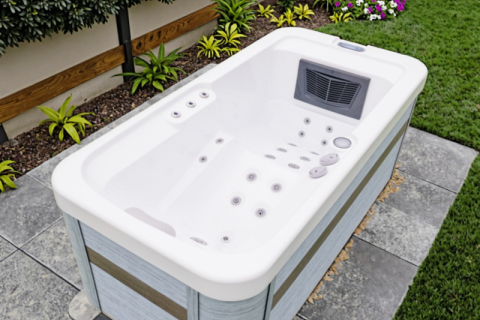
According to the Aquatic Exercise Association, for young children and the elderly, the water temperature in a swim spa tub typically needs to be warmer—ranging between 84°F and 94°F—whereas for adults, a comfortable pool temperature usually falls between 85°F and 89°F.