


How long does it take for baking soda to work in an outdoor hot tub?
2026-08-27 15:30For outdoor spa hot tub owners, "incorrect water parameters" is rarely a single, isolated issue. Many users find that after a few uses, the water exhibits low pH, insufficient Total Alkalinity (TA), or instability that becomes increasingly difficult to manage. Consequently, "adding a little baking soda" has become a common remedy. However, the question that truly puzzles many users isn't whether baking soda works, but rather: "How long does it actually take to take effect?"
Some users re-test the water just ten or fifteen minutes after adding baking soda; seeing little change in pH, they add more. Others dump in a large amount at once, hoping for a quick pH correction, only to end up with excessively high alkalinity—forcing them to use acidic chemicals to fix the imbalance. Additionally, some owners conflate baking soda, "pH Up" products, soda ash, and specialized alkalinity increasers, assuming they all serve the same purpose of raising pH. In reality, while these products all have an alkalizing effect on the water, their chemical properties and primary functions differ.
Baking soda primarily serves to raise the water's total alkalinity while providing a relatively mild boost and buffering effect on the pH. For most residential outdoor whirlpool spa hot tubs, baking soda does not take "hours to start reacting" once added; it dissolves and integrates into the water's buffering system quite rapidly. The actual waiting period is required to ensure the chemical is thoroughly mixed throughout the tub and to allow the water parameters to stabilize through circulation, gas exchange, and chemical equilibrium. Therefore, from a practical maintenance standpoint, you should generally allow the hot tub to circulate for about 20–30 minutes after adding baking soda before re-testing according to the equipment and product instructions. To confirm stable alkalinity and pH levels, a safer approach is to wait several hours before testing again, rather than repeatedly adding chemicals within a few minutes. Some professional spa products recommend circulating the water for at least 30 minutes before testing, while others advise waiting 4–6 hours before re-checking total alkalinity and pH.
So, what exactly does baking soda change in an outdoor spa hot tub? Why is the change in pH sometimes minimal after adding chemicals? Why does the pH become more stable once total alkalinity is correctly adjusted? For owners of residential outdoor spa hot tubs or commercial spas—as well as those currently shopping for such equipment—understanding these issues is far more important than simply memorizing "how much baking soda to add."

Why is the time it takes for baking soda to take effect a challenge in outdoor spa hot tub water management?
One of the key differences between an outdoor spa hot tub and a standard household bathtub is that the former is not a "fill-soak-drain" single-use fixture, but rather a water treatment system involving continuous circulation, filtration, heating, and sanitization. A residential outdoor spa hot tub typically holds anywhere from several hundred to over 1,000 liters of water, which constantly flows through circulation pumps, filters, heaters, and massage jets. Every time a user enters the water, substances such as sweat, sebum, skincare products, and bathing residues are introduced; airborne dust, rainwater, and outdoor environmental pollutants can also find their way into the tub.
Consequently, the water quality in an outdoor spa hot tub is not static. Parameters such as pH, total alkalinity, sanitizer concentration, calcium hardness, and total dissolved solids (TDS) fluctuate based on usage. The CDC recommends regular water quality testing for residential pools and hot tubs, advising that pH levels be maintained between 7.0 and 7.8; sanitizer levels also require continuous monitoring in hot tubs.
In this context, the value of baking soda lies in raising total alkalinity and enhancing pH buffering capacity, rather than simply forcing a rapid spike in the pH reading. CDC water quality guidelines indicate that total alkalinity represents the water's ability to neutralize hydrogen ions and resist drastic pH fluctuations, with bicarbonates serving as a key component of this alkalinity. When total alkalinity is too low, the water's pH is prone to rapid shifts—a phenomenon commonly known as "pH bounce."
This explains a peculiar issue many outdoor whirlpool spa hot tub owners encounter: the pH is adjusted to a normal level one day, only to drop by the next; it is adjusted again, yet drops once more a few days later. The root problem may not be that the pH wasn't adjusted enough, but rather that the total alkalinity failed to stabilize. If total alkalinity is too low, repeatedly adjusting the pH directly can lead to a cycle of constant chemical dosing.
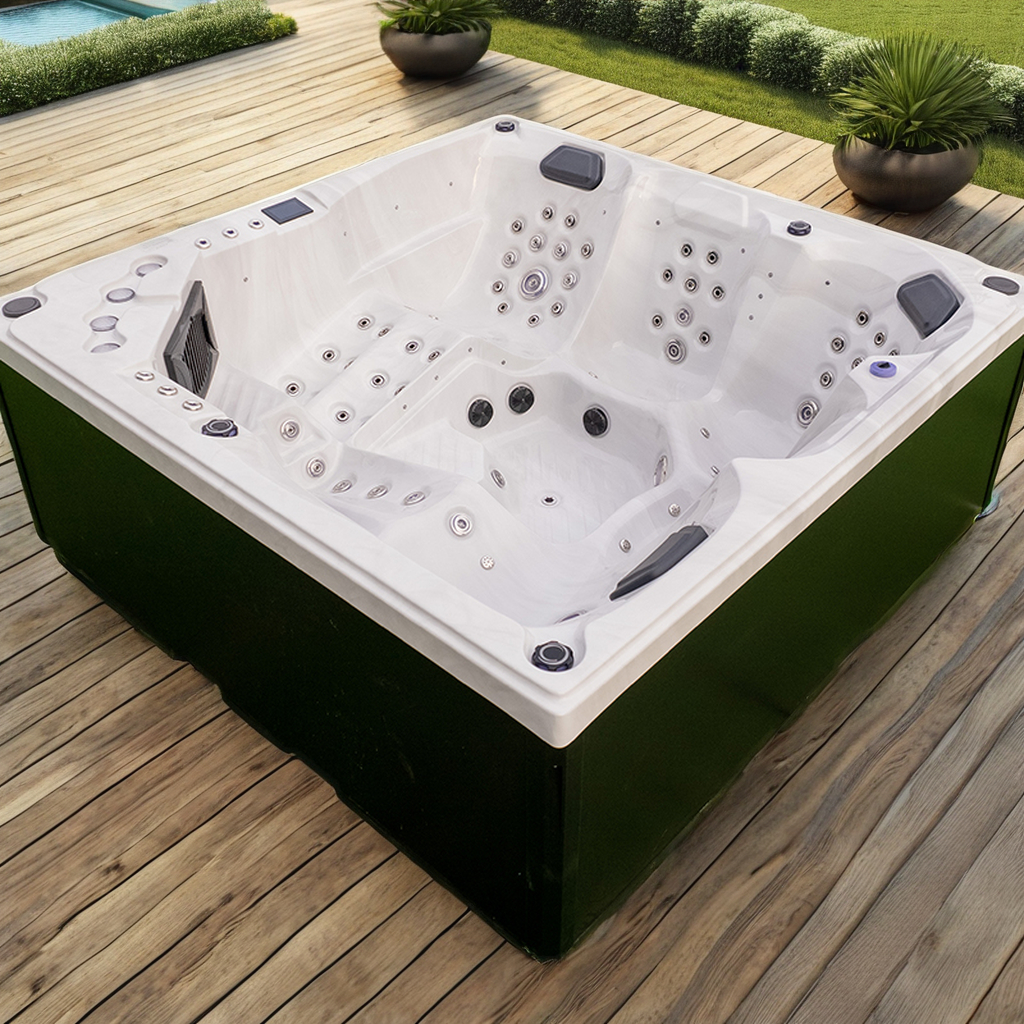
How long does it take for baking soda to take effect in an outdoor spa hot tub?
If "taking effect" here refers to when the baking soda begins to dissolve and participate in the water's chemical equilibrium, the answer is: very quickly. Baking soda—sodium bicarbonate (NaHCO₃)—dissolves rapidly upon entering the water and immediately engages with the carbonate-bicarbonate buffer system.
However, if "taking effect" refers to "when the adjusted total alkalinity can be accurately measured," the answer isn't simply a matter of a few minutes.
Once baking soda is added to an outdoor spa hot tub, it relies on the circulation pump and jets to distribute evenly throughout the water. If a hot tub holds 1,000 liters and the user simply pours the powder into one spot, actual concentrations may vary across different areas of the tub for a time. Taking a sample immediately might yield results that do not accurately represent the water as a whole.
Therefore, standard maintenance advice is to run the circulation system after adding baking soda to ensure the water is thoroughly mixed. Some spa chemical instructions recommend circulating the water for about 30 minutes before testing; for instance, certain sodium bicarbonate-based products require at least 30 minutes of circulation before checking total alkalinity.
If the user is making a significant water chemistry adjustment rather than a minor top-up, a safer strategy is to circulate the water, stop adding chemicals, and wait several hours before performing a follow-up check. Some spa water care products suggest waiting 4–6 hours before re-testing total alkalinity (TA) and pH to avoid overdosing caused by the water not yet having fully stabilized.
In short, you can break the timing down this way: baking soda starts working almost immediately; the 20–30 minute window is primarily for thorough mixing; and the 4–6 hour (or longer) period is for observing water stability. These are distinct stages.
Does baking soda raise the pH of an outdoor spa hot tub, or does it raise total alkalinity?
Baking soda is primarily a total alkalinity adjuster rather than a potent pH increaser. While it can raise the pH slightly, its main function is to boost the water's buffering capacity. Consequently, when a hot tub's total alkalinity is low, baking soda is usually a more appropriate choice than using a strongly alkaline pH increaser alone. Suppose an outdoor spa hot tub tests at a pH of 7.1 with a Total Alkalinity (TA) of only 50 ppm. If a user focuses solely on pH and adds a potent "pH Up" product, the pH might temporarily rise to 7.4; however, because the TA remains low, the pH is likely to fluctuate again quickly.
A more prudent approach is to first use baking soda to gradually raise the TA to an appropriate range, thereby enhancing the water's resistance to pH fluctuations. Afterward, one can observe the pH level; if it remains low, a specialized pH-raising product can be used for fine-tuning.
CDC water quality guidelines indicate that Total Alkalinity serves as a crucial buffer against pH changes, with a commonly recommended range of 60–180 ppm; traditional public spa guidelines for bromine-based systems have historically targeted a TA range of 100–120 ppm.
For modern residential outdoor whirlpool spa hot tubs, specific target values should be based on the recommendations of the equipment manufacturer and the water treatment products being used. Many residential spa systems target a TA of approximately 80–120 ppm, but since water treatment systems vary, a single figure cannot be mechanically applied to every outdoor spa hot tub.
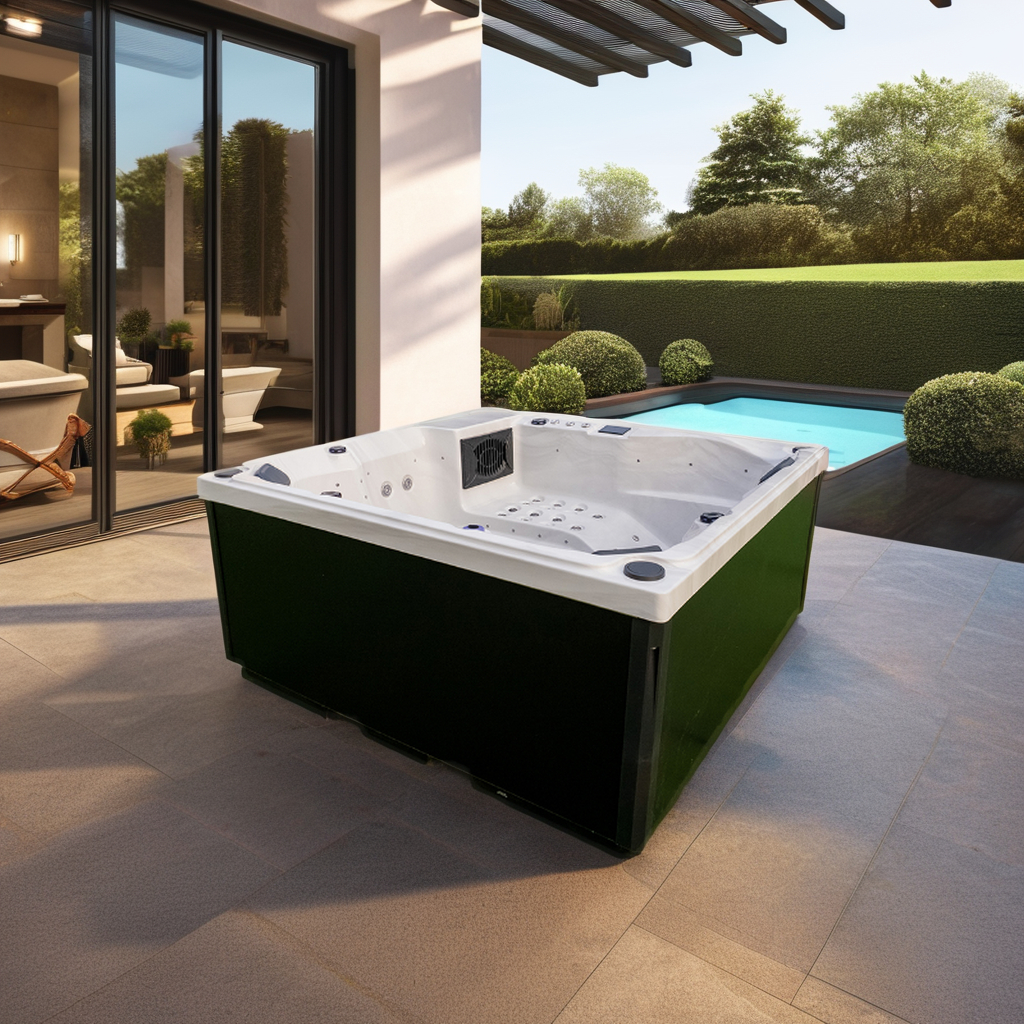
Why doesn't the pH rise significantly after adding baking soda to an outdoor spa hot tub?
If an outdoor spa hot tub has a pH of 7.1 and low TA, adding an appropriate amount of baking soda will likely cause a noticeable rise in TA, but the pH will not increase as rapidly or drastically as it would with sodium carbonate (soda ash). This does not mean the baking soda is ineffective.
In fact, this characteristic is precisely what makes baking soda an effective buffer.
Unlike strong alkalis, baking soda does not drastically alter the water's pH; instead, it strengthens the water's buffering capacity through the bicarbonate system. Consequently, you may see a significant change in TA while the pH undergoes only a relatively mild shift.
Therefore, if the goal is to "quickly raise pH from 6.9 to 7.4," baking soda may not be the best tool; however, if the goal is to address "low TA causing unstable pH," then baking soda is extremely valuable.
This is why professional outdoor whirlpool spa hot tub maintenance emphasizes a specific sequence: test TA first, then assess pH; if TA is low, prioritize stabilizing TA before addressing pH. The CDC specifies that the pH level should be maintained between 7.0 and 7.8, as this range strikes an optimal balance between disinfection effectiveness, equipment longevity, and user comfort.
What should be done 20–30 minutes after adding baking soda to an outdoor spa hot tub?
After adding baking soda, the priority is not to add more chemicals, but to allow the substance to disperse thoroughly.
If the equipment allows, the circulation system should be activated to keep the water flowing. Many spa manufacturers recommend running the circulation system on high for at least 20–30 minutes to ensure the sodium bicarbonate is distributed quickly and evenly throughout the water.
For outdoor whirlpool spa hot tubs equipped with multiple massage jets, the water flow generally facilitates rapid chemical mixing. However, note that if the jets are set to inject large amounts of air, the increased water-to-air contact area may alter the rate at which carbon dioxide escapes, potentially shifting the pH reading. Therefore, when making precise water quality adjustments, follow the testing guidelines provided by the equipment and chemical manufacturers rather than simply assuming "more jets are better."
Additionally, it is best to sprinkle the baking soda evenly across the water surface rather than dumping it all in one spot. If the product instructions require pre-dissolving, dissolve the product in clean hot tub water first before adding it evenly to the tub. This minimizes areas of high local concentration and promotes faster mixing.
If using a professional-grade "Alkalinity Increaser," you must follow the dosage instructions on the product label, as purity, recommended dosages, and target concentrations can vary between products.
How much baking soda should be added to a 1,000-liter outdoor spa hot tub?
This is a crucial practical question, yet there is no single, fixed figure that applies to every baking soda product.
The dosage of water treatment chemicals should be calculated based on three variables: the actual water volume of the hot tub, the current Total Alkalinity (TA), and the target TA.
For example, if an outdoor whirlpool spa hot tub has an actual capacity of 1,000 L, a tested TA of 60 ppm, and a target TA of 100 ppm, the TA theoretically needs to be raised by approximately 40 ppm. In this case, you should not simply estimate based on "a few scoops of baking soda"; instead, calculate the required amount according to the dosage instructions for the specific product being used. Data from the CDC’s Model Aquatic Health Code provides a useful conversion factor: adding 1.4 pounds of sodium bicarbonate per 10,000 US gallons of water raises total alkalinity by approximately 10 ppm. This converts to roughly 635 g per 37,854 L, meaning about 0.0168 g of baking soda is required per liter of water to raise alkalinity by 10 ppm.
Based on this calculation, raising the alkalinity of 1,000 L of water by 10 ppm requires approximately 17 g of sodium bicarbonate; raising it by 30 ppm requires a theoretical amount of about 51 g. In practice, however, you should always follow the specific product label instructions and add the chemical in increments rather than dumping the entire theoretical dose in at once.
This explains why some professional spa products provide guidelines such as "approximately 17 g to raise 1,000 L by 10 ppm," though actual product concentration, testing methods, and water conditions will still influence the final result.
For residential outdoor whirlpool spa hot tubs, it is better to make small adjustments, allow the water to circulate, and retest, rather than adding a large dose in an attempt to reach the target level in a single step.
When is the best time to retest after adding baking soda to an outdoor spa hot tub?
For minor adjustments—such as raising total alkalinity (TA) by only 10–20 ppm—running the hot tub's circulation system for 20–30 minutes before an initial test helps determine if the chemical has been evenly distributed.
If a significant adjustment has been made, it is not advisable to perform repeated tests (e.g., at 5 or 10-minute intervals) and continue adding chemicals immediately. At that stage, the water may not be fully mixed, and pH and TA readings can be skewed by localized concentrations and the current state of the water.
Some professional spa chemical instructions recommend testing after 20–30 minutes of circulation, while others suggest waiting 4–6 hours before re-checking TA and pH levels. Therefore, a prudent maintenance routine for a residential outdoor whirlpool spa hot tub involves running the circulation system for approximately 20–30 minutes after adding baking soda to ensure the chemical is fully dispersed. You may perform a test to check for initial changes; however, if further dosage adjustments are required, it is best to allow the water more time to stabilize—typically waiting several hours before re-testing.
For commercial spas or frequently used outdoor whirlpool spa hot tubs, testing schedules should be established in accordance with local regulations, equipment manufacturer guidelines, and chemical product instructions. The CDC recommends testing pH and disinfectant levels in public hot tubs at least twice daily, with increased testing frequency during periods of heavy use.
How soon can you use the hot tub again after adding baking soda?
There is no simple answer like "you can use it after 30 minutes."
This is because "the chemicals are fully mixed" and "the hot tub is safe for use" are two different matters.
If only a small amount of baking soda was added for a minor adjustment, the chemical is likely evenly dispersed after thorough circulation; however, you should still re-test pH and disinfectant levels before use to ensure all key parameters fall within the ranges specified by the equipment and product manufacturers.
The CDC recommends maintaining hot tub pH levels between 7.0 and 7.8 and testing for disinfectants and pH to reduce the risk of waterborne illnesses.
If "shocking," adding disinfectant, or performing other chemical treatments simultaneously, you must also adhere to the re-entry times specified on the respective product labels. You should not overlook other recently added chemicals simply because "only a little baking soda" was used.

FAQ: Common Questions About Using Baking Soda in Outdoor Hot Tubs
1. Is 30 minutes enough after adding baking soda to the hot tub?
Thirty minutes serves as a general guideline for allowing the water to circulate and mix thoroughly, but it does not guarantee that all water quality parameters have fully stabilized by that time. Some products recommend testing after 20–30 minutes of circulation; however, if significant adjustments are made, you may need to wait 4–6 hours before re-checking Total Alkalinity (TA) and pH.
2. Does baking soda raise the pH of an outdoor hot tub?
Yes, it does. However, since baking soda’s primary function is to increase total alkalinity and enhance buffering capacity, its effect on pH is usually milder than that of dedicated "pH Up" products. If TA is low, baking soda is generally the better choice for establishing a stable buffer system; if TA is within the normal range but pH remains low, you should consider other pH adjustment methods based on specific water conditions.
3. What is the ideal TA level for an outdoor hot tub?
Requirements vary depending on the equipment and water treatment system. Many residential spa systems target a range of 80–120 ppm, while CDC guidelines suggest a broader total alkalinity range of 60–180 ppm; historically, public spa guidelines for bromine systems cited 100–120 ppm as the ideal range. In practice, you should prioritize the instructions provided by the hot tub manufacturer and the chemical product manufacturer.
4. Are baking soda and "pH Up" products the same thing?
No. Baking soda (sodium bicarbonate) is primarily used to raise total alkalinity and has a mild effect on pH, whereas many "pH Up" products contain ingredients like sodium carbonate that are better suited for directly raising pH. They are not simply interchangeable; the appropriate product should be selected based on actual TA and pH test results.
5. Do I still need to test for sanitizer after adding baking soda?
Yes. Baking soda primarily affects alkalinity and pH balance; it cannot replace sanitizers like chlorine or bromine. Outdoor hot tubs still require proper sanitizer levels. The CDC currently recommends maintaining a pH of 7.0–7.8 for residential hot tubs and regularly testing sanitizer and pH levels based on usage; for bromine systems, the CDC suggests a reference range of 4–8 ppm. Therefore, after adjusting the sodium bicarbonate, do not neglect the disinfection system simply because the Total Alkalinity (TA) and pH have returned to normal levels.