


What happens when you soak in a hot tub with excessively high bromine levels?
2026-08-26 15:30Many hot tub owners operate under a common misconception: since bromine kills bacteria, having a bit more in the water must make it more hygienic. They often add extra bromine tablets, granules, or shock treatments after several people have used the tub, believing this ensures safer water quality. In reality, however, more sanitizer is not necessarily better. Water treatment for outdoor whirlpool spa hot tubs requires balancing effective sanitization against user comfort and equipment safety. When bromine levels consistently exceed the upper limits specified by the equipment or product, the water shifts from a state of "insufficient sanitization" to one of "excessive chemical exposure." Users may experience dry or stinging skin, eye irritation, and discomfort in the mucous membranes. Risks escalate further if concentrations are abnormally high—particularly involving concentrated bromine chemicals or rapid bromine release caused by improper mixing.
The U.S. CDC recommends a bromine range of 4–8 ppm and a pH of 7.0–7.8 for residential hot tubs. For public hot tubs, where controlling *Legionella* risk is critical, the CDC similarly recommends an operating range of 4–8 ppm bromine and 7.2–7.8 pH, while emphasizing adherence to manufacturer-specified upper limits. It is important to note that labeling requirements vary by country, region, equipment type, and specific bromine product. Therefore, one should not simply apply a single universal figure; instead, the manufacturer’s manual, the sanitizer product label, and local regulations should serve as the definitive guidelines.
So, what actually happens if you soak in a hot tub with excessive bromine? Why do some people experience dry skin and stinging eyes while others notice no ill effects? How can you distinguish between a "normal bromine odor" and water quality that has spiraled out of control? What steps should be taken if high bromine levels are detected? These questions touch upon various aspects of hot tub maintenance, including sanitization chemistry, water balance, human exposure, and equipment care. The following sections provide a systematic analysis of these issues.
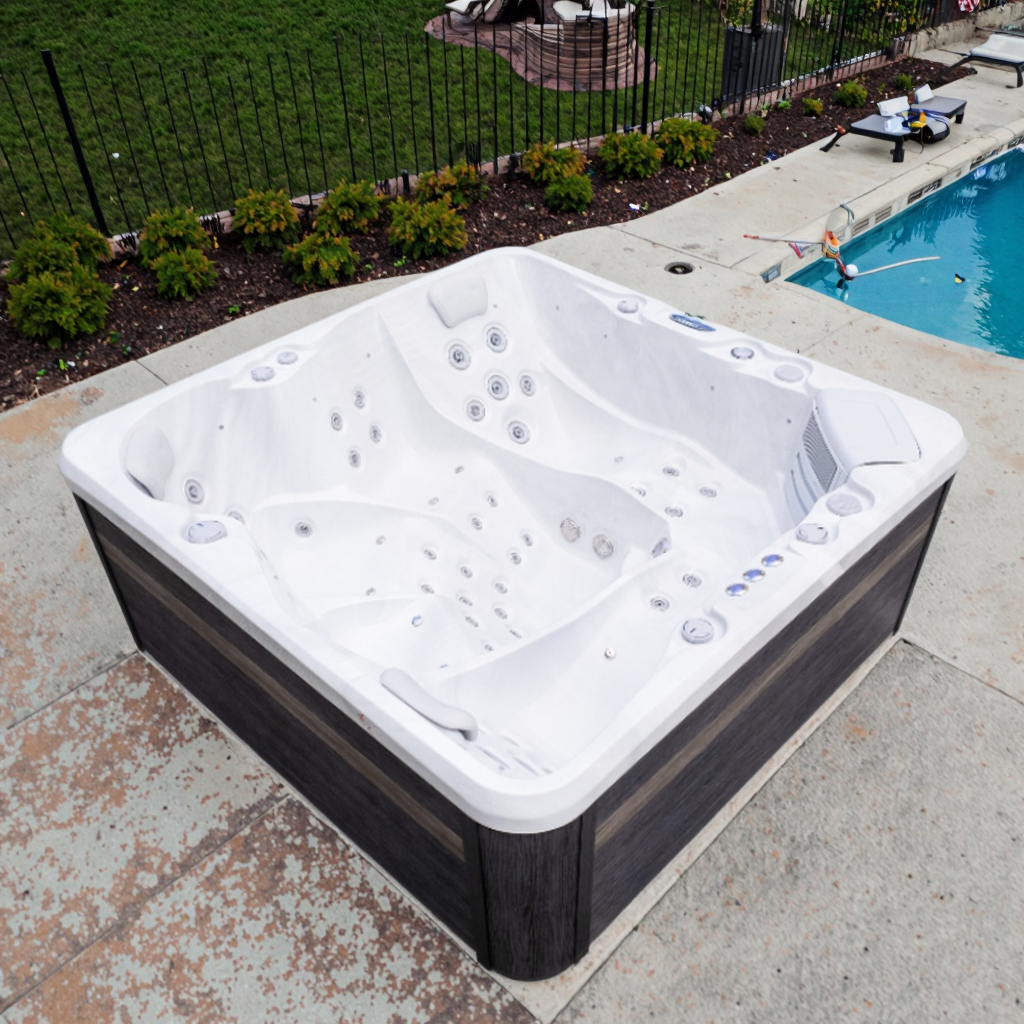
Why is the belief that "higher bromine equals greater safety" one of the most common misconceptions regarding outdoor spa hot tub water quality?
The primary difference between an outdoor whirlpool spa hot tub and a standard bathtub is that a hot tub is typically not drained immediately after each use. A residential outdoor spa hot tub may hold anywhere from several hundred to over 1,000 liters of water, while units used in hotels, resorts, or commercial spas can have even larger capacities. Because the water is continuously recirculated through pumps, filters, heaters, and massage jets for repeated use over a period of time, maintaining a stable residual level of disinfectant is essential for controlling microorganisms.
Bromine is widely used in spas and outdoor spa hot tubs due to its effective disinfection performance in warm water; furthermore, many users find it better suited to the high-temperature environments of spas compared to certain chlorine-based systems. For outdoor spa hot tubs typically operating between 38°C and 40°C, a stable disinfection system is crucial; the combination of warmth, moisture, water circulation, and high usage loads makes controlling microorganisms significantly more challenging than in standard cold-water environments.
However, a fundamental principle of disinfection applies: levels must be maintained within an "effective concentration range" rather than simply increased indefinitely. The CDC recommends a bromine concentration of 4–8 ppm for residential hot tubs and explicitly advises that if test results fall outside this range, the operator should be notified or corrective measures taken immediately.
This means that a test result of around 8 ppm represents a completely different issue from water containing "no bromine at all." The former raises concerns about whether the level exceeds the limits permitted for the specific equipment and product, whereas the latter indicates insufficient disinfection capability. In particular, if levels reach 10 ppm, 15 ppm, or higher, the situation cannot be justified by the logic that "more disinfectant means greater safety"; instead, use should be suspended, and the water re-tested, diluted, or replaced.
More importantly, users must distinguish between "elevated bromine concentration" and "severe exposure to concentrated bromine chemicals." Detecting a few ppm of bromine in spa water is not the same as direct contact with concentrated bromine chemicals or the inhalation of high-concentration bromine vapors. The CDC notes that bromine itself can irritate the skin and mucous membranes; inhalation exposure may cause coughing, breathing difficulties, headaches, tearing, and irritation of the oral and nasal mucosa, while skin contact with high concentrations can lead to irritation or even chemical burns. Therefore, risk assessment must consider the actual concentration detected in the water, the duration of exposure, pH levels, and the specific type of chemical involved, rather than drawing conclusions based solely on the presence of a "bromine smell."
What are the initial physical reactions to soaking in an outdoor spa hot tub with excessively high bromine levels?
If the bromine level in an outdoor whirlpool spa hot tub only slightly exceeds the target range and the duration of exposure is short, healthy adults may not necessarily experience immediate, obvious symptoms. However, as concentrations rise and exposure time lengthens, the body typically becomes increasingly aware of the water quality abnormalities.
The most common issue is skin irritation.
Users may experience dry, tight, or itchy skin, or notice slight redness after exiting the tub. These sensations may be more pronounced in individuals with sensitive skin. High concentrations of disinfectants increase chemical irritation on the skin's surface, while the hot water itself boosts blood flow and thermal load, making irritation symptoms more noticeable.
A second issue is eye irritation.
Prolonged soaking—where water comes into direct contact with the eyes, or where massage jets create significant water droplets and aerosols—can easily lead to stinging, tearing, and general discomfort. CDC data on bromine exposure clearly indicates that bromine can irritate tissues, including the mucous membranes of the nose and mouth.
A third issue involves nasal and respiratory discomfort.
It is important to distinguish between the bromine concentration in spa water and high concentrations of bromine gas in the air. However, hot tub jets generate large amounts of droplets and mist; when water chemistry is severely unbalanced, airborne chemical irritants can become more noticeable. Users should exit the tub immediately if they experience significant coughing, chest tightness, difficulty breathing, or persistent tearing.
A fourth issue is a sensation of extreme dryness after soaking.
While this does not necessarily mean bromine levels have reached a dangerous threshold, it can signal an imbalance in water chemistry. Factors beyond disinfectant concentration—such as pH, total alkalinity, water hardness, and other dissolved substances—also affect how the water feels on the skin. Therefore, one should not assume bromine levels are excessive simply because the skin feels dry; instead, testing tools should be used to verify the levels.
Why does an outdoor spa hot tub with high bromine levels cause skin discomfort?
Physical irritation caused by outdoor whirlpool spa hot tubs is actually the result of multiple interacting factors, rather than a simple equation of "bromine equals irritation."
The first factor is bromine concentration. Theoretically, the higher the level of active bromine in the water, the greater the chemical exposure and the higher the risk of irritation. However, bromine levels within the normal maintenance range do not necessarily cause irritation to the human body; the key concern is whether the levels exceed the ranges specified for the equipment and products.
Next is pH. The CDC currently recommends maintaining the pH of residential hot tubs between 7.0 and 7.8, while the recommended range for public hot tubs is typically 7.2 to 7.8. If the pH is too low, skin and eye irritation may occur; if the pH is too high, the performance of the disinfection system may be altered.
Third is water temperature. outdoor spa hot tubs usually operate at high temperatures; the CDC recommends that water temperature not exceed 104°F (40°C). Higher temperatures increase the body's heat load and can affect the volatilization of chemicals and the formation of aerosols. Consequently, a combination of high water temperature, high bromine levels, and prolonged soaking may cause more pronounced physical discomfort than high bromine levels alone.
Fourth is soaking duration. Spending 10 minutes in an outdoor whirlpool spa hot tub involves a completely different exposure time compared to soaking for 60 consecutive minutes; even if the chemical parameters of the water are identical, the total exposure dosage differs.
Therefore, professional water quality management cannot simply answer the question "at what ppm level is it definitely harmful," because the human body's reaction depends on concentration, duration, temperature, pH, and individual sensitivity.
At what level is bromine in an outdoor spa hot tub considered "too high"?
For residential outdoor spa hot tubs, the CDC currently recommends a bromine level of 4–8 ppm. While this serves as a valuable reference range, it does not mean that every outdoor spa hot tub must strictly operate within these limits. Different equipment may utilize different bromine products, automatic dosing systems, and water treatment protocols; consequently, manufacturer manuals may specify different target ranges.
At the same time, CDC guidelines for public hot tubs emphasize that operators should maintain a minimum bromine level of 4 ppm without exceeding the manufacturer's specified upper limit. Understanding this principle is actually more important than simply memorizing a specific number.
For instance, if a manufacturer's manual specifies a bromine range of 3–5 ppm for a particular outdoor whirlpool spa hot tub, a user measuring 8 ppm cannot simply assume that "since the CDC allows 8 ppm, it must be fine." Conversely, if a specific commercial system and its chemical labeling authorize higher concentrations under certain conditions, the system's specifications should be followed. Furthermore, the labels of certain EPA-approved spa sanitizers specify conditions for re-entry. For instance, some bromine-based product labels explicitly prohibit re-entry if the bromine level in the spa water exceeds 6 ppm under specific usage conditions. This indicates that the "safe re-entry level" (in ppm) must be determined based on the specific product's label rather than applying a generic figure to all products.
Therefore, from a practical standpoint, the "4–8 ppm" range can be viewed as a crucial reference guideline provided by the CDC for residential hot tubs; however, if test results significantly exceed the manufacturer's maximum allowable limit, usage should be suspended until water quality is corrected.
What should be done if bromine levels of 10 ppm, 15 ppm, or higher are detected in an outdoor spa hot tub?
If test results are significantly above the equipment's normal operating range, the primary rule is not to continue soaking, but to stop using the tub and verify the test results.
Home test strips can be affected by factors such as reagent expiration, testing technique, water sampling location, and reading timing. If an initial test indicates abnormally high bromine levels, it is advisable to re-test using the correct procedure. For commercial equipment or cases where results are uncertain, more accurate titration tests or professional water quality analysis should be employed.
If a re-test still shows significantly high levels, use of the outdoor whirlpool spa hot tub should be suspended.
The simplest way to lower levels is usually to stop adding bromine, allow the system to circulate, and wait for the concentration to drop naturally; however, the specific waiting time depends on the equipment, water volume, temperature, circulation status, and the specific bromine product used. In cases of significant over-concentration, partially draining the tub and adding fresh water can usually lower levels more quickly. For example, if an outdoor spa hot tub has an actual volume of 1,000 L and 30% of the water is replaced, the bromine concentration should—under ideal mixing conditions—drop significantly according to dilution principles, though the actual outcome will also be influenced by circulation and any continued sanitizer dosing.
If water quality has become severely compromised, completely draining the tub, cleaning the unit and filters, and re-establishing chemical balance may be more practical than simply waiting for the concentration to drop naturally.
It is important to note that one should never arbitrarily add other chemicals to the tub in an attempt to "quickly lower bromine levels." Incompatible reactions can occur between different water treatment products. Labels on certain EPA-approved bromine products explicitly warn against directly mixing concentrated products with other chemicals, as violent reactions could result.
What should you do if your skin stings after using an outdoor spa hot tub with high bromine levels?
If you have already entered an outdoor whirlpool spa hot tub where the water quality is visibly abnormal, you should immediately stop soaking, thoroughly rinse your body with clean running water, and avoid further exposure.
If you experience only mild skin dryness or brief irritation, you can simply monitor the situation after leaving the water and cleaning your skin. However, if you develop significant redness or swelling, persistent pain, blisters, severe skin irritation, or if symptoms do not subside, you should seek an evaluation from a medical professional.
CDC information on bromine exposure indicates that skin contact with bromine can cause irritation and burns; if actual bromine exposure is suspected, you should leave the area, wash your body, and seek medical help as soon as possible.
If you experience coughing, difficulty breathing, a severe headache, dizziness, persistent tearing of the eyes, or respiratory tract irritation, you must not remain near the outdoor spa hot tub. Leave the area immediately and move to a location with fresh air; seek medical help promptly if symptoms are severe or if chemical exposure is suspected. It is important to note that bromine levels in spa water exceeding the target range are different from direct exposure to high concentrations of bromine gas; therefore, do not automatically assume you have "bromine poisoning" simply because water quality levels are high, though you should not ignore obvious symptoms.
High Bromine Levels Are Not the Same as "Hot Tub Rash"
Many consumers assume that "bromine levels are too high" whenever they notice a red rash on their bodies after using an outdoor whirlpool spa hot tub.
In reality, this is not necessarily the case.
The CDC notes that "hot tub rash" is typically associated with *Pseudomonas aeruginosa* bacteria. Common symptoms include itching, red bumps (papules), and pus-filled blisters around hair follicles, often appearing a few days after using a poorly maintained hot tub.
This means that if a user develops skin issues after using an outdoor spa hot tub, they must consider various possibilities—such as inadequate disinfection, bacterial contamination, poor filtration system maintenance, aging water, and chemical irritation—rather than attributing every skin problem solely to "excessive bromine."
This is why water quality management for outdoor whirlpool spa hot tubs must focus on two key aspects: ensuring disinfectant levels do not drop too low (which would fail to control microorganisms effectively) while also avoiding excessively high levels in a misguided attempt to achieve "super-strong disinfection."
The true goal is to maintain stable and appropriate residual disinfectant levels.
FAQ: Common Questions About High Bromine Levels in Outdoor Hot Tubs
1. What is considered a normal bromine level for an outdoor hot tub?
The CDC currently recommends a bromine concentration of 4–8 ppm and a pH of 7.0–7.8 for residential hot tubs; a reference range of 4–8 ppm is also cited for public hot tubs. However, requirements may vary depending on the brand, equipment, and sanitizer used; therefore, you should prioritize the guidelines provided by the hot tub manufacturer and the product label.
2. Is it safe to use an outdoor hot tub if bromine levels exceed 8 ppm?
You cannot make a determination based on a single number alone. Since 8 ppm is at the upper limit of the CDC's recommended range for residential hot tubs, a reading above this level requires checking the specific limits set for your equipment and chemicals. If the level significantly exceeds the manufacturer's specified range, stop using the hot tub. Reduce the concentration through circulation, waiting, dilution, or water replacement, and re-test before deciding whether to resume use.
3. What should I do if my skin stings after using an outdoor hot tub with high bromine levels?
First, stop soaking and rinse your body with clean, running water. If symptoms are mild, you can monitor to see if they resolve on their own; however, seek medical evaluation if you experience persistent pain, significant redness or swelling, blisters, or severe irritation. If you also experience difficulty breathing, significant coughing, dizziness, or other severe symptoms, leave the area immediately and seek medical help. The CDC notes that exposure to high concentrations of bromine can irritate the skin and respiratory tract.
4. Does a strong "bromine smell" from the outdoor hot tub mean the bromine level is too high?
Not necessarily. Odor is not an accurate indicator of the bromine concentration (ppm) in the water. While a strong chemical smell may suggest issues with water quality or maintenance, you should verify bromine and pH levels using test strips or other water testing methods rather than relying on smell. The CDC also recommends using testing tools to check sanitizer levels and pH in hot tubs.
5. Can I add other chemicals to lower the bromine level if it is too high?
Mixing different chemicals on your own is not recommended. Some bromine product labels explicitly warn against mixing concentrated products directly with other chemicals, as violent reactions may occur. A safer approach is to stop adding chemicals, verify the test results, follow the product and equipment instructions regarding circulation and waiting times, and—if necessary—lower the concentration by partially or completely replacing the water.