


Why is the Water Pressure from My Outdoor Spa Jacuzzi Jets Fluctuating?
2026-06-11 15:35For many people, one of the most important aspects of the outdoor spa jacuzzi experience is the hydro-massage effect provided by the jets. Whether it involves invigorating back massage, soothing lower back relaxation, or therapeutic leg hydrotherapy, the stability of the jet pressure directly impacts the overall comfort level of the spa. However, after prolonged use, many users encounter a very common issue: the water pressure from the spa jets fluctuates—sometimes strong, sometimes weak.
At times, the massage intensity feels powerful, only to suddenly diminish moments later; in other instances, some jets maintain normal pressure while others feel noticeably weak; there are even situations where jets spray intermittently, sometimes accompanied by unusual bubbling, strange noises, or uneven water flow.
When faced with this situation, many people's first reaction is often: "Are the jets clogged?" While clogging is indeed a common culprit, it is by no means the only one. In the context of an outdoor spa jacuzzi tub, fluctuations in jet pressure can stem from a variety of underlying issues involving the circulation system, pump performance, filtration, water levels, air induction systems, plumbing pressure, or even water chemistry balance.
In short, fluctuating jet pressure is rarely just a simple case of "broken jets."
This is particularly true for outdoor spa jacuzzi tubs, which feature complex circulation systems and extensive hidden plumbing networks; if an anomaly occurs at any point within this system, the consequences will ultimately manifest as irregularities in the jet pressure.
Therefore, what users truly need to understand is not simply "are the jets clogged?" but rather: why is the water flow within the entire spa system becoming unstable?
This article will provide a comprehensive analysis of why spa jet pressure fluctuates, examining the issue from multiple angles—including the operating principles of the jets, the logic behind water circulation, the root causes of pressure changes, and the most common types of malfunctions—to identify which specific problems are most likely to trigger this phenomenon.

How Do Spa Jacuzzi Jets (Hydro-Jets) Actually Work?
Many people assume that spa jets are merely simple nozzles designed to "squirt water"; in reality, however, the jet system within an outdoor jacuzzi tub is far more sophisticated than one might imagine.
The jet system of a spa jacuzzi tub typically consists of the following components:
•Water pump
•Circulation piping
•Air mixing system
•Diverter valves
•Jet assemblies
•Filtration system
When the outdoor jacuzzi tub is switched to massage mode, the water pump draws water from inside the tub into the circulation system, then delivers it under high pressure to the various jet locations. Simultaneously, many jets also mix in air, creating a more intense sensation of impact and a bubbly massage effect.
Consequently, the water pressure ultimately delivered by the jets is, in reality, the result of the combined action of multiple systems working together.
If a problem arises in any one of these links, it may lead to:
•Water pressure fluctuations
•Uneven jet output
•Weakened water flow
•Pressure that surges and subsides

Why does the water pressure from spa jacuzzi jets fluctuate?
Many users notice that the jets aren't "completely dry," but rather:
•Strong at times
•Weak at others
•Normal occasionally
•Intermittent at other times
This phenomenon usually indicates that the system is still operational, but its circulation has become unstable. The underlying causes of this instability are often more complex than a simple blockage.
A Clogged Filter is One of the Most Common Causes
Among all potential issues, a clogged filter in an outdoor jacuzzi tub is the easiest to overlook—yet it is also one of the most frequent culprits.
The spa jacuzzi tub's filter is responsible for trapping:
•Hair
•Dust
•Body oils/sebum
•Impurities
•Microscopic particles
As usage time increases, the filter gradually accumulates dirt. When the filter becomes clogged, the volume of water flowing into the pump decreases.
What happens then?
Although the water pump continues to run at high speed, the internal circulation becomes unstable due to an insufficient water supply. The result is that the pressure from the jets begins to fluctuate—surging and subsiding. This effect becomes particularly pronounced when the tub is operating in high-power massage mode. Many users mistakenly assume that the jets themselves are broken, but in reality, the filter has simply become severely clogged.
If the spa jacuzzi tub filter is left uncleaned for an extended period, it can lead to further complications, such as:
•Increased load on the water pump
•Slower water circulation
•System pressure instability
•Increased pump noise
Therefore, whenever the water pressure from your spa jacuzzi tub jets seems abnormal, the filter should typically be the very first component you check.
Low Water Levels in Spa Jacuzzi Tubs Can Lead to Unstable Jet Pressure
Many people do not realize that the water level actually has a direct impact on jet pressure. When an outdoor jacuzzi tub is in operation, the water pump requires a continuous supply of water to draw from. If the water level is too low, vortices can easily form near the intake ports, causing the pump to begin drawing in air.
Once air enters the system:
•The water flow becomes intermittent.
•Pressure levels fluctuate.
•The intensity of the jets varies erratically.
In some instances, these issues may be accompanied by:
•Abnormal air injection from the jets.
•Sudden interruptions in water flow.
•Unusual noises within the plumbing.
Many users mistakenly attribute these symptoms to clogged jets; however, the actual problem is simply that the water level is too low.
This is particularly common with outdoor spa jacuzzi tubs; after multiple people have used the tub, splashing and evaporation can cause the water level to drop. If the water is not topped up for an extended period, issues with jet pressure are highly likely to arise.
Air Entering the Spa Jacuzzi Tub's Circulation System Causes the Typical "Surging" Effect
Air entering the plumbing lines is another common cause of pressure fluctuations in outdoor jacuzzi tub jets. Under normal operating conditions, the circulation system should maintain a steady, continuous flow of water. However, if a significant amount of air enters the system, it creates a phenomenon known as "airlock" (or air obstruction). Simply put, the air disrupts the otherwise continuous stream of water.
The resulting symptoms include:
•Intermittent water flow.
•Pressure levels that surge up and down.
•Unstable jet performance.
In many cases, air enters the system due to:
•Excessively low water levels.
•Failure to properly purge air after draining and refilling.
•Loose plumbing connections.
•The water pump running dry (cavitation).
•Insufficient water supply reaching the filter.
This is especially critical after changing the water; if the outdoor jacuzzi tub is not properly purged of air afterward, residual air trapped inside the system can cause abnormal jet pressure for a prolonged period.

What Happens When the Spa Jacuzzi Jets Themselves Become Clogged?
Of course, physical clogging of the jets themselves is also a very common problem.
This is particularly likely to occur in situations involving:
•Regions with high water hardness (high calcium levels).
•Failure to change the water for extended periods.
•Severe limescale/mineral buildup.
•The presence of biofilm within the plumbing.
•Inconsistent or poor water quality management.
Under these conditions, the interior of the jets can easily accumulate:
•Limescale and mineral deposits.
•Sticky residues and impurities.
•Microbial buildup.
Since the apertures of spa jacuzzi tub jets are inherently small, even partial blockage can result in abnormal water flow and compromised jet performance. However, it is important to note that pressure issues caused by clogged jets are typically "localized" in nature.
For example:
•A specific set of jets appears noticeably weaker.
•Pressure is abnormal in a particular zone.
•Some jets produce little to no water flow.
If all the jets throughout the entire outdoor jacuzzi tub are fluctuating—alternating between strong and weak—the problem is likely not merely a simple blockage.
A decline in the performance of the spa jacuzzi tub's water pump can also lead to changes in jet pressure.
The water pump serves as the core power source for the entire outdoor jacuzzi tub system. If the pump itself malfunctions, the pressure at the jets will inevitably be affected.
For example:
•Pump aging
•Worn impeller
•Declining motor performance
•Internal bearing issues
•Damage caused by running without sufficient water (dry running)
These issues can result in:
•Reduced circulation capacity
•Unstable pressure
•Fluctuating water flow (alternating between strong and weak)
Many outdoor jacuzzi tub owners notice that while the water pressure appears normal immediately after startup, it becomes noticeably weaker after the unit has been running for a while. This scenario often indicates that the water pump is unable to maintain stable pressure once the operational load increases.
Malfunctions in the diverter valve system can also impact jet pressure in a spa jacuzzi tub.
Many high-end outdoor jacuzzi tub models are equipped with a diverter valve system. Its function is to control the distribution of water flow to jets located in different zones.
For example:
•Increasing flow to the back massage zone
•Reducing flow to the leg massage zone
•Switching between specific massage modes
If the internal components of the diverter valve experience issues such as:
•Sticking or jamming
•Limescale buildup
•Aging seals
...then the distribution of water flow may become unstable.
The result is that some jets may suddenly become stronger, while others abruptly weaken. Users sometimes mistakenly attribute this to a problem with the jets themselves, when in reality, the issue lies within the diverter system.
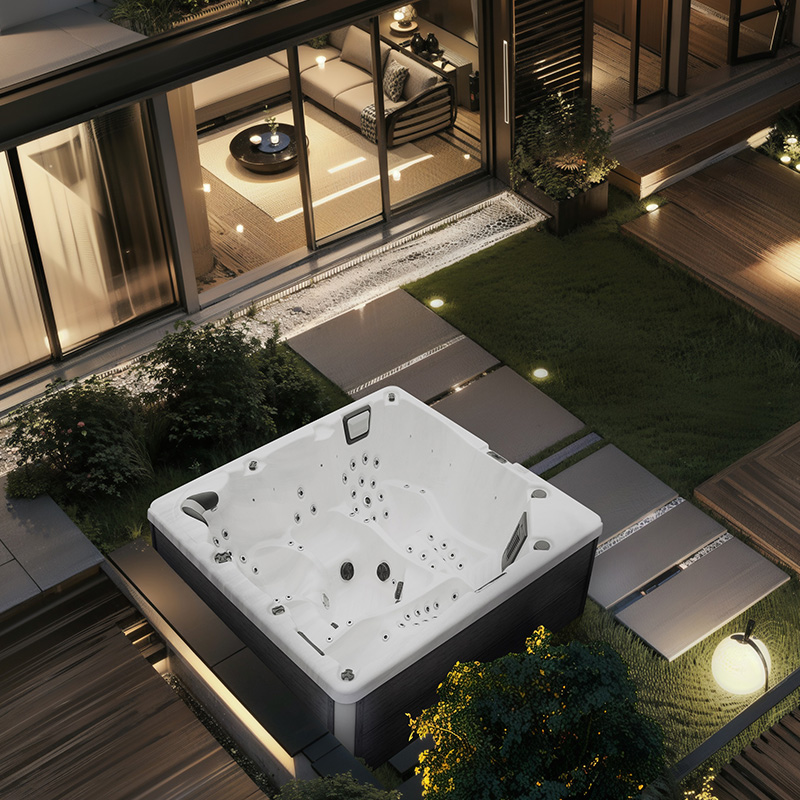
Why does high calcium hardness cause a drop in jet pressure within a spa jacuzzi tub?
After a spa jacuzzi tub has been in use for an extended period, white crystalline deposits may gradually begin to appear around the jets. These deposits are, in fact, typical limescale.
When the calcium hardness level in the water is excessively high, minerals will continuously accumulate in areas such as:
•The orifices of the jets
•Pipe elbows and bends
•The water pump housing
•The vicinity of the heating element
Over time, the internal diameter of the plumbing pipes will gradually narrow. This leads to:
•Increased water flow resistance
•Exacerbated pressure loss
•Weakened jet intensity
This is particularly true when an outdoor jacuzzi tub operates continuously at high temperatures over extended periods, as the rate of limescale formation accelerates significantly.
Biofilm can also affect the pressure of outdoor jacuzzi tub jets.
Many users focus solely on "limescale" while overlooking the issue of biofilm. In reality, the interior of a spa jacuzzi tub—being consistently warm, damp, and rich in organic matter—provides an ideal environment for biofilm formation. These sticky microbial deposits gradually accumulate on the inner surfaces of the plumbing and jets.
The consequences include:
•Restricted water flow
•Intermittent jet operation
•Pressure fluctuations
•Abnormal water flow direction
If these symptoms are accompanied by:
•Unpleasant odors
•A slimy or slippery sensation
•Black, flocculent (fluffy) debris
then it is highly likely that a biofilm issue is present.
Why do the jets sometimes suddenly return to normal?
Many users notice that their jets occasionally function normally for a moment, only to revert to abnormal behavior shortly thereafter. This situation typically indicates that the system issue is not a complete blockage, but rather an "unstable state."
For example:
•Trapped air is occasionally expelled
•Pump pressure briefly recovers
•Deposits within the plumbing shift position
•Water levels fluctuate
Therefore, jets that are "working intermittently" (sometimes fine, sometimes not) actually serve as a stronger indication that underlying issues exist within the system's internal system.
What are the typical signs of abnormal jet pressure in a spa jacuzzi?
If the jet system has begun to develop problems, it is usually accompanied by the following phenomena:
•Water flow that fluctuates between strong and weak
•Certain jets lacking power
•Intermittent jet operation
•An abnormal increase in air bubbles
•Increased noise from the water pump
•Unusual noises coming from the plumbing lines
•Unstable water flow direction
•Visible limescale deposits around the jets
All of these signs suggest that an abnormality exists within the circulation system.
How should one properly troubleshoot jet pressure issues in a whirlpool jacuzzi tub?
When it comes to whirlpool jacuzzi tubs, following the correct troubleshooting sequence is crucial.
It is generally recommended to prioritize checking the following:
1.Is the water level normal?
Ensure that the suction inlets are completely submerged.
2.Is the filter clogged?
Many issues are, in fact, simply caused by an overly dirty filter.
3.Have deposits accumulated on the jets?
Check the area surrounding the jets for any white mineral deposits.
4.Is there trapped air in the system?
This is particularly important to check after refilling the spa with fresh water.
5. Is the Water Pump Functioning Normally?
Observe for:
•Noise
•Vibration
•Circulation capacity
6. Is the Diverter Valve Functioning Normally?
Verify that the water flow distribution is stable.
How Can You Minimize Issues with Spa Jacuzzi Jet Pressure?
To ensure consistent massage performance over the long term, the key lies in maintaining the stability of the entire circulation system.
For example:
•Clean the filters regularly
•Maintain the proper water level
•Change the water periodically
• Control calcium hardness
• Prevent limescale buildup
• Clean the plumbing lines
• Maintain proper water chemistry balance
This is because, in the context of an outdoor spa jacuzzi tub, issues with the jets are often merely the "symptom"; the root cause of the problem typically lies within the overall circulation system.