


Why does my outdoor swim spa tub always get scale buildup?
2026-07-25 15:35Compared to traditional hot tubs, outdoor swim spa tubs not only meet the needs of daily family relaxation and spa massage, but also provide continuous swimming training, low-impact exercise rehabilitation, and full-body muscle workouts through a counter-current water flow system, making them increasingly popular with consumers. However, many users encounter a frustrating problem during long-term use: despite regularly adding disinfectant and cleaning the filter, why does my outdoor swim spa tub still easily develop white scale, nozzle scale, heater scale, and even scale buildup inside the pipes?
In fact, scale buildup is not a problem unique to any particular brand or type of equipment; it's a phenomenon that all spa equipment may encounter during long-term operation. Outdoor swim spa tubs, in particular, are more prone to scale buildup than ordinary swimming pools due to their larger capacity, longer circulation time, and consistently higher water temperature, while undergoing continuous heating, circulation, evaporation, and replenishment processes daily. Ignoring scale buildup not only affects the appearance and user experience of the outdoor swim spa tub, but can also reduce heating efficiency, clog nozzles, increase energy consumption, and even shorten the lifespan of the circulation system and heating equipment.
So, why do outdoor swim spa tubs always accumulate limescale? What exactly is limescale? What factors accelerate limescale formation? And how should it be prevented and treated scientifically? This article will provide a comprehensive analysis of these questions, combining practical maintenance experience and relevant data to help users establish a more scientific approach to water quality management.
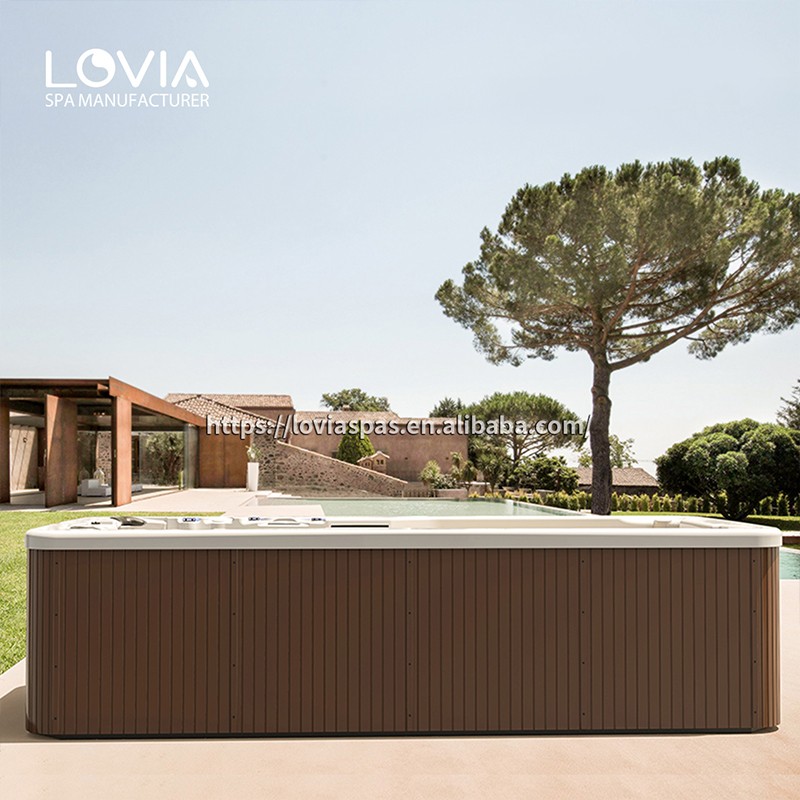
Why do outdoor swim spa tubs easily accumulate limescale?
Limescale typically refers to insoluble deposits formed by minerals such as calcium and magnesium ions in water under specific conditions, with calcium carbonate being the most common. Over time, these minerals gradually adhere to the inner walls, nozzles, circulation pipes, heaters, and filtration systems of outdoor swim spa tubs, forming white, grayish-white, or light yellow deposits.
Many users believe that limescale only affects aesthetics, but the problems it causes go far beyond that. As limescale accumulates, it reduces the heat exchange efficiency of the equipment, requiring the heater to consume more energy to reach the set temperature. Simultaneously, narrowed nozzle outlets affect the massage and counter-current water flow effects, while limescale buildup in pipes can increase circulation resistance, causing the circulation pump to operate under high load for extended periods.
Compared to regular swimming pools, outdoor swim spa tubs are more prone to limescale buildup, primarily due to three characteristics of their operating environment: consistently high water temperature, high circulation frequency, and rapid water evaporation. These three factors all promote mineral precipitation, thus accelerating limescale formation.
Hard Water Is the Main Cause of Limescale Bbuildup In Outdoor Swim Spa Tubs
The vast majority of severe limescale buildup in outdoor swim spa tubs is primarily related to the hardness of the local water source.
Hard water refers to natural water containing a high concentration of calcium and magnesium ions. Water quality varies greatly from region to region; in some areas, groundwater is rich in minerals and has a significantly higher hardness than surface water. Generally, water with a total hardness exceeding 180 milligrams per liter (calculated as calcium carbonate) is considered relatively hard.
When hard water enters an outdoor swim spa tub, the mineral concentration increases with heating and evaporation. Once the concentration reaches a certain level, calcium ions combine with carbonate ions to form insoluble calcium carbonate crystals, which gradually adhere to the surface of the equipment.
Many users have noticed that newly filled water is crystal clear, but after a few weeks, white deposits begin to appear around the nozzles. This is a typical sign of hard water minerals precipitating out.
If the local tap water is inherently hard, and the user doesn't regularly test the calcium hardness level, scale buildup in outdoor swim spa tubs is almost inevitable.
The Higher The Water Temperature, the Easier It Is For Scale to Form In Outdoor Swim Spa Tubs
Besides hard water, continuous heating is another significant reason why outdoor swim spa tubs are prone to scale buildup.
According to chemical principles, when water temperature rises, the stability of soluble minerals such as calcium bicarbonate decreases, making them more prone to decomposition and the formation of calcium carbonate precipitate. Therefore, the higher the temperature, the easier it is for minerals to precipitate out.
Although outdoor swim spa tubs are primarily used for swimming training, many users still maintain the water temperature between 28°C and 36°C to accommodate spa and relaxation functions, while the water temperature in a typical home swimming pool is usually only 24°C to 28°C. Higher operating temperatures mean faster mineral precipitation.
Furthermore, the local temperature of the heater in an outdoor swim spa tub is usually higher than the overall water temperature. When water flows over the heater surface, minerals are more likely to deposit there first, making the heater one of the most prone areas to scaling.
Data shows that even a scale layer of only about 1 mm thick can reduce heating efficiency by about 5% to 10%. If scale continues to accumulate, not only will power consumption increase, but it can also cause localized overheating of the heating element, thus shortening the equipment's lifespan.
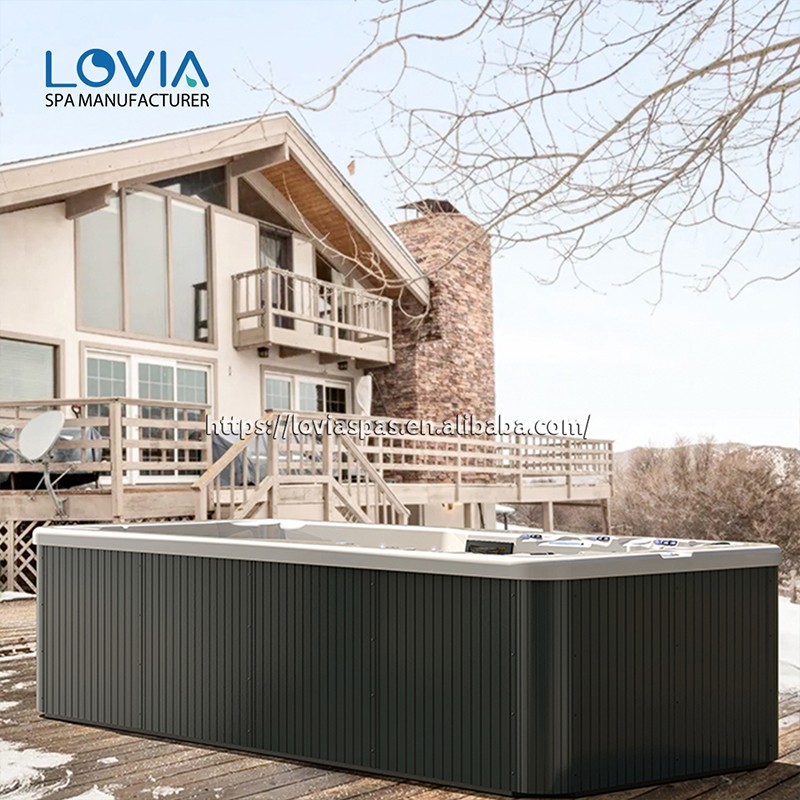
Water Evaporation in Outdoor Swimming Spa Tubs Increases Mineral Concentration
Many users add a small amount of fresh water to their outdoor swim spa tubs daily, but they overlook the impact of evaporation.
During normal operation, especially in summer or windy weather, outdoor swim spa tubs evaporate a certain amount of water daily. What evaporates is pure water, while minerals remain in the water, thus continuously increasing the mineral concentration in the remaining water.
With continuous water replenishment and evaporation, minerals continue to accumulate, forming increasingly higher levels of total dissolved solids (TDS) and calcium hardness.
When the mineral concentration reaches saturation, scale will naturally form even if the equipment is functioning correctly.
This is why outdoor swim spa tubs that haven't had their water changed for a long time are usually more prone to white deposits than those that have just had their water changed.
High pH Levels Significantly Accelerate Scale Formation in Outdoor Swim Spa Tubs
In water quality management, pH level is a crucial indicator affecting scale formation.
Ideally, the pH level of outdoor swim spa tubs should be maintained between 7.2 and 7.8. If it consistently exceeds 7.8, especially reaching 8.0 or even above 8.2, the rate of calcium carbonate precipitation will significantly increase.
This is because as pH rises, bicarbonate ions in the water gradually convert to carbonate ions, which more easily combine with calcium ions to form precipitates.
Many users frequently add alkaline regulators to reduce water acidity without simultaneously monitoring the pH level, ultimately leading to chronically alkaline water and accelerating scale formation in outdoor swim spa tubs.
Therefore, focusing solely on disinfectant concentration is far from sufficient; regular pH testing is equally important.
Improper Calcium Hardness Control is Also a Significant Factor
Besides pH level, calcium hardness is another important indicator of whether outdoor swim spa hot tub combos are prone to scale formation.
If the calcium hardness is too low, the water will be somewhat corrosive, potentially damaging equipment components; however, if the calcium hardness is too high, it easily leads to the formation of large amounts of scale.
It is generally recommended that the calcium hardness of outdoor swim spa hot tub combos be maintained between 150 and 250 ppm, with the specific range adjustable according to the manufacturer's recommendations.
Many users never test calcium hardness, focusing only on chlorine concentration and pH value. When calcium hardness consistently exceeds 400 ppm, even if other indicators are normal, the risk of scaling increases significantly.
Therefore, professional water quality maintenance typically tests free chlorine, pH value, total alkalinity, and calcium hardness simultaneously, rather than focusing on a single parameter.
Not Changing the Water for Extended Periods Increases the Risk of Scaling in Outdoor Swim Spa Hot Tub Combos
Filtration systems can remove suspended particles, but they cannot remove minerals already dissolved in the water.
With prolonged use of outdoor swim spa hot tub combos, calcium, magnesium, salts, and various dissolved substances in the water accumulate, leading to a continuous increase in total dissolved solids (TDS).
When TDS increases, the water is more likely to reach mineral saturation, resulting in scale formation.
Therefore, even if the filtration system is functioning normally, it is still necessary to regularly drain and refill it according to the frequency of use.
For average households, it's generally recommended to perform a complete water change every 3 to 6 months in outdoor swim spa hot tub combos. If used frequently or shared by multiple people, the interval should be shortened accordingly.
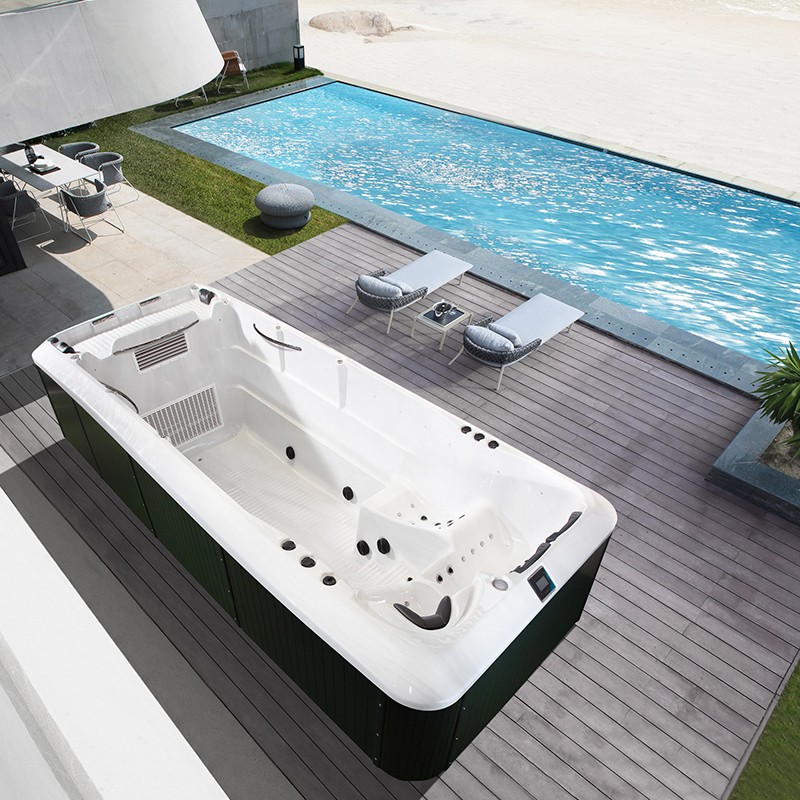
How to prevent scale buildup in outdoor swim spa hot tub combos?
Prevention is usually simpler and less costly than later scale removal.
First, water quality should be tested regularly, including pH, total alkalinity, calcium hardness, and TDS. It's recommended to test at least twice a week and record the data trends.
Second, adjustments should be made based on local water quality characteristics. If the area has hard water, consider installing a water softener or using partially softened water when topping up to reduce mineral content at the source.
Third, maintain a reasonable pH range to avoid long-term alkalinity.
Fourth, regularly drain and replace the water to prevent unlimited mineral accumulation.
Fifth, use a professional anti-scaling agent as needed according to the product instructions. These products can slow down the formation of calcium ions into crystals, thus reducing the rate of scale buildup.
Finally, consistently cleaning the filter and circulation system to ensure smooth water flow also helps reduce localized scale buildup.
What should I do if my outdoor swim spa hot tub combo has scale buildup?
If your outdoor swim spa hot tub combo has noticeable scale buildup, it's not recommended to use metal brushes or strong acids for direct cleaning, as this may damage the acrylic surface or equipment components.
It's generally recommended to drain the equipment first, then use a professional descaling agent suitable for acrylic materials. For nozzles and pipes, you can run the tub with a circulating cleaning solution for a period of time to gradually dissolve the internal deposits.
If the scale buildup inside the heater is severe, it should be disassembled and cleaned by a professional maintenance personnel to avoid affecting the safety of the equipment.
It's important to note that after removing the scale, the water quality parameters should be readjusted; otherwise, new scale may form quickly.
FAQ
Why is my outdoor swim spa hot tub combo starting to scale again shortly after changing the water?
If you live in a hard water area, the newly added water itself contains higher mineral content, and scale may form quickly after continuous heating.
Will scale affect the use of my outdoor swim spa hot tub combo?
Yes. Scale will reduce heating efficiency, clog nozzles, increase circulation resistance, and may shorten the lifespan of the equipment.
Can scale inhibitors completely prevent limescale buildup in outdoor swim spa hot tub combos?
They cannot completely eliminate limescale, but they can effectively slow down the rate of mineral crystallization and adhesion. The effect is even better when combined with proper water quality management.
How often should the water quality of outdoor swim spa hot tub combos be tested?
It is recommended to test at least twice a week. If the bathtub is used frequently or shared by multiple people, the testing frequency can be increased to allow for timely adjustments to water quality parameters.