


Why is a filtration system important for outdoor whirlpool hot tubs?
2026-09-08 15:35With the development of global home garden economies, high-end residences, hotel resorts, and the wellness industry, outdoor whirlpool hot tubs are becoming increasingly popular outdoor leisure equipment. Compared to traditional bathtubs, outdoor spa hot tubs not only provide a constant-temperature bathing experience but also combine massage, hydrotherapy, relaxation, and social entertainment, making them increasingly popular among families, villa owners, guesthouse operators, hotel groups, and commercial spa projects.
However, in actual use, many users encounter an easily overlooked problem: Why do some outdoor whirlpool hot tubs initially have clear water and good massage effects, but after a period of time, the water becomes cloudy, the odor increases, the water flow from the nozzles weakens, the filter becomes frequently clogged, and even the equipment's operating efficiency decreases? Many consumers immediately assume this is a problem with the water treatment product or a decline in equipment quality. However, one of the important reasons for these problems is inadequate design or maintenance of the filtration system.
The biggest difference between outdoor whirlpool hot tubs and ordinary household bathtubs is that outdoor spa hot tubs typically use a circulating water system. Regular bathtubs are typically single-use, drained and cleaned after use. Outdoor hot tubs, however, usually store hundreds or even over 1000 liters of water, continuously circulating, heating, and filtering it through a pump to maintain a comfortable water temperature over a long period. Without a high-efficiency filtration system, dust, body oils, sweat, skincare product residue, hair, pollen, and fine particles will accumulate in the water, ultimately affecting water quality and equipment operation.
Based on industry experience, a residential outdoor spa hot tub may need to circulate and process hundreds of liters of water daily. Commercial outdoor hot tubs, such as those in hotel spa areas or resort outdoor spas, experience even higher usage frequencies, resulting in significantly increased water circulation and filtration pressures. Therefore, the filtration system is not merely an auxiliary component of an outdoor spa hot tub, but a crucial core system that determines water quality, safety, equipment lifespan, and long-term operating costs.
This article will provide an in-depth analysis from multiple perspectives, including water quality management, equipment protection, energy consumption, commercial operation, and selection criteria.
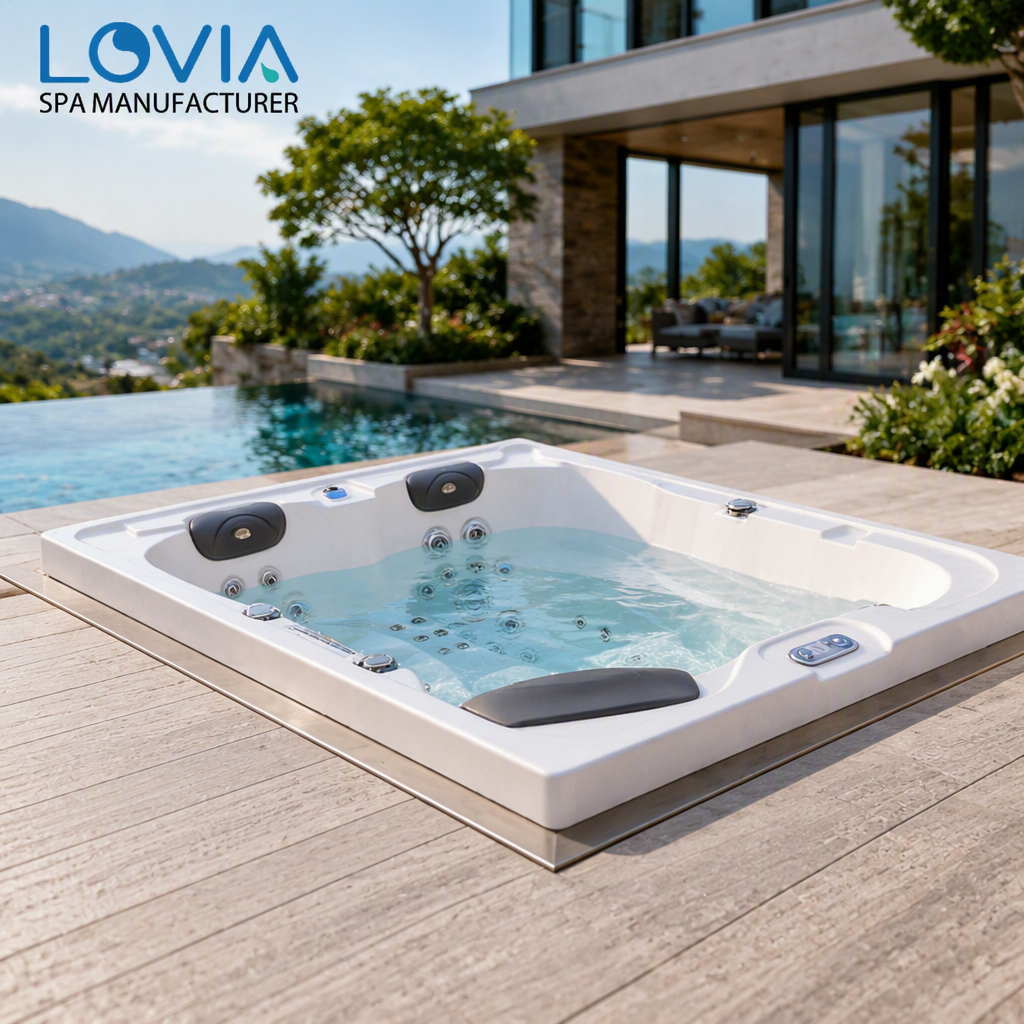
Why must outdoor hot tubs rely on filtration systems to maintain water quality?
Many first-time users of outdoor whirlpool hot tubs wonder: since regular water changes are possible, why is a complex filtration system necessary?
The answer lies in the way outdoor spa hot tubs are used, which necessitates a long-term, stable water supply through a circulating filtration system.
A typical household outdoor spa hot tub usually has a capacity of 800 to 1500 liters, while large commercial spa facilities may have even higher capacities. Draining all the water after each use and then refilling with cold water and heating it again would not only waste a significant amount of water but also increase energy consumption. This is especially true in winter or colder regions, as heating large amounts of fresh water to a suitable bathing temperature requires even more electricity.
Therefore, most outdoor spa hot tubs currently employ a "circulating filtration + water quality management" system. The system uses a pump to draw water from inside the tub into the filtration system, where it is filtered and then returned to the tub, maintaining a relatively clean water level.
The outdoor spa hot tub filtration system primarily performs three tasks:
First, it filters visible contaminants such as dust, leaves, hair, and airborne particles.
Second, it reduces organic contaminants in the water, such as body oils, sweat, skincare products, and other residues.
Third, it protects the internal components of the equipment, preventing contaminants from entering the pump, heater, and piping system.
Therefore, a high-performance filtration system can maintain more stable water quality in outdoor whirlpool hot tubs while reducing the frequency of user maintenance.
What sources of contamination does an outdoor hot tub filtration system need to handle?
The biggest characteristic of outdoor spa hot tubs is that they are installed outdoors, so they face more complex sources of contamination than indoor hot tubs.
First, there are human contaminants. When users enter the warm water, oils, sweat, dead skin cells, and skincare product residue from their skin enter the water. This accumulation rate increases significantly, especially with multiple users. If the filtration system cannot handle this in time, it can easily lead to an oil film on the water surface, decreased water transparency, and even unpleasant odors.
Second, there is external environmental pollution. Since outdoor whirlpool hot tubs are usually installed in yards, gardens, terraces, or next to pools, they are inevitably affected by the natural environment. For example, dust, pollen, leaf debris, insects, and soil particles from the air can all enter the water. Especially in areas with high pollen counts in spring or high leaf litter counts in autumn, users will noticeably increase maintenance if the filtration system is inefficient.
Third, there are residues from the water treatment process. Outdoor whirlpool hot tubs typically require a combination of disinfection systems and water balancing products to maintain a safe water environment. If organic pollutants in the water are not filtered out in time, it increases disinfectant consumption and makes water quality management more difficult.
Therefore, the filtration system is actually a crucial foundation of the entire water treatment system. It cannot completely replace disinfection, but it can reduce water treatment pressure and improve overall water quality stability.
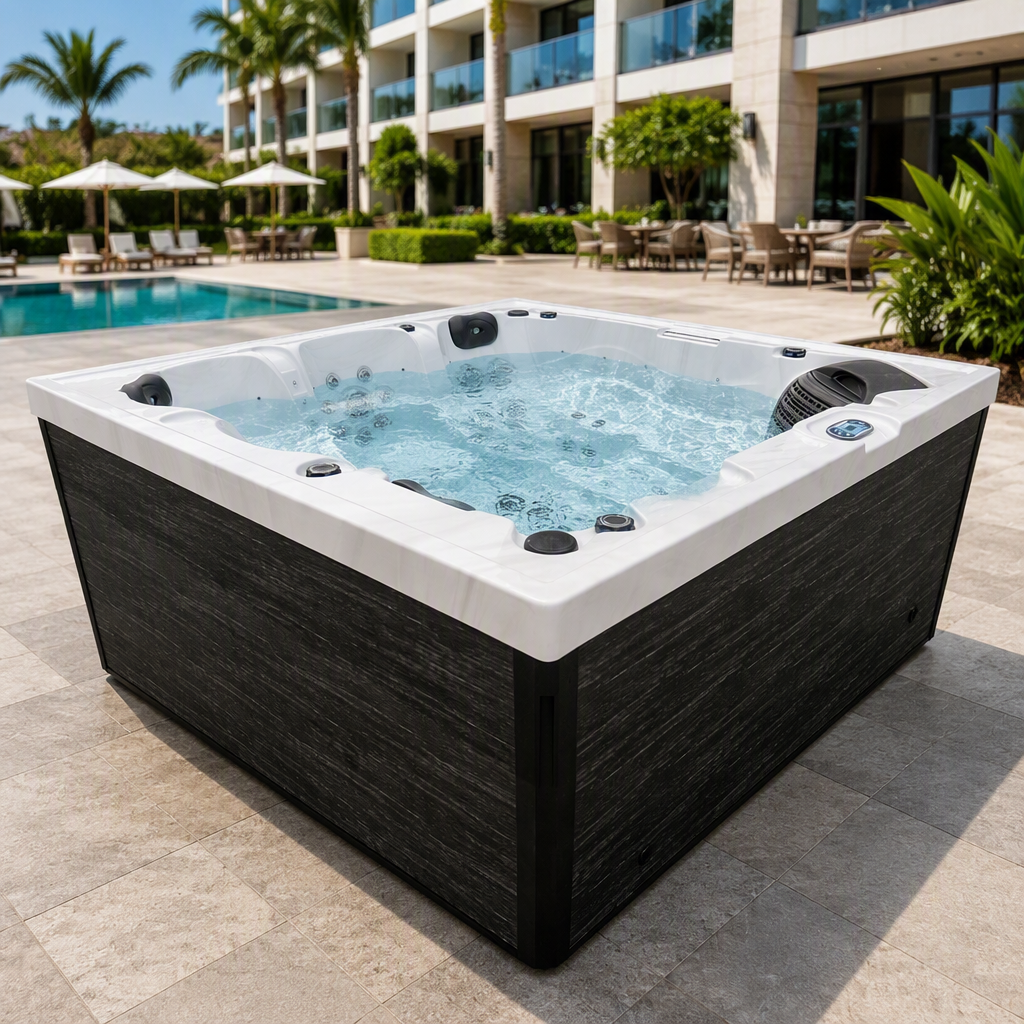
How does an outdoor spa hot tub filtration system work?
A complete outdoor spa hot tub filtration system usually consists of a filter pump, a filter, circulation piping, an inlet, and a return system.
When the system is running, the circulation pump draws water from inside the tub into the filtration pipes. As the water flows through the filter, pollutants are trapped by the filter media, and the treated water is then returned to the tub.
Currently, the most common filtration methods for outdoor hot tubs on the market include cartridge filtration, multi-stage filtration, and recirculation filtration designs.
Cartridge filtration is the most common method, typically using pleated filter media to increase the pollutant capture capacity by increasing the filtration area. This structure is cost-effective, easy to maintain, and suitable for most household outdoor whirlpool hot tubs.
Some high-end outdoor spa hot tubs employ multi-stage filtration designs, progressively removing contaminants of varying sizes through different filtration layers. For example, the first stage filters larger impurities, while the second stage filters fine suspended particles, thus improving water cleanliness.
Furthermore, the circulation filtration time is also a crucial factor affecting effectiveness. A well-designed outdoor whirlpool hot tub needs to have its circulation time rationally arranged based on its capacity, pump flow rate, and usage frequency to ensure more water undergoes filtration.
How does a high-efficiency filtration system enhance the user experience of an outdoor hot tub?
For users, the most direct value of a filtration system is improved water quality.
Common problems arising from an inadequate outdoor hot tub filtration system include:
1. Turbid water. Suspended particles cannot be removed promptly, resulting in water that appears cloudy.
2. Oil film on the water surface. Human oils, sunscreen, and skincare product residue tend to float on the surface; if the circulation filtration efficiency is insufficient, a noticeable oil film will form.
3. Odor. Long-term accumulation of organic pollutants affects water quality and increases the difficulty of chemical treatment.
4. Algae growth. Insufficient filtration efficiency coupled with unstable water quality management can lead to green or yellow algae blooms.
These problems not only affect the visual experience but also reduce user satisfaction with outdoor spa hot tubs.
Especially for hotels, guesthouses, and resorts, water quality is a crucial component of the customer experience. If guests find the water quality poor while using an outdoor hot tub, it will not only negatively impact reviews but may also damage the brand image.
Therefore, a superior filtration system can help operators reduce maintenance burdens and improve customer satisfaction.
Why can a filtration system extend the lifespan of an outdoor hot tub?
Many users believe that the filtration system is only responsible for "cleaning the water," but in reality, it is equally important for protecting the internal structure of the equipment.
Outdoor spa hot tubs contain several critical components, such as the water pump, heater, nozzles, piping, and control system. If impurities in the water continuously enter the circulation system, it can cause equipment wear and tear.
First, the filtration system reduces the load on the water pump. If a large amount of particulate matter enters the water circulation system, it can increase water flow resistance, raising the pump's operating pressure, and potentially leading to increased noise or decreased efficiency over time.
Second, the filtration system protects the heating elements. Minerals and impurities in the water can accumulate over time, forming scale, which affects heating efficiency. This problem is more pronounced in hard water areas. Scale buildup on the heating element reduces heat exchange efficiency, causing the device to take longer to reach the set temperature.
Third, a filtration system reduces the risk of nozzle clogging. The massage effect of an outdoor spa hot tub relies on a stable water flow. If particles enter the nozzle structure, the water flow may be weakened in some nozzles, affecting the massage experience.
Therefore, a good filtration system not only improves water quality but is also an important protective measure for the entire outdoor whirlpool hot tub system.
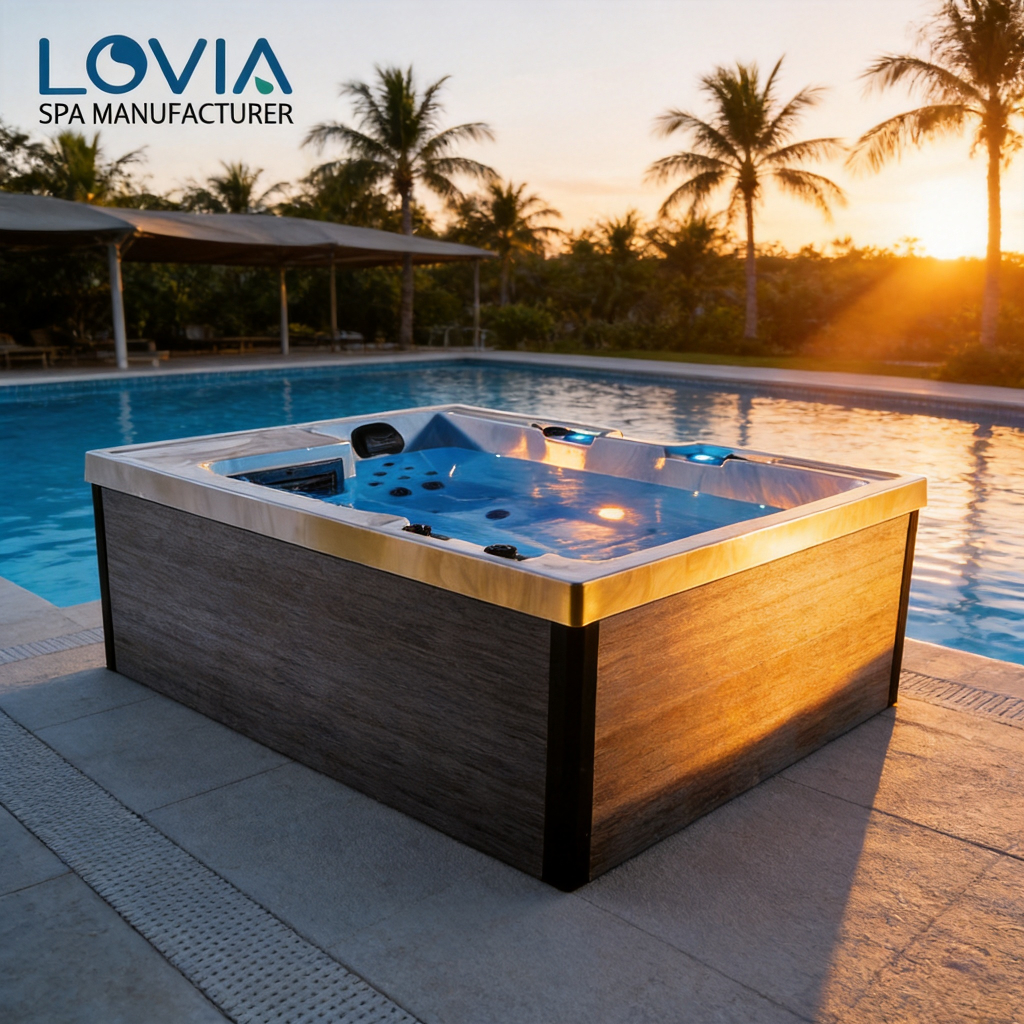
Why do commercial outdoor hot tub projects place greater emphasis on filtration systems?
Compared to residential use, commercial projects have higher requirements for filtration systems.
Residential users may use the tub once or a few times a day, while hotels, resorts, fitness centers, and commercial spas may receive a large number of different users daily. This means that contaminants enter the water more quickly, and the filtration system needs to bear a higher load.
Commercial outdoor spa hot tub projects typically focus more on:
First, water quality stability. Commercial clients need to ensure a consistent user experience throughout the day.
Second, maintenance efficiency. Operational staff cannot perform frequent complex maintenance, therefore, the equipment needs a higher degree of automation.
Third, operating costs. If the filtration system is inefficient, frequent water changes or the addition of water treatment products will increase long-term operating costs.
Therefore, when purchasing outdoor spa hot tubs for commercial projects, the filtration system is often one of the key evaluation criteria for suppliers.
Professional outdoor spa hot tub manufacturers typically offer different filtration solutions based on project scale, number of users, and local water quality conditions, rather than simply recommending standard products.
How to determine the quality of a filtration system when choosing an outdoor hot tub?
Consumers and buyers should not only focus on appearance, number of massage nozzles, or price when choosing an outdoor whirlpool hot tub, but also need to understand the filtration system design.
First, understand the type of filtration. Different filtration solutions are suitable for different usage environments and need to be selected based on residential, commercial, and climatic conditions.
Second, consider circulation capacity. An excellent outdoor spa hot tub should be able to circulate the entire water body effectively, not just provide partial filtration.
Third, consider ease of maintenance. Whether the filter is easy to disassemble and replace, and whether filter cartridges are readily available, will affect the long-term user experience.
Fourth, pay attention to the supplier's technical capabilities. Professional outdoor spa hot tub manufacturers usually provide detailed information on filtration system design, water circulation schemes, and maintenance recommendations, rather than just emphasizing the product's appearance.
Fifth, consider long-term spare parts supply. Filter cartridges, water pumps, and other components are consumables and require maintenance over long-term use; a stable supply is crucial.
What should you pay attention to for the daily maintenance of an outdoor hot tub filtration system?
Even with an advanced filtration system, proper maintenance is necessary to maintain optimal performance.
Generally, home users are advised to regularly check the filter's condition and clean it according to usage frequency. If the outdoor whirlpool hot tub is used frequently, such as by multiple people daily, the maintenance cycle should be shortened.
Over time, filter cartridges accumulate a large amount of contaminants, gradually reducing their filtration capacity; therefore, they need to be replaced regularly according to the manufacturer's recommendations.
At the same time, users also need to maintain a proper water quality balance. The outdoor spa hot tub filtration system primarily handles physical filtration, while the disinfection system controls microorganisms; both need to be used in conjunction.
Proper maintenance includes:
• Regularly cleaning the filter;
• Checking the water circulation status;
• Maintaining the appropriate pH level;
• Controlling scale formation;
• Regularly checking the equipment's operational status.
Only when filtration, circulation, and water treatment work together can the long-term stable operation of an outdoor spa hot tub be guaranteed.
FAQ
Q1: How often should the outdoor hot tub's filtration system be cleaned?
Generally, for home users, it is recommended to check and clean the filter every 2 to 4 weeks, depending on usage frequency. If the outdoor whirlpool hot tub is used by multiple people daily, or if the installation environment has a lot of dust and pollen, more frequent maintenance is required.
Q2: Can the filtration system completely solve the water quality problem of an outdoor hot tub?
No. The filtration system is mainly responsible for removing suspended particles and some contaminants, while the disinfection system is responsible for controlling bacteria and microorganisms. Both need to be used together to maintain stable water quality.
Q3: Why does the water in an outdoor hot tub become cloudy after a period of use?
Common causes include inadequate filtration, insufficient circulation time, abnormal water balance, accumulation of body oils, and the introduction of environmental contaminants. Inadequate filtration system performance is one of the important reasons.
Q4: Does a more advanced filtration system mean a higher price for an outdoor hot tub?
Generally, a high-performance filtration system increases manufacturing costs, but it also reduces long-term maintenance expenses and improves equipment stability. Therefore, it's necessary to evaluate it from a total lifecycle cost perspective.
Q5: What parameters should I focus on when purchasing an outdoor hot tub for its filtration system?
It's recommended to focus on the filtration method, circulation flow rate, filtration area, ease of maintenance, filter cartridge availability, and the technical support provided by the manufacturer. Professional outdoor spa hot tub suppliers usually provide complete filtration solution specifications.