


Why Does My Outdoor Spa Hot Tub Constantly Accumulate Limescale?
2026-06-12 15:30Before purchasing an outdoor spa hot tub, many people tend to focus primarily on the massage experience, water temperature, aesthetic design, and seating layout. However, once they begin using the unit regularly over the long term, one of the most common—and frustrating—issues they encounter is "limescale."
Many users discover that, even after using their spa hot tub for only a short period, white deposits begin to slowly form on the tub walls, jets, areas surrounding the heater, and even inside the filtration system. Sometimes these deposits resemble a fine powder, while at other times they appear as hard, crystalline formations. In severe cases, they can even encrust the jets, thereby disrupting water flow and diminishing the effectiveness of the massage function.
Many people’s initial reaction is to suspect that the spa hot tub itself is defective or that there is a problem with its circulation system. In reality, however, the vast majority of cases, the root cause of the problem lies not with the equipment, but with the "water."
This is particularly true for outdoor spa hot tubs; because they operate in a state of continuous high-temperature circulation—with the water constantly being heated, evaporating, and recirculating—the minerals within the water become increasingly concentrated. Consequently, compared to standard bathtubs, spa hot tubs are far more prone to limescale formation.
As a result, many users find themselves asking a new set of questions:
•Why is my spa hot tub particularly susceptible to limescale buildup?
•Is there something wrong with the water I’m using to fill it?
•Is standard tap water unsuitable for use in a spa hot tub?
•Can limescale actually cause damage to the equipment?
•Can I add vinegar to my spa hot tub every day to remove limescale?
•Is using white vinegar truly safe?
In fact, the issue of limescale in spa jacuzzi hot tubs is not merely a simple matter of "cleanliness"; rather, it involves a complex interplay of factors such as water hardness, mineral content, temperature fluctuations, chemical balance, and equipment maintenance. If mishandled, attempts to resolve the issue may not only fail to eliminate the problem but could also inadvertently damage the heater, jets, plumbing, and circulation system.
This article will provide a comprehensive analysis of why spa hot tubs are prone to limescale accumulation, exactly how limescale forms, which common habits accelerate its buildup, and why you should avoid indiscriminately adding vinegar over the long term.
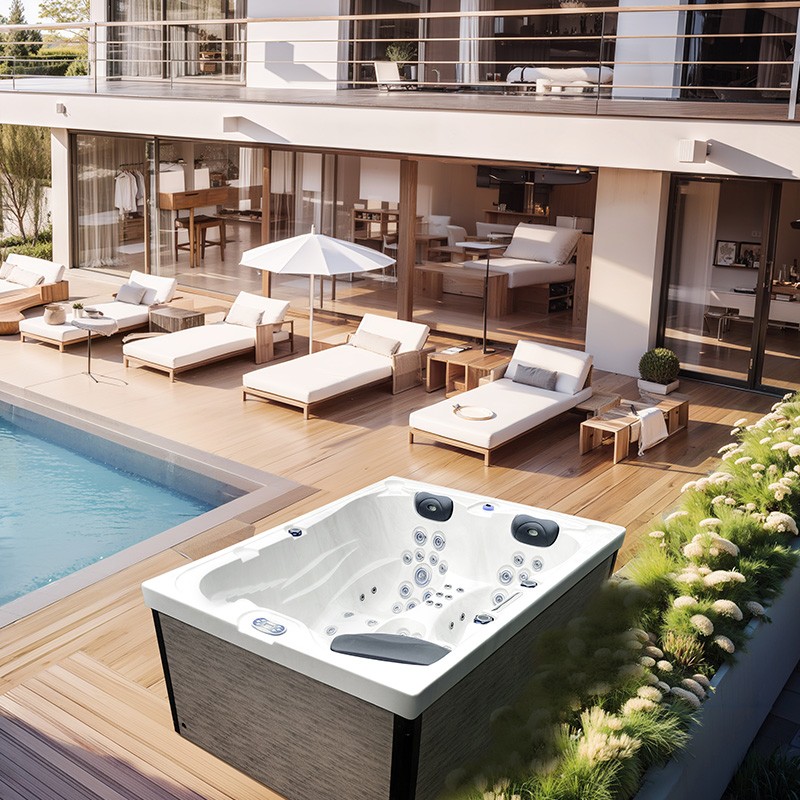
Why Are Spa Hot Tubs Particularly Prone to This Issue?
When people observe white deposits adhering to the surfaces of their spa hot tubs, they often mistakenly assume them to be dust, general impurities, or residual sanitizers. In reality, in most cases, these hard white deposits are simply typical limescale. Limescale—or "water scale," as it is sometimes called—is essentially a deposit formed when minerals dissolved in water precipitate out under high-temperature conditions.
The most common components include:
•Calcium carbonate
•Magnesium carbonate
•Calcium salts
•Magnesium salts
•Deposits of certain metal ions
These minerals are naturally dissolved in the water and appear completely harmless at first glance. However, as the water is continuously heated, circulated, and subjected to evaporation, the concentration of these minerals steadily increases; eventually, they begin to precipitate out and adhere to the surfaces of the equipment.
Spa jacuzzi hot tubs, in particular, possess several characteristics that make them highly susceptible to limescale formation:
First: High Temperatures. Most spa jacuzzi hot tubs are maintained at a constant temperature of approximately 37°C to 40°C. The higher the temperature, the more easily minerals precipitate out of the water.
Second: Circulation. The water in a spa jacuzzi hot tub constantly circulates through heaters, jets, and internal piping; this continuous flow causes minerals to become increasingly concentrated in specific localized areas.
Third: Evaporation. In outdoor environments, hot water evaporates at a faster rate. As the water evaporates, the minerals remain behind in the tub, leading to a steady rise in their overall concentration.
Fourth: Prolonged, Repeated Use. Many users do not frequently perform a complete water change; instead, they opt to simply top up the water level. This practice allows minerals to accumulate continuously over time.
Consequently, it is a perfectly normal phenomenon—and indeed, to be expected—that spa jacuzzi hot tubs are more prone to developing visible limescale compared to standard bathtubs.

If my spa jacuzzi hot tub is prone to limescale, does that mean there is something wrong with the water I’m using?
When users discover limescale, their first reaction is often: "Is there something wrong with my home's water supply?" In fact, this line of reasoning has some merit; however, the issue does not necessarily mean the water is "dirty," but rather that it is likely "hard."
1. What is "Hard Water"?
Simply put, "hard water" refers to water that contains a relatively high concentration of dissolved minerals.
Specifically, water is classified as typically "hard" when it contains elevated levels of:
•Calcium ions
•Magnesium ions
Water quality varies significantly from one region to another. In areas with abundant groundwater resources, the tap water itself may naturally contain higher levels of dissolved minerals. While such water may pose no issues for daily consumption, it creates an environment where limescale forms much more readily—particularly within a spa jacuzzi hot tub, which involves the continuous heating and circulation of water over extended periods.
The most obvious characteristics of hard water include:
•White deposits easily form after boiling the water.
•Kettles tend to accumulate limescale.
•Shower glass is prone to developing white spots.
•Areas around faucets tend to turn white.
If you already observe these phenomena in your home, there is a high probability that your spa jacuzzi hot tub is also operating in an environment with a high risk of limescale buildup.
2. Why does high temperature accelerate limescale formation?
Many users notice that with the same water supply, the water appears fine when cold; however, once it enters the spa jacuzzi hot tub, limescale buildup becomes significantly more pronounced.
This is primarily related to temperature fluctuations. As water temperature rises, the stability of certain minerals within the water decreases. Calcium carbonate compounds, in particular, are more prone to shifting from a dissolved state to a solid deposit when exposed to high temperatures. Furthermore, the areas immediately surrounding the heating elements within a spa jacuzzi hot tub tend to reach even higher temperatures; consequently, these are often the locations where limescale accumulation is most severe.
Additionally, high temperatures accelerate water evaporation. While the water evaporates, the minerals do not vanish along with it; instead, they remain behind in the water. Over time, the concentration of these minerals increases, eventually leading to the formation of more visible and substantial limescale deposits. This explains why many outdoor spa hot tubs become increasingly susceptible to limescale buildup—even when the water is topped up regularly.
What problems does limescale cause in a spa jacuzzi hot tub?
Some people assume that limescale is merely an aesthetic issue—something that looks "unsightly"—but in reality, the situation is far more complex. For an outdoor jacuzzi tub, the long-term accumulation of limescale not only detracts from the appearance but also causes damage to the entire circulation system.
1. Reduced Heating Efficiency
One of the primary locations where limescale tends to adhere is the surface of the heating element. Because the heater operates at high temperatures for extended periods, minerals are more likely to precipitate out and form deposits in this area. As the limescale layer thickens, it creates a structure resembling an "insulating layer," thereby preventing heat from being efficiently transferred into the water.
The result is:
•Slower heating times.
•Increased electricity consumption.
•Elevated temperatures within the heating element itself.
Over time, this persistent condition can significantly shorten the lifespan of the heating element.
2. Clogged Jets and Plumbing Lines
The interior of an outdoor jacuzzi tub contains a multitude of jets and circulation pipes—areas that are, by nature, relatively narrow and confined. If mineral deposits accumulate continuously:
•Nozzle apertures will narrow
•Water pressure will drop
•Massage intensity will diminish
In severe cases, this can even lead to partial blockages. Many people notice that the massage effect is becoming weaker; however, this is not necessarily a problem with the water pump, but rather may be due to a significant buildup of limescale inside the nozzles.
3. Impact on the Filtration System
Once limescale enters the filtration system, it will also adhere to the surfaces of the filters.
This leads to:
•Reduced filtration efficiency
•Increased resistance to water flow
•Slower circulation speeds
As the burden on the circulation system increases, the water pump in the outdoor jacuzzi tub is also subjected to higher operational pressure.
4. Impact on Water Quality Stability
Excessive limescale can also disrupt the overall chemical balance of the water within the outdoor jacuzzi tub.
For example:
•pH levels may fluctuate
•The efficacy of disinfectants may decline
•The water is more prone to becoming cloudy
Therefore, limescale is not merely a matter of "white marks"; it actually impacts the operational status of the entire system.

Why do some people's outdoor jacuzzi tubs accumulate almost no limescale?
This is actually related to several factors. First, water quality varies significantly from region to region. Some areas have "soft water," which naturally contains lower levels of minerals; consequently, limescale buildup is naturally minimal.
Second, maintenance practices play a crucial role.
Many users regularly:
•Test water quality
•Adjust pH levels
•Control alkalinity
•Clean the filters
•Perform periodic water changes
All of these practices help slow down the rate at which limescale forms.
Additionally, some users install water softening systems or pre-filtration devices to reduce the amount of minerals entering the outdoor jacuzzi tub right at the source. Therefore, the extent of limescale buildup depends on more than just the equipment itself.
Can I add vinegar to my outdoor jacuzzi tub every day?
This is a question that concerns many people. Since the idea that "white vinegar removes limescale" has become a common piece of household wisdom, many users naturally wonder: "If my outdoor jacuzzi tub has limescale, can I simply add a little vinegar every day to solve the problem?"
In reality, this practice is not recommended.
1. Why is vinegar effective at removing limescale?
Vinegar is able to remove limescale because it contains acetic acid. When the calcium carbonate-based substances found in limescale come into contact with this acid, a chemical reaction occurs, causing the deposits to gradually dissolve. Therefore, when cleaning electric kettles, faucets, or shower glass, white vinegar does indeed possess some descaling efficacy. However, the issue is that a spa hot tub is not merely an ordinary container.
Its internal components include:
•Water pumps
•Heaters
•Seals
•Plumbing lines
•Jets
•Filtration systems
These components are not designed to be exposed to an acidic environment for prolonged periods.
2. Why is it not recommended to add vinegar daily?
1) It disrupts the chemical balance of the water.
The water in a spa hot tub is not ordinary static water; rather, it is circulating water that requires the maintenance of a stable chemical balance.
If vinegar is added daily:
•The pH level will continuously drop.
•The acidity of the water will increase.
•The stability of disinfectants will be compromised.
Chlorine-based disinfection systems, in particular, are significantly affected by acidic environments.
This may result in:
•More rapid deterioration of water quality.
•An increased risk of bacterial proliferation.
•The water becoming cloudy.
2) It may corrode metal components.
Many spa hot tubs contain internal metal heating elements, stainless steel connectors, and various metal structural supports.
In a prolonged acidic environment:
•Metal components become susceptible to corrosion.
•Protective surface coatings are damaged.
•The lifespan of the components is reduced.
Acidic corrosion accelerates even further under high-temperature conditions.
3) It may damage seals and rubber components.
Spa hot tubs also contain numerous rubber seals and plastic connectors.
Frequent, long-term addition of vinegar:
May lead to:
•Premature aging of seals.
•A loss of elasticity.
•Water leaks.
Many people focus solely on the "descaling" effect while overlooking the detrimental impact that acidic liquids have on the internal materials.
4) It fails to address the root cause of the problem.
Even if vinegar is added daily, it merely dissolves a portion of the surface limescale on a temporary basis.
However, if:
•The water remains excessively hard.
•The pH balance remains unstable over time.
•Evaporation continues to concentrate mineral deposits.
Then limescale will continue to form unabated.
Therefore, the long-term practice of adding vinegar to a spa hot tub is not a proper method of maintenance.

What is the correct method for dealing with limescale in a spa hot tub?
The truly effective approach is not to engage in "frantic descaling," but rather to control the issue at its source.
1. Regularly test the water hardness.
This is the most critical step. If you reside in an area with hard water, consider the following:
•Using softened water
•Installing a pre-filter system
•Reducing the mineral intake
2. Maintain the Correct pH Level
Generally, the water in an outdoor jacuzzi tub requires a relatively stable pH range. If the pH level remains excessively high over an extended period, minerals are more prone to precipitating out of the water.
Therefore, regularly testing and adjusting the water's chemical balance is crucial.
3. Change the Water Periodically
Many users tend to simply top up the water level over long periods without ever performing a full water change. This practice leads to an increasing concentration of minerals in the water.
Even if the water appears crystal clear on the surface, the actual mineral concentration may already be quite high.
Consequently, performing regular, complete water changes can significantly reduce issues related to limescale buildup.
4. Clean the Filtration System Regularly
When filters become clogged, circulation efficiency declines; this indirectly accelerates the rate at which minerals deposit within the system.
Therefore:
•Cleaning the filters
•Ensuring smooth water circulation
are equally important steps.
5. Use Professional Descaling Products
Rather than relying on vinegar over the long term, it is highly recommended to use professional descaling agents specifically formulated for outdoor jacuzzi tubs.
This is because professional products are typically designed with the following factors in mind:
•Compatibility with metal components
•Safety for seals and gaskets
•Stability of water chemistry
Compared to ordinary vinegar, these products are far more suitable for long-term maintenance.
What signs indicate that limescale buildup has become a serious issue in your spa jacuzzi hot tub?
If you observe any of the following conditions, it typically signifies that significant limescale buildup has already occurred within the internal system:
•White crystalline deposits appearing around the jets
•A noticeable reduction in water flow strength
•Slower heating rates
•A rough or gritty texture on the interior walls of the tub
•The frequent formation of white floating particles on the water's surface
•Whitening or discoloration in the heater area
•Increased noise levels from the water pump
These symptoms often serve as warning signs that mineral deposits have begun to compromise the spa's circulation system.