


Why Do Outdoor Swim Spas Experience Faster Evaporation Than Indoor Ones?
2026-08-03 15:30As the demand for backyard leisure grows, swim spa tubs have become a popular outdoor amenity for many households. Compared to traditional swimming pools, swim spas offer greater flexibility regarding space requirements while combining swimming, hydrotherapy, massage, fitness, and relaxation functions. Consequently, they are increasingly found in villa gardens, vacation rentals, high-end residences, and outdoor leisure areas.
However, users often notice a distinct issue: the water level in outdoor swim spa tubs tends to drop faster than in indoor models. This is particularly noticeable during hot summers, periods of low humidity in autumn and winter, or windy weather—conditions that may even require users to frequently top up the water.
First-time owners often mistakenly assume the unit has a leak, but inspections usually reveal that the actual cause of the water loss is evaporation.
In reality, water evaporation in a swim spa tub is a perfectly normal physical phenomenon; it is simply accelerated by the outdoor environment. Factors such as airflow, direct sunlight, temperature differentials, humidity fluctuations, and the operation of jet systems all contribute to higher evaporation rates outdoors compared to indoor settings.
So, why do outdoor swim spa tubs lose water to evaporation more quickly? What are the key factors influencing this rate? And how can users minimize evaporation, reduce heat loss, and lower maintenance demands? This article provides a systematic analysis of these questions.
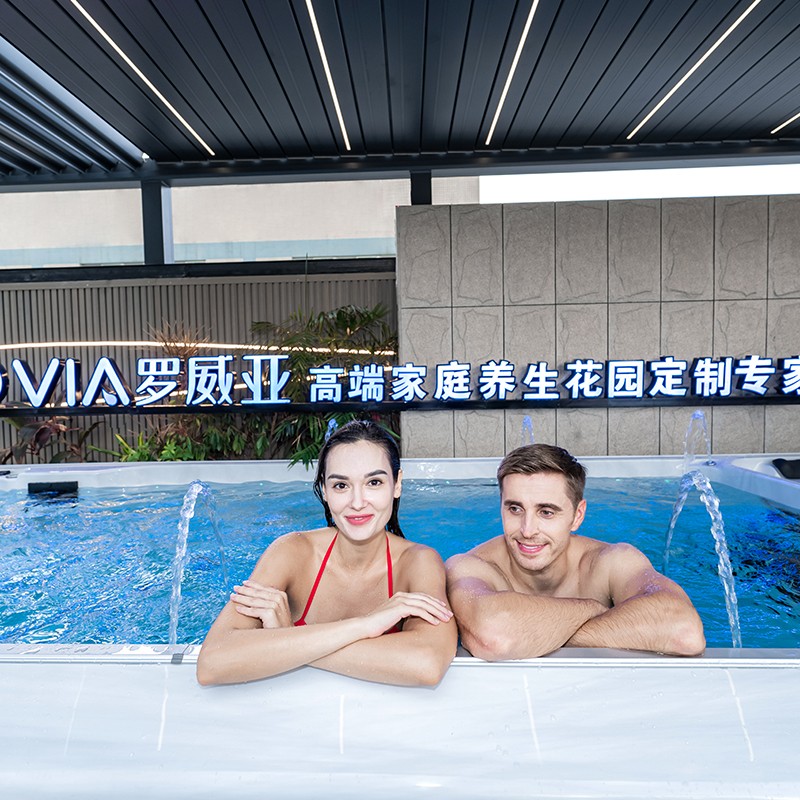
What exactly is evaporation in a swim spa tub?
At its core, evaporation is the process by which water molecules at the liquid's surface gain enough energy to transition from a liquid state to a gas and enter the surrounding air. Wherever there is an exposed water surface, evaporation is inevitable—and swim spa tubs are no exception.
However, compared to standard bathtubs or ordinary water storage vessels, swim spa tubs possess several distinct characteristics: higher water temperatures, continuous water circulation, frequent jet system operation, and aeration systems that increase the surface area exposed to air. Furthermore, these units are often situated in open outdoor environments. All these factors significantly accelerate the rate of evaporation. Outdoor swim spas, in particular, are directly exposed to the natural environment and are therefore subject to various external factors such as wind speed, air humidity, solar radiation, and diurnal temperature fluctuations. Compared to indoor units—which operate in relatively stable environments—outdoor swim spas typically experience more pronounced evaporation issues.
In winter, users often observe steam rising continuously from the surface of their swim spa tub; this is actually water vapor resulting from significant evaporation. However, because the evaporation process is gradual, many people overlook its long-term impact on water levels and energy consumption.
Why do outdoor swim spa tubs experience more evaporation than indoor ones?
1. Higher air flow velocity
Air movement is a key factor influencing evaporation in swim spa tubs.
Indoor environments are usually relatively enclosed with low air flow, allowing a humid layer of air to form above the water surface. This layer slows further evaporation because the air is already humid and has a limited capacity to absorb additional water vapor.
Outdoor swim spa tubs, however, face completely different conditions. Outdoor air is constantly in motion; wind continuously strips away the humid air layer above the water, bringing fresh, drier air into contact with the surface. Generally, the faster the air exchange, the higher the rate of evaporation.
Many users notice that even when the ambient temperature isn't particularly high, strong winds can cause a significant drop in the swim spa tub's water level. Evaporation tends to be especially severe in the following settings:
•Open courtyards;
•High-rise terraces;
•Coastal areas;
•Mountainous regions;
•Locations constantly exposed to the wind.
In fact, wind speed often has a more significant impact on swim spa tub evaporation than the ambient temperature itself.
2. Higher water temperatures accelerate evaporation
One of the primary differences between a swim spa and a standard swimming pool is the need to maintain a constant water temperature.
Many swim spa hot tub combos are kept at temperatures ranging from 32°C to 40°C for extended periods. While the swimming zone may be maintained at a temperature suitable for exercise, the spa zone is usually kept warmer to enhance the massage and relaxation experience.
When the water temperature exceeds the air temperature, molecular activity within the water intensifies, making it easier for water molecules to escape into the air as vapor. This is particularly true during the autumn and winter months; while the ambient air temperature is low, the water in the swim spa hot tub combo remains hot, leading to a significant increase in evaporation.
Many users notice visible white vapor rising from the surface of their outdoor swim spa tubs during winter—a phenomenon caused by the rapid evaporation of the hot water.
In contrast, indoor swim spa hot tub combos benefit from more stable ambient temperatures and a smaller temperature differential between the air and the water, resulting in a much slower rate of evaporation compared to outdoor units.
3. Outdoor humidity levels fluctuate more significantly
Humidity also directly affects the rate of evaporation in swim spa tubs.
The drier the air, the greater its capacity to hold water vapor, leading to faster evaporation. Conversely, if the air is already highly humid, it is more difficult for additional water vapor to enter the atmosphere.
Indoor environments typically experience minimal humidity fluctuations, whereas outdoor environments change constantly with the weather. For example:
•Humidity is lower during autumn and winter;
•Air is drier in northern regions;
•Evaporation is more pronounced in high-altitude areas;
•Humidity drops more rapidly during windy weather.
In regions with low humidity, significant evaporation can occur even if the swim spa tub is not frequently used and is simply kept heated.
Consequently, users often find that the rate of evaporation for the exact same swim spa tub model varies significantly depending on the region.
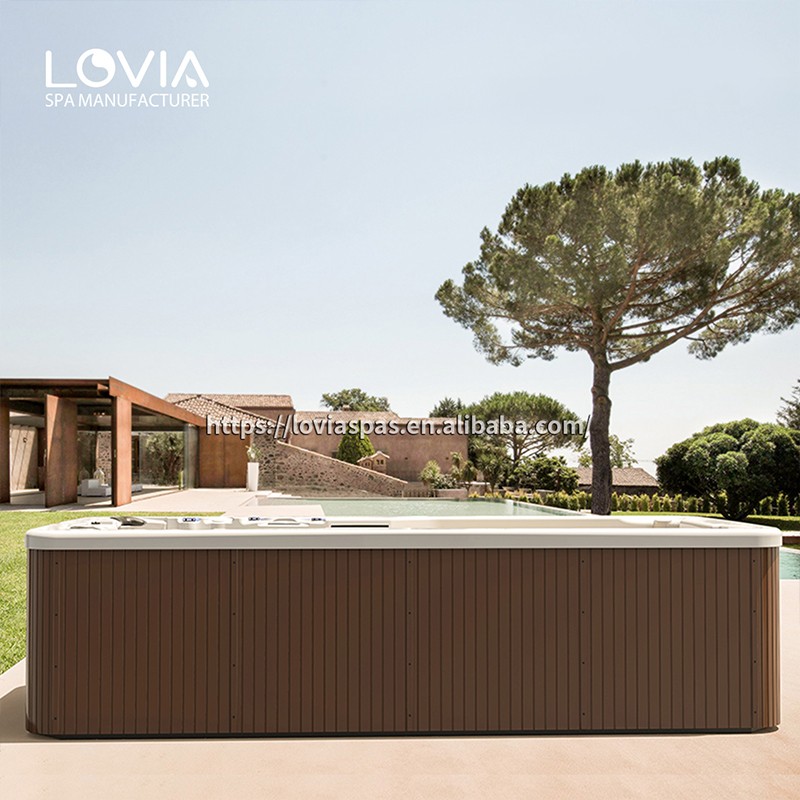
4. Exposure to direct sunlight accelerates evaporation
Solar radiation is another major factor influencing swim spa tub evaporation.
When an outdoor swim spa hot tub combo is exposed to prolonged sunlight, the water temperature rises further; as water molecules absorb more thermal energy, they transition more easily from a liquid to a gaseous state.
Evaporation rates often increase noticeably, particularly around midday in the summer.
Additionally, dark-colored shells or covers absorb more heat, indirectly raising the surface temperature of the swim spa hot tub combo. Many users observe a continuous drop in water levels during summer—even with infrequent use—which is directly attributable to prolonged exposure to the sun.
Therefore, outdoor swim spa hot tub combos located in areas without shade typically experience significantly higher evaporation rates than those equipped with shading structures.
5. Jet and bubble systems increase the surface area for evaporation
A key feature of swim spa tubs is their powerful jet systems and hydrotherapy massage capabilities.
However, many users are unaware that these jet systems are a major factor accelerating evaporation.
While evaporation rates from a still water surface are relatively limited, activating the jets constantly disrupts the surface, spraying a multitude of tiny droplets into the air and rapidly expanding the contact area between air and water.
At the same time:
•Bubble systems increase air exchange;
•Water circulation accelerates surface evaporation;
•Splashing creates a large number of micro-droplets;
•High-speed water flow continuously carries away heat.
Consequently, prolonged use of massage modes or high-power jet settings typically leads to a significant increase in the swim spa hot tub combo's evaporation rate.
6. Diurnal temperature fluctuations continuously deplete heat and moisture
Outdoor swim spa hot tub combos are also affected by the temperature difference between day and night.
During the day, the unit absorbs heat, whereas the outside air cools rapidly at night. When cold air comes into contact with the warm water surface, continuous evaporation occurs. This phenomenon is particularly pronounced in mountainous areas, high-altitude regions, or during the autumn and winter seasons.
Many users notice visible vapor around the swim spa tub in the morning; this is actually the result of continuous overnight evaporation.
In contrast, indoor swim spa tubs benefit from a stable ambient temperature and are not subject to the drastic temperature fluctuations experienced by outdoor units.
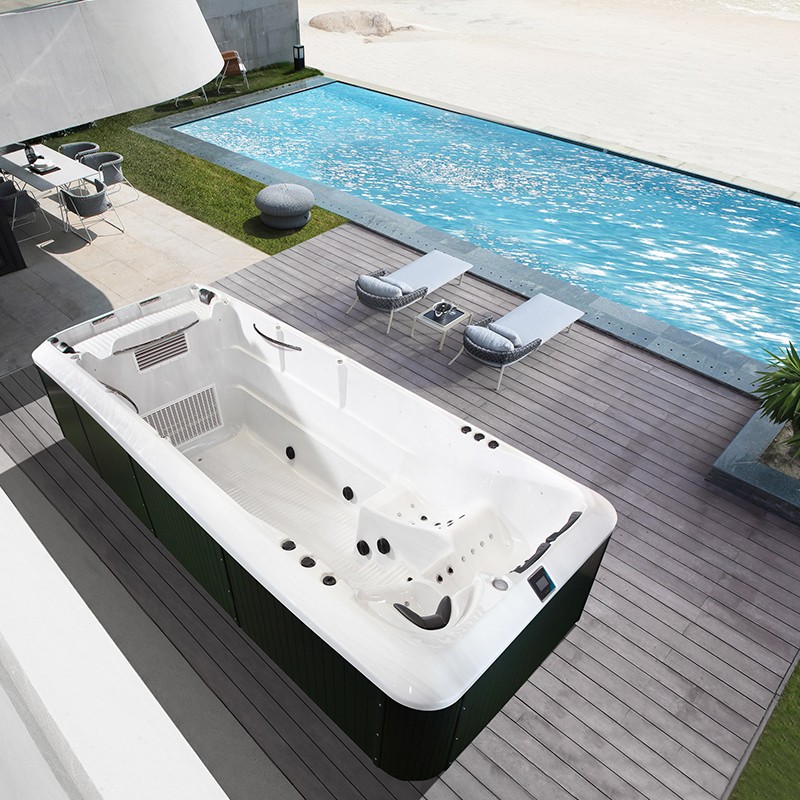
What are the consequences of swim spa evaporation?
Many consumers view evaporation simply as a minor loss of water, but in reality, long-term evaporation can trigger a chain of issues for the swim spa tub.
The most immediate consequence is the need for more frequent water replenishment. If the water level remains too low for an extended period, the circulation system may draw in air, compromising the stable operation of the water pumps.
Secondly, evaporation signifies heat loss. In fact, evaporation often accounts for a significant portion of a swim spa tub's total heat loss. As hot water turns into vapor and leaves the surface, it carries away a substantial amount of thermal energy; the unit must then continuously heat the water to maintain a constant temperature, resulting in increased energy consumption. Furthermore, evaporation affects water quality stability. Since water evaporates while many minerals and chemicals do not, their concentrations in the water gradually rise. If left unaddressed over the long term, issues such as increased scale buildup, cloudy water, pH fluctuations, and reduced disinfection efficiency can arise.
Therefore, for long-term users of swim spa hot tub combos, controlling evaporation is not merely a matter of water conservation; it also impacts equipment maintenance, operating costs, and the overall user experience.
How can you reduce water evaporation in a swim spa tub?
1. Use a high-quality thermal cover
For outdoor swim spa tubs, a thermal cover is one of the most effective ways to minimize evaporation.
Promptly covering the unit when not in use significantly reduces direct contact between the air and the water surface, while also minimizing heat loss and the impact of wind.
High-quality thermal covers typically feature excellent sealing, moisture resistance, and insulation properties, effectively slowing the rate of evaporation.
Many users overlook the issue of cover degradation. In reality, if the cover becomes warped, waterlogged, or cracked, or if the seal fails, the rate of evaporation often increases significantly. Therefore, regularly inspecting the condition of the cover is crucial.
2. Limit prolonged use of the jet system
While jet systems enhance the hydrotherapy experience, continuous operation significantly increases evaporation.
Consequently, it is advisable to manage jet usage based on actual needs. For example, avoid running high-power massage modes when the spa is unattended, and promptly turn off bubble systems and high-intensity jet modes after use.
Evaporation rates tend to rise sharply when multiple jet systems operate simultaneously, particularly in large swim spa tubs.
3. Create a windbreak
Since wind speed significantly accelerates evaporation, improving the outdoor environment is important.
Many users mitigate the impact of wind on their swim spa tubs by:
•Installing fences;
•Adding glass windbreaks;
•Creating a semi-enclosed patio area;
•Using outdoor privacy screens;
•Planting greenery to act as a windbreak.
These measures reduce direct airflow across the water surface, thereby lowering the rate of evaporation. In practice, many users find that under the same temperature conditions, a swim spa hot tub combo located in a sheltered area (protected from the wind) experiences significantly slower evaporation than one in an open area.
4. Regulate water temperature appropriately
Higher water temperatures are not necessarily better for swim spa hot tub combos.
Maintaining excessively high temperatures over the long term not only increases evaporation but also significantly raises operating costs.
Therefore, the temperature can be lowered during periods of non-use. For example:
•Lower the set temperature at night;
•Switch to energy-saving mode during extended periods of disuse;
•Avoid maintaining the maximum temperature for prolonged periods.
Proper temperature control not only reduces evaporation but also lowers energy consumption.
5. Install shading structures
Shading can also help reduce evaporation from swim spa tubs.
Installing features such as pergolas, outdoor canopies, parasols, or patio covers can reduce surface heating caused by direct sunlight.
Shading structures are particularly effective at reducing evaporation in hot regions. Additionally, shading helps slow down the aging of the spa's shell and cover.
6. Maintain an appropriate water level
Many users continue to operate their swim spa tubs with low water levels; however, a low water level results in stronger jet impact, increased air entrainment, and more splashing.
These factors all contribute to increased evaporation.
Therefore, maintaining the correct water level ensures stable equipment operation and helps minimize water loss.
7. Minimize the time the spa remains uncovered
The longer a swim spa hot tub combo remains exposed to the air, the more significant the evaporation will be.
Consequently, maintenance professionals often advise users to make a habit of covering the spa promptly. For example:
•Close the cover immediately after use;
•Keep the cover closed at night whenever possible;
•Cover the spa promptly after cleaning;
•Avoid leaving the unit uncovered for extended periods.
Many users habitually leave their swim spa tub covers open all day, but this leads to continuous heat and water loss.
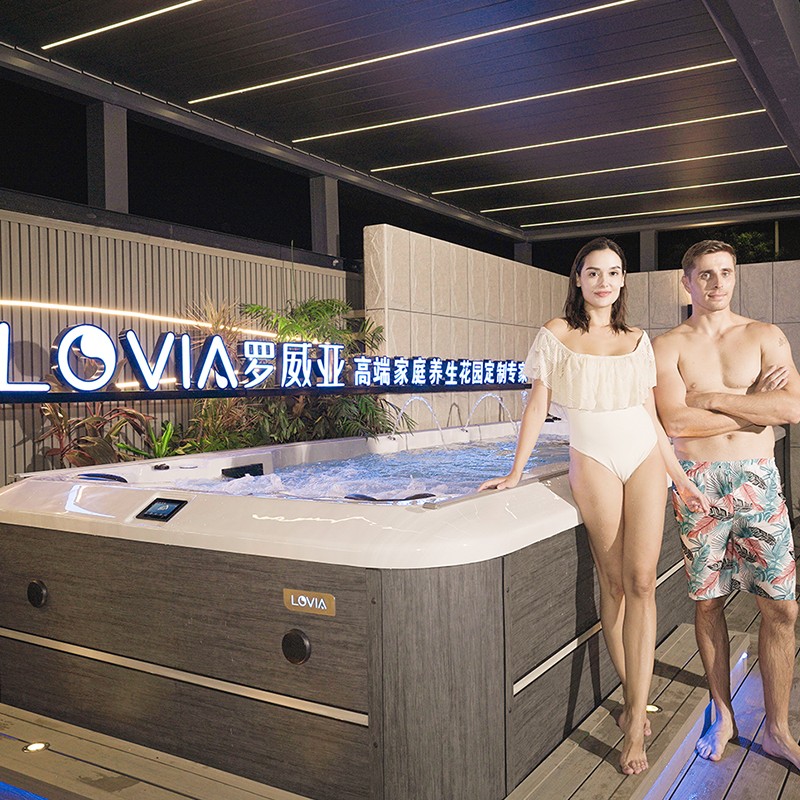
Why do many users mistakenly think their swim spa tub is leaking?
Because outdoor swim spa tubs experience relatively rapid evaporation, many consumers mistakenly believe the unit has a leak.
In reality, there is a distinct difference between evaporation and a leak. Evaporation typically manifests as:
•A slow drop in water level;
•Increased rate during hot, windy weather;
•A slower drop rate when the cover is closed;
•No significant accumulation of water on the ground.
In contrast, actual leakage usually presents as:
•A rapid drop in water level;
•Little correlation with weather changes;
•Persistent dampness near the piping;
•Accumulated water around the equipment.
For swim spa tub users, if the water level drop slows significantly after closing the cover, the cause is likely evaporation rather than an equipment leak.
FAQ (Frequently Asked Questions)
What is the normal daily evaporation rate for an outdoor swim spa tub?
It depends on surface area, temperature, wind speed, and humidity. Generally, an open outdoor water surface may lose about 3mm to 8mm of depth daily due to evaporation. Evaporation is more pronounced with larger surface areas, hotter weather, and stronger winds.
Why is evaporation more noticeable in outdoor swim spa tubs during winter?
Because the water temperature is usually much higher than the air temperature, creating a significant temperature difference. Additionally, the air is drier, which accelerates the loss of heat and moisture.
Is using an insulating cover for an outdoor swim spa tub really effective?
Yes, very effective. An insulating cover reduces the water's exposure to air, minimizes the impact of wind, and cuts down on heat loss; it is a key measure for reducing evaporation and heating costs.
Does a drop in water level always indicate a leak?
Not necessarily. Normal evaporation, heavy usage, and splashing can all cause the water level to drop. If the level drops unusually fast and is accompanied by water pooling around the equipment, then you should check for a leak.
How can I reduce the long-term operating costs of an outdoor swim spa tub?
In addition to minimizing evaporation, maintain good insulation, regularly service the filtration system, manage water temperature efficiently, and properly balance water chemistry. These steps help reduce costs associated with refilling, heating, and maintenance while improving overall operational efficiency.