


What Should the Water Hardness Be for an Outdoor Spa Hot Tub?
2026-08-24 15:30When purchasing an outdoor spa hot tub, consumers often prioritize features like acrylic material, insulation performance, the number of massage jets, heating power, and filtration systems. However, they frequently overlook a crucial water quality parameter that directly impacts the equipment's lifespan and the user experience: water hardness. In reality, outdoor spa hot tubs operate in environments characterized by high temperatures, constant water circulation, aeration, and frequent use by multiple people; consequently, calcium and magnesium ions in the water interact with pH levels, total alkalinity, and temperature. Excessively high water hardness leads to scale formation on heaters, jets, piping, and within filtration systems. Conversely, excessively low water hardness can make the water corrosive, causing long-term damage to metal components, pump housings, and other parts of the spa system.
This explains why some outdoor whirlpool spa hot tubs function perfectly for the first few months after installation but later develop issues such as cloudy water, reduced jet output, decreased heating efficiency, scale buildup on heater surfaces, and even abnormal operating noises. While many users immediately assume the filter is dirty or the water quality is poor, the root cause may actually be a failure to properly manage calcium hardness. This is particularly relevant in areas with hard water, where tap water naturally contains high concentrations of calcium and magnesium minerals. Continuous heating and evaporation in the hot tub can further concentrate these minerals. Therefore, managing water hardness is not simply a matter of "the softer the water, the better"; instead, it requires adhering to the manufacturer's recommended ranges and maintaining overall water chemistry balance.
So, what exactly should the water hardness level be for an outdoor whirlpool spa hot tub? Why do different brands provide varying recommendations? What are the specific consequences of hardness levels being too high or too low? How can you adjust the water hardness if it exceeds recommended limits? This article provides a systematic analysis covering the definition of water hardness, recommended parameters, impacts on equipment, testing methods, adjustment strategies, and routine maintenance, offering outdoor spa hot tub owners professional and actionable guidance on water quality management.
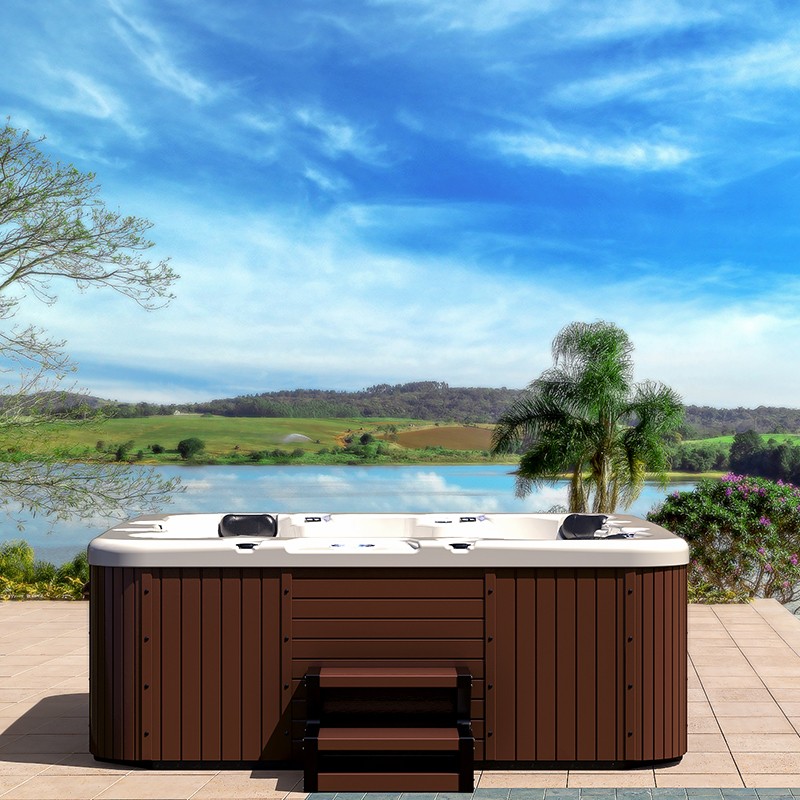
Why Is Water Hardness Particularly Important for outdoor spa hot tubs?
Water quality management for outdoor spa hot tubs differs significantly from that of standard household bathtubs. Unlike standard bathtubs—which are typically filled, used once, and drained—outdoor spa hot tubs hold hundreds or even thousands of liters of water that is continuously circulated through heaters, pumps, filters, massage jets, and water treatment systems. Consequently, minerals in the water do not disappear after a brief session; instead, they accumulate and redistribute over an extended period.
More importantly, outdoor spa hot tubs usually operate at high temperatures. Many models function within the 37–40°C range, with some reaching maximum temperatures around 40°C. High temperatures accelerate chemical reactions and evaporation. As water evaporates due to the heat and outdoor environment, minerals like calcium and magnesium remain in the tub rather than escaping with the water vapor. When users top up the tub with fresh tap water, new minerals are introduced. Over time, if the source water has high hardness, the calcium hardness level inside the hot tub can gradually rise.
This highlights a key difference between water quality management for outdoor spa hot tubs and standard swimming pools. Hot tubs contain a relatively small volume of water but operate at higher temperatures, utilize more concentrated circulation systems, and feature complex internal plumbing; consequently, the impact of scale buildup on components like heaters and jets is much more pronounced. Maintenance guidelines from major brands explicitly state that excessive calcium hardness can lead to scale deposits on heaters, jets, pumps, and piping, while excessively low calcium hardness can increase the water's corrosiveness.
Therefore, assessing the water quality of an outdoor whirlpool spa hot tub requires more than just checking for clarity or measuring pH and sanitizer levels. Professional water quality maintenance involves monitoring a range of parameters, including calcium hardness, total alkalinity, pH, sanitizer levels, and total dissolved solids (TDS).
What should the water hardness level be for an outdoor spa hot tub?
First, it is important to clarify that in the context of outdoor whirlpool spa hot tub maintenance, "water hardness" primarily refers to calcium hardness (CH). This metric reflects the concentration of dissolved calcium ions in the water, though it is also related to other hardness-causing ions, such as magnesium. The industry standard for expressing water hardness is ppm (parts per million), which is equivalent to mg/L.
There is no single, universal hardness value that applies to every brand and model of outdoor spa hot tub. Different manufacturers utilize varying acrylic materials, heater designs, pump systems, saltwater systems, ozone systems, and water treatment protocols; consequently, recommended ranges differ. For instance, Jacuzzi’s publicly available maintenance guidelines for spa equipment recommend a calcium hardness range of 150–250 ppm to minimize the risk of corrosion and scaling, while some of its hot tub maintenance materials specify a range of 175–275 ppm.
In contrast, Hot Spring employs different parameters depending on the specific equipment and water treatment system. Some of its standard water quality guidelines recommend a calcium hardness of 75–150 ppm, whereas certain saltwater systems target significantly lower levels—such as a target of approximately 50 ppm, with an allowable range of 25–75 ppm.
This highlights a crucial point: there is no "universal standard answer" regarding water hardness for outdoor spa hot tubs. The truly correct target value should be determined primarily by consulting the specific manufacturer's owner's manual and water treatment system requirements.
For general water quality management in standard outdoor spa hot tubs (excluding specialized saltwater systems), the 150–250 ppm range serves as a valuable reference; however, if a manufacturer explicitly specifies a range such as 100–150 ppm, 75–150 ppm, or another figure, those manufacturer-provided parameters take precedence. For outdoor spa hot tubs equipped with specialized saltwater electrolysis systems, standard hardness ranges cannot be applied directly, as these systems may require lower calcium hardness levels.
Therefore, when consumers ask, "What should the water hardness of an outdoor spa hot tub be?" the most accurate answer is that while standard tubs can reference the common 150–250 ppm range, the final target value must be determined based on the specific brand, model, and water treatment system. One should not blindly lower calcium hardness to extremely low levels in pursuit of "soft water," nor should one ignore steadily rising hardness levels simply because there is no visible scale buildup yet.
What impact does excessively high water hardness have on an outdoor spa hot tub?
The most immediate issue caused by excessively high water hardness in an outdoor spa hot tub is scale buildup. When calcium ion concentrations in the water reach high levels, the combined effects of high temperatures, elevated pH, and evaporation make it much more likely for mineral deposits—such as calcium carbonate—to form. While these deposits may first appear at the waterline, on acrylic surfaces, around massage jets, or near filters, the real concern lies in the scale hidden deep within the equipment.
Heaters are among the components most noticeably affected by hard water. They must continuously heat large volumes of water; if a layer of mineral deposits forms on the heating element, it impedes the transfer of heat into the water. Simply put, the heat generated by the heater should transfer rapidly to the water, but a layer of scale acts as a thermal barrier, reducing heating efficiency. For outdoor whirlpool spa hot tubs that need to maintain a constant temperature of around 38–40°C, this not only prolongs heating times but also increases energy consumption.
Scale buildup can also impact circulation pumps and massage jets. outdoor whirlpool spa hot tub jets rely on pump pressure to force water through narrow channels, creating the massage effect. If mineral deposits gradually accumulate inside the jets, it can lead to reduced water output, altered spray angles, or uneven flow. In severe cases, users might notice that certain jets are significantly weaker than others; the issue may not stem from the pump's power, but rather from long-term scale accumulation.
Filtration systems are similarly affected. Minerals in the water can combine with other contaminants to form deposits, making filters more prone to clogging. Increased resistance within the filter reduces flow rates in the circulation system, thereby compromising filtration efficiency, heating performance, and jet output. Hot Spring has also noted that high water hardness can lead to scaling, cloudy water, and mineral deposits within plumbing and equipment.
Therefore, high water hardness is not merely a matter of the water "feeling hard" to the touch; it is an issue that can progressively compromise the entire water circulation system of an outdoor spa hot tub.
Is it better to have very low water hardness in an outdoor spa hot tub? The answer is no
After learning that high hardness leads to scaling, many users fall into the misconception that the softer the water, the better. In reality, excessively low calcium hardness can also cause problems. When the calcium ion concentration in the water is too low, the water may exhibit a stronger tendency to be corrosive. For outdoor spa hot tubs containing metal heating elements, pump components, connectors, and other water circulation parts, prolonged exposure to unbalanced, low-hardness water can increase the risk of material corrosion and surface damage. Some older Hot Spring owner's manuals explicitly state that excessively low calcium hardness can make the water corrosive, whereas maintaining appropriate calcium levels helps mitigate this risk.
Low hardness can also interact with other water chemistry parameters to create issues. For instance, if the pH and total alkalinity are low while calcium hardness is also significantly deficient, the risk of corrosion may escalate further. In such cases, focusing solely on adjusting "water hardness" can lead to neglecting other critical factors.
Therefore, professional water treatment for outdoor spa hot tubs is not simply about aiming for "soft" water; rather, it involves finding a balance between the risks of corrosion and scale formation. The ideal state can be visualized as a specific window: hardness levels should be neither too low nor too high, but consistently maintained within the range specified by the equipment manufacturer.
The Relationship Between Water Hardness, pH, and Total Alkalinity in Outdoor Spa Hot Tubs
This is a crucial aspect of water quality maintenance for outdoor whirlpool spa hot tubs. Many users find that even after correctly adjusting the calcium hardness, scale continues to form after a few days, leading them to believe the hardness test is inaccurate. In reality, scale formation is not determined by calcium hardness alone.
pH is a key factor influencing scale formation. Generally, the recommended pH range for outdoor spa hot tub water is approximately 7.2 to 7.8, with many manufacturers suggesting a target range of 7.4 to 7.6. Publicly available information from Jacuzzi, for example, sets the recommended pH range at 7.2 to 7.8, emphasizing that an appropriate pH level helps reduce the risks of both corrosion and scaling.
Total alkalinity acts as a "buffer system." The commonly recommended range is approximately 80 to 120 ppm. If total alkalinity is too low, the pH is prone to significant fluctuations; conversely, if it is too high, the pH may remain consistently high, making adjustments more difficult. This means that even if the calcium hardness of an outdoor spa hot tub is within the 150–250 ppm range, significant scale buildup can still occur if the pH is consistently maintained above 8.0. Conversely, even with slightly lower calcium hardness, severe imbalances in pH and total alkalinity can create a risk of corrosion.
Therefore, during routine maintenance, it is recommended to perform basic adjustments in the order of "Total Alkalinity → pH → Sanitizer" and then manage calcium hardness according to equipment specifications. Jacuzzi’s published maintenance guidelines also advise adjusting total alkalinity first, followed by pH and sanitizer, and ensuring the water circulates thoroughly after adding chemicals.
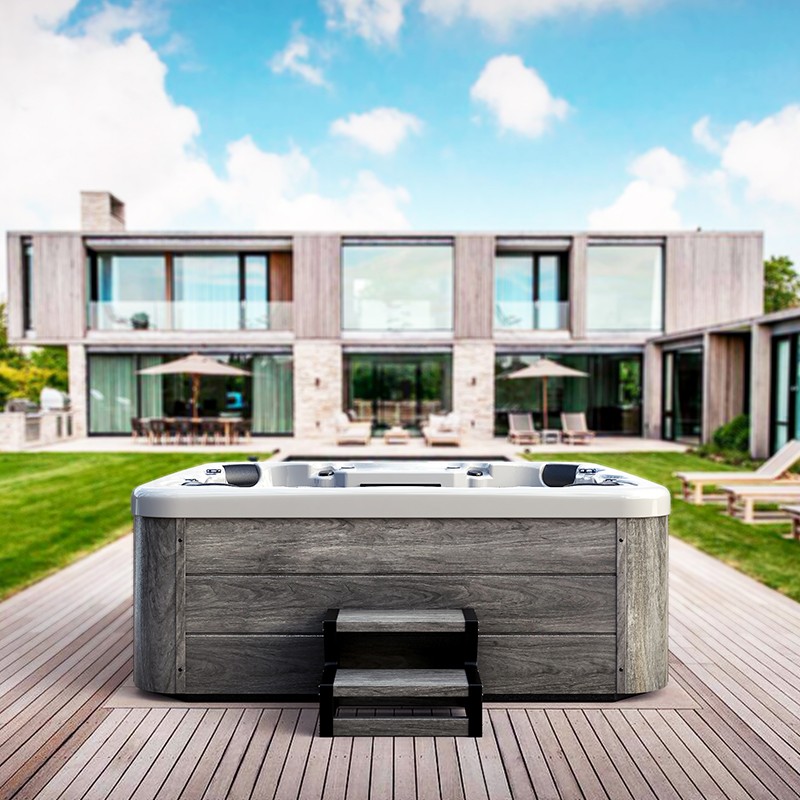
How can excessively high water hardness in an outdoor spa hot tub be reduced?
If testing reveals that the calcium hardness significantly exceeds the manufacturer's recommended range, the extent of the excess must first be assessed. If the level is only slightly high, mineral concentration can be gradually reduced by partially draining and refilling the tub with water of lower hardness. If the hardness is extremely high, using water-softening equipment before refilling may be necessary.
It is important to emphasize that standard pH reducers cannot effectively solve the problem of excessive calcium hardness. Lowering the pH only alters the water's acidity or alkalinity; it does not fundamentally remove existing calcium ions. Attempting to "fix hardness" by continuously adding pH-lowering agents can result in an excessively low pH while leaving high levels of calcium ions in the water.
More effective methods for reducing calcium hardness include partial water replacement, the use of specialized calcium hardness removal products, and the use of portable water-softening equipment. In areas with hard water, filling the tub with softened water initially is often more convenient than treating the water afterward. Hot Spring’s documentation explicitly recommends considering a portable water softener when hardness exceeds 300 ppm; for water with hardness between 150 and 300 ppm, appropriate softening methods can be selected based on the specific equipment and water treatment system.
If significant scale buildup has already occurred in the outdoor whirlpool spa hot tub, simply reducing water hardness will not cause the existing scale to disappear immediately. In such cases, it is necessary to follow the manufacturer's maintenance requirements to drain the tub, clean the plumbing and filters, and descale the internal components. Components such as heaters and jets with significant deposits require professional maintenance rather than just an increase in chemical dosage.
How should you handle low water hardness in an outdoor spa hot tub?
Increasing water hardness is generally easier than lowering it. Calcium hardness increasers are available on the market specifically designed to replenish calcium ions in the water in a controlled manner. When using these products, you must calculate the dosage strictly based on the hot tub's actual water volume and the product instructions; adding a large amount of chemicals based on guesswork is not recommended.
For example, if an outdoor whirlpool spa hot tub holds 1,500 liters of water and test results fall significantly below the manufacturer's recommended minimum, you need to calculate the required increase in ppm based on the product label. You cannot simply apply a fixed ratio (such as "grams per 1,000 liters") because the concentration of active ingredients varies between products; therefore, dosage calculations must follow the specific product instructions.
After adding the chemical, allow the circulation system to run thoroughly before re-testing. Avoid adding large amounts in quick succession simply because the initial test result remains low; chemicals require time to disperse evenly, and excessive dosing could cause the water hardness to suddenly exceed the target range.
For outdoor whirlpool spa hot tubs, the ideal approach is not to frequently raise and lower hardness levels, but rather to establish appropriate water conditions upon the initial fill and maintain calcium hardness within a reasonable range over the long term through consistent water replenishment and drainage strategies.
FAQ: Common Questions About Outdoor Hot Tub Water Hardness
FAQ 1: Is a water hardness level of 150 ppm normal for an outdoor hot tub?
If the manufacturer recommends a range of 150–250 ppm, then 150 ppm falls at the lower end of that range; if the equipment requires 75–150 ppm, then 150 ppm is near the upper limit. Therefore, 150 ppm is generally not an abnormal reading, but you should ultimately consult the manual for your specific hot tub model.
FAQ 2: Can I still use the hot tub if the water hardness exceeds 300 ppm?
Exceeding 300 ppm does not mean the equipment becomes unusable immediately, but maintaining such high calcium hardness over the long term increases the risk of scale buildup, especially during high-temperature operation. For water sources exceeding 300 ppm, some manufacturers recommend pre-treatment using a portable water softener.
FAQ 3: What are the signs of water hardness being too low in an outdoor hot tub?
Excessively low water hardness can increase the water's corrosiveness, potentially damaging metal parts, heaters, pumps, and other circulation components over time. Therefore, you should not lower calcium hardness indefinitely just to prevent scale. Low-hardness water should be adjusted using an appropriate calcium hardness increaser, following the manufacturer's recommendations.
FAQ 4: Why is the water fine right after a refill, but scale starts to form after a while?
A common reason is that the water used to top up the tub introduces significant amounts of calcium and magnesium minerals. As water evaporates, these minerals remain in the tub rather than dissipating with the steam; continuous topping up with high-hardness tap water can cause calcium levels to rise gradually. Additionally, if the pH level remains high for an extended period, the risk of scale formation increases.