


What is the typical heating capacity for an outdoor spa hot tub?
2026-11-27 15:30When shopping for an outdoor spa hot tub, consumers typically focus on factors like capacity, the number of massage jets, thermal insulation, and heating speed. Among these, heating capacity is a key parameter that influences both the user experience and energy costs.
Currently, a 3kW electric heater is a very common configuration in the outdoor spa hot tub market. It effectively meets the daily heating and temperature-maintenance needs of many households, while striking a balance between power supply requirements, equipment costs, and heating efficiency. However, many consumers assume that higher heating power automatically translates to faster heating and superior product performance. In reality, this assumption is not entirely accurate.
For an outdoor spa hot tub, a higher heating capacity is not necessarily better. The ideal power level depends on a combination of factors, including the tub's capacity, initial water temperature, local climate, insulation design, frequency of use, and the household's electrical supply capacity. If the power is too low, the water may heat up too slowly; if it is too high, it can place an excessive load on the electrical circuit, increase equipment costs, and potentially even necessitate a complete redesign of the unit's electrical system.
So, what heating capacity is typically used in outdoor whirlpool hot tubs? Why is the 3kW heater so common? And how should consumers choose the right power level based on their specific needs?
This article explores these questions by examining heating principles, technical specifications, and energy consumption.
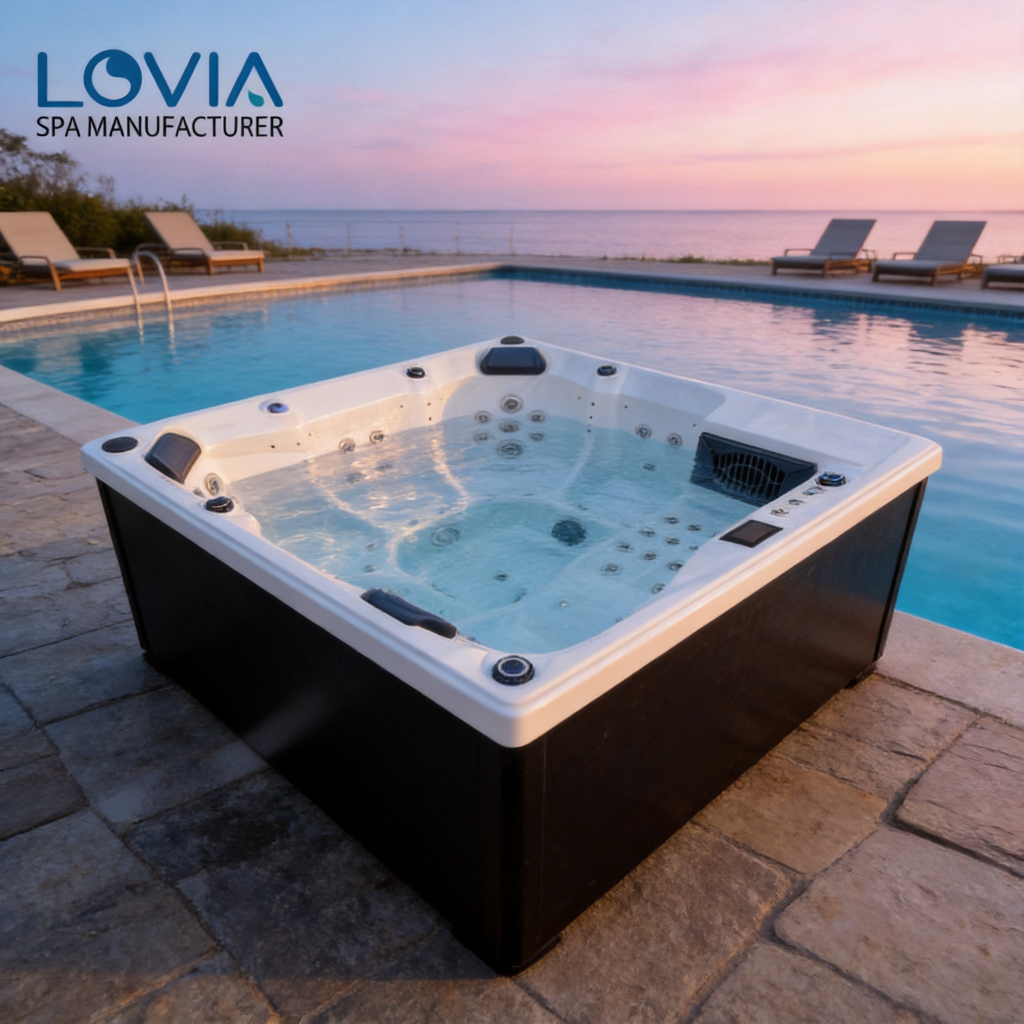
What is the typical heating capacity of an outdoor hot tub?
Most outdoor spa hot tubs on the market today use electric heating. An electric heating element converts electrical energy into heat, and a circulation pump moves the water through the heating system, gradually bringing it to the desired temperature.
Heating capacities vary by brand and model, with common options including 1.5kW, 2kW, 3kW, 4kW, 5kW, and 6kW. The 3kW configuration is particularly widespread, especially for residential outdoor whirlpool hot tubs that operate on a 220–240V single-phase power supply.
Outdoor hot tub heaters with different wattages are suitable for different scenarios:
•1.5kW–2kW: Suitable for smaller hot tubs or environments with limited electrical supply, though the heating process is relatively slow. •3kW: A common configuration suitable for many residential outdoor hot tubs, capable of handling both initial heating and temperature maintenance.
•4kW–5kW: Suitable for larger-capacity hot tubs or units that require faster heating; these necessitate a compatible electrical supply system.
•6kW and above: Best suited for large-capacity units with specialized electrical designs or commercial spa systems.
It is important to note that the heater’s power rating is not the same as the total power consumption of the entire outdoor spa hot tub unit. In addition to the heater, these units typically include circulation pumps, massage pumps, air blowers, lighting, and control systems. If all these components operate simultaneously, the total electrical load can be significantly higher than the heater’s rated power.
Therefore, when purchasing an outdoor spa hot tub, you should consider not only the heater’s power but also the unit’s total maximum power consumption and maximum operating current.
Why is a 3kW heater a common configuration for outdoor hot tubs?
A 3kW heater strikes a reasonable balance between heating capacity, residential power supply constraints, and equipment costs, which is why it is adopted by many outdoor whirlpool hot tub manufacturers.
1. Suitable for standard single-phase power supply environments
With a 230V single-phase power supply, a 3kW heater has a theoretical operating current of approximately 13A; at 220V, the operating current is about 13.6A.
Compared to 4kW, 5kW, or 6kW heaters, a 3kW setup places a lower load on the electrical supply system, making it easier to integrate into residential installations designed with appropriate electrical specifications.
For example, the 3000W auxiliary spa hot tub heater offered by Harvia is designed for a 230V single-phase power supply, demonstrating that 3kW heaters are a practical choice for residential spa equipment.
2. Capable of meeting the temperature maintenance needs of most households
Many residential users do not wait until just before use to heat their spa hot tub; instead, they pre-heat it to between 37°C and 40°C and then use a thermostat system to maintain that temperature.
In this scenario, the heater does not need to run at full capacity continuously; it only activates when the water temperature drops, compensating for heat loss. If an outdoor hot tub features effective insulation, a well-insulated base, and a high-quality, tightly sealed cover, a 3kW heater is generally sufficient to maintain a constant temperature for typical household use.
3. Mature Supporting Technology and Maintenance Systems
The 3kW heater is already a well-established solution for spa hot tubs and spa equipment. A wide range of compatible components—such as heating elements, temperature sensors, controllers, and overheat protection devices—is readily available.
For outdoor whirlpool hot tub manufacturers, adopting a proven 3kW heating system helps control production costs, improves component compatibility, and simplifies future maintenance and part replacement.
Ultimately, the popularity of the 3kW heater stems not just from its moderate power output, but from its ability to effectively meet the practical needs of many household users.
What is the actual heating capacity of a 3kW heater in an outdoor hot tub?
Determining whether a 3kW heater is suitable for a specific outdoor spa hot tub requires a calculation based on the tub's water capacity and the target temperature.
The specific heat capacity of water is approximately 4.186 kJ/(kg·°C). For standard water, it can be estimated that:
Heating 1,000 liters of water by 1°C theoretically requires approximately 1.163 kWh of energy.
Since a 3kW heater provides 3 kWh of energy per hour, it can theoretically raise the temperature of 1,000 liters of water by approximately 2.58°C per hour (excluding heat loss).
Assuming an initial water temperature of 20°C and a target temperature of 38°C, the theoretical heating time required for various capacities is as follows:
| Hot Tub Capacity | Temperature Increase | Theoretical Heating Time |
| 800 L | 18°C | 5.6 hours |
| 1,000 L | 18°C | 7.0 hours |
| 1,200 L | 18°C | 8.4 hours |
| 1,500 L | 18°C | 10.5 hours |
| 1,800 L | 18°C | 12.6 hours |
| 2,000 L | 18°C | 14.0 hours |
Note: The figures above are based on ideal theoretical conditions and do not account for ambient temperature, heat loss through plumbing, or heat loss due to the tub's insulation properties. In practice, heating times are typically longer.
For example, heating 1,500 liters of water in an outdoor whirlpool hot tub from 20°C to 38°C requires approximately 31.4 kWh of energy; using a 3kW heater, this would take about 10.5 hours.
If the unit is operated outdoors during winter, the lower ambient temperature will increase heat loss from the tub, which may significantly extend the time required to reach the target temperature. This also illustrates that when evaluating the heating performance of an outdoor whirlpool hot tub, one cannot rely solely on the heater's power rating; factors such as water capacity and thermal insulation must also be considered.
Is a higher-power heater always better for an outdoor hot tub?
The answer is no. While a high-power heater can indeed shorten the time required to raise the water temperature, it also increases the electrical load and is not necessarily suitable for every outdoor spa hot tub.
1. High-power heaters in outdoor hot tubs can reduce heating time
Assuming two outdoor spa hot tubs each have a capacity of 1,500 liters, an initial water temperature of 20°C, and a target temperature of 38°C—and disregarding heat loss—the heating times for different power ratings are as follows:
| Heater Power | Theoretical Heating Time |
| 2 kW | 15.7 hours |
| 3 kW | 10.5 hours |
| 4 kW | 7.9 hours |
| 5 kW | 6.3 hours |
| 6 kW | 5.2 hours |
As the data shows, the higher the heating power, the shorter the theoretical time required to reach the target temperature.
For hotels, resorts, and commercial spas—where the water in an outdoor whirlpool hot tub may need to be changed frequently—a high-power heater can offer greater practical value.
2.Outdoor hot tubs with high-power heaters place greater demands on the electrical supply system
Taking a 230V single-phase power supply as an example, the theoretical operating currents for heaters of various power ratings are as follows:
| Heater Power | Voltage | Operating Current |
| 2 kW | 230 V | 8.7 A |
| 3 kW | 230 V | 13.0 A |
| 4 kW | 230 V | 17.4 A |
| 5 kW | 230 V | 21.7 A |
| 6 kW | 230 V | 26.1 A |
This means that if an outdoor spa hot tub originally equipped with a 3kW heater is upgraded to a 6kW heater, it is essential to verify whether the power supply lines, circuit breakers, residual current devices (RCDs), and controllers can handle the increased load.
Simply swapping in a higher-power heater without re-evaluating the existing electrical circuit can lead to circuit overloads, frequent tripping of protective devices, or even electrical safety hazards.
Therefore, upgrading to a high-power heater is not merely a simple component swap; it requires ensuring that the entire electrical system of the unit is compatible.
3. A high-power outdoor hot tub does not necessarily consume more total electricity
This is a common point of confusion for consumers.
To heat 1,500 liters of water from 20°C to 38°C, approximately 31.4 kWh of energy is theoretically required. Under ideal conditions, the total electrical energy needed to complete this heating task remains essentially the same, regardless of whether a 3kW or 6kW electric heater is used.
The difference lies in the following:
•A 3kW heater would theoretically require approximately 10.5 hours to complete the task. •A 6kW heater would theoretically require approximately 5.2 hours.
Because a 3kW heater takes longer to heat the water, there is a greater opportunity for heat to be lost to the surrounding environment during the heating process. A 6kW heater completes the heating process more quickly, which, in some cases, can actually reduce total heat loss during the warm-up phase.
However, actual energy consumption also depends on ambient temperature, insulation quality, equipment efficiency, and the thermostat control strategy.
Therefore, the long-term electricity costs for an outdoor whirlpool hot tub are not determined solely by the heater's power rating; the quality of the insulation is equally important.
What factors determine the appropriate heater power for an outdoor hot tub?
When selecting a heater for an outdoor hot tub, consider the following five key factors:
1. Tub Capacity
The larger the volume of water, the more heat is required to raise the temperature. For instance, an 800L small outdoor spa hot tub and a 2000L large-capacity tub will show a significant difference in heating time, even when using the same 3kW heater.
Consequently, manufacturers should tailor the heating capacity to the actual water volume of each tub, rather than applying the exact same configuration to every model.
2. Local Climate
Outdoor spa hot tubs are directly affected by ambient temperature. In warmer regions, heat dissipates from the tub relatively slowly, meaning a 3kW heater may be sufficient to meet requirements.
In regions with cold winters, however, the temperature differential between the water and the air increases, leading to greater heat loss through the tub shell, base, and plumbing. If the insulation is inadequate, even a higher-power heater may struggle to maintain a stable water temperature.
3. Insulation Quality
This is a critical factor influencing the heating efficiency of an outdoor whirlpool hot tub.
The insulation layer within the tub shell, the thermal barrier at the base, the insulation around the plumbing, and the thermal cover on top all affect heat loss.
Poor insulation forces the heater to cycle on and off more frequently, increasing energy consumption over the long term. Conversely, a well-insulated design minimizes heat loss, allowing even a 3kW heater to effectively maintain a consistent temperature.
Therefore, when purchasing an outdoor hot tub, consumers should look beyond just the heater's power rating and carefully evaluate the insulation structure of the entire unit.
4. Frequency of Use
Residential users typically preheat their hot tubs and maintain the water temperature over a set period; therefore, they tend to prioritize temperature stability and long-term electricity costs.
For outdoor whirlpool hot tubs in hotels and resorts, which may need to accommodate a succession of different guests, faster heating rates and quicker system recovery are essential.
If a commercial setup requires frequent draining and reheating, a higher-power heating system should be considered.
5. Power Supply Requirements
Generally, a higher-power heater draws more current. Before upgrading a heater, it is crucial to verify that the household’s electrical capacity, wiring specifications, protective devices, and control systems meet the necessary requirements.
For instance, one cannot simply install a 6kW heater on a system designed only for 3kW, even if the 6kW unit offers faster heating.
For which types of outdoor hot tubs is a 3kW heater suitable?
In terms of practical application, an outdoor hot tub with a 3kW heater is well-suited for the following scenarios:
First, small-to-medium-capacity residential outdoor whirlpool hot tubs. For units with a volume of approximately 800–1,200 liters—provided they feature effective insulation—a 3kW heater is generally sufficient for daily heating and temperature maintenance.
Second, outdoor hot tubs located in warmer regions. If a unit is primarily used during the spring, summer, and autumn—when ambient temperatures are relatively high—a 3kW configuration is usually quite appropriate.
Third, residential hot tubs that are kept at a constant temperature over long periods. If users preheat the water and utilize an insulated cover to retain heat—rather than heating from cold every single day—a 3kW heater typically provides a satisfactory user experience.
However, if the spa hot tub capacity exceeds 1,800–2,000 liters, or if rapid heating is required during cold winter months, it is necessary to further evaluate whether a 3kW heater is sufficient.
It should be noted that whirlpool hot tub capacity is merely a preliminary criterion for selection. Two spa hot tubs of the same capacity may exhibit significant differences in actual heating performance depending on their insulation structure and the environment in which they are used.
Common Issues and Solutions for Outdoor Hot Tub Heating Systems
1. Is a slow heating rate necessarily a sign of insufficient heater power?
Not necessarily. Slow temperature rise may be caused by an excessively large tub capacity, a low initial water temperature, a low ambient temperature, or a poorly sealed thermal cover. It could also indicate a malfunction in the circulation pump or the heater.
Solution: First, verify the tub capacity and the initial water temperature, then inspect the heater, circulation pump, and insulation. Only after ruling out other issues should you consider increasing the heating power.
2. What should I do if the water temperature drops quickly in winter, causing the equipment to cycle on and off frequently?
In winter, low ambient temperatures lead to significantly higher heat loss in outdoor spa hot tubs. If the insulation is inadequate or the thermal cover is not properly sealed, the heater will need to activate frequently.
Solution: Use a high-quality thermal cover and check the insulation of the tub shell and plumbing. In colder regions, ensure the equipment features reliable freeze protection and perform winter maintenance as specified by the manufacturer.
3. What should I do if the circuit breaker trips frequently after upgrading the heater?
This is usually due to an electrical load mismatch. The existing wiring and control system may have been designed for a 3kW heater; upgrading to a 6kW unit significantly increases the operating current.
Solution: Have a qualified electrician inspect the wiring, circuit breakers, residual current devices (RCDs), and the rated load capacity of the controller. If necessary, have the power supply system redesigned. Do not attempt to install a higher-wattage heater on your own.
4. Why do heaters tend to fail or get damaged?
Clogged filters, circulation pump malfunctions, or insufficient water flow can cause localized overheating in the heater. Additionally, long-term scale (limescale) buildup can impair heating efficiency.
Solution: Choose a heating system equipped with flow detection, temperature sensors, and overheat protection. Regularly clean the filters and maintain water quality according to the manufacturer's requirements.
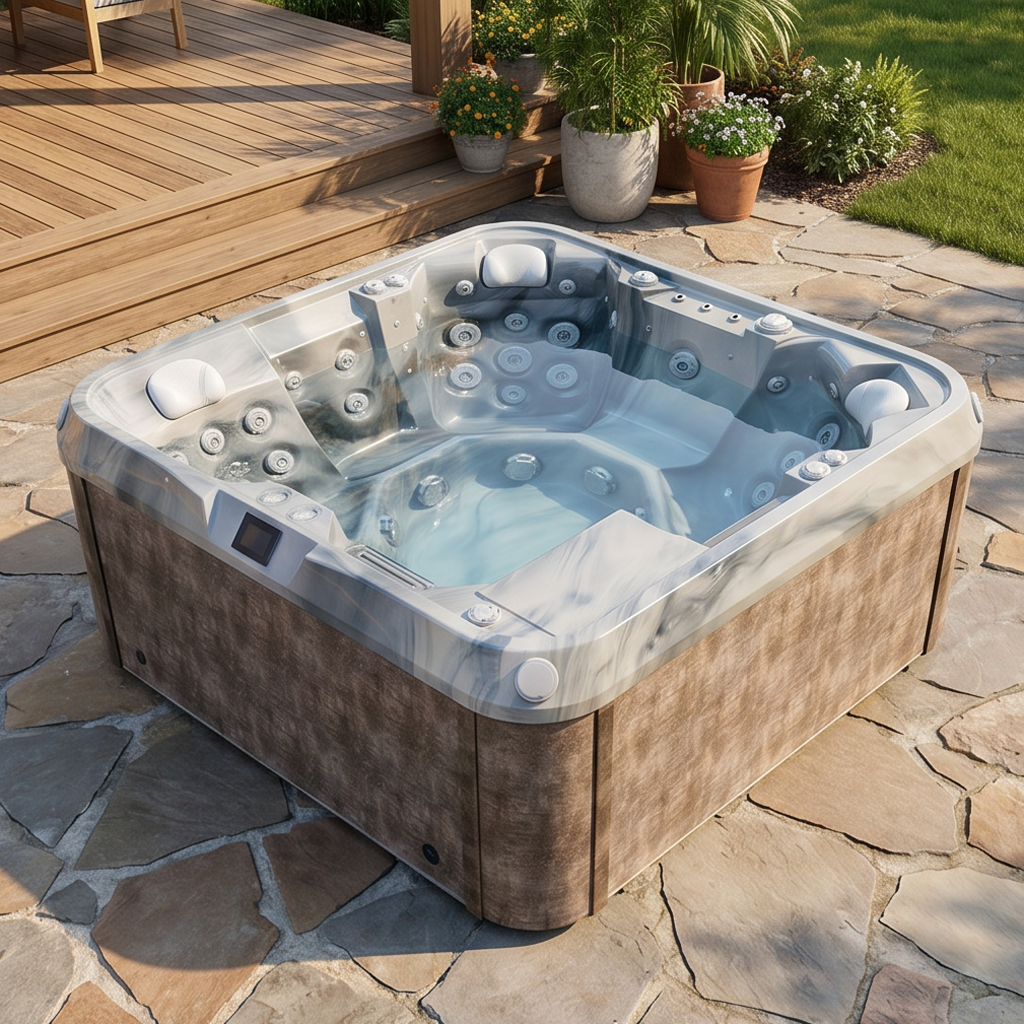
Frequently Asked Questions (FAQ) Regarding Outdoor Hot Tub Heating Power
Q1: What power ratings are typically used for outdoor whirlpool hot tub heaters?
Common configurations include 1.5kW, 2kW, 3kW, 4kW, 5kW, and 6kW. Among these, 3kW is a very standard option, suitable for many residential outdoor spa hot tubs.
Q2: Is a 3kW heater sufficient for a residential outdoor spa hot tub?
Generally, yes. For a residential outdoor spa hot tub with moderate capacity and good thermal insulation, a 3kW heater is sufficient to handle daily heating and temperature maintenance. If the hot tub has a larger capacity or is used in environments with low ambient temperatures during winter, further assessment may be required.
Q3: How long does it take for a 3kW heater to raise the temperature of 1,000 liters of water to 38°C?
Assuming an initial water temperature of 20°C and a target temperature of 38°C, the theoretical heating time is approximately 7 hours. In actual operation, heat loss must also be taken into account.
Q4: How much electricity does a 3kW heater for an outdoor hot tub consume per hour?
If it operates continuously at its rated power, the theoretical consumption is 3 kWh (i.e., 3 units of electricity) per hour. If the temperature-maintenance system operates intermittently, the actual power consumption will be lower.
Q5: Is a higher heating power always better for an outdoor spa hot tub?
No. While higher power can shorten the time required to heat the water, it also places a greater load on the power supply. The appropriate power rating should be selected based on the whirlpool hot tub's capacity, thermal insulation, and available power supply conditions.