


What is ODM Manufacturing for Outdoor Spa Hot Tubs?
2026-10-24 15:35As the markets for outdoor leisure, backyard living, and home spas continue to grow, an increasing number of brands, importers, and distributors are seeking more flexible approaches to product development. Compared to traditional OEM production, ODM (Original Design Manufacturer) allows clients to leverage a manufacturer's existing design, R&D, and production capabilities to launch their own branded products more quickly.
So, what exactly is ODM manufacturing for outdoor spa hot tubs? Simply put, ODM means the manufacturer is responsible not only for production but also for product design, structural development, functional configuration, engineering prototyping, and mass production. Clients can modify an ODM manufacturer's established product platform or submit their own market requirements for the manufacturer to execute the product development.
For companies that lack a full-scale R&D team but wish to enter the outdoor spa hot tub market quickly, ODM offers a highly efficient partnership model.
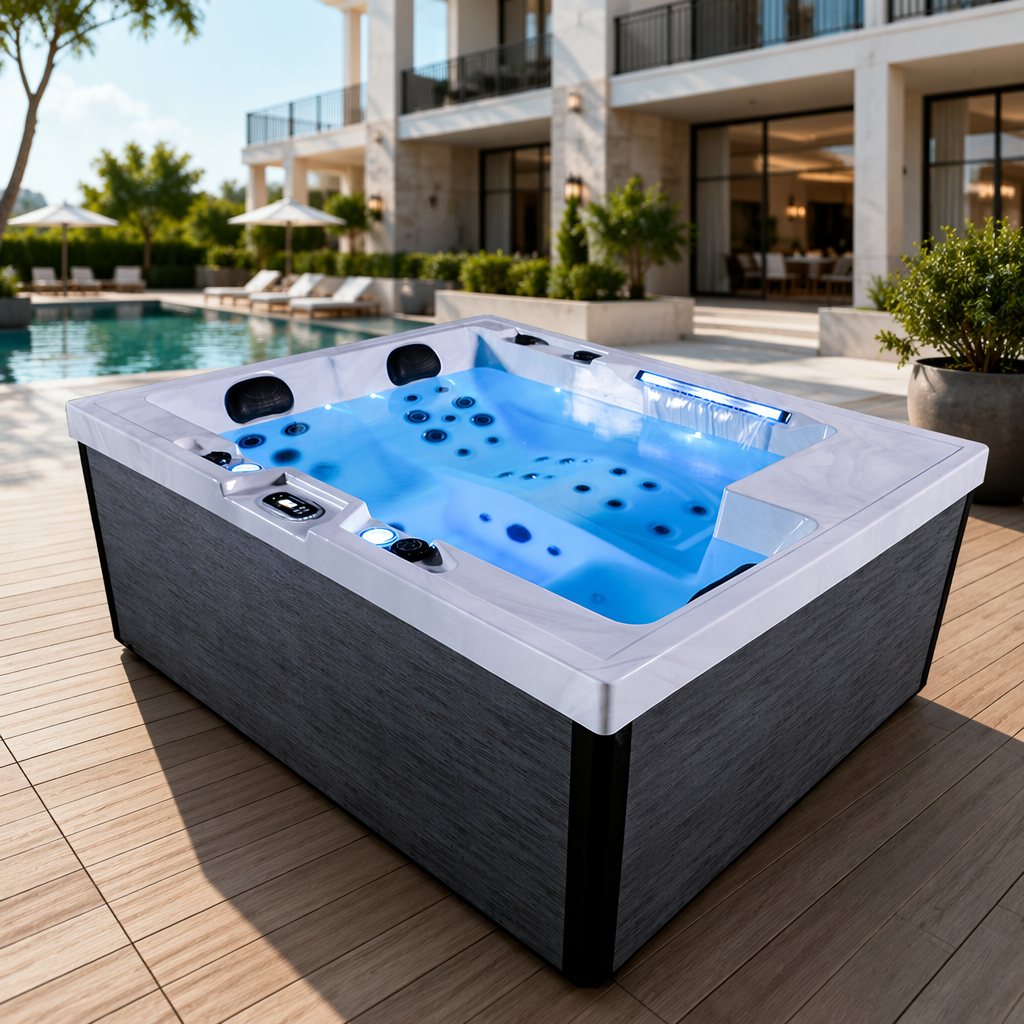
What is an ODM Outdoor Hot Tub?
An ODM outdoor hot tub can be understood as a model where "the manufacturer provides product development capabilities, while the client handles branding and market positioning."
For instance, a brand might want to launch a 6-person outdoor hot tub but lacks internal teams for structural, hydraulic, and electrical R&D. An ODM manufacturer can provide a mature hot tub platform—including the acrylic shell, base frame, seating, insulation system, pumps, heaters, jets, and control system.
The client can specify requirements such as adjusting dimensions, adding jets, altering seating layouts, incorporating foot massage features, changing acrylic colors, adding LED lighting, modifying the skirt design, and adjusting electrical specifications to meet the standards of the target sales region.
The manufacturer handles engineering design, prototyping, testing, and mass production, with the final product sold under the client's own brand.
Therefore, the core of ODM is not merely "private labeling" (sticking a logo on a product); rather, it involves leveraging the manufacturer's R&D and production capabilities to help the brand bring a market-ready outdoor spa hot tub to life.
OEM vs. ODM Outdoor Hot Tubs: What’s the Difference?
OEM and ODM are often confused, but the focus of the partnership differs between the two.
OEM is closer to a "client designs, factory manufactures" model. The client typically already possesses comprehensive product blueprints, structural plans, and technical specifications, while the outdoor spa hot tub manufacturer is primarily responsible for production.
ODM, on the other hand, places greater emphasis on the manufacturer's involvement in the design process. Clients need only specify product positioning, target markets, functional requirements, and price ranges, leaving the ODM supplier to handle structural design, functionality, and engineering specifications.
For instance, a client might simply request: "I need a six-person outdoor hot tub for the US market within a specific price range, featuring around 50 jets and a foot massage function." If the supplier then takes charge of seating configuration, jet layout, pump matching, insulation structure, and electrical systems, this constitutes a typical ODM development process.
Conversely, if a client already possesses complete 3D drawings and engineering documentation and simply requires the factory to manufacture the product according to those specifications, the process leans closer to OEM.
Therefore, determining whether a supplier truly possesses ODM capabilities requires looking beyond simple logo or color customization; the crucial factor is whether they have genuine product R&D and engineering expertise.
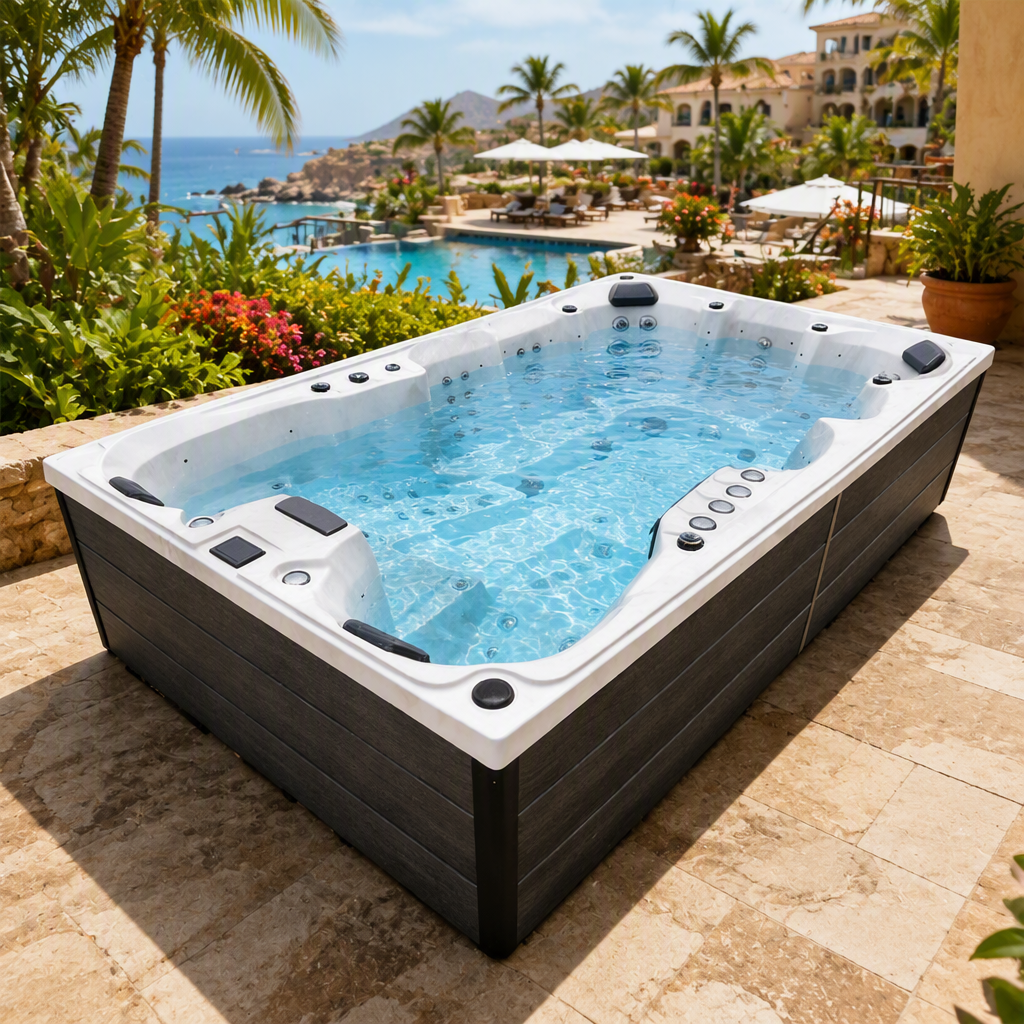
Why are more brands choosing ODM for outdoor spa hot tubs?
Outdoor spa hot tubs are not merely simple box-like products. A complete unit typically comprises numerous components, including acrylic molding, FRP (fiberglass-reinforced plastic) structures, insulation, water pumps, heaters, filtration systems, jets, PVC piping, controllers, electrical systems, and lighting.
For example, a six-person outdoor hot tub might be equipped with 40 to 60 or more jets, alongside therapeutic pumps, circulation systems, and heaters. These various components require precise integration regarding hydraulics, electrical systems, and structural integrity.
If a brand were to handle development entirely in-house, it would need to invest heavily in industrial design, mechanical and electrical engineering, mold making, and testing. For companies new to the market, this entails high development costs and lengthy product development cycles.
The ODM model allows brands to leverage the manufacturer's existing product platforms and supply chains, delegating the bulk of foundational development work to a specialized team, while the client focuses their energy on branding, distribution channels, and sales.
What aspects of ODM outdoor hot tubs can be customized?
Mature ODM outdoor hot tub offerings typically allow for customization across several areas.
First is product dimensions. Products can be developed with varying lengths, widths, and heights to suit specific target markets and usage scenarios. Models intended for residential backyards must account for spatial constraints, whereas export models require consideration of packaging and shipping dimensions.
Second is seating layout. Products can be designed to accommodate 2–3, 4–5, or 6+ people, with various seating configurations available—such as standard seats, loungers, and primary massage seats.
Third is the jet system. Depending on the product positioning, clients can choose from approximately 30 to 60+ jets, with layouts tailored to target the shoulders/neck, back, waist, and feet.
Fourth are the pump and heating systems. Electrical requirements vary across the US, Europe, and other markets; therefore, configurations must be adjusted to meet the voltage, frequency, amperage, and installation standards of the target country.
Fifth is the exterior design, including acrylic colors, skirting, headrests, control panels, LED lighting, water features, and branding logos.
Sixth is the insulation system. Different insulation structures can be selected based on the target market's climate and the product's positioning, balancing manufacturing costs against long-term energy consumption.
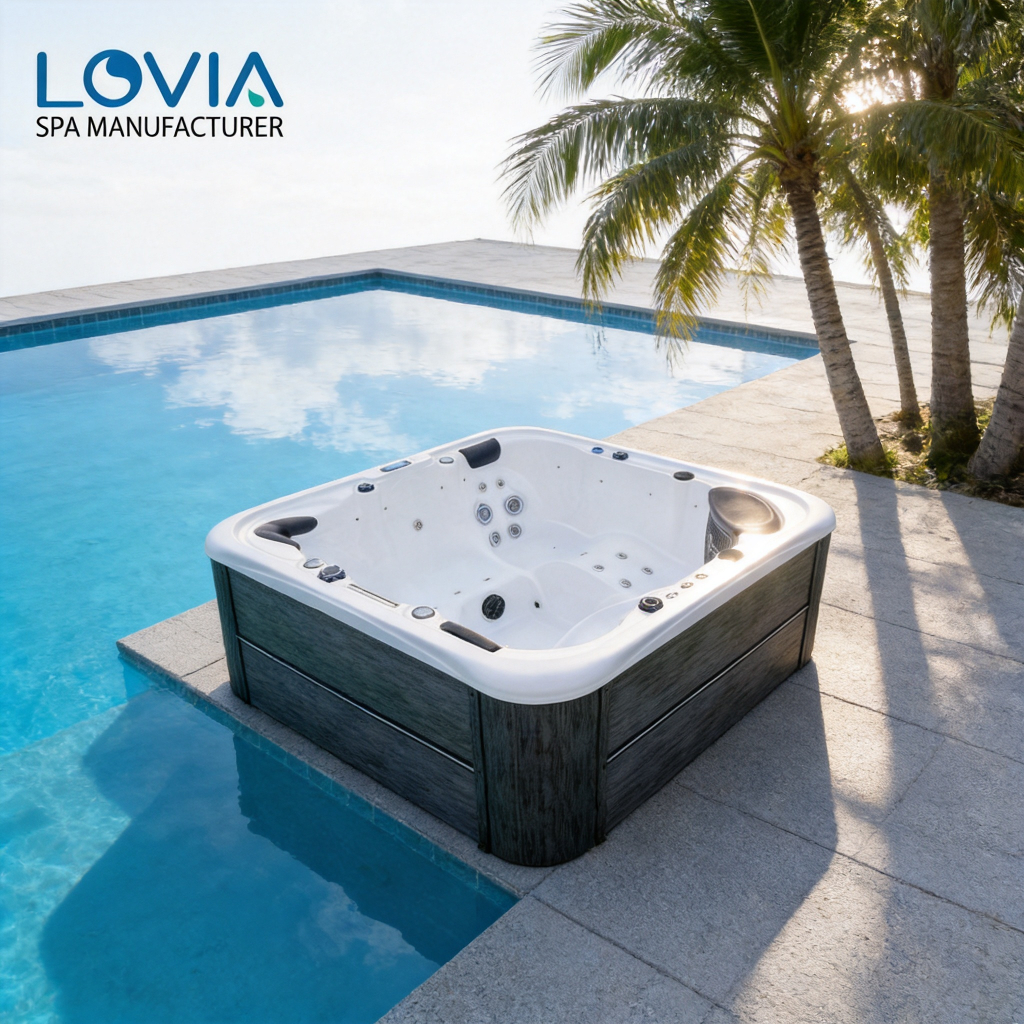
What are the common pain points in the outdoor hot tub ODM industry?
The first issue is "fake ODM."
Some suppliers claim to offer ODM services but can only modify colors, logos, or minor accessories. They lack the engineering capability to accommodate requests for changes to seating, jet layouts, pumps, or structural design.
A genuine ODM manufacturer of outdoor spa hot tubs must possess capabilities in product design, structural development, and engineering modification.
The second issue is "more features mean higher costs."
Many clients want to add features like more jets, massage pumps, waterfalls, LEDs, audio systems, Wi-Fi, and smart controls. However, each added feature can impact electrical, hydraulic, and control systems, as well as production costs.
Therefore, ODM development should not simply chase a high number of features; instead, it should focus on selecting configurations that offer genuine value to the target consumer.
The third issue is "inconsistency between prototypes and mass production."
If the materials and components used in the prototype differ from those in mass production, the final product may exhibit discrepancies in water flow, appearance, or performance.
Consequently, in an ODM partnership, once the prototype is approved, it is essential to lock in the Bill of Materials (BOM), key suppliers, and quality standards to ensure the mass-produced product matches the prototype.
Which costs can the ODM model help brands reduce?
One of the greatest advantages of the ODM model is the reduction of redundant R&D. If a supplier already possesses mature designs for the bathtub structure, molds, pump platforms, jet systems, and control schemes, the client avoids the need for development from scratch.
However, ODM does not imply a total absence of development costs; specialized molds, entirely new structural designs, unique control systems, and custom components can still incur additional expenses.
A more rational approach is to customize the elements that truly drive market competitiveness while standardizing mature internal structures as much as possible.
For instance, a client might focus on customizing the exterior, seating, jet configuration, control functions, and branding, while retaining the proven chassis, pump interfaces, and core internal structure—thereby striking a balance between product differentiation and cost efficiency.
How do you choose an ODM manufacturer for outdoor spa hot tubs?
When selecting an ODM supplier, look beyond factory size and product photos; instead, evaluate their actual R&D capabilities.
First, verify whether the supplier has in-house product design and engineering teams. Second, assess their capabilities in 3D modeling, structural design, and hydraulic system development. Third, confirm their ability to manufacture and test prototypes. Fourth, check the stability of their supply chain for critical components such as pumps, heaters, controllers, and jets.
It is also crucial to confirm their capacity to supply spare parts for mass-produced units.
Outdoor spa hot tubs are designed for long-term use, and components like pumps, heaters, controllers, and jets may eventually require replacement. Therefore, the ability to provide a steady supply of standardized spare parts is a key indicator of whether an ODM manufacturer is suitable for a long-term partnership.
Which clients are best suited for ODM outdoor hot tubs?
ODM outdoor hot tubs are particularly well-suited for three types of clients.
The first group consists of brands just entering the outdoor hot tub industry; these companies may possess established sales channels but lack a full-scale R&D team.
The second group includes established companies in the outdoor furniture, pool equipment, or home goods sectors that wish to add an outdoor spa hot tub product line.
The third group comprises brands with existing sales channels that want to rapidly expand their product portfolio (SKUs). Through ODM, they can develop products with varying sizes, jet configurations, and aesthetics based on a proven platform.
If a client already possesses a complete R&D team, engineering drawings, and technical specifications, a deep OEM or joint development model would be more appropriate.
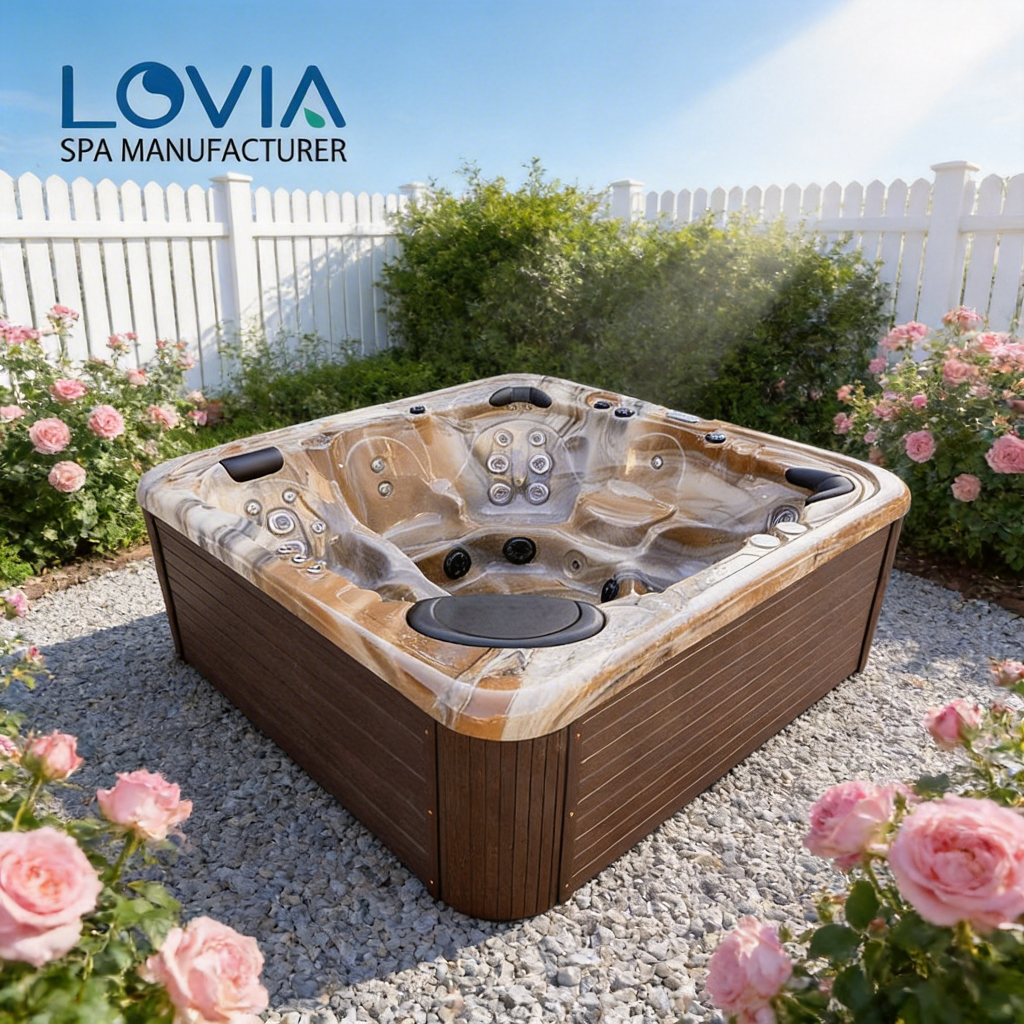
FAQ: ODM Outdoor Hot Tubs
1. What is an ODM outdoor hot tub?
An ODM (Original Design Manufacturer) outdoor spa hot tub is a product where the manufacturer is involved in the design, R&D, and production processes. Clients can customize specifications—such as dimensions, jet configurations, seating, aesthetics, functions, and electrical systems—to meet market demands.
2. What is the difference between OEM and ODM outdoor hot tubs?
In an OEM (Original Equipment Manufacturer) arrangement, the client provides the design while the manufacturer handles production. With ODM, the manufacturer participates in the product's design and development. Simply put, OEM leans towards "client-designed, factory-produced," whereas ODM leans towards "manufacturer-designed and developed, with client customization for branding and market positioning."
3. What aspects of an ODM outdoor hot tub can be customized?
Customizable features typically include dimensions, seating layout, jets, pumps, heaters, control systems, LED lighting, acrylic colors, cabinet skirting, and brand logos.
4. Are ODM outdoor hot tubs necessarily cheaper than OEM ones?
Not necessarily. While ODM can reduce the client's investment in independent R&D, specialized molds, new structural designs, and custom features still incur development costs. However, leveraging established platforms is generally more effective for controlling overall development costs.
5. How long does it take to develop an ODM outdoor hot tub?
The timeframe depends on whether the product is a modification of an existing platform or a completely new development. Factors such as structural design, mold creation, prototype testing, and certification requirements influence the development cycle; therefore, a clear development plan should be established at the project's outset.