


Outdoor Swim Spas: What Are the Risks of Insufficient Ground Load-Bearing Capacity?
2026-11-25 15:35As outdoor swim spas become increasingly popular in residential backyards, hotels, resorts, and commercial spa facilities, the requirements for their installation have become a key concern for both purchasers and users. Compared to standard outdoor hot tubs, outdoor swim spas typically feature larger water capacities, longer structural dimensions, and more complex water circulation and counter-current systems—all of which place higher demands on the load-bearing capacity of the ground where they are installed.
During the installation process, users often focus on dimensions, massage jets, counter-current swimming features, and heating systems, while overlooking a critical question: can the ground support the total weight of the unit when it is completely filled with water over the long term? If the foundation’s load-bearing capacity is inadequate, even a high-quality swim spa hot tub combo can lead to issues such as ground subsidence, concrete cracking, structural deformation of the unit, and damage to plumbing—potentially even compromising the structural integrity of the surrounding architecture.
So, what specific risks arise when the ground cannot support the weight of an outdoor swim spa hot tub? How should one evaluate the load-bearing requirements for different installation environments? This article explores these concerns, focusing on factors such as equipment weight and potential load-related risks.

Why Do Outdoor Swim Spas Require High Ground Load-Bearing Capacity?
An outdoor swim spa is more than just a piece of spa equipment; it is a facility designed to hold a significant volume of water over an extended period. Combining features like swim training, hydrotherapy massage, and temperature control, these units house a large water reservoir, a support frame, circulation pumps, heaters, and filtration systems. Consequently, the actual weight of the unit—when fully filled with water—must be carefully considered prior to installation.
1. The Weight of the Water Is the Primary Load Factor
Water accounts for the largest portion of an outdoor swim spa’s total weight. The density of water at room temperature is approximately 1,000 kg/m³; in other words, one cubic meter of water weighs about 1,000 kg.
For example, an outdoor swim spa hot tub combo with an effective water capacity of 5,000 liters (5 m³) carries a water weight of approximately 5,000 kg—or 5 metric tons. When you add the weight of the unit itself, its support structure, internal components, and the users, the total weight increases even further.
2. Larger Dimensions and Water Capacity
Standard outdoor hot tubs are primarily designed for massage and relaxation, and thus have a relatively limited water capacity. In contrast, outdoor swim spas require sufficient space for swimming; consequently, they are generally longer and wider, with a larger internal water volume.
A greater water capacity translates to a higher total weight that the installation foundation must support. If the ground is not properly engineered, long-term loading can lead to excessive localized stress, increasing the risk of ground deformation and subsidence.
3. Do Not Rely Solely on the Empty Weight of the Unit
When evaluating installation requirements, some users focus only on the net weight (dry weight) listed in product catalogs, overlooking the actual weight when the unit is filled with water.
A comprehensive load-bearing calculation must account for the empty weight of the unit, the weight of the water, the maximum number of occupants, and other additional loads. Therefore, when purchasing an outdoor swim spa hot tub, you should confirm the empty weight, actual water capacity, total weight when filled, and the specific requirements for base support with the manufacturer.
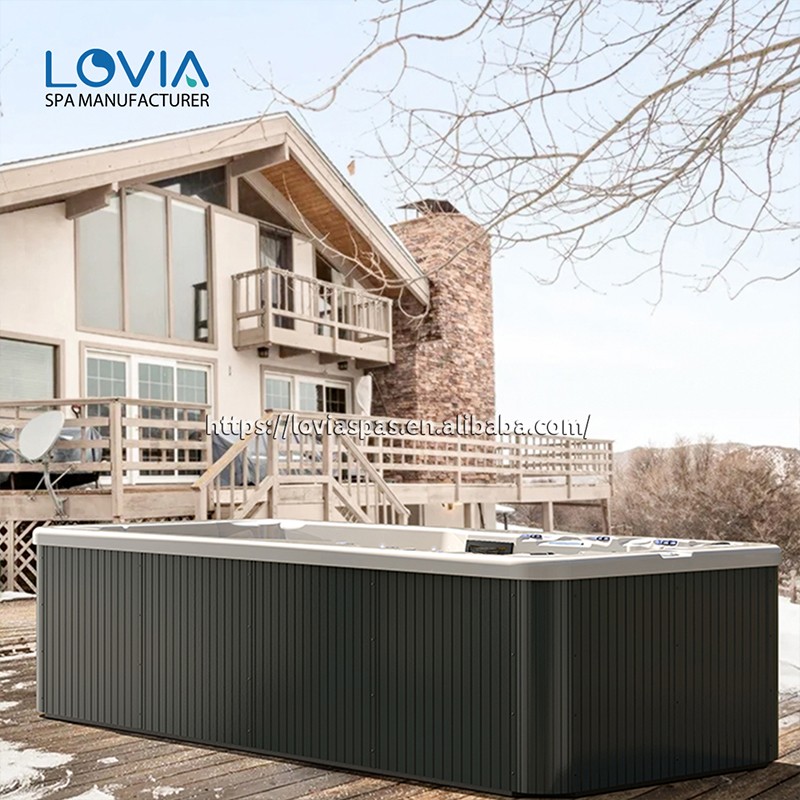
What are the primary risks associated with insufficient ground load-bearing capacity for an outdoor swim spa?
Load-bearing issues with an outdoor swim spa hot tub combo may not manifest immediately after installation. A foundation might appear stable initially, but structural problems can gradually emerge over time due to the unit remaining filled with water, the presence of occupants, and continuous vibration from the equipment.
1. Ground Subsidence Leading to Unit Tilting
If the installation site consists of soft soil or backfill, or if the foundation has not been adequately compacted, the ground may undergo uneven subsidence when the outdoor swim spa is kept filled for long periods.
For instance, if the foundation sinks on one side while remaining at its original level on the other, the unit will tilt. This not only affects the appearance but can also alter the water level distribution, potentially disrupting drainage and the proper functioning of certain water circulation systems.
Solution: Assess the soil type and foundation conditions prior to installation, and design the foundation based on the weight of the unit. In cases involving soft soil or backfill, the ground should be addressed through soil replacement, compaction, or professional foundation reinforcement, depending on site-specific conditions.
2. Cracking of the Concrete Foundation
Some users assume that simply pouring a concrete slab beneath an outdoor swim spa hot tub is sufficient to meet installation requirements. In reality, factors such as concrete thickness, reinforcement methods, the degree of soil compaction, and the load-bearing capacity of the foundation all influence the final outcome.
If the foundation is not designed to accommodate the actual load, cracks may develop over time due to sustained weight; in severe cases, this can compromise the overall structural support.
Solution: Design the concrete foundation based on the equipment’s weight when filled with water and the specific site conditions. For large outdoor swim spas, a professional should determine the required concrete thickness, strength, reinforcement, and soil preparation methods.
3. Deformation of the pool shell, increasing the risk of structural damage
Outdoor swim spas typically feature an acrylic shell, a composite structure, and an integrated support frame. If the base is left unsupported in certain areas—or if the support is uneven—specific sections may be subjected to excessive concentrated loads.
Over time, this can cause the support frame to deform and the pool shell to experience uneven stress, increasing the risk of cracks in the shell and damage to connection points.
Solution: Ensure that the entire base of the unit—specifically the load-bearing points designated by the manufacturer—is fully supported. Do not simply place support blocks under the corners of the unit, and never use a few shims or spacers as a substitute for a proper, complete foundation.
4. Additional stress on plumbing and connection components
Outdoor swim spas contain various internal components, including circulation pumps, heaters, filtration systems, massage jets, and counter-current swimming systems. These are interconnected via a network of pipes.
If the unit tilts or deforms due to ground settlement, the internal plumbing may be subjected to additional tension or bending stress, increasing the risk of loose joints, seal failure, and water leaks.
Solution: Verify that the foundation is level before installation to ensure no part of the unit is left unsupported. Additionally, implement proper drainage to prevent water from pooling around the foundation in the event of a leak.
5. Increased equipment vibration and dynamic loads
Outdoor swim spa hot tubs are often equipped with powerful circulation pumps and counter-current systems. During operation, the motors and pumps generate vibrations, while the movement of water exerts dynamic forces on the pool shell and its support structure.
If the foundation lacks sufficient rigidity—or if the unit is installed on a wooden deck or floor slab with limited load-bearing capacity—long-term operation can lead to vibration transmission, localized deformation, and noise issues. Solution: In addition to static weight, foundation design must account for vibrations and dynamic effects generated during the operation of the equipment. For installations on rooftops or terraces, a comprehensive assessment by a structural engineer is required.
6. Potential Risk to Structural Integrity
If an outdoor swim spa hot tub combo is installed on a balcony, terrace, or rooftop platform with insufficient load-bearing capacity, the long-term load may exceed the structural design limits of the building. This can lead to floor slab cracking, significant deflection, or even structural failure.
Therefore, the fact that a standard balcony can support the weight of people and furniture does not imply it can support an outdoor swim spa weighing several tons. Such projects must undergo professional structural calculations beforehand.
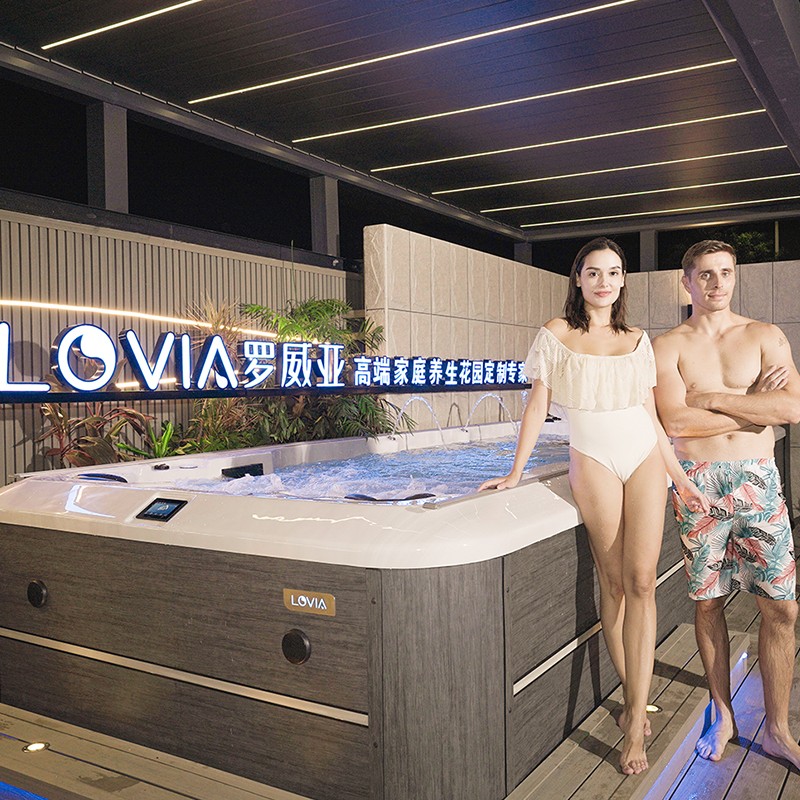
Where does the installation of an outdoor swim spa require special attention regarding load-bearing capacity?
Load-bearing risks vary depending on the foundation and structural conditions of the installation site.
1. Residential Courtyards
While courtyards are common installation locations, not all ground surfaces are suitable for placing an outdoor swim spa directly. If the site consists of recently backfilled soil, soft ground, or areas prone to water accumulation, particular attention must be paid to the risk of foundation settlement.
It is recommended to construct a professionally designed concrete foundation with proper drainage. In regions subject to freeze-thaw cycles, seasonal soil changes must also be taken into account.
2. Balconies and Rooftop Platforms
Balconies and rooftops represent higher-risk installation environments. For instance, under the 2021 International Residential Code (IRC) in the United States, the standard uniform live load for residential exterior balconies and decks is 40 psf (approximately 195 kg/m²).
However, this figure cannot be used as the sole criterion for the load-bearing capacity required for an outdoor swim spa hot tub. Actual projects must also account for the equipment's dead load, concentrated loads, floor span, and load-transfer paths.
Consequently, before installation, one must obtain the building's structural documentation, have a professional structural engineer perform the necessary calculations, and implement structural reinforcements if required.
3. Wooden Decks
Some users may wish to install an outdoor swim spa hot tub combo on a wooden deck to integrate the unit into their garden landscape. However, standard wooden decks are generally not designed to support the weight of large spa equipment. The span of timber beams, their cross-sectional dimensions, the positioning of support columns, and the strength of connectors all influence the actual load-bearing capacity. If a timber platform is to be used, a professional structural design is required to ensure that the equipment load can be reliably transferred to the ground foundation.
4. Semi-inground and Inground Installation
Some outdoor swim spa installations are designed to be semi-inground or fully inground. In such cases, in addition to the load-bearing capacity of the base, one must also account for lateral soil pressure, waterproofing, and drainage.
Backfill soil that has not been properly engineered can exert uneven lateral pressure on the spa shell. Therefore, independent foundations and necessary retaining structures must be designed based on the equipment’s structural requirements, and adequate space for maintenance access must be reserved in accordance with the manufacturer’s specifications.
How should the actual weight of an outdoor swim spa be calculated?
Before assessing the ground's load-bearing capacity, it is essential to determine the total weight of the equipment when filled with water.
Calculation Formula:
Total Weight = Empty Unit Weight + Water Weight + User Weight + Other Additional Loads.
The weight of the water can be estimated using the following formula:
Water Weight (kg) ≈ Water Capacity (L) × 1 kg/L.
For example, if an outdoor swim spa has an effective water capacity of 6,000 L, an empty unit weight of 1,200 kg, and accommodates 4 users (estimated at 80 kg each):
| Load Component | Weight |
| Water Capacity | 6,000 kg |
| Empty Spa Weight | 1,200 kg |
| Four Users | 320 kg |
| Total Weight | 7,520 kg |
This means that when the unit is filled with water and in use, the total weight is approximately 7.52 metric tons.
Assuming an actual support footprint of 12 m², the average load is approximately 626.7 kg/m².
Please note that this is merely an average load for the sake of the example and does not represent the required load-bearing capacity for the foundation design. Actual loads are influenced by the base frame, the distribution of support points, and localized stress concentrations; therefore, structural verification cannot be performed simply by dividing the total weight by the external dimensions.
Since different outdoor swim spa hot tub combo models vary in terms of water capacity, empty weight, and base support structure, calculations must be based on the specific parameters of the product in question.
How can one address insufficient ground load-bearing capacity for an outdoor swim spa?
If the load-bearing capacity of the intended installation site is insufficient, the issue should not be addressed by simply adding shims or thickening the existing flooring. Instead, targeted measures must be taken based on the weight of the equipment and the specific installation environment.
1. Use a Professionally Designed Reinforced Concrete Foundation
For outdoor swim spas installed at ground level, a reinforced concrete foundation is a common solution. It provides stable support and reduces the risk of the equipment deforming due to uneven load distribution.
Some manufacturers provide specific requirements for foundation thickness—for instance, recommending a 10–15 cm concrete base. However, this is not a universal standard for all outdoor swim spas; the actual construction should be determined based on the soil’s load-bearing capacity, the weight of the equipment, and local building codes.
2. Reinforce Soft or Unstable Ground
If the installation area consists of soft soil or backfill, the unsuitable soil should be removed and replaced with compacted fill (applied in layers), topped with a proper layer of crushed stone.
In areas with poor load-bearing capacity or high groundwater levels, specialized ground reinforcement solutions may be necessary to prevent uneven settlement over the long term.
3. Reinforce Balcony or Rooftop Structures
If a user intends to install an outdoor swim spa hot tub combo on a second-floor terrace or a rooftop, the existing building structure must first be inspected by a structural engineer.
Depending on site conditions, it may be necessary to add load-bearing beams, support columns, or other reinforcements to ensure that the equipment’s load is reliably transferred to the building’s primary structural framework.
Simply adding steel plates or extra concrete layers to a floor slab is not sufficient to improve load-bearing capacity, as these additional materials also increase the building’s permanent (dead) load.
4. Ensure Uniform Support for the Equipment Base
During installation, it is essential to follow the manufacturer’s requirements to ensure that all designated support points on the underside of the equipment are adequately braced. The foundation must be level and stable, with no significant height variations or areas where the equipment might be left unsupported (hanging in mid-air).
Additionally, sufficient space should be left around pumps, heaters, and filtration systems to allow for future maintenance and repairs.
What should be checked before installing an outdoor swim spa?
To minimize the risk of construction errors and the need for future repairs, it is recommended to complete the following checks prior to installation.
| Inspection Item | Key Requirements |
| Product Weight | Confirm empty and filled weight |
| Water Capacity | Obtain actual water volume |
| Ground Condition | Check soil type and compaction |
| Foundation Strength | Verify load-bearing capacity |
| Surface Levelness | Check flatness and support points |
| Drainage System | Ensure adequate drainage |
| Maintenance Access | Reserve repair clearance |
| Structural Assessment | Obtain professional approval |
First, obtain the following information from the outdoor swim spa hot tub manufacturer: the unit’s dry weight, actual water capacity, filled weight, external dimensions, and requirements for base support. Second, construction personnel must assess the installation site, including ground conditions, soil type, and drainage. If the installation involves a building structure—such as a balcony or rooftop—relevant structural documentation must also be obtained.
Finally, determine the foundation construction plan based on the specific circumstances, including concrete thickness, reinforcement, subgrade preparation, and the method for supporting the unit. For complex projects, a professional design plan must be provided by a structural engineer.

Frequently Asked Questions (FAQ) Regarding Load-Bearing for Outdoor Swim Spa Installations
Q1: How much does an outdoor swim spa typically weigh when filled with water?
This varies significantly by model and must be calculated based on the water capacity and the unit’s dry weight. For example, a unit with a water capacity of 6,000 liters contains approximately 6 metric tons of water alone; the total weight increases further when accounting for the unit itself and the users.
Q2: Can an outdoor swim spa be installed directly on a standard concrete surface?
Not necessarily. A standard concrete surface does not automatically guarantee sufficient load-bearing capacity. Factors such as concrete thickness, subgrade conditions, reinforcement, and surface evenness must be evaluated.
Q3: Can an outdoor swim spa hot tub combo be installed on a balcony or rooftop?
This requires a professional assessment. A structural engineer must perform calculations based on the unit’s filled weight, the structural integrity of the floor slab, and load distribution to ensure safety before construction begins.
Q4: Does an uneven surface affect an outdoor swim spa hot tub combo?
Yes. An uneven surface can lead to uneven support, placing excess stress on the frame and the spa shell, which increases the risk of deformation and structural damage.
Q5: What type of foundation should be used for an outdoor swim spa?
For ground-level installations, a professionally designed reinforced concrete foundation is typically used. The specific thickness, reinforcement, and subgrade preparation methods must be determined based on the unit’s weight, soil conditions, and the manufacturer’s requirements.