


How do you assess the water quality of an outdoor swim spa tub?
2026-07-08 15:35How do you assess the water quality of an outdoor swim spa tub? Algae issues vs. filtration problems: How can you distinguish between them and prevent them?
As the lifestyle of backyard leisure gains popularity, more households are installing outdoor swim spa hot tubs. Compared to traditional swimming pools, swim spas have a smaller footprint while offering a versatile range of functions—including swim training, hydrotherapy massage, rehabilitative exercise, and family entertainment—making them a favorite among owners of high-end homes. However, purchasing the equipment is merely the first step; the key factors determining the user experience and the equipment's lifespan are often related to water quality management.
Many swim spa tub owners have had a similar experience: the water, previously crystal clear, suddenly turns cloudy; the walls feel slimy; tiny particles float on the surface; or an unpleasant odor develops. While the immediate reaction is often simply "the water is dirty," the causes of water quality deterioration vary. Two of the most common—and frequently confused—issues are algae growth and filtration system malfunctions.
During maintenance, owners often mistake algae issues for filtration problems, or vice versa. This not only wastes chemicals and money but can also exacerbate the problem. Therefore, every owner should possess the fundamental knowledge to accurately assess water quality, distinguish between algae and filtration issues, and implement effective preventive measures.
This article provides a comprehensive analysis covering water quality standards, the mechanisms of algae formation, filtration system principles, common signs of malfunction, and preventive maintenance strategies, helping owners develop a systematic approach to swim spa hot tub water quality management.
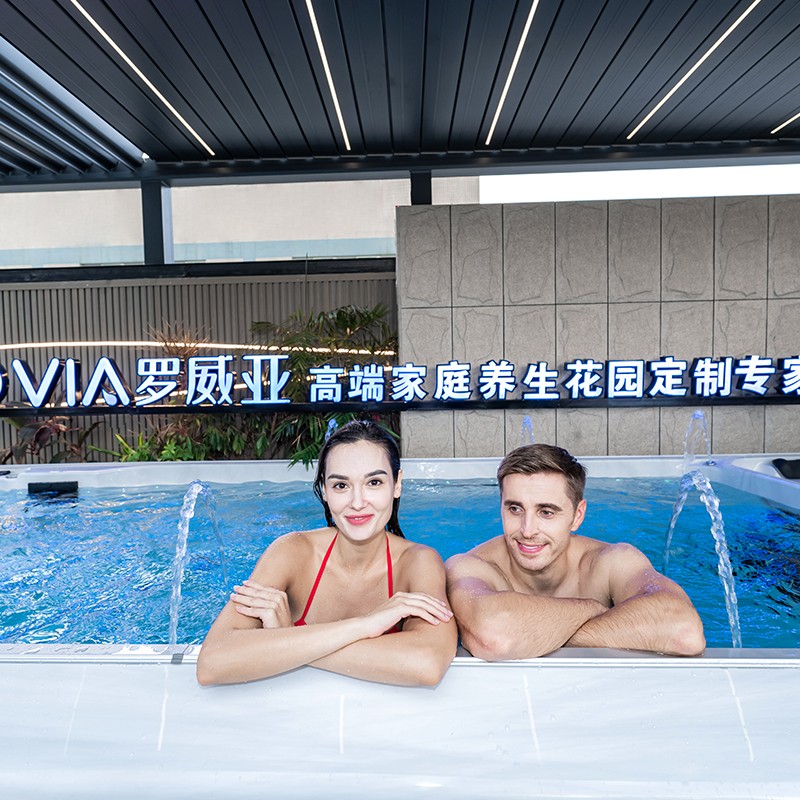
Assessing swim spa water quality: Clarity isn't the only indicator
When evaluating swim spa hot tub water quality, many owners rely primarily on visual clarity. However, clear water does not necessarily guarantee good quality, nor does cloudiness always indicate severe contamination. A truly scientific assessment requires a comprehensive analysis that considers visual appearance, chemical parameters, and equipment performance.
An outdoor swim spa hot tub in ideal condition should exhibit several key characteristics. First, the water has high clarity, allowing the pool floor and corners to be clearly seen without visible suspended particles. Second, the water surface is clean, free from oil films, foam accumulation, or floating debris. Third, the pool walls and seating areas feel smooth to the touch, without any noticeable slime or slipperiness. Fourth, the water lacks pungent odors and does not smell musty, putrid, or strongly of chlorine. Finally, water quality parameters remain within reasonable ranges; for instance, the pH level is maintained between 7.2 and 7.8, free chlorine typically stays between 1 and 3 ppm, and total alkalinity is controlled at approximately 80 to 120 ppm.
According to common standards in the international pool and spa industry, outdoor swim spa hot tubs are generally considered to have good visual clarity when turbidity is below 0.5 NTU. Conversely, when turbidity exceeds 1 NTU, most users can clearly perceive the water becoming cloudy. Although few home users own professional turbidimeters, a basic assessment can often be made by observing whether markers on the pool floor remain clearly visible.
It is important to note that some outdoor swim spa hot tubs may still appear clear even when water quality has begun to deteriorate. For example, during the early stages of an algae bloom, the number of algae cells may not yet be visible to the naked eye, even though rapid proliferation has already begun. Conversely, if the filtration system malfunctions, the water may quickly become cloudy without necessarily involving microbial contamination. Therefore, relying solely on visual inspection is often insufficient to accurately identify the root cause of the problem.
Why are outdoor swim spa tubs prone to algae issues?
Compared to indoor units, outdoor swim spa tubs are more susceptible to environmental factors, and algae growth is one of the most common water quality challenges.
Algae are essentially photosynthetic microorganisms. They are ubiquitous, found in the air, water sources, on plant surfaces, and even on users' bodies. Under favorable conditions, a small number of algae cells can multiply rapidly, resulting in visible algae contamination.
Outdoor swim spa tubs are particularly prone to algae issues primarily due to prolonged exposure to sunlight. Ultraviolet and visible light from the sun provide ample energy for algae, while warm water temperatures further accelerate their growth. Many outdoor swim spa hot tubs are maintained at temperatures between 28°C and 38°C year-round—a range that happens to be ideal for the rapid growth of most green algae.
Furthermore, airborne spores constantly find their way into the water. Even when the spa cover is closed, algal spores can be carried into the system by the wind. Additionally, nutrients introduced by leaves, pollen, insects, and rainwater serve as fuel for algal proliferation.
Moreover, if sanitizer levels remain consistently low, algae can more easily breach the system's defenses. Industry data indicates that the risk of an algae outbreak rises significantly when free chlorine levels drop below 1 ppm. Since sanitizer consumption rates are often more than 30% higher in the heat of summer compared to winter, outdoor swim spas require particularly close monitoring during the hot season.

What are the typical signs of algae problems in outdoor swim spas?
To identify algae issues effectively, it is crucial to understand the progression of the problem, as the symptoms vary across different stages.
In the early stages, the water in an outdoor swim spa tub may simply lose its luster, appearing somewhat "dull" or "grayish." While water quality parameters may already be deviating from the norm, visual changes are often subtle. Many users overlook this phase until the problem escalates.
As the issue progresses to the intermediate stage, the water begins to take on a slight green, yellow, or milky-white turbidity. The pool walls and steps may feel slightly slippery or slimy to the touch; the surface no longer feels as smooth as usual because algae are beginning to form a biofilm.
If left untreated, the algae enter a phase of rapid reproduction. The water may turn distinctly green, algae patches may appear in specific areas, and significant deposits can accumulate around jets and filters. In severe cases, the bottom of the spa may become invisible.
Different types of algae manifest in various colors. Green algae, the most common type, turn the water green or yellow-green; yellow algae tend to adhere to shaded areas; and black algae are known for their strong adhesion, making them particularly difficult to remove once established.
A key indicator of an algae problem is that the pool walls become slippery. If users notice that the walls of their outdoor swim spa hot tub have become noticeably slimy, they should be highly alert to potential algae growth, even if the water has not yet undergone significant discoloration.
What are the signs of problems with an outdoor swim spa's filtration system?
Unlike algae issues, filtration system problems are primarily mechanical in nature.
The filtration system's main task is to remove suspended particles, organic debris, and certain microorganisms. When filtration efficiency drops, the water can become noticeably cloudy, even if sanitizer levels remain normal.
Common filtration issues include clogged filter cartridges, insufficient circulation pump flow, blocked piping, and inadequate filtration runtimes.
When an outdoor swim spa tub's filtration system malfunctions, it typically exhibits several distinct characteristics. First, water clarity decreases, though the color change may not be dramatic; the water often appears milky or grayish-white and cloudy, rather than green.
Second, the spa walls usually remain smooth without a noticeable slimy feel, as the issue stems from the accumulation of suspended particles rather than algal biofilm.
Additionally, users may notice reduced flow from the jets, slower water return, or an abnormal rise in filter pressure. For swim spa hot tubs equipped with pressure gauges, a reading 20% to 30% above normal often indicates that the filtration system requires cleaning.
Another easily overlooked phenomenon is the rapid fluctuation of turbidity. If water quality improves when the circulation system is running but deteriorates quickly once it is turned off, the problem is likely due to insufficient filtration capacity rather than algae proliferation.
How can one quickly distinguish between algae problems and filtration issues in an outdoor swim spa?
For many users, the primary concern is not the underlying mechanism, but rather how to quickly identify the source of the problem during routine maintenance.
A simple method is to observe the water color. If the swim spa tub water turns green, yellow-green, or develops localized discolored patches, an algae problem is likely. Conversely, if the water is merely cloudy with a white or gray tint, the issue is more likely related to filtration.
A second method is to touch the spa walls. A surface that feels slippery, sticky, or coated in a film-like layer is usually associated with algae growth. If the walls remain smooth, the filtration system is the more probable culprit.
A third method is to test the sanitizer concentration. If free chlorine levels remain consistently low while the water becomes cloudy, the risk of algae growth increases significantly. Conversely, if disinfectant levels are normal or even high yet the water remains cloudy, the filtration system should be the primary focus of your inspection.
A fourth method is to check the condition of the filter cartridge. If the cartridge is severely clogged, discolored, or covered in heavy sediment, filtration issues are likely the root cause.
In reality, algae problems and filtration issues in outdoor swim spa hot tubs are often interconnected. When filtration efficiency drops, nutrients and microorganisms accumulate more easily in the water, creating favorable conditions for algae growth. Consequently, these two types of problems frequently occur together.
How can you prevent algae problems in outdoor swim spas?
Prevention is always more cost-effective than remediation.
First, maintaining stable disinfectant levels is crucial. For most outdoor swim spa tubs, keeping free chlorine levels between 1 and 3 ppm is generally effective at inhibiting algae proliferation. You may want to increase the frequency of testing during periods of high usage or hot weather.
Second, perform regular shock treatments. Shock treatment involves temporarily raising disinfectant levels to eliminate potential microorganisms and organic contaminants. Many professional technicians recommend a mild shock treatment once a week, especially during the hot summer months.
Additionally, maintaining proper water circulation is vital. Insufficient circulation can lead to "dead zones" where water stagnates, creating a breeding ground for algae. Generally, the total daily circulation time should be tailored to the water volume and usage frequency; units used frequently often require longer circulation cycles.
For outdoor swim spa tubs that will not be used for extended periods, ensure the thermal cover is securely in place to minimize sunlight exposure and the entry of external contaminants.
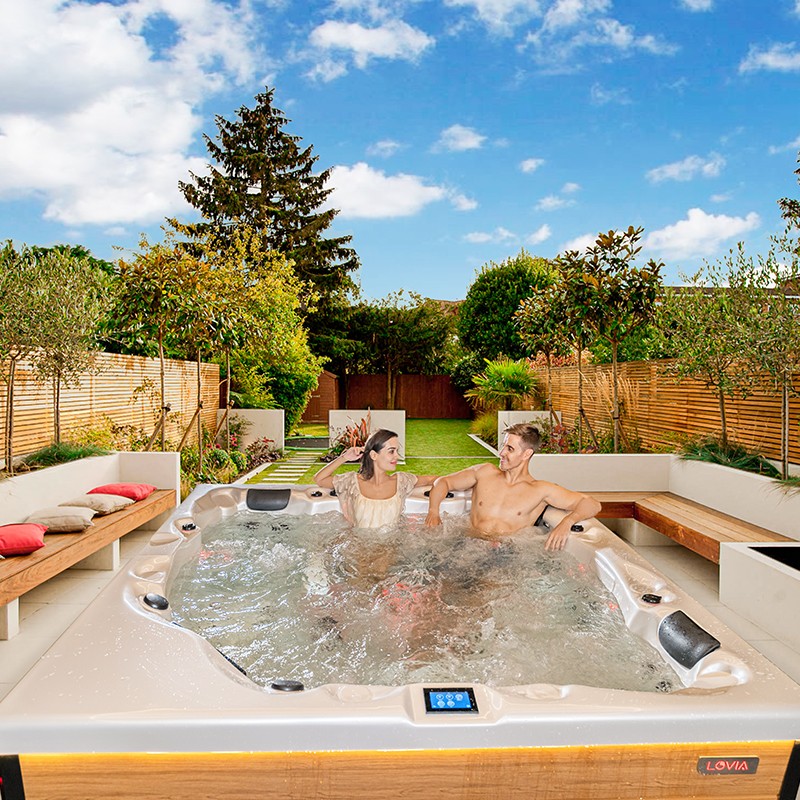
How can you prevent filtration system issues from affecting water quality in outdoor swim spas?
Filtration system maintenance is an aspect often overlooked by many residential users.
Filter cartridges are not permanent components; even if the surface appears clean, significant amounts of fine particles may have accumulated inside. Most manufacturers recommend cleaning the cartridge every 2 to 4 weeks and replacing it every 12 to 24 months, though the exact schedule should be adjusted based on usage intensity.
At the same time, regularly check the operating status of the circulation pump. If you notice reduced flow, increased noise, or sluggish water return, investigate the cause promptly. For large outdoor swim spa hot tubs, the filtration time setting is equally important. If the system runs a filtration cycle for only a short period each day, it may fail to effectively remove contaminants, even if the filter cartridge is in good condition.
Additionally, keeping the area around the unit tidy can significantly reduce the strain on the filtration system. For example, regularly clearing away fallen leaves, trimming nearby trees, and minimizing sources of pollen can help lighten the load on the swim spa's filtration system.
Establishing a Long-Term, Stable Water Quality Management System
Truly effective water quality management is not about solving problems after they arise, but rather preventing them before they develop.
Swim spa hot tub users are advised to establish a regular testing schedule. Test pH levels, free chlorine, and total alkalinity at least once a week—or even more frequently during periods of heavy use. Keeping a record of data trends over time also helps in identifying potential risks early on.
Many professional service providers have found that users who consistently maintain excellent water quality do not necessarily use more chemicals; instead, they have established more disciplined maintenance habits. Through continuous monitoring, timely adjustments, and regular cleaning, they can intervene at the first sign of an issue, thereby avoiding the need for major corrective measures later.
FAQ
Does green water in an outdoor swim spa hot tub always indicate algae?
In most cases, it is an algae issue, but contamination by certain metal ions can also cause water discoloration. If the pool walls feel slippery and sanitizer levels are low, the likelihood of an algae problem is higher.
If the water in an outdoor swim spa tub is cloudy but not green, does that mean there is no algae?
Not necessarily. In the early stages of an algae bloom, there may not yet be a noticeable color change; therefore, a comprehensive assessment based on the texture of the pool walls, sanitizer concentration, and test data is required.
How often should the filter cartridge of an outdoor swim spa be cleaned?
It is generally recommended to clean it every 2 to 4 weeks, though the interval can be shortened during periods of heavy use or seasons with heavy leaf fall.
Why is the water in an outdoor swim spa tub cloudy even when free chlorine levels are normal?
This is usually related to reduced filtration system efficiency, high total dissolved solids (TDS), or the accumulation of fine particles; it is not necessarily a sanitization issue.
Do outdoor swim spa hot tubs require the use of algaecides?
If the disinfection system is functioning properly, frequent use of algaecides is often unnecessary. However, during hot seasons or in environments prone to algae growth, the moderate use of preventative algaecides can help reduce risks.
How can you determine whether an outdoor swim spa is experiencing a filtration issue or an algae problem?
You can make an assessment by considering factors such as water color, the texture of the pool walls, sanitizer levels, and the condition of the filter. Green water or a slimy feel on the walls usually points to an algae problem, whereas cloudy white water combined with smooth walls is more likely indicative of a filtration issue.