


Can low calcium levels cause cloudy water in outdoor swim spa tubs?
2026-07-16 15:35For many new owners of outdoor swim spa tubs, water quality management is often the aspect most easily overlooked, yet it is also the area that raises the most questions. When maintaining their spas, many people focus heavily on sanitizer levels, pH balance, and filter cleanliness, while neglecting another crucial water quality parameter: calcium hardness (CH). When the water suddenly turns cloudy, the immediate reaction is often to wonder if the filter is clogged or if too little sanitizer was added; rarely do users consider that low calcium hardness could be a significant factor affecting water stability.
In the realm of water treatment, people are generally more familiar with the issue of high calcium levels causing scale—a concept that is easy to grasp, as high calcium readily leads to white deposits and scale buildup on equipment. However, problems caused by excessively low calcium levels are frequently overlooked. In reality, low calcium hardness can disrupt water balance and destabilize water quality, leading to the presence of numerous microscopic suspended particles. This manifests as water that appears whitish, grayish, or slightly cloudy.
What makes this even more baffling is that, even with the filtration system running around the clock, users often find these tiny particles impossible to fully filter out; the water never quite achieves perfect clarity. Why does this happen? Why can't the filter quickly remove all these particles? Is the filter damaged? The issue is far more complex than it seems, involving factors such as chemical balance, particle size, filtration precision, circulation efficiency, and the type of filter media used.
This article provides an in-depth analysis of whether low calcium causes cloudiness in outdoor swim spa tubs, the importance of calcium hardness, the reasons why these fine particles are difficult to filter out quickly, and how to address these issues scientifically. We hope to help swim spa tub owners develop a more systematic and scientific approach to water quality management.
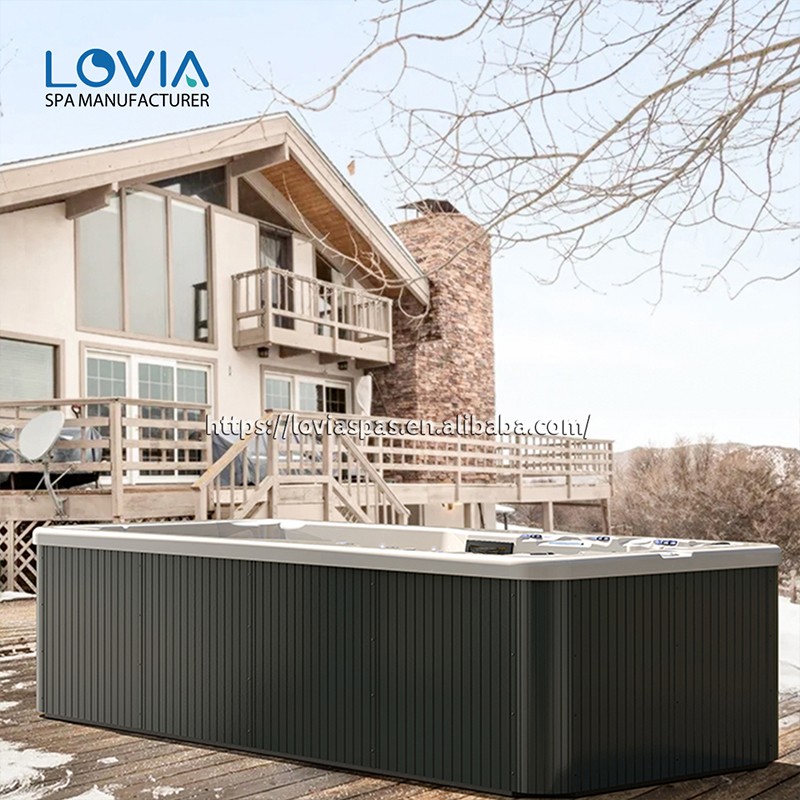
What is calcium hardness? Why is it a critical water quality parameter for outdoor swim spas?
Calcium hardness refers to the concentration of dissolved calcium ions in the water, typically expressed in ppm (mg/L, calculated as calcium carbonate). It is a key indicator for assessing water balance; together with pH, total alkalinity, and sanitizer concentration, it forms the core set of parameters for managing water treatment in outdoor swim spa tubs.
Many users mistakenly believe that calcium is merely an ordinary mineral with little impact on water quality; in reality, calcium ions play a crucial stabilizing role within the overall water chemistry system. When calcium hardness is maintained within an optimal range, the water retains a favorable chemical balance, preventing both excessive equipment corrosion and the formation of severe scale deposits.
While recommendations vary slightly depending on the brand and materials of the outdoor swim spa tub, the industry standard for residential spa products typically suggests a range of 150–250 ppm, whereas larger swim spa tub units may require levels between 150 and 300 ppm. Users should always consult the equipment manufacturer's maintenance manual for specific figures.
If calcium hardness significantly exceeds the recommended range, scale and mineral deposits are likely to form. Conversely, if levels remain consistently below the recommended range, the water can become "aggressive"; this not only damages equipment materials but also compromises chemical stability, indirectly increasing the risk of cloudy water.
Why can low calcium levels lead to cloudy water in outdoor swim spa tubs?
In fact, low calcium levels do not directly produce large amounts of white precipitate—as high calcium levels do—but they trigger a chain reaction by altering the water's overall balance.
First, when calcium hardness remains consistently low, the water tends to seek a new mineral equilibrium. Simply put, the water continuously "absorbs" soluble minerals to achieve a new state of chemical stability. This process can cause minerals to leach from equipment surfaces, piping, or cement-based materials into the water, thereby increasing the concentration of fine particles.
Second, low calcium levels often indicate an overall mineral deficiency and reduced buffering capacity. When pH or total alkalinity fluctuates even slightly, the entire chemical system becomes unstable, potentially causing substances that were previously dissolved to precipitate out as microscopic suspended particles. These particles are typically so tiny that individual ones are invisible to the naked eye, yet they can give the water in an outdoor swim spa tub a slightly whitish or cloudy appearance.
Furthermore, a low-calcium environment can reduce the stability of certain water treatment chemicals, making it easier for impurities to remain suspended rather than quickly clumping together and settling. This explains why many users find that, even with the filtration system running constantly, the water fails to regain its crystal-clear clarity.
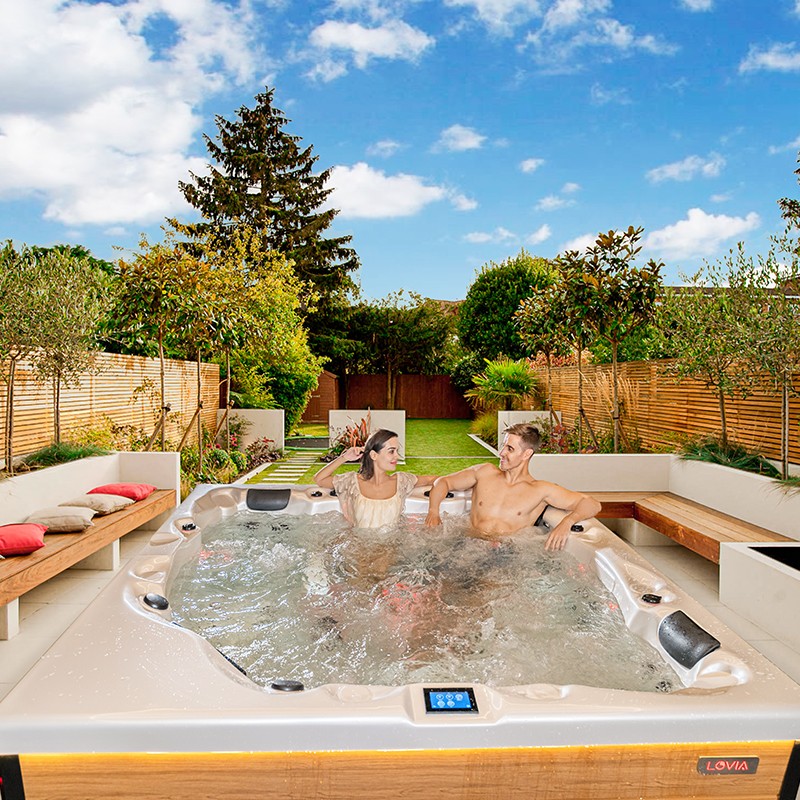
Why aren't these particles quickly filtered out of the outdoor swim spa tub?
Many people assume that as long as the filter is working properly, any particle should be quickly removed. However, the reality of the filtration process is far more complex.
1. Particles are too small for the filter's optimal capture range
Outdoor swim spa tubs typically use pleated cartridge filters as their primary filtration medium. While these filters effectively trap hair, leaves, insect debris, and larger suspended impurities, their efficiency drops significantly when dealing with extremely fine particles.
For instance, suspended particles resulting from changes in water chemistry may measure only a few microns—or even less—in diameter. Standard filter cartridges cannot fully capture such minute particles in a single pass. Consequently, even after the filtration system has run for hours, the water may remain slightly cloudy.
2. Particles remain in a state of suspension
Many users mistakenly believe that particles naturally settle to the bottom, but this is not the case.
In an outdoor swim spa tub, massage jets, circulation pumps, and swim-against-the-current systems generate continuous water flow, keeping the water in constant motion. Due to their negligible mass, these tiny particles tend to remain suspended in the water rather than settling quickly to the bottom; thus, the filter can only capture a fraction of them as the water passes through.
3. Water flow velocity affects filtration efficiency
The circulation system of an outdoor swim spa tub must strike a balance between flow rate and filtration performance.
If the water flows too quickly, many fine particles may pass straight through the filter cartridge without sufficient time to adhere to the filtration medium. This phenomenon is particularly pronounced in large outdoor swim spa tubs, where the water volume is significantly higher than in standard spas, placing greater demands on the filtration system. 4. The outdoor swim spa filter itself is nearing saturation
If the filter cartridge is not cleaned for an extended period, large amounts of oils, hair, and organic contaminants will coat the filter media, progressively reducing the effective filtration area. As the filter load increases, its ability to trap fine particles diminishes further.
Therefore, the issue is often not that the filter is broken, but rather that the cartridge is no longer operating at peak efficiency.
Besides low calcium levels, what other factors can cause cloudy water in an outdoor swim spa?
It is important to emphasize that low calcium is just one possible cause; not all cloudiness is due to low calcium.
For example, insufficient sanitizer levels can lead to bacterial growth; consistently high or low pH levels can cause water chemistry imbalances; abnormal total alkalinity affects water stability; and factors such as clogged filters, biofilm detachment, organic contaminant accumulation, and heavy usage by multiple people can all cause varying degrees of cloudiness.
Therefore, when addressing the issue, one should not focus solely on calcium hardness but should instead conduct a comprehensive analysis based on complete water quality test results.
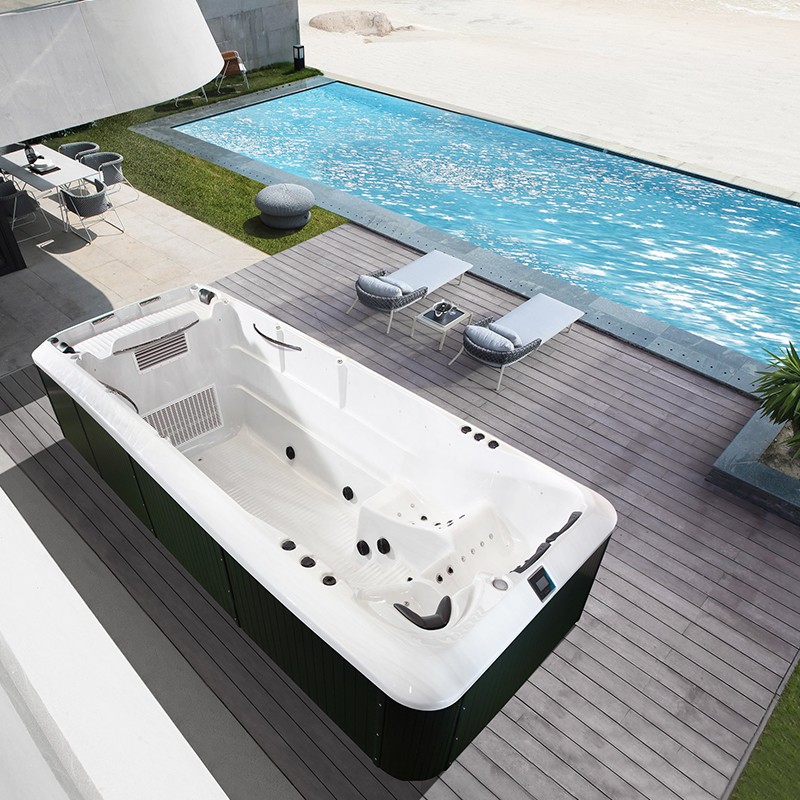
How can you determine if the cloudiness in your outdoor swim spa is caused by low calcium?
The most reliable method remains performing a complete water quality test.
It is recommended to test the following key parameters:
•Calcium Hardness (CH)
•pH Level
•Total Alkalinity (TA)
•Sanitizer Concentration (Free Chlorine or Bromine)
•Total Dissolved Solids (TDS, if equipment allows)
If the test results show calcium hardness significantly below the manufacturer's recommended range while other parameters are largely normal—and the water appears uniformly slightly milky without obvious algae, biofilm, or large amounts of suspended debris—then there is a high probability that water chemistry instability caused by low calcium is the issue.
Additionally, if the spa is consistently topped up with softened water, purified water, or reverse osmosis (RO) water, the risk of insufficient calcium hardness is higher.
How can you resolve cloudiness caused by low calcium in an outdoor swim spa?
If insufficient calcium hardness is confirmed, avoid adding a large amount of calcium all at once; instead, adjust the levels gradually. You can generally use a calcium hardness increaser designed for spas and outdoor swim spa tubs; add it gradually according to the product instructions and re-test the water after each adjustment to avoid overdosing.
At the same time, you should also check the pH level and total alkalinity. Since these three parameters interact with one another, adjusting calcium hardness alone while ignoring the others often fails to truly restore water balance.
If the water already contains a large number of fine suspended particles, you can extend the filtration system's operating time and promptly clean or replace the filter cartridge to improve filtration efficiency.
For extremely fine particles that cannot be filtered out over time, you can use an appropriate amount of clarifier—provided you verify compatibility with your equipment first. Clarifiers cause tiny particles to clump together into larger flocs, making them easier for the filter to trap. However, always control the dosage strictly according to the instructions to avoid causing other water quality issues through overuse.
How can you prevent the water in your outdoor swim spa from becoming cloudy again due to low calcium levels?
Establishing a sound routine maintenance schedule is more important than reactive treatment.
It is recommended to test key water quality parameters—including calcium hardness, pH, total alkalinity, and sanitizer levels—at least once a week to ensure they remain within the ranges recommended by the manufacturer.
Additionally, schedule water changes based on usage frequency. For a typical residential outdoor swim spa tub, a complete water change every 3 to 4 months is recommended; however, if the spa sees heavy use or is shared by many people, you should shorten this interval to minimize the impact of accumulated total dissolved solids (TDS) and mineral imbalances.
Clean the filter regularly—a deep clean every 2 to 4 weeks is usually advised—and replace the cartridge as needed based on usage. Proper filtration not only improves water clarity but also enhances the operating efficiency of the entire circulation system.
If you live in an area with soft water or consistently use softened water for refills, pay close attention to calcium hardness levels. Replenish calcium ions promptly when necessary to prevent long-term low calcium levels from destabilizing the water quality.
FAQ
Does low calcium always cause the water in an outdoor swim spa tub to become cloudy?
Not necessarily. Low calcium levels are just one potential cause of cloudy water; a comprehensive assessment must also consider pH, total alkalinity, sanitizer concentration, filtration status, and usage patterns. However, consistently low calcium hardness does increase the risk of chemical instability and water cloudiness.
Why does the water remain cloudy even though the outdoor swim spa filter runs continuously?
Many particles causing cloudiness are extremely small, meaning standard outdoor swim spa tub filter cartridges cannot capture them all in a single circulation cycle. Furthermore, continuous water flow keeps these particles suspended; achieving perfect clarity usually takes time and requires proper water balance management.
What is the ideal calcium hardness level for an outdoor swim spa tub?
Recommendations vary by brand, but the general range is 150–250 ppm, while some larger units may suggest 150–300 ppm. You should prioritize the specific values recommended in the manufacturer's maintenance instructions.
Can using softened water in an outdoor swim spa tub lead to low calcium hardness?
Yes, it is possible. Softened water reduces the risk of scale buildup by lowering calcium and magnesium ion levels; however, relying exclusively on softened water for top-ups over the long term can cause calcium hardness to drop continuously. Therefore, regular testing and adjustments are necessary.
How can I ensure the water in my outdoor swim spa tub stays clear in the long run?
It is recommended to establish a structured maintenance plan that includes weekly water testing, regular filter cleaning, periodic water replacement, and the maintenance of proper calcium hardness, pH, and total alkalinity levels. Additionally, perform shock treatments and circulation system maintenance based on usage frequency. Only by combining these measures can you ensure the water remains stable, clear, and safe over the long term.