


Can I pour boiling water into my outdoor whirlpool hot tub?
2026-08-11 15:30Outdoor hot tubs have become so widespread that the trend of installing whirlpool spa hot tubs is no longer confined to wealthy homes. Now, you will also discover hot tubs in luxury courtyard villas and high-class hotels, top-flight guest houses, as wells as commercial spas. For many homeowners, buying an outdoor whirlpool hot tub is more than just getting a spa treatment every once in a while and relaxing in massage water; it's about making long-term use of this luxury and upgrading lifestyle by means of it . Nonetheless, a number of hot tub users hold inaccurate notions about equipment maintenance. One of them is: can I pour in boiling water directly to raise the water temperature of my outdoor whirlpool hot tub? this question is common especially in areas where the weather is very cold.
Take, for example, low-temperature situations in winter - once you have stopped using your outdoor whirlpool hot tub for a long time, it may be very slow to refill and also to reach an acceptable temperature. So, some users, wanting to save time, may consider the idea of adding boiling water directly into the tub, in the hope that this will raise the temperature quite fast to somewhere about 37°C-40°C. But the reality is far different and that could mean damaging it. So it's better not to take such a chance and even the structural stability of the hot tub, its water circulation system, and its lifetime can also be seriously affected.
What it boils down to is, although outdoor whirlpool spa hot tubs are designed mainly for providing us with hot water relaxation, they are not specifically built to handle shocks through contact with water in a boil stage (at 100°C). On the contrary, serious issues can arise if a whirlpool spa hot tub is suddenly subjected to boiling water. The major point that outdoor hot tub manufacturers are focusing on is durability of materials, water pressure variations, heating cycles, and the chemical stability that a product of a long life under the conditions of a water temperature around 40°C is capable of.
The answer, therefore, is very clear and simple: you should not pour boiling water into an outdoor whirlpool hot tub at all. The best practice is always through the heat pump that the tub came with, or the other heating components, that is the heating pad or the heater, if it has a direct heating function, plus proper insulation, and control of water level and changes of temperature, so that the hot tub runs well as an appliance without breaking down within a safe range. This is because when water is very hot, it expands. If you pour boiling water, the expansion may be greater. Therefore, there will be more stress on the tub, its components or parts that could break down or get damaged.
We will now have a closer look at the reason why the above approach to adding boiling water to the whirlpool hot tub is wrong, with such factors being discussed as the construction of various materials involved in a tub structure, the impact of water temperature, the changes in water quality, maintenance of equipment, and professionally developed solutions.
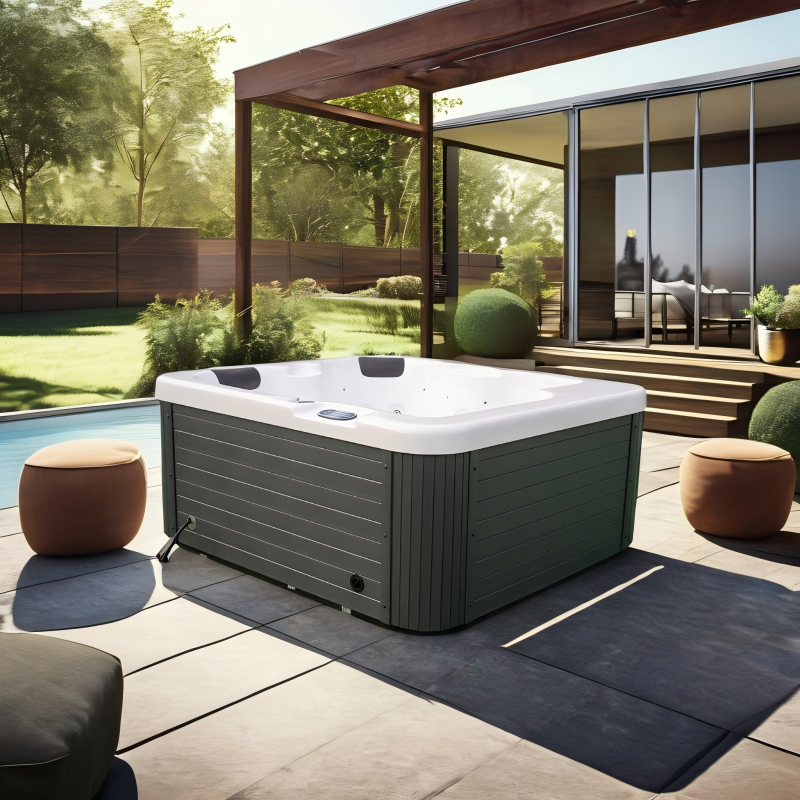
Why pouring boiling water directly into an outdoor hot tub is strictly prohibited?
The concept is the very essence behind an outdoor tub being a hot water bath: the heating system is employed only to keep the water at the target temperature. It is not intended for rapid change of temperature through the means of an external hot fluid at a very high level.
The range of working temperatures of a household outdoor whirlpool hot tub is generally about 35℃-40℃. In some units, the maximum limit is as high as 40℃-41℃. This temperature range that the manufacturer of an outdoor heat pump has come up with for the safety of the human body from burns (or over-heating), the spa experience, and the functioning of the equipment is a standard industry range.
On the other hand, boiling water is basically around 100℃. The two are very different on the temperature scale. Suppose the temperature of the whirlpool hot tub water is 20℃ and a person adds water that is in a boiling state at 100℃, the localized contact surface will, in a way, be subject to a temperature change of 60 ℃ in an instant, which is very sudden.
While adding a small amount of boiling water would not necessarily push the temperature of the spa up to a point at which it turns life-threatening or dangerous, the danger comes from the thermal impact that happens in only the one or few spots. It is obvious to the layperson that an outdoor whirlpool hot tub is not a single homogeneous item, but rather an assembly. It is made up of acrylic-lined tank, glass fiber reinforced plastics (FRP) structural core, insulation material, tubes, water pump, jets, and sealing parts. The materials and the various layers of the hot tub will heat up and expand at different rates when they are suddenly exposed to heat. As a consequence, internal stresses will result between the different materials or layers and between the layers that were in contact before but are no longer so. For example, the glass fiber layers might expand more rapidly than the other ones.
Over many such abnormal temperature shocks, these factors that are brought about could get worse:
• Speed up aging of materials;
• Seals wear;
• Changes in pressure at pipe connections;
• Susceptibility to microcracks at the surface.
Therefore, even if after a single attempt of pouring in boiling water, the whirlpool hot tub remains in working condition, one cannot be sure if such a method is safe. A tub must be used as per the manufacturer, and never at the cost of resorting to the means of extreme rapid heating.
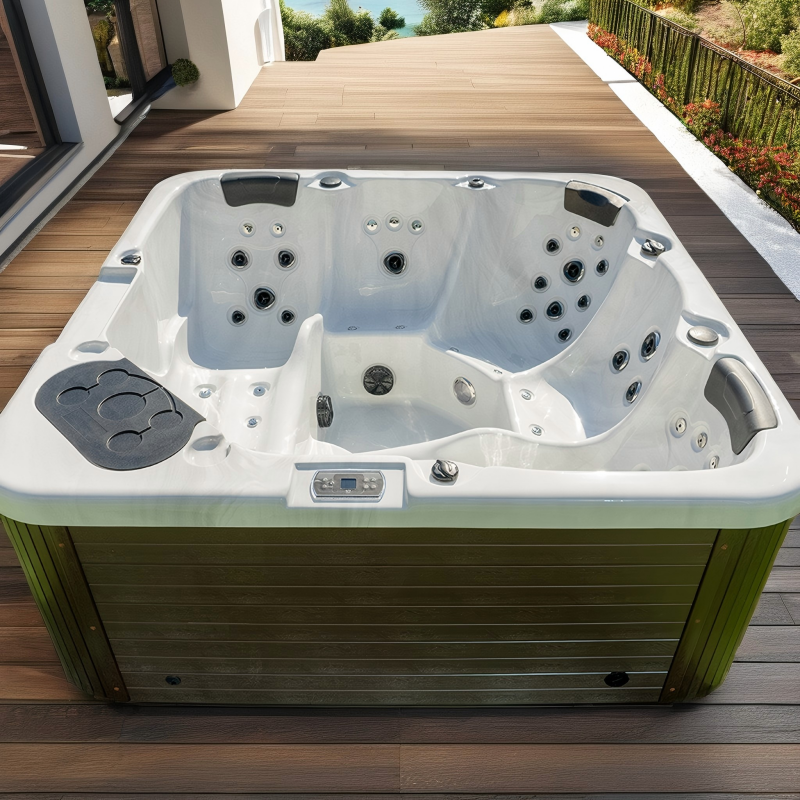
Which components of an outdoor hot tub might be affected by boiling water?
An outdoor whirlpool hot tub is a complete spa system, and a problem with any component can affect the overall performance. The effects of boiling water are mainly concentrated in the following aspects:
I. Acrylic tub body may be subject to temperature shocks
Most high-quality outdoor whirlpool hot tubs on the market currently use acrylic material for the surface and inner tank. Acrylic has good gloss, corrosion resistance, and easy cleaning characteristics, and is also a commonly used material for high-end outdoor hot tubs.
However, acrylic is suitable for long-term stable warm water environments and is not suitable for repeated exposure to extreme temperature changes.
Under normal circumstances, the internal water temperature of an outdoor whirlpool hot tub is typically maintained below 40℃, and the materials are in a stable state. If a large amount of boiling water is suddenly added, localized areas may heat up rapidly, causing differences in thermal expansion across the material.
This change may not immediately manifest as noticeable damage, but repeated use over a long period can increase:
• Surface stress;
• Material fatigue;
• Risk of localized deformation.
This method is particularly discouraged in large outdoor hot tubs, where the larger tub area leads to more pronounced temperature differences.
II. Water Circulation System and Sealing Components May Be Affected
Outdoor whirlpool hot tubs have a complex water circulation system, including:
• Circulating water pump;
• Heater;
• PVC pipes;
• Nozzle assembly;
• Sealing rings;
• Connecting valves.
These components are typically designed for long-term operation at around 30℃-45℃.
If hot water close to 100℃ is suddenly added, the pipes and sealing components near the inlet will be affected first.
Potential problems include:
• Accelerated aging of sealing materials;
• Thermal expansion and contraction at pipe connections;
• Pressure variations at interfaces.
While modern outdoor whirlpool hot tubs use materials with some heat resistance, this doesn't mean they can withstand unlimited temperature shocks. The equipment's ability to withstand normal operating temperatures doesn't mean it's suitable for direct exposure to boiling water.
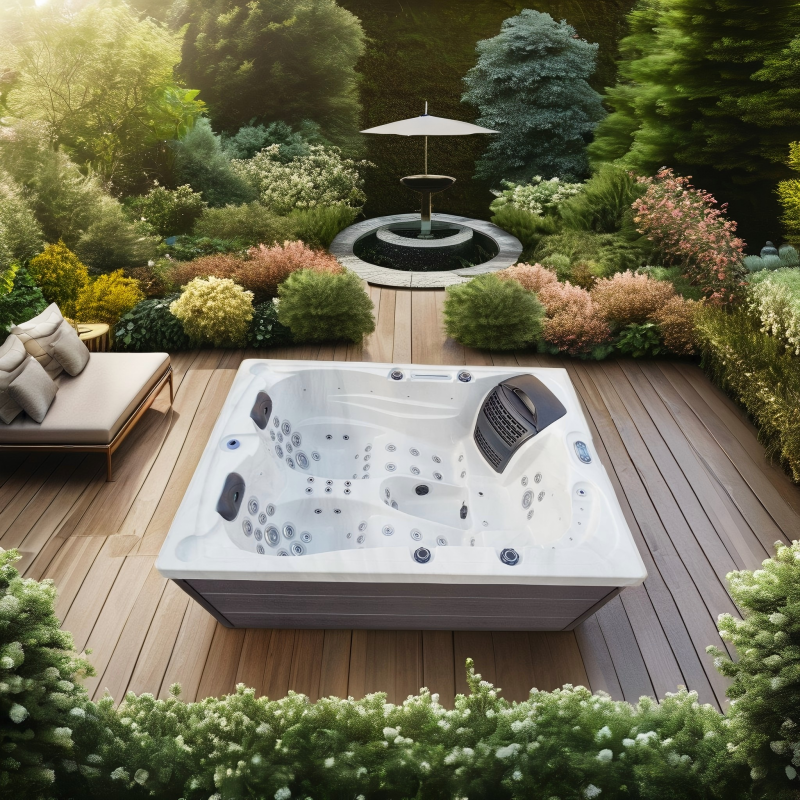
Why doesn't boiling water solve the problem of heating up an outdoor hot tub?
Many users choose to add boiling water, primarily hoping to quickly raise the water temperature. However, this method is not only risky but also less efficient than expected.
Assuming a family outdoor whirlpool hot tub has a capacity of 1500 liters and the current water temperature is 20°C, even adding tens of liters of boiling water will result in a very limited temperature increase due to the large overall volume.
Simple calculation:
1500 liters of water is equivalent to approximately 1500 kilograms of water. If 50 liters of 100°C hot water are added, although these hot waters are very hot, the overall temperature increase after mixing is usually only a few degrees Celsius or even less.
In other words, the user bears the risk of the equipment without gaining a significant temperature increase.
In contrast, more effective methods include:
• Turning on the heating system in advance;
• Maintaining proper insulation;
• Improving the equipment's insulation performance;
• Selecting a heating power appropriate for the environment.
Therefore, from the perspectives of efficiency, safety, and long-term cost, adding boiling water is not the correct solution to the problem of outdoor whirlpool hot tub heating.
Will boiling water affect the water quality of outdoor whirlpool spa hot tubs?
Besides equipment structure issues, changes in water quality are also an important factor that cannot be ignored.
Outdoor whirlpool hot tubs need to maintain a stable water chemistry environment, including:
• pH value;
• Total alkalinity;
• Disinfectant concentration;
• Calcium hardness.
General recommendations:
• Maintain pH between 7.2 and 7.8;
• Maintain total alkalinity between 80 and 120 ppm.
Adding large amounts of hot water from different sources directly may alter the original water quality balance.
For example, the mineral content of tap water varies significantly from region to region. Some areas are hard water areas, containing a higher proportion of calcium, magnesium, and carbonates. Adding untreated water may increase:
• Scale formation;
• Heater strain;
• Risk of pipe buildup.
Furthermore, many users believe that boiling water has a sterilizing effect, so adding it to the bathtub can improve hygiene. However, this is incorrect.
The reasons are:
First, boiling water cools rapidly after entering an outdoor whirlpool hot tub and does not maintain a sterilizing temperature.
Second, outdoor hot tub contamination primarily comes from people, air, the environment, and long-term usage accumulation, not simply from newly added water.
Third, truly effective water quality management relies on filtration systems, disinfection systems, and regular maintenance, not simply adding hot water once.
What is the correct solution when the outdoor hot tub water temperature is too low?
Since boiling water cannot be added, how can the outdoor whirlpool hot tub temperature be increased quickly and safely?
I. Using the unit's own heating system
This is the safest method and the one most recommended by manufacturers.
Modern outdoor whirlpool hot tubs are typically equipped with electric heating systems, such as:
• 2kW heater;
• 3kW heater;
• Commercial-grade higher power heating solutions.
While the heating process may take several hours, this is a safety-proven method.
The heating system automatically adjusts its operation based on:
• Water temperature sensor;
• Control system;
• Heating protection mechanism;
to prevent overheating or equipment damage.
II. Improve Insulation and Reduce Heat Loss
Many users believe slow heating is due to insufficient heater power, but heat loss is also a significant factor.
Factors affecting the insulation of outdoor whirlpool spa hot tubs include:
• Quality of the insulation cover;
• Outer shell insulation structure;
• Installation environment;
• Wind speed and air temperature.
High-quality outdoor whirlpool hot tubs typically employ multi-layer insulation designs, such as:
• PU foam insulation;
• Insulated base plate;
• High-density insulation cover.
Good insulation not only improves heating speed but also reduces long-term electricity bills.
III. Add Warm Water When Necessary, Not Boiling Water
If you must add water, consider adding warm water close to the current temperature, rather than boiling water (100°C).
For example:
• 30℃-40℃ warm water;
Compared to:
• 100℃ boiling water; The temperature difference is smaller, making it safer for the equipment.
Additionally, after adding water, the circulation system needs to be turned on to ensure the water is fully mixed.
Why do outdoor hot tub manufacturers of professional grade prohibit their users from adding boiling water?
With professional outdoor hot tub manufacturers, the selling of equipment is also coupled with a comprehensive guide to use the product over time.
Majorly quality manufacturers will usually specifically alert the users to:
• Do not add boiling water;
• Do not surpass the temperature limit;
• Do not use unsuitable chemicals;
• Do not carry out unauthorized maintenance operations.
The reason is a great many of machine breakdowns are not defects in the production of the machine but the result of incorrect usage.
Such as:
• Thermal shock;
• Wrong treatment of water;
• Operate the machine without water over long time;
• Do not protect whirlpool spa hot tub from freeze during winter.
These improper usages will definitely wear out your outdoor whirlpool spa hot tub at a pace much faster than it should. That's why a good professional outdoor hot tub manufacturer has to manufacture not only good-quality equipment, but also has to assist the customers in developing the correct maintenance habits.
How to prolong the life of the outdoor whirlpool hot tub?
A proper use definitely affects the lifespan of an outdoor whirlpool hot tub.
First, keep the water temp stable and avoid abrupt and frequent changes in temp. Though the whirlpool hot tub is self-temperature regulator, long and dramatic temp changes will generate added stress on the materials and components.
Second, perform the water quality tests regularly. Users are strongly recommended to monitor and test the following parameters to maintain a good water quality at least weekly:
• pH level;
• Disinfectant levels;
• Total alkalinity.
Third, keep the filters very clean. Long term running will make filters dirtier and the filter will not be able to efficiently circulate the water. Moreover, your heating system will work harder to compensate for the lack of circulation.
Fourth, tailor your maintenance to meet the season's needs. During freezing winters, make sure that the pipes do not get damaged by freezing water, especially if you are in cold regions.
For premium outdoor whirlpool spa hot tub models, if the user pays attention to the maintenance of their whirlpool hot tubs, they will not only be able to use the whirlpool hot tub for a long time but they will also be able to lower the repair costs considerably.
FAQ: Questions You Might Be Concerned About While Adding Boiling Water
Question 1: Why can't we add boiling water to an outdoor whirlpool hot tub?
Adding water with a temperature very different from the water's current temperature will cause the water temperature to drop quickly. We suggest keeping the temperatures as similar as possible when adding water to avoid causing a dramatic temperature shock. Therefore, hot water which would cause a very large difference would not be a good idea to add.
Question 2: Does a little amount of boiling water added to the whirlpool hot tub cause a damage to it at once?
Of course, there won't be the case where you damage a whirlpool hot tub straight away, but adding boiling water may bring possible risks. Over many years, using this method repeatedly may cause the hot tub's materials and parts to age and wear much faster than normal use.
Question 3: What are the causes of the slow increase in the outdoor hot tub temperature?
Factors that cause an increase in water temperature very slowly mainly include the large amount of water in the tub, the cold air surrounding of the tub if it is an outdoor one, lack of proper insulation and the heating source of the outdoor whirlpool hot tubs itself is weak. Therefore, it is natural that the increase of the water temperature requires a very long time.
Question 4: How can I speed up heating of my outdoor hot tub to its target temperature in winter?
One of the most effective way to speed up heating would be to activate the heater early on when it is very cold. The whirlpool spa hot tub can be warmed up better this way. The second way would be to make better insulation. This way, the tub won't lose the heat quickly. Another suggestion would be to put on a good quality and well-insulated cover over the whirlpool spa hot tub. One of the last but very essential tips is not to open the cover and expose the tub to cold air so often because you would be getting heat out every time you do so!
Question 5: What is the maximal temperature that we can set for an outdoor whirlpool hot tub?
Normally, an indoor-type residential whirlpool spa hot tubs have a maximum heat setting of around 40 to 41 degrees Celsius. Please be aware that the exact specifications of your product and its safety regulations should be adhered to.