


Will outdoor acrylic hot tubs yellow more?
2025-12-30 15:30Many users have this question when choosing and using hot tubs: Will outdoor acrylic hot tubs yellow more easily than indoor ones?
This question seems simple, but it actually involves several professional aspects, including the properties of acrylic materials, the effects of ultraviolet radiation, water quality, differences in the usage environment, and the stability of the surface structure.
Without a systematic analysis, it's easy to draw one-sided conclusions, such as "outdoor use will definitely cause yellowing" or "acrylic itself is prone to discoloration."
So, will outdoor acrylic spa hot tubs really yellow more? Is this change inevitable? Is it controllable?
This article will provide a systematic, rational, and professional analysis of these core questions.
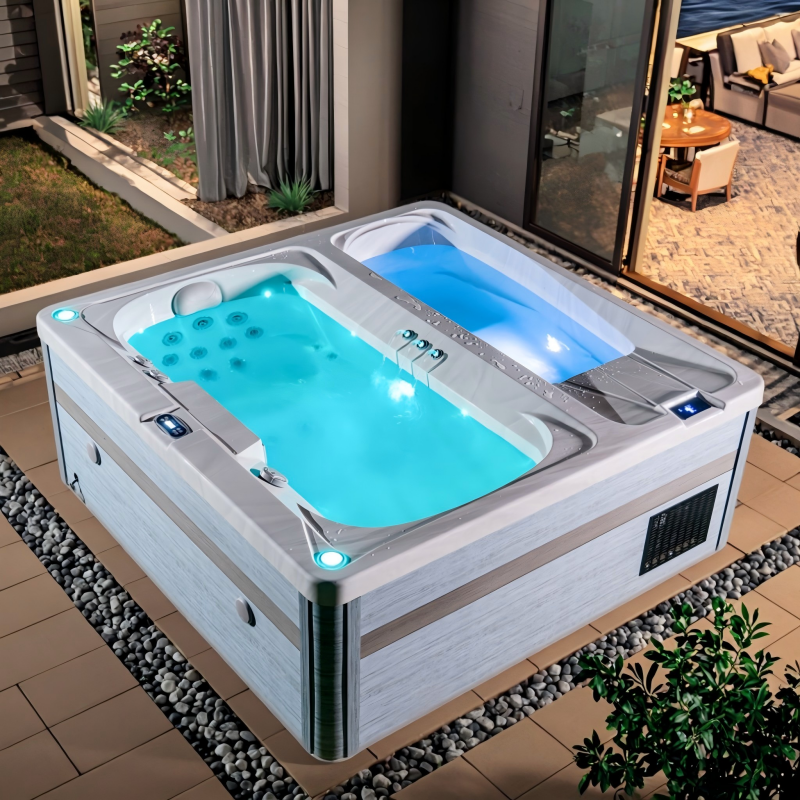
What does "yellowing" of acrylic hot tubs mean?
Before discussing whether outdoor acrylic hot tubs will yellow more, we must first clarify a concept:
What constitutes "yellowing"?
In a professional context, "yellowing" typically refers to:
• A color shift on white or light-colored surfaces
• A change in surface color from pure white or bright white to a slightly yellowish or warm tone
• Not a stain, but a change in the material's optical properties
For acrylic spa hot tubs, this change occurs more in the surface optical structure than in the overall material "deterioration."
Therefore, "yellowing" is not equivalent to quality failure, but rather a quantifiable and analyzable material aging phenomenon.
Does the inherent material properties of acrylic hot tubs determine their susceptibility to yellowing?
The material used in acrylic hot tubs is PMMA (polymethyl methacrylate), whose material characteristics include:
• High transparency
• Stable molecular structure
• Good weather resistance
• Natural UV resistance superior to most common plastics
From a materials science perspective:
Acrylic is not a material "naturally prone to yellowing."
Compared to some low-grade resins or recycled plastics, acrylic spa hot tubs have a significant advantage in color stability. This is one of the key reasons why acrylic has become the mainstream material for high-end hot tubs.
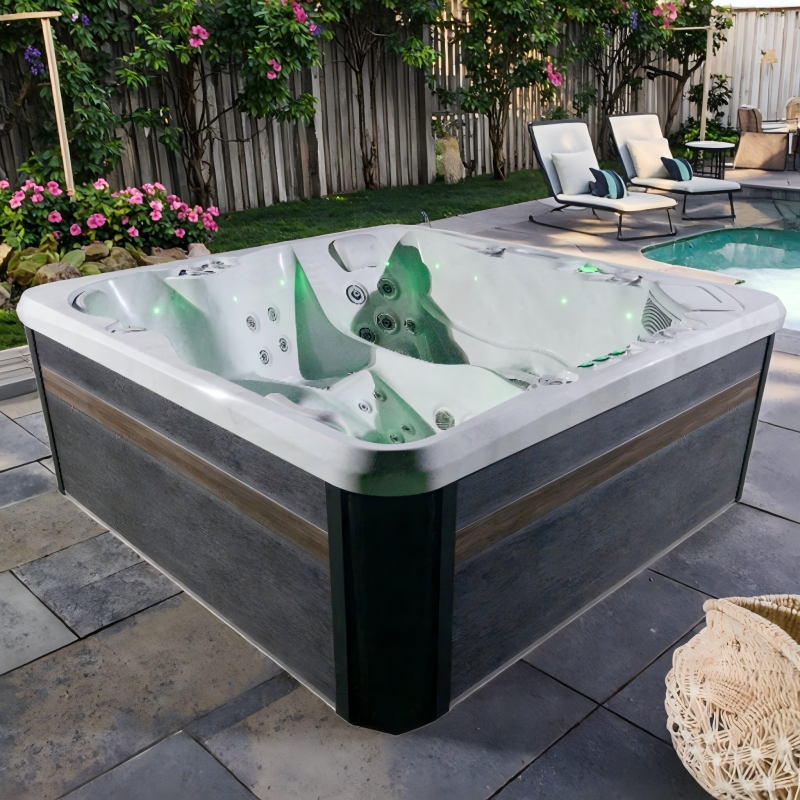
How do outdoor and indoor environments differ for acrylic hot tubs?
To answer the question "Is it easier for acrylic hot tubs to yellow outdoors?", we must analyze the environmental differences.
Key characteristics of the outdoor environment include:
• Longer hours of sunshine
• More direct UV exposure
• Wider temperature range
• Potentially more dust and moisture in the air
Key characteristics of the indoor environment include:
• Lower UV intensity
• Relatively stable temperature
• Greater environmental controllability
Theoretically, the outdoor environment does place higher demands on any polymer material, including acrylic spa hot tubs.
However, this does not mean "outdoor use = guaranteed yellowing."
Is UV radiation the primary cause of yellowing in acrylic hot tubs?
UV radiation is a crucial factor that cannot be ignored when discussing this issue.
The mechanisms by which ultraviolet (UV) radiation affects acrylic hot tubs include:
• Long-term exposure may cause changes in the surface molecular chain microstructure.
• Slight changes in optical refractive index.
• Visually, this manifests as a color shift.
However, it's important to clarify that:
• High-quality acrylic hot tubs typically contain UV stabilizers.
• Acrylic itself has higher UV resistance than ordinary plastics.
• Short-term or ordinary sunlight exposure does not necessarily cause noticeable yellowing.
Therefore, UV radiation is one of the influencing factors, not the "determinant factor."
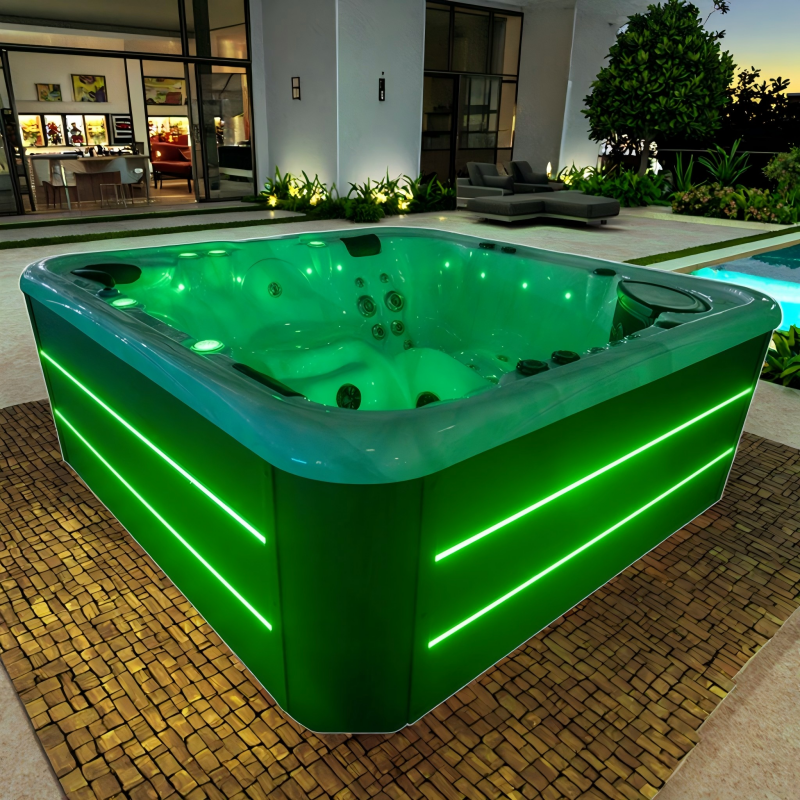
Does water quality cause acrylic hot tubs to yellow?
This is a question many people easily overlook.
Water quality itself does not directly change the color of acrylic materials, but the following situations may have an indirect impact:
• High-calcium, high-mineral water
• Scale buildup on the surface over time
• Impurities in the water depositing at high temperatures
These situations may lead to:
• The surface appearing "yellowish"
• The actual change is due to deposits altering the visual effect
Therefore, when analyzing whether an acrylic spa hot tub has turned yellow, it is essential to distinguish:
Whether the yellowing is due to a change in the material's inherent color or a visual distortion caused by surface deposits.
Does temperature and thermal cycling affect the color stability of acrylic hot tubs?
Acrylic hot tubs are designed to operate in a constantly changing hot and cold environment.
From a material perspective:
• Acrylic has good thermal stability
• Normal operating temperatures are far below the material's aging temperature
• Temperature changes themselves do not directly cause yellowing
However, it is important to note that:
• High temperatures + ultraviolet radiation + buildup of dirt
• This may accelerate the surface aging process
Therefore, temperature itself is not the primary cause, but rather one of the many environmental factors.
What role does the surface structure of an acrylic hot tub play in combating yellowing?
High-quality acrylic spa hot tubs typically possess the following structural characteristics:
• High-density acrylic surface layer
• Uniform thickness design
• Stable surface gloss layer
These structural characteristics can:
• Delay the effects of UV rays on the internal structure
• Improve anti-aging capabilities
• Slow down the rate of color change
This is why, even among acrylic hot tubs, different products exhibit significant differences in their resistance to yellowing.
Are outdoor acrylic hot tubs necessarily more prone to yellowing than indoor ones?
Now let's return to the core question.
From a professional perspective:
The outdoor environment does indeed increase the challenges to color stability for acrylic spa hot tubs.
However, "more yellow" is not an inevitable result.
Whether significant yellowing occurs depends on the following combined factors:
• Acrylic material grade
• Surface treatment quality
• Whether it has a UV-stabilized design
• Usage and cleaning habits
• Environmental exposure level
Therefore, "outdoor = definitely more yellow" is an oversimplified conclusion.
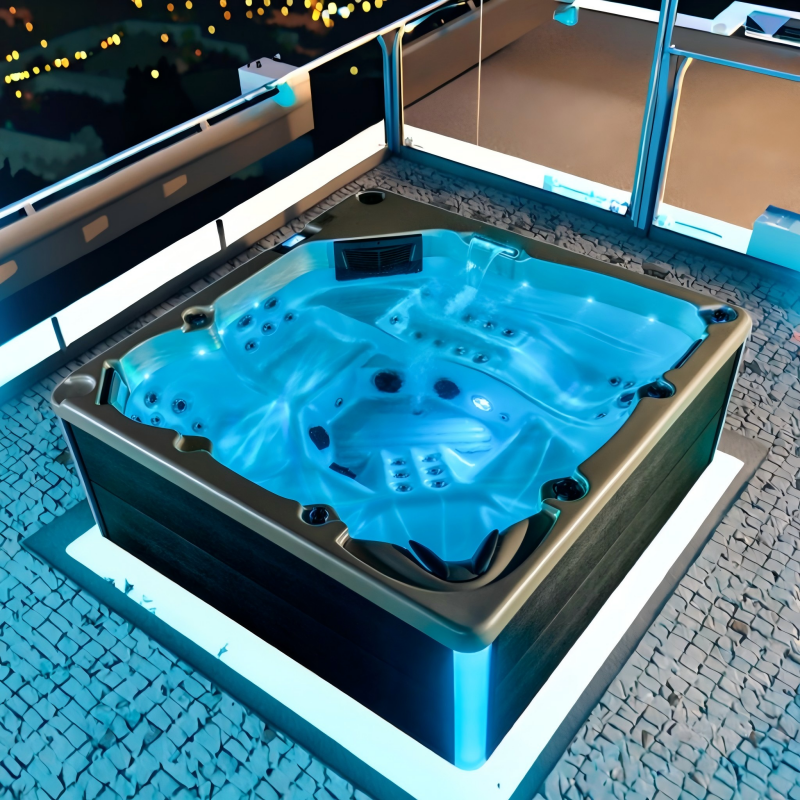
How to objectively view the "yellowing risk" of acrylic hot tubs?
It's crucial to approach this issue rationally.
It's important to clarify the following:
• All polymer materials change under long-term environmental influences.
• Acrylic hot tubs are no exception.
• However, the changes are slow, controllable, and gradual.
Under reasonable use and normal maintenance, the color stability of acrylic spa hot tubs is in line with long-term usage expectations.
Will outdoor acrylic hot tubs yellow more?
The answer is: not necessarily. It depends on the combined effects of material quality, structural design, and the usage environment.
• Acrylic hot tubs are not inherently prone to yellowing.
• The outdoor environment does present greater challenges, but it's not the decisive factor.
• Ultraviolet radiation, water quality, and surface structure all influence color stability.
• Under reasonable conditions, outdoor acrylic spa hot tubs will not necessarily "yellow more."