


What is the role of an outdoor spa hot tub's own weight?
2026-07-01 15:35With the rise of outdoor lifestyles and home spa culture, outdoor spa hot tubs are no longer exclusive to high-end resorts or luxury estates; they have become common features in backyards, on terraces, and in private courtyards. When purchasing an outdoor spa hot tub, consumers often focus on the number of massage jets, heating efficiency, insulation performance, shell materials, and smart control systems. However, one crucial factor—seemingly inconspicuous yet directly impacting safety, stability, and longevity—is frequently overlooked: the hot tub's own weight.
Many consumers are unfamiliar with the concept of "own weight" (or dry weight) when they first encounter it, sometimes mistakenly believing it is a concern relevant only to shipping or installation. In reality, this weight factor affects not only the tub's stability but also structural load-bearing, wind resistance, operational safety, foundation requirements, and long-term maintenance costs. In other words, if the jets are the "massage system" and the heater is the "circulation system," then the unit's own weight acts as the "skeletal stability system" for the entire device. Without a proper weight design, even the most advanced outdoor spa hot tub may develop structural risks over time.
So, what exactly is an outdoor whirlpool hot tub's own weight? Why is it important? Is heavier always better? How should consumers interpret this parameter when shopping? This article provides an in-depth analysis of the core role of an outdoor whirlpool hot tub's weight, examining it from the perspectives of structural engineering, user experience, safety performance, and installation requirements.
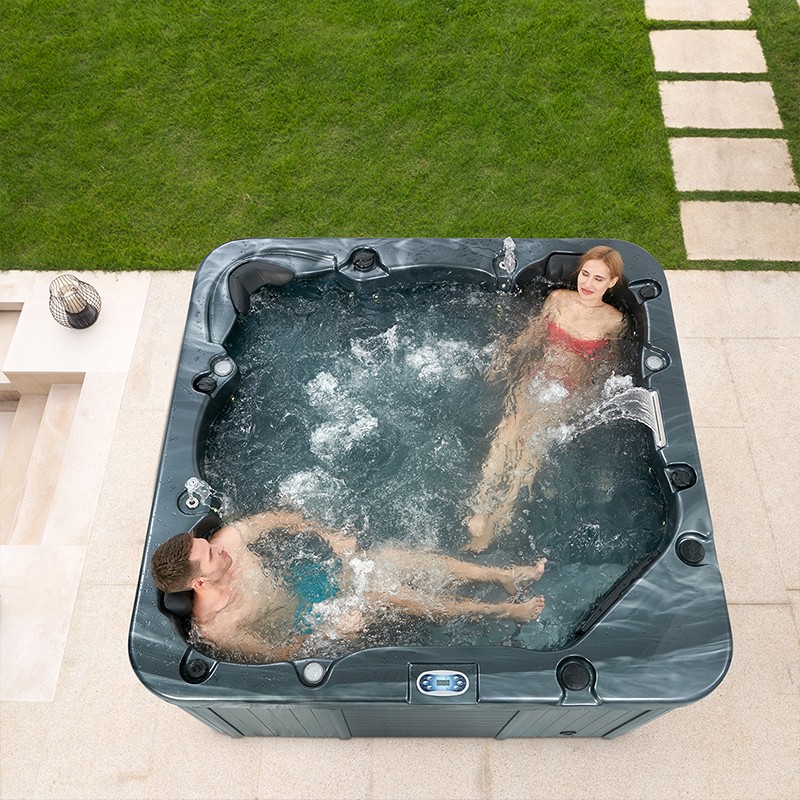
What is an outdoor spa hot tub's own weight?
Generally speaking, the weight of an outdoor spa hot tub can be categorized into three parts: dry weight (empty weight), filled weight (weight with water), and total loaded weight (weight with water and occupants). "Own weight" typically refers to the weight of the equipment itself in an empty state—that is, the total weight comprising the shell, frame, insulation, plumbing, heating system, base, and internal structure, excluding water and users. For instance, the dry weight of a medium-sized, four-person outdoor hot tub might range from 300 to 500 kilograms, whereas a large model accommodating six to eight people can weigh between 600 and 900 kilograms. Some high-end, commercial-grade outdoor hot tubs can even exceed 1,000 kilograms. While this dry weight is substantial, the truly staggering figure is the total weight when fully loaded. Given that the density of water is approximately 1,000 kilograms per cubic meter—meaning one liter of water weighs roughly one kilogram—a spa hot tub with a 1,500-liter capacity holds 1,500 kilograms of water alone. When the weight of four to six adults (assuming an average of 70 kilograms per person) is added, the total weight can easily surpass 2,000 kilograms and approach 3,000 kilograms.
This is precisely why the unit's own weight is far from a trivial specification; it determines the whirlpool hot tub's stability when subjected to significant dynamic loads.
Primary Function of the Hot Tub's Own Weight: Enhancing Overall Structural Stability
For any large vessel, greater weight generally translates to a more stable center of gravity. Outdoor spa hot tubs are no exception.
When a spa hot tub is filled with water and occupied by multiple users, the water is not static. Users entering, moving around, standing up, or even slightly shifting their bodies cause the water to surge. Activating the jets further intensifies internal circulation, creating continuous turbulence. These dynamic changes exert complex lateral forces and torsional loads on the hot tub's structure.
If the spa hot tub lacks sufficient weight, it becomes more susceptible to issues such as slight base displacement, structural twisting, stress concentration within the frame, and long-term fatigue deformation. While these problems may not be immediately apparent, prolonged use can lead to structural aging, loosened joints, and even cracks in the shell.
Adequate weight effectively mitigates these risks. A higher base weight helps maintain a low center of gravity, making the unit less prone to shifting when subjected to lateral disturbances. Engineering studies indicate that lowering a unit's center of gravity by 10% typically improves lateral stability by 15% to 20%. This is why high-end outdoor spa hot tubs often feature high-strength bases, reinforced frames, and robust chassis designs to increase overall weight and stability.
The second major benefit of an outdoor hot tub's inherent weight: enhanced wind resistance
Many consumers underestimate the impact of wind on outdoor equipment, particularly in open courtyards, rooftop terraces, or mountain villas. In reality, wind load is a critical factor in outdoor spa hot tub design.
If an empty outdoor spa hot tub lacks sufficient weight, it may be at risk during extreme weather. Although most outdoor hot tubs are large and unlikely to tip over easily, strong winds can still cause shifting or vibration. This risk is heightened when units are installed on high-rise terraces, in coastal homes, or in windy regions.
According to data from building wind engineering, doubling the wind speed increases the wind pressure exerted on an object by approximately fourfold. For instance, at a wind speed of 80 km/h, the wind load acting on the side of a large unit can reach hundreds of newtons. If the spa hot tub is too light and ground friction is insufficient, the unit may undergo slight displacement.
Greater inherent weight significantly improves stability against the wind. This not only enhances safety but also minimizes issues such as strain on plumbing connections caused by minor shifting. For spa hot tubs installed in challenging environments, weight is just as crucial as waterproofing and thermal insulation performance.

The third major benefit of an outdoor hot tub's inherent weight: reduced operational vibration
This is an aspect often overlooked by users. In reality, an outdoor spa hot tub is not completely stationary during operation.
Continuous mechanical vibrations are generated internally when the circulation pump starts, the heating system runs, and the jets operate at full power. These vibrations originate from various components, including water pumps, motors, blowers, and the high-pressure water flow itself. Hot tubs that are poorly constructed or excessively lightweight are more prone to issues such as excessive operational noise, chassis resonance, and slight shell vibration.
Why does this happen? Because structures with lower mass are more easily excited by vibrations. Based on the principles of mechanical dynamics, increasing a system's mass typically reduces its high-frequency vibration response. In other words, greater inherent weight helps the outdoor spa hot tub "absorb" some of the vibration energy, resulting in smoother operation.
What does this mean for the user experience? It means that while using the spa hot tub, you won't feel significant mechanical vibration or hear excessive low-frequency resonance noise—factors that are particularly important in the quiet atmosphere of the evening.
Does the unit's weight affect its thermal insulation performance?
The answer is yes—and significantly so.
While many believe insulation depends primarily on the thickness of the foam layer, structural mass also plays a role in thermal stability. Greater weight usually implies a thicker base, a denser frame, and higher-quality structural materials; these materials possess greater thermal inertia.
Higher thermal inertia means slower temperature changes. Simply put, when the ambient temperature drops sharply, a heavier whirlpool hot tub tends to lose heat more slowly than a lightweight one. This characteristic reduces the frequency of heating system cycles, thereby lowering energy consumption.
Industry data shows that, under identical environmental conditions, outdoor whirlpool hot tubs with optimized structural insulation can reduce winter energy consumption by 10% to 18%. For long-term users, this represents a significant energy-saving advantage.
Is a heavier whirlpool hot tub always better?
There is no absolute answer to this question.
From the perspectives of stability, safety, and vibration resistance, greater weight is generally beneficial. However, "heavier" does not always mean "better," as excessive weight can create practical issues.
First, there are transportation costs. Increased weight makes handling and installation more difficult; large spa hot tubs may even require a crane for delivery. Second, there are foundation requirements. Not all patios, wooden decks, or rooftop structures can support extremely heavy loads. If the unit is too heavy—especially when combined with the weight of the water and the users—the total load could exceed the structure's weight-bearing capacity.
How do you determine if the weight is appropriate?
The assessment shouldn't rely solely on absolute weight but should consider a combination of factors: unit dimensions, water capacity, frame materials, installation location, and the number of users. Generally, mid-to-high-end outdoor spa hot tubs strike a balance between structural strength and weight, rather than simply adding mass indiscriminately.
Why are lightweight outdoor spa hot tubs becoming more common?
In recent years, many lightweight outdoor spa hot tubs—particularly portable or inflatable models—have appeared on the market. These products are marketed for their ease of installation, low shipping costs, and affordable prices.
However, reduced weight often implies lower structural rigidity. To compensate for the lack of mass, these products typically rely on other methods to enhance stability, such as increasing the base's contact area, adding external support structures, or optimizing material strength. While this approach is reasonable for short-term use or mobile applications, traditional, heavier whirlpool hot tubs still hold a distinct advantage when it comes to long-term stability, a deep hydrotherapy experience, and high-intensity jet massage.

Why is the weight specification important when buying an outdoor whirlpool hot tub?
Many consumers overlook the "Dry Weight" (unloaded weight) entry when reviewing product specifications, yet this figure is crucial.
It helps you gauge the product's structural quality. Generally, a very low weight may indicate a thinner frame, insufficient chassis strength, or lower-grade materials. While this isn't a definitive rule, it serves as a key reference indicator.
When shopping for an outdoor spa hot tub, consider these questions: What is the unit's dry weight? What is the total weight when filled? Can the installation surface support the load? Is the frame reinforced with steel or composite materials? These factors collectively determine the spa hot tub's long-term safety.

FAQ
1. Is a heavier outdoor spa hot tub always better?
Not necessarily. Greater weight usually implies better stability but also increases the difficulty of transport and installation; the choice depends on the intended use.
2. What is the typical dry weight of an outdoor spa hot tub?
Mid-sized residential models usually weigh between 300 and 700 kg, while large, high-end models can exceed 1,000 kg.
3. Does weight affect heat retention?
Yes. Heavier units generally offer better thermal inertia, helping to minimize temperature fluctuations and reduce energy consumption.
4. Are lightweight outdoor whirlpool hot tubs safe?
They are generally safe if well-designed, though their overall stability and vibration resistance may not match those of heavier models.
5. Is it necessary to check the weight when purchasing an outdoor whirlpool hot tub?
It is highly recommended to do so. Weight reflects structural strength, stability, and long-term reliability, making it a key parameter.