


What is the Fire Rating of an Acrylic Spa Hot Tub?
2026-04-07 15:30When purchasing a hot tub, consumers typically focus on aesthetics, comfort, functional features, and service life. However, as awareness regarding home safety continues to rise, fire resistance is gradually becoming a critical factor that can no longer be overlooked.
This is particularly true for acrylic spa hot tubs—structures centered around electric heating and water pump systems—where questions regarding the material's flammability, its combustion rate in the event of a fire, and its compliance with building and household safety codes have become focal points of concern for many users.
So, what exactly is the fire rating of an acrylic spa hot tub? Is acrylic material truly safe? Does it comply with international fire safety standards?
This article provides a systematic, professional, and verifiable analysis of the fire resistance properties of acrylic hot tubs.

What is a Fire Rating? Why is Fire Resistance a Concern for Acrylic Spa Hot Tubs?
A fire rating is a comprehensive assessment of a material's performance when exposed to flames, high temperatures, or heat sources. It evaluates factors such as the ease with which the material ignites, its combustion rate, its ability to self-extinguish, and the potential impact generated during the burning process.
For acrylic hot tubs, fire ratings are of particular importance for several key reasons:
•Acrylic hot tubs are typically equipped with electric heaters, water pumps, and electronic control systems.
•They operate continuously within a high-temperature water environment.
•They are frequently installed indoors, or within enclosed or semi-enclosed spaces.
•They are often situated in close proximity to building materials such as wooden structures, walls, and electrical wiring.
Consequently, understanding the fire rating of an acrylic hot tub—and correctly interpreting its safety boundaries—is a crucial prerequisite for making an informed purchase and ensuring safe operation.
What are the Primary Material Components of an Acrylic Spa Hot Tub?
To understand the fire rating of an acrylic hot tub, one must first understand its material composition.
A standard acrylic hot tub structure typically consists of the following components:
1.Acrylic Surface Layer (PMMA)
2.Fiberglass Reinforcement Layer (FRP)
3.Structural Support Layer
4.Insulation Layer (Foam or Composite Materials)
5.Electrical System Enclosures and Plumbing Systems
Among these components, the acrylic surface layer is the core material that directly determines the fire rating, while the fiberglass reinforcement layer and the underlying structural framework exert a significant influence on the overall fire resistance performance.

Is Acrylic Material Itself Flammable?
This is a critical question. In terms of material properties:
•Acrylic (PMMA) is classified as an organic polymer material.
•Theoretically, it is combustible.
•However, its combustion behavior exhibits distinct characteristics.
The combustion characteristics of acrylic materials include:
•A relatively high ignition temperature (typically above 300°C).
•It is not a spontaneously combustible material.
•Its burning rate is relatively slow.
•Upon removal from an open flame, certain grades of acrylic can self-extinguish.
•It does not spread flames rapidly in the manner of lower-grade plastics.
Therefore, acrylic is not a material that poses an immediate "flammable and dangerous" risk; rather, its fire safety performance must be evaluated based on specific grade standards.
What are the common fire safety ratings for acrylic spa hot tubs?
In actual manufacturing and testing practices, acrylic spa hot tubs typically reference the UL94 fire safety rating standard (which is widely applied to plastics and polymer materials).
Common ratings include:
•UL94 HB
•UL94 V-2
•UL94 V-1
•UL94 V-0
Under proper manufacturing conditions, the acrylic sheets used in high-quality spa hot tubs typically meet or exceed the UL94 HB rating; furthermore, through structural lamination, they achieve superior overall fire safety performance.
Within the UL94 fire safety rating system, which category does acrylic typically fall into?
UL94 HB (Horizontal Burning)
•A horizontal burning rating.
•The burning rate is limited.
•Flames do not spread rapidly.
•This serves as the baseline fire safety rating for most standard acrylic materials.
UL94 V-2 / V-1 / V-0 (Vertical Burning)
•These ratings impose stricter requirements.
•The V-0 rating signifies:
oRapid self-extinguishing upon removal from the flame source.
oNo burning drips.
•These ratings can be achieved through the incorporation of flame-retardant additives or specialized composite structures.
In the context of acrylic hot tubs:
•A standalone acrylic sheet typically meets the HB rating.
•However, when combined with fiberglass reinforcement layers and flame-retardant structural designs, the complete hot tub assembly demonstrates significantly enhanced fire safety performance.

Does the fiberglass reinforcement layer affect the fire safety performance of an acrylic spa hot tub?
The answer is: Yes—and the effect is a positive one. The backing of acrylic hot tubs typically features a fiberglass-reinforced layer. Its function extends beyond mere structural support to include:
•Reducing the likelihood of direct contact between open flames and the acrylic layer
•Enhancing overall heat resistance
•Restricting the pathways for flame propagation
•Slowing down the concentration of heat
Fiberglass itself is an inherently non-combustible material; when incorporated into a composite structure, it significantly boosts the overall fire safety stability of the acrylic hot tub.
Does an acrylic hot tub pose a fire risk in high-temperature environments?
Under normal operating conditions, the answer is: almost none.
The reasons include:
•The operating water temperature of an acrylic hot tub typically does not exceed 40°C.
•There is structural isolation between the electric heating system and the acrylic surface layer.
•The operating temperature remains well below both the heat distortion temperature and the ignition temperature of acrylic.
Provided that basic installation and electrical codes are strictly followed, an acrylic hot tub will not approach its critical combustion threshold during everyday use.
How does the electrical system of an acrylic hot tub impact its overall fire safety?
Fire safety ratings depend not only on the materials used but also—critically—on the system's design.
High-quality acrylic hot tubs typically feature:
•Flame-retardant insulation on electrical wiring
•Waterproof and moisture-resistant electrical enclosures
•Temperature control and protection systems
•Automatic power-cutoff mechanisms to prevent overheating
These design features ensure that, even in the event of an anomaly, the risk of fire is effectively minimized.
A Comparison of Fire Safety Performance: Acrylic Hot Tubs vs. Tubs Made from Other Materials
From a fire safety perspective:
•Acrylic Hot Tubs:
oPossess controllable combustion characteristics
oFire safety ratings can be enhanced through composite structural designs
•Fiberglass Tubs:
oThe resin component remains combustible
•Cast Iron and Steel Tubs:
o The base material is non-combustible, but poses a risk of high-temperature heat conduction
All factors considered, acrylic hot tubs strike an excellent balance between safety and user comfort.
How should one correctly interpret the concept of "fire safety" regarding acrylic hot tubs?
It is essential to clarify the following points:
•"Fire safety" does not equate to being completely non-combustible.
•A fire safety rating represents the degree of controllability and the established safety margins.
•In terms of design, materials, and structure, acrylic hot tubs fully comply with both residential and commercial safety standards.
Provided that an acrylic hot tub is manufactured by a reputable producer, utilizes compliant materials, and is installed correctly, its fire safety performance is both reliable and controllable.
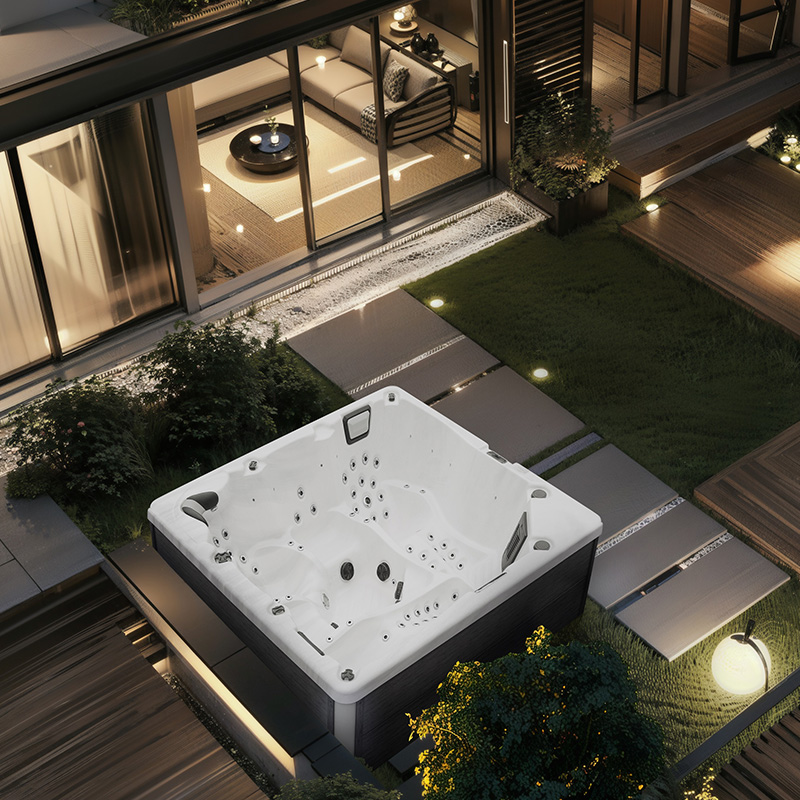
Is the fire rating of acrylic spa hot tubs reliable?
Based on a comprehensive assessment of material properties, structural design, and industry standards:
•Acrylic hot tubs are not considered high-risk, highly flammable products.
•Common acrylic materials can achieve a fire rating of UL94 HB or higher.
•Their composite structure and fiberglass reinforcement layers significantly enhance overall fire safety.
•Under conditions of normal use and proper installation, their fire resistance performance is reliable.
Therefore, in terms of fire safety, acrylic spa hot tubs are fully validated and represent a mature product that meets both residential and commercial requirements.