


What Is Free Chlorine in an Outdoor Whirlpool Hot Tub?
2026-10-30 15:30Free Chlorine in Outdoor Hot Tubs: Function, Testing Methods, and Water Quality Management Guide
Outdoor hot tubs are typically equipped with heaters, pumps, filters, and massage jets; the combination of warm water and complex circulation piping makes water quality management particularly important. If disinfectant levels are insufficient, contaminants such as sweat, skin oils, and dust can increase the risk of microbial growth. Conversely, excessive disinfectant can lead to irritating odors, physical discomfort, or damage to the hot tub’s components.
Therefore, understanding what free chlorine is, how to test for it, and what the appropriate concentration range should be is a vital part of routine hot tub maintenance. This article explores how free chlorine works, the differences between free chlorine, combined chlorine, and total chlorine, the factors that affect its concentration, common issues, and professional solutions.
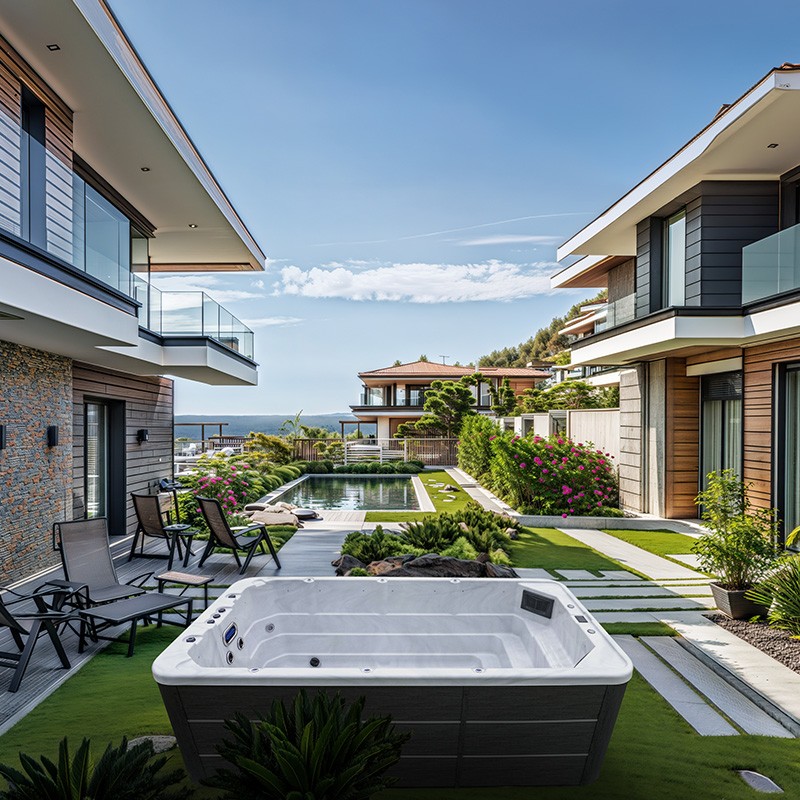
What Is Free Chlorine in an Outdoor Whirlpool Hot Tub?
"Free chlorine" refers to the form of chlorine in water that is available for disinfection—specifically, hypochlorous acid (HOCl) and the hypochlorite ion (OCl⁻). These compounds react with microorganisms and certain contaminants in the water, helping to control bacteria and other pathogens.
In an outdoor whirlpool hot tub, the primary role of free chlorine is to provide continuous disinfection. Unlike cleaning agents used for a one-time scrub, free chlorine must be maintained within an appropriate range and monitored or adjusted based on usage. Because human sweat, skin oils, and environmental pollutants constantly deplete chlorine, simply adding disinfectant when the tub is first filled is not enough to ensure long-term water quality stability.
Free chlorine is typically measured in ppm (parts per million), which is approximately equivalent to mg/L (milligrams per liter). For instance, a free chlorine level of 3 ppm means there are roughly 3 milligrams of free chlorine per liter of water.
It is important to note that "free chlorine" does not account for all forms of chlorine present in the water. Testing may also involve "combined chlorine" and "total chlorine"—three distinct metrics that each provide different insights into water quality.
Free Chlorine, Combined Chlorine, and Total Chlorine in Outdoor Hot Tubs: What’s the Difference?
Understanding the relationship between these three parameters helps in determining whether the disinfection system of a modern outdoor jacuzzi tub is functioning correctly.
Free chlorine is the form of chlorine in water that directly performs the primary disinfection function. Maintaining an appropriate concentration of free chlorine is fundamental to controlling microbial contamination in a whirlpool hot tub.
Combined chlorine refers to chlorine compounds formed when chlorine reacts with substances such as nitrogen-containing compounds; this includes chloramines. Combined chlorine may produce a distinct, irritating odor, though the presence of an odor alone is not an accurate indicator of its concentration.
Total chlorine is the sum of free chlorine and combined chlorine. Generally, this relationship can be expressed as follows:
Total Chlorine = Free Chlorine + Combined Chlorine
For example, if an outdoor whirlpool hot tub tests at 4 ppm for total chlorine and 3 ppm for free chlorine, the combined chlorine level is approximately 1 ppm. When performing actual tests, one should account for the precision of the testing equipment and potential reading errors.
| Water Parameter | Meaning | Why It Matters |
| Free Chlorine | Chlorine available for disinfection | Indicates the available disinfectant residual |
| Combined Chlorine | Chlorine combined with other compounds | May indicate reactions with contaminants |
| Total Chlorine | Free chlorine plus combined chlorine | Helps evaluate overall chlorine levels |
| pH | Measures water acidity or alkalinity | Affects chlorine disinfection performance |
In the case of a modern outdoor jacuzzi tub, if the total chlorine level appears normal but the free chlorine level is low, one cannot conclude that the disinfection capacity is sufficient based solely on the total chlorine figure. Conversely, even if both free chlorine and pH levels are within an appropriate range, the overall water quality should still be evaluated by considering filtration, cleanliness, and usage patterns.
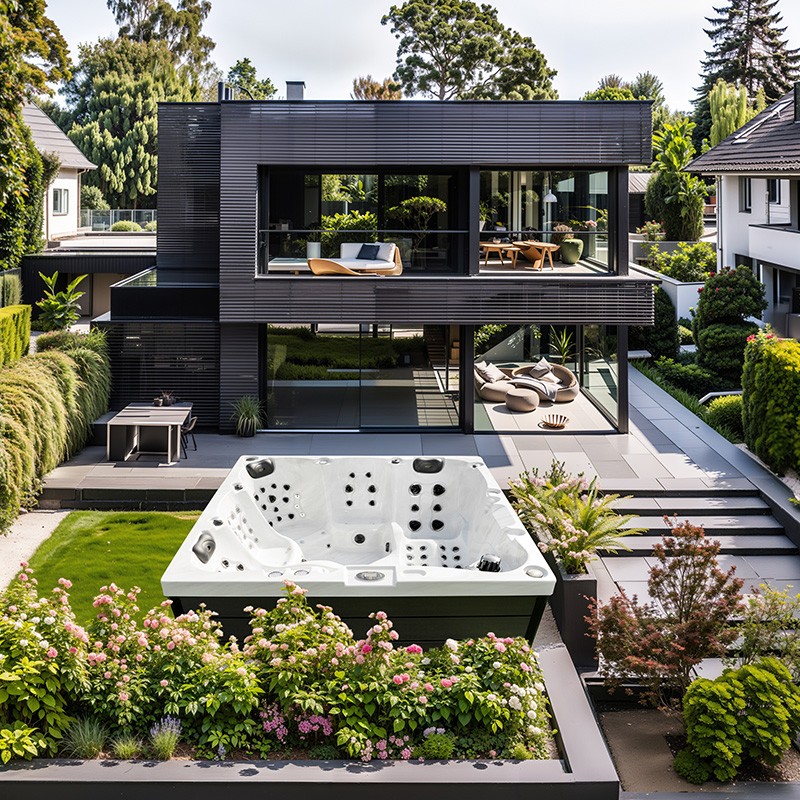
What should the free chlorine level be in a modern outdoor jacuzzi tub?
The appropriate concentration of free chlorine should be determined by referring to the equipment manufacturer’s requirements, the labels on disinfection products, and local health regulations. The U.S. Centers for Disease Control and Prevention (CDC) recommends that for hot tubs, free chlorine levels should be at least 3 ppm, with a pH range of 7.0–7.8.
For practical maintenance, please refer to the table below:
| Parameter | General Reference | Maintenance Advice |
| Free Chlorine | At least 3 ppm under CDC guidance | Test regularly and maintain the required residual |
| pH | 7.0–7.8 under CDC guidance | Adjust according to test results |
| Water Temperature | No higher than 40°C (104°F) | Follow equipment safety limits |
| Testing Frequency | At least twice daily for routine CDC guidance | Test more often during heavy use |
| Filter Maintenance | Follow manufacturer instructions | Clean or replace filters as required |
These values serve as a reference guide and should not be considered a universal standard applicable to all equipment. In particular, for outdoor whirlpool hot tubs that utilize different disinfection systems, specialized water treatment protocols, or are subject to commercial operational requirements, priority should be given to the relevant product instructions and local regulations.
Higher free chlorine levels are not necessarily better. Concentrations that are too low may result in inadequate disinfection, while concentrations that are too high can increase the risk of irritation to the skin, eyes, and respiratory tract, and may also damage certain equipment materials. If test readings exceed the product's permitted upper limit, use should be suspended. The water should be managed according to the disinfectant’s instructions and the equipment manufacturer’s guidelines—do not attempt to "neutralize" the excess by simply adding other chemicals.
Why do free chlorine levels in outdoor hot tubs drop rapidly?
Many users observe that while free chlorine readings are normal immediately after adding a disinfectant, they drop significantly after a few hours of use. This does not necessarily indicate a problem with the quality of the disinfectant; rather, it is typically related to the contamination load, water temperature, sunlight exposure, and the circulation system.
1. Sweat and skin oils increase disinfectant consumption. When users enter an outdoor whirlpool hot tub, sweat, skin oils, and other organic matter are introduced into the water. These substances react with chlorine, reducing the concentration of residual free chlorine. Disinfectant consumption is generally faster when multiple people use the hot tub in succession.
2. High water temperatures. Outdoor whirlpool hot tubs often operate at high temperatures. Factors such as temperature, water circulation/jets, and the formation of water droplets or mist all influence the consumption and loss of disinfectant; therefore, maintenance practices used for standard cold-water swimming pools cannot simply be applied to hot tubs. The CDC notes that human-introduced contaminants, sunlight, and water droplets or mist generated by jets can all lower chlorine concentrations in the water.
3. Sunlight exposure. When an outdoor whirlpool hot tub is exposed to sunlight for extended periods, ultraviolet (UV) rays accelerate the decomposition of chlorine. It is important to note that while cyanuric acid is sometimes used in swimming pools to stabilize chlorine, the CDC does not recommend using cyanuric acid—or stabilized chlorine products containing it—in hot tubs, as it can slow down the disinfection process. Always select a disinfectant based on the specific instructions provided for your hot tub.
4. Inadequate filtration and plumbing maintenance. While filters cannot replace disinfectants, they do help remove suspended particles and organic contaminants. If filter cartridges are not cleaned regularly, or if a biofilm has formed within the circulation plumbing, the contamination load may continue to rise, causing free chlorine to be consumed more rapidly.
5. Incorrect application methods. If a disinfectant is not added according to the label instructions, or if the water is not allowed to circulate properly before re-testing, the test results may not accurately reflect the conditions of the entire body of water. Different chlorine-based products contain varying active ingredients and concentrations; therefore, one cannot determine whether free chlorine levels are adequate based solely on the product name or the amount added.
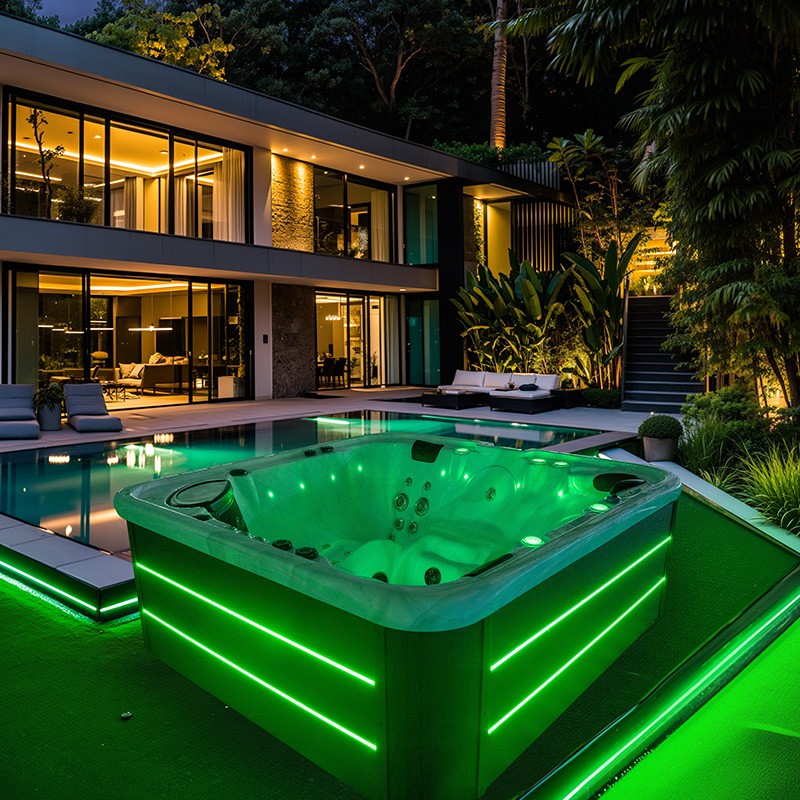
How can you accurately test for free chlorine in an outdoor hot tub?
Testing for free chlorine is fundamental to routine water quality management. You cannot accurately gauge disinfectant concentration simply by observing whether the water is clear or checking for odors.
The first method involves using test strips. These are easy to use and well-suited for routine checks by residential users. Ensure the test strips are within their expiration date, and strictly follow the instructions regarding immersion time and when to read the results. While test strips are useful for quick screening, they may be less precise than professional testing equipment.
The second method uses a DPD colorimetric test kit. DPD is a standard water quality testing method used to measure both free chlorine and total chlorine. The CDC notes that, for residential pools and whirlpool hot tubs, a properly used DPD test kit is generally more accurate than test strips.
Keep the following points in mind when testing:
•Ensure the water is circulating properly, and collect samples according to the instructions provided with your equipment and test kit—avoid taking samples from only one localized area.
•Test for both free chlorine and pH levels, as both factors influence the effectiveness of disinfection.
•Increase the frequency of testing after heavy use, after adding disinfectants, or if the water appears cloudy or develops an unusual odor.
•If a reading is abnormally low or shows zero, do not immediately add a large amount of disinfectant. First, verify that your test kit, testing procedure, and water sample are all valid.
It is important to note that, according to the CDC, if chlorine concentrations exceed 10 ppm, some DPD tests may experience a "bleaching effect," causing the reading to appear falsely low—or even zero. Therefore, an abnormally low result does not necessarily mean there is no chlorine in the water. In such cases, use an appropriate alternative testing method to verify the results.
Frequently Asked Questions (FAQ)
1. What is "free chlorine" in an outdoor whirlpool hot tub?
Free chlorine refers to the forms of chlorine in the water that are capable of disinfection—primarily hypochlorous acid and hypochlorite ions. Maintaining an appropriate concentration of free chlorine helps control microbial contamination in the water.
2. What should the free chlorine level be in an outdoor whirlpool hot tub?
The CDC recommends that the free chlorine level in a hot tub be at least 3 ppm, with a pH range of 7.0–7.8. Specific requirements should also take into account equipment instructions, disinfectant product labels, and local regulations.
3. Does a higher level of free chlorine in an outdoor hot tub always mean better disinfection?
No. Levels that are too low may result in inadequate disinfection, while levels that are too high can increase the risk of irritation. Adjustments should be made based on test results and product specifications; do not add chemicals indiscriminately.
4. Why does the free chlorine level in a modern outdoor jacuzzi tub drop so quickly?
Common causes include an increase in contaminants introduced by users, high water temperature, exposure to sunlight, inadequate filter maintenance, and the accumulation of organic matter within the circulation piping. You should investigate by reviewing water quality records and the condition of the equipment.
5. Why does a hot tub still have an odor even when the free chlorine level is within the normal range?
This may be due to the presence of combined chlorine, organic contaminants, a clogged filter, or deposits within the plumbing. It is recommended to test for total chlorine and pH levels, inspect the filtration system, and clean the unit or replace the water as necessary.