


What functions do the different jets in outdoor spa hot tubs serve?
2026-09-03 15:35For the growing number of households purchasing outdoor spa hot tubs, jets have become a key feature influencing the user experience. When shopping, consumers often notice specifications like "20 jets," "40 jets," "60 jets," or even over a hundred, and naturally assume that a higher number of jets guarantees a better massage.
However, upon actual use, many discover that the experience varies significantly: some jets deliver a concentrated stream ideal for massaging the shoulders and neck; others rotate to create a kneading sensation; some offer a gentler flow suited for back relaxation; and others target specific areas like the soles of the feet, calves, or lower back. Why do jets—despite sharing the same name—provide such vastly different experiences?
This highlights a common misconception in the outdoor spa hot tub industry. The number of jets does not directly equate to massage quality. The true determinants of the hydrotherapy experience are factors such as jet type, nozzle aperture, internal flow channels, spray direction, water flow rate, pump output, air-to-water mixing ratios, and the strategic placement of jets relative to the body.
Therefore, when consumers encounter an outdoor spa hot tub featuring jets of various shapes, sizes, and spray patterns, the real questions to ask are not "How many jets are there?" but rather: "Which body area does this jet target? Does it provide concentrated pressure, a rotating kneading action, pulsating stimulation, or a gentle flow? How does it integrate with the massage pump and plumbing system?" Only by understanding these aspects can one truly appreciate the hydrotherapy system of an outdoor whirlpool spa hot tub.
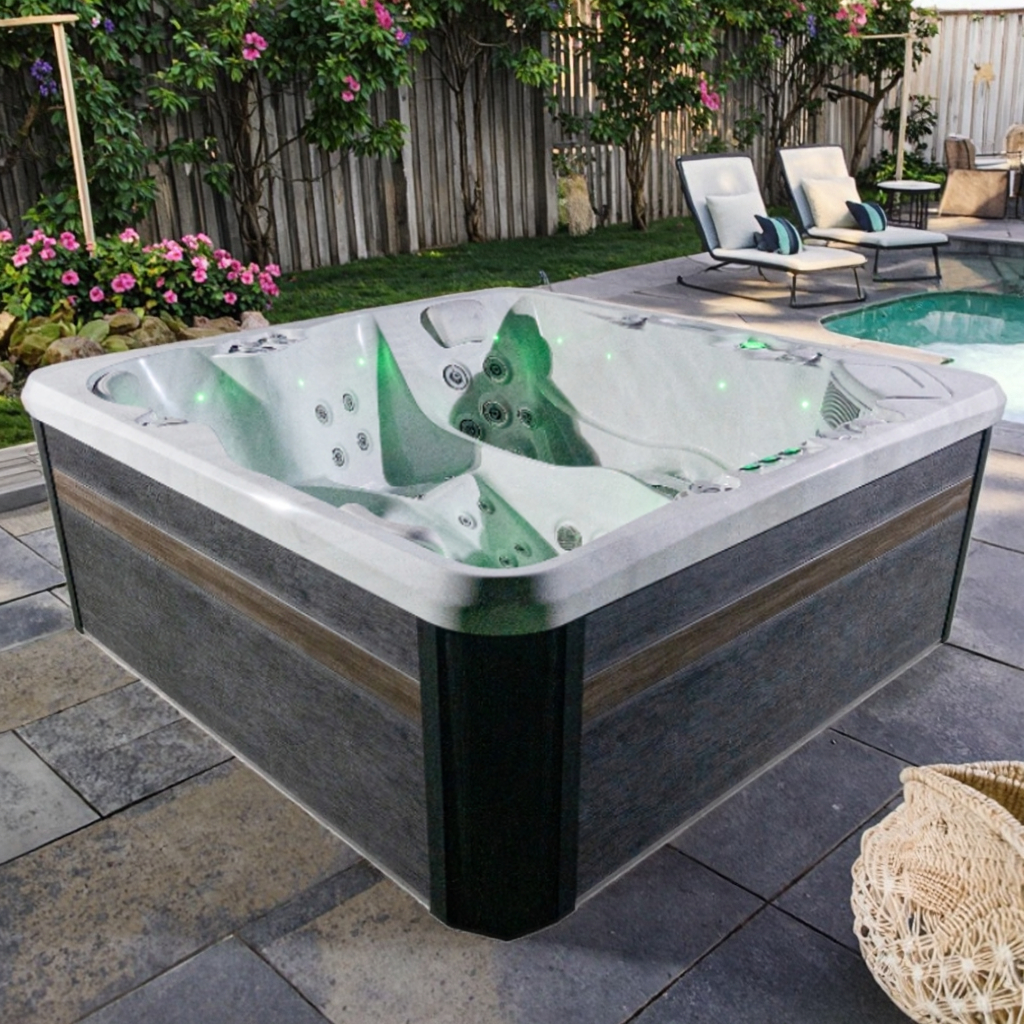
Why is jet design in outdoor spa hot tubs becoming increasingly complex?
While traditional outdoor hot tubs primarily catered to the need for a simple hot water soak, modern spa products have evolved toward "hydrotherapy." Warm water alone promotes physical relaxation, but jets utilize pressurized water streams to provide mechanical stimulation to specific body parts, transforming a basic soak into a targeted hydrotherapy experience.
The challenge, however, is that the human body does not present a perfectly flat surface. Different areas of the body—such as the neck and shoulders, shoulder blades, sides of the lumbar spine, buttocks, thighs, calves, and soles of the feet—vary in terms of muscle thickness, sensitivity, and massage requirements. If an outdoor whirlpool spa hot tub used identical straight-stream jets throughout, it would be difficult to simultaneously meet the specific massage needs of these different areas. Consequently, modern outdoor spa hot tubs typically employ a combination of various jet types.
For instance, the neck and shoulder area often requires a more concentrated stream, necessitating jets with adjustable direction; the back may benefit more from rotating or multi-port jets to ensure even pressure distribution; the lower back might require a strong, directional stream; while the soles of the feet and calves can utilize smaller pulsating, air-bubble, or concentrated jets. Users seeking a gentler experience might prefer large-surface, multi-outlet jets.
Product literature from Clearwater Spas illustrates this approach by assigning specific jet structures—such as Directional, Rotational, and Double Rotational jets—to different body zones; for example, directional jets target the neck, shoulders, and hips, while rotational jets create a kneading-like sensation through their spinning action.
This implies that a well-designed outdoor whirlpool spa hot tub is not simply one where a multitude of jets are randomly installed on the interior walls; rather, it should feature a logical "Hydrotherapy Zone" design.
How exactly do outdoor spa hot tub jets work?
Water in the whirlpool spa hot tub first passes through filtration, circulation, and heating systems; a massage pump then drives the water into dedicated plumbing lines before it is released through the jets. Jacuzzi describes its hydrotherapy system this way: water passes through the filtration system and heater before re-entering the tub through various types of jets, with the final flow pattern determined by a combination of factors, including jet type, pump size, and air mixing.
Therefore, a jet does not operate in isolation.
It relies on the coordination of at least three core systems: the massage pump, the internal plumbing, and the jet’s own internal channels and outlet nozzles.
The massage pump provides the motive power for the water flow; the plumbing routes the water to different zones; and the jet converts the flow into a specific spray pattern.
This explains why the notion that "more jets are better" is not entirely accurate. Suppose an outdoor whirlpool spa hot tub has 60 jets, but the massage pump output, plumbing cross-sectional area, and valve design are insufficient to supply adequate flow to all 60 simultaneously; in this case, the flow rate reaching each individual jet would be restricted when all are active. Conversely, a hot tub with only 30 jets—featuring well-designed plumbing, properly matched pumps, and ergonomically positioned jets—might offer a more concentrated and comfortable massage experience.
This relates to the industry concept known as the "Jet-to-Pump Ratio"—the balance between the number of jets and the capacity of the massage pumps.
Therefore, when evaluating the hydrotherapy performance of an outdoor hot tub, one should not look solely at the number of jets, but also consider how many jets are driven by a pump of a specific specification.
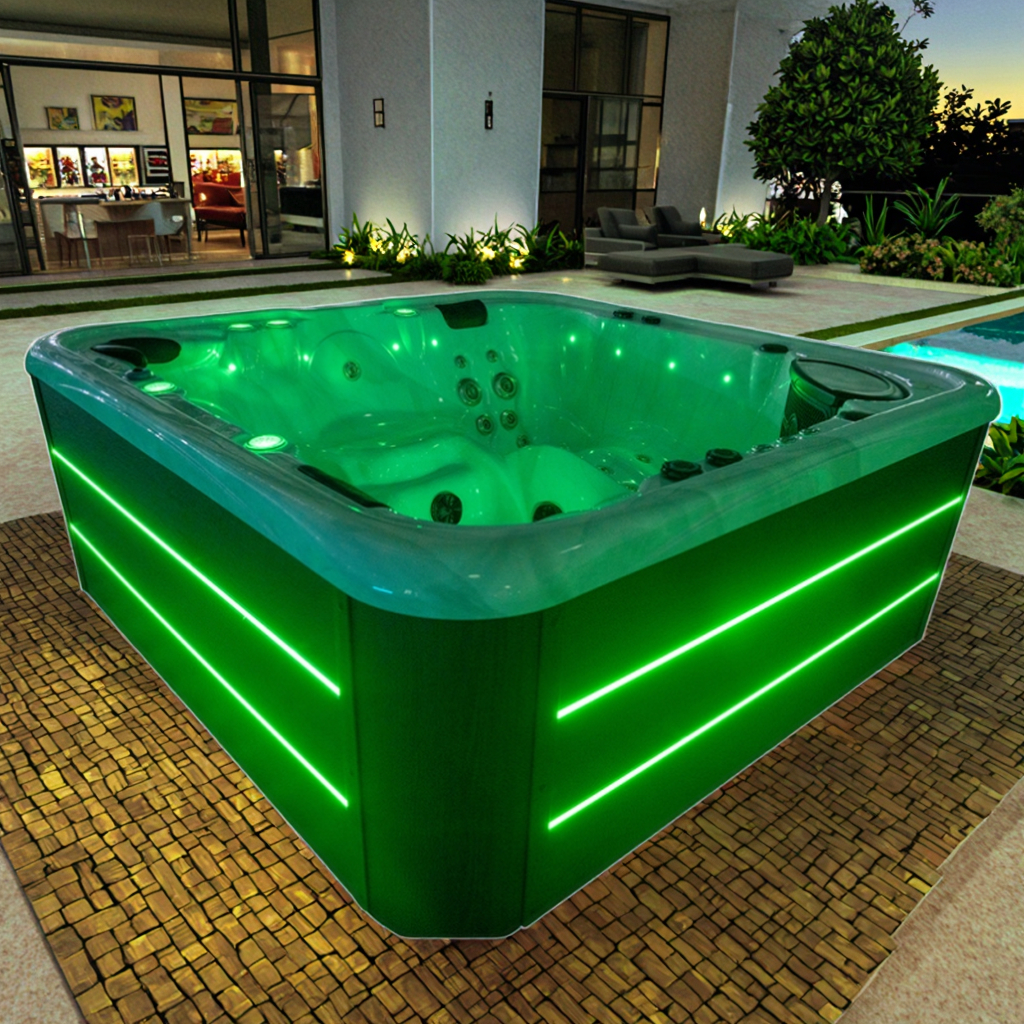
What is the function of directional jets in outdoor spa hot tubs?
Directional jets are the most basic and common type of jet found in outdoor spa hot tubs.
Their defining characteristic is a distinct flow direction; users can typically adjust the angle of the jet to direct the water precisely toward the area they wish to massage.
The core advantage of this type of jet is not "coverage area," but rather "precision."
For instance, if a user sitting in the whirlpool spa hot tub wants to focus on the muscles near the shoulder blades, they can slightly adjust the directional jet so the water targets that specific area. If the jet also features flow control, the massage intensity can be further customized.
Consequently, directional jets are particularly well-suited for areas requiring targeted stimulation, such as the shoulders, lower back, hips, arms, and calves.
In terms of flow characteristics, directional jets typically deliver a distinct, concentrated stream of water. Under identical system conditions, a smaller nozzle aperture often results in a visually more concentrated stream; however, actual massage intensity cannot be determined by aperture size alone, as pump flow rate, plumbing resistance, internal jet structure, and air mixing all influence the final experience.
For whirlpool spa hot tub manufacturers, the installation angle of directional jets is also crucial. Even if a jet is highly capable, if its placement does not align with the user's seated posture, the water might strike bony prominences rather than muscle tissue, resulting in a poor user experience. Therefore, effective directional jets do not simply "spray water out"; they require precise positioning that accounts for seat height, the user's posture, and the specific muscle groups being targeted.
Why do rotary jets in outdoor spa hot tubs create a "kneading" sensation?
If directional jets emphasize "precision," rotary jets emphasize "dynamics."
Rotary jets typically direct the water flow in a circular motion; internal mechanisms often use the water flow itself to drive the rotation of the nozzle, creating a constantly shifting massage pattern.
The key difference between this dynamic flow and a fixed stream is that pressure is not continuously concentrated on a single point.
If a directional jet remains aimed at one spot, the user feels constant pressure; in contrast, a rotary jet constantly shifts the water's position, moving the pressure across a specific area. Consequently, rotary jets often provide more even stimulation for larger muscle groups, such as the back, thighs, and glutes.
Some large rotary jets also feature a dual-outlet design.
Therefore, if a consumer sees terms like "Rotary Jet," "Dual Rotary Jet," or "Double Rotational Jet" in product specifications, it indicates a design utilizing rotating water flow. However, one must consult the manufacturer's documentation for specific structural details, as naming conventions vary across the industry.
What distinguishes "double rotary jets" in outdoor whirlpool spa hot tubs?
Double rotary jets can be understood as an enhancement of the standard rotary jet design through the addition of a second spray channel.
While a traditional single rotary jet produces flow from one rotating outlet, a double rotary structure allows two streams of water to create a simultaneous rotating motion.
The advantage of this design is broader coverage and a more dynamic massage pattern.
However, a double rotary design does not necessarily equate to greater massage intensity than a single rotary design.
Adding an outlet means the water flow must be distributed across multiple channels. If the massage pump's flow rate is not adjusted accordingly, the flow volume at each individual outlet may actually decrease.
Therefore, evaluating double rotary jets requires considering the massage pump, the number of jets, and the entire plumbing system.
This is why professional outdoor spa hot tub design focuses not merely on complex jet structures, but on achieving a balanced integration of the pump, plumbing, and jets.
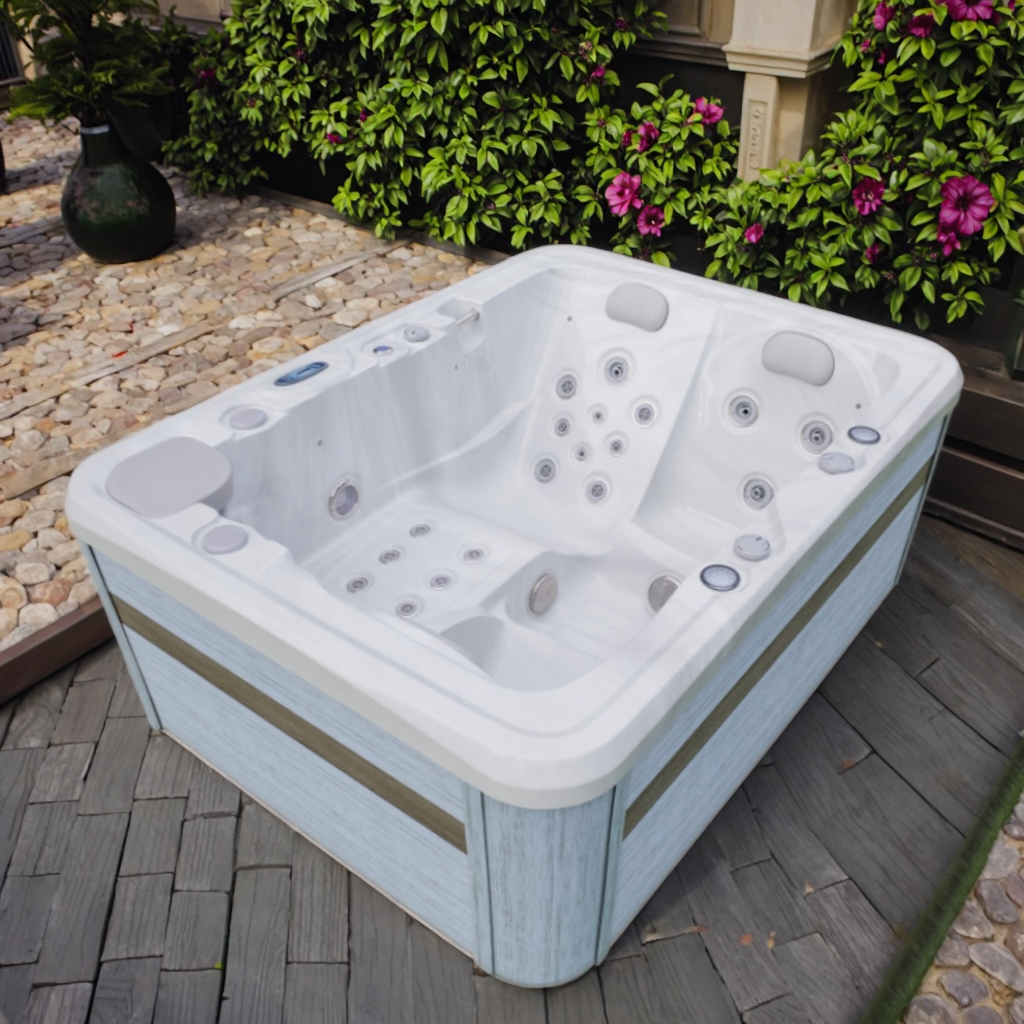
What is the function of multi-port massage jets in outdoor spa hot tubs?
In addition to single-port and dual-port designs, multi-port jets are also commonly found in outdoor whirlpool spa hot tubs.
These jets typically feature multiple small outlets, dispersing the water flow into several distinct streams. For instance, some large massage jets may be configured with 10, 12, or even 14 outlets. Spa product brochures often showcase designs such as 5.25-inch, 14-port massage jets; their primary characteristic is the creation of a richer massage experience through multiple concentrated streams of water.
The core advantage of multi-port jets in outdoor whirlpool spa hot tubs is "pressure dispersion."
While a single-port jet concentrates a large volume of water onto a very small area—resulting in a more direct massage sensation—a multi-port jet disperses the flow into multiple smaller streams, thereby covering a larger surface area.
These types of jets are particularly well-suited for the back, shoulders, and other areas requiring broader coverage.
However, it is important to note that an increase in the number of ports does not automatically equate to an increase in total water flow. Without sufficient system flow to support it, a 14-port jet might simply result in a more diffused stream rather than a more powerful one. Therefore, one cannot simply judge a product based on the idea that "more ports equal a stronger massage."
Why are "Cluster Jets" suitable for targeted massage in outdoor hot tubs?
Cluster jets generally refer to a group of small jets arranged closely together in a specific area.
While they share some similarities with large multi-port jets, their structure and water flow dynamics may differ. By creating multiple points of water flow within a limited space, cluster jets are ideal for targeting areas such as the shoulders, back, arms, and feet.
Jacuzzi lists cluster jets as a standard type of hydrotherapy jet, noting that this configuration creates a concentrated massage effect through multiple small jet points.
The advantage of cluster jets lies in their versatility.
When seating space in an outdoor spa hot tub is limited but multiple massage points are desired for the shoulders or lower back, using several small jets often makes it easier to achieve an ergonomic layout compared to installing a single, oversized jet.
What is the function of pulsating jets in outdoor whirlpool spa hot tubs?
The water flow from pulsating jets is not continuous; instead, the jet's internal structure causes the flow to undergo periodic variations. This type of water flow creates a "rhythmic, pulsating sensation" against the body, distinguishing it from the steady, continuous stream of standard water jets.
For the calves and feet, pulsating jets provide a distinct, dynamic form of stimulation. Some high-end spa systems utilize mechanical components or specialized plumbing to induce periodic pressure fluctuations in the water flow.
In terms of the user experience, pulsating jets are ideal for those who dislike a constant, powerful stream but still desire the sensation of a dynamic massage.
It is important to note that the specific frequency, intensity, and effect of pulsating jets depend heavily on the product's design; the massage quality cannot be judged solely by the label "Pulsating."
What is the difference between air jets and standard water jets?
Air jets are another type of nozzle that consumers often confuse with others.
Rather than delivering massage primarily through high-pressure water streams, they introduce air into the water to create a multitude of bubbles.
Consequently, the sensation produced by air jets is generally softer, more diffused, and lighter.
When describing their various jet types, Jacuzzi distinguishes air jets from traditional hydro-massage jets, noting that air jets primarily introduce air to create a gentle, bubbly sensation, as opposed to the distinct pressure-based massage provided by high-flow water jets.
These jets are particularly well-suited for users seeking relaxation rather than a deep-tissue massage.
Therefore, equipping an outdoor spa hot tub with both water jets and air jets is not redundant; each serves a distinct functional purpose in the user experience.
Water jets focus on pressure and directional flow, whereas air jets emphasize bubbles, gentle stimulation, and overall ambiance.
What functions do waterfall jets and neck jets serve in outdoor hot tubs?
Modern outdoor spa hot tubs may also feature waterfall jets or neck jets.
Waterfall jets utilize a wide outlet to create a continuous sheet of water cascading down over a broad area. This feature is designed primarily for relaxation and visual appeal rather than deep-tissue massage.
Neck jets, on the other hand, represent a highly targeted hydrotherapy feature.
The neck area is sensitive, making the positioning, angle, and pressure control of these jets crucial. If the flow is too weak, the user may not feel any significant benefit; conversely, if the flow is too strong or directed at an inappropriate spot, it can cause discomfort. Therefore, for individuals who lead sedentary lifestyles, work in offices, or spend long hours using computers, neck and shoulder jets in an outdoor whirlpool spa hot tub are often more practically beneficial than simply adding a large number of foot jets.
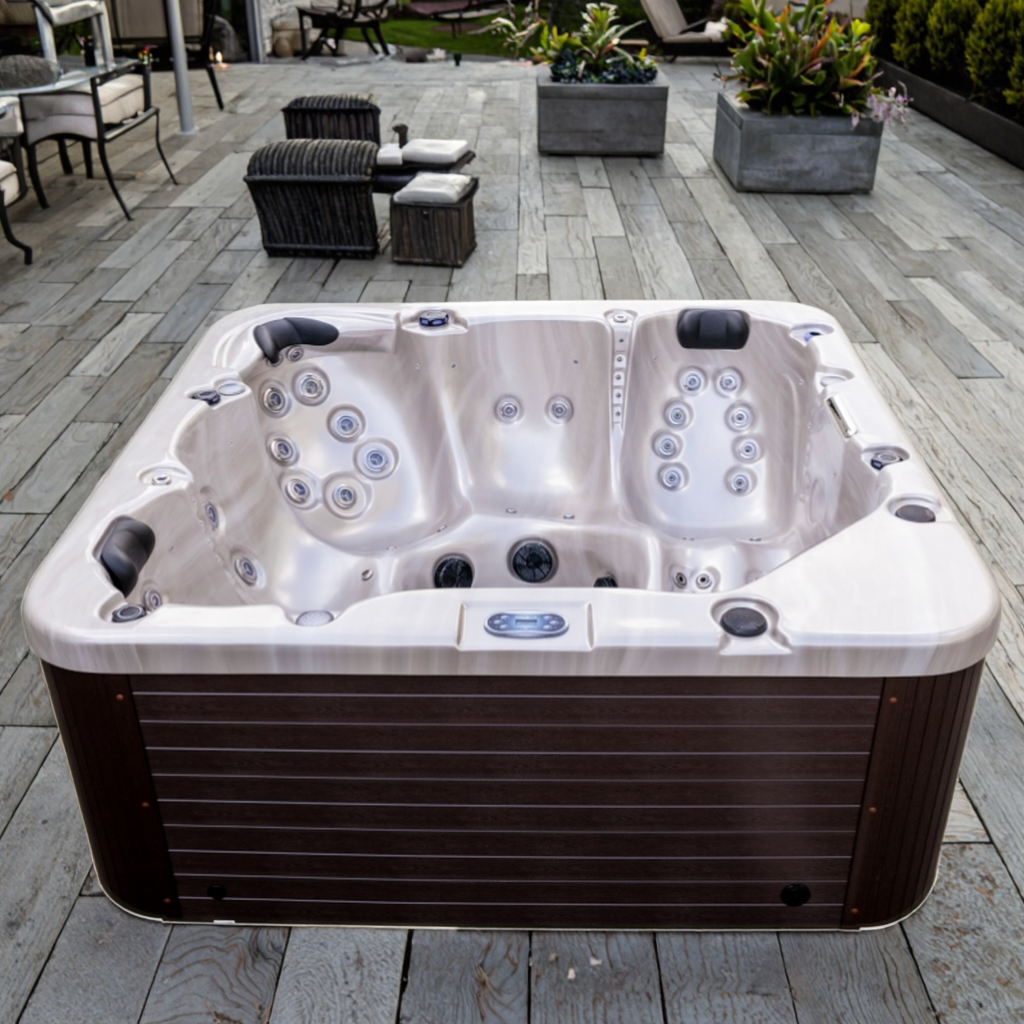
Why does LOVIA® emphasize the synergy between jets and the overall system in its outdoor hot tubs?
For outdoor hot tub manufacturers, jets are not merely isolated, decorative components; they are the core terminal elements of the entire hydrotherapy system.
Take LOVIA®’s product development philosophy, for instance: jet design must be considered in conjunction with massage pumps, plumbing, filtration, heating, and water treatment systems. The user experience is defined not by simply adding another jet, but by ensuring a stable water output from the pump and distributing that flow efficiently through the plumbing to various seating positions and hydrotherapy zones.
This is a crucial aspect of OEM/ODM outdoor whirlpool spa hot tub projects. If a client aims to develop a product for home wellness, hotels, resorts, or commercial spas, the jet configuration should be tailored to the target audience rather than relying on a generic, one-size-fits-all jet layout.
For example, a residential whirlpool spa hot tub might prioritize relaxation for the neck, shoulders, lower back, feet, and the whole body; a high-end wellness model might feature distinct zones for deep tissue massage, general relaxation, and foot massage; meanwhile, a commercial spa model would prioritize jet durability, ease of maintenance, plumbing reliability, and stability during prolonged operation.
FAQ: Common Questions About Outdoor Hot Tub Jets
FAQ 1: Is it always better to have more jets in an outdoor spa hot tub?
No. The number of jets is merely one metric; what truly matters is the jet type, placement, pump capacity, plumbing design, and how well the jets align with the human body. A whirlpool spa hot tub with 30 high-quality jets can easily provide a superior massage experience compared to one packed with a large number of low-flow jets.
FAQ 2: Why do outdoor hot tubs use different types of jets?
Because different areas of the body require different types of water flow. The neck and shoulders may benefit from directional jets; the back is well-suited for rotating or multi-port massage jets; the lower back requires concentrated flow; and the calves and feet can utilize small directional, pulsating, or air-bubble jets. A combination of different jet types creates a more comprehensive hydrotherapy experience.
FAQ 3: Which jets should I focus on when buying an outdoor whirlpool spa hot tub?
We recommend focusing on six key areas—neck/shoulders, back, lower back, hips, calves, and soles of the feet—and checking whether each area is equipped with the appropriate type of jet. Rather than simply counting the total number of jets, you should focus on the jet types, installation locations, flow adjustment capabilities, and how well the massage pumps are matched to the jets.
FAQ 4: Do outdoor whirlpool spa hot tub jets require regular cleaning?
Yes. Dust, leaves, hair, and mineral deposits in an outdoor environment can affect water flow through the jets, particularly with rotating jets. In addition to cleaning the jets, you should also ensure the filter and the entire water treatment system of the outdoor whirlpool spa hot tub are functioning properly.