


What does "Sleep Mode" mean on an outdoor spa hot tub?
2026-09-01 15:30As outdoor spa hot tubs become increasingly common in courtyards, on terraces and balconies, in villa gardens, and in commercial leisure spaces, the functions available on their control panels have become more diverse. Beyond standard features like temperature adjustment, jet massage, filtration cycles, lighting, and pump controls, many models offer a "Sleep Mode" (often labeled "SL" or "SLP"). For first-time users, this feature can be confusing, as control systems vary across brands. While "Sleep Mode" generally implies low energy consumption, low-frequency operation, and extended periods of inactivity, the specific logic governing temperature control, filtration cycles, heating triggers, and freeze protection can differ significantly. Therefore, one cannot simply assume that "Sleep Mode" operates the same way across all spa hot tub models.
Taking spa hot tubs that utilize common control logic (such as the Balboa system) as an example, Sleep Mode typically means the unit only checks the water temperature and heats the water during scheduled filtration cycles. It allows the water temperature to drop significantly below the user's set point—sometimes by as much as 20°F (approx. 11°C)—thereby reducing energy consumption associated with heating and circulation when the tub is not in use.
A key issue in the industry is that consumers often focus on features like the number of massage jets, heating speed, and seating capacity when purchasing a spa hot tub, while overlooking how the control system manages heat. In reality, long-term operating costs are directly influenced by factors such as usage frequency, local ambient temperatures, insulation structure, acrylic shell design, cover performance, filtration cycle duration, and the control system's operating mode.
Thus, understanding "Sleep Mode" goes beyond merely recognizing a button on the control panel; it involves understanding how the home spa balances comfort, hygiene maintenance, equipment protection, and energy efficiency.
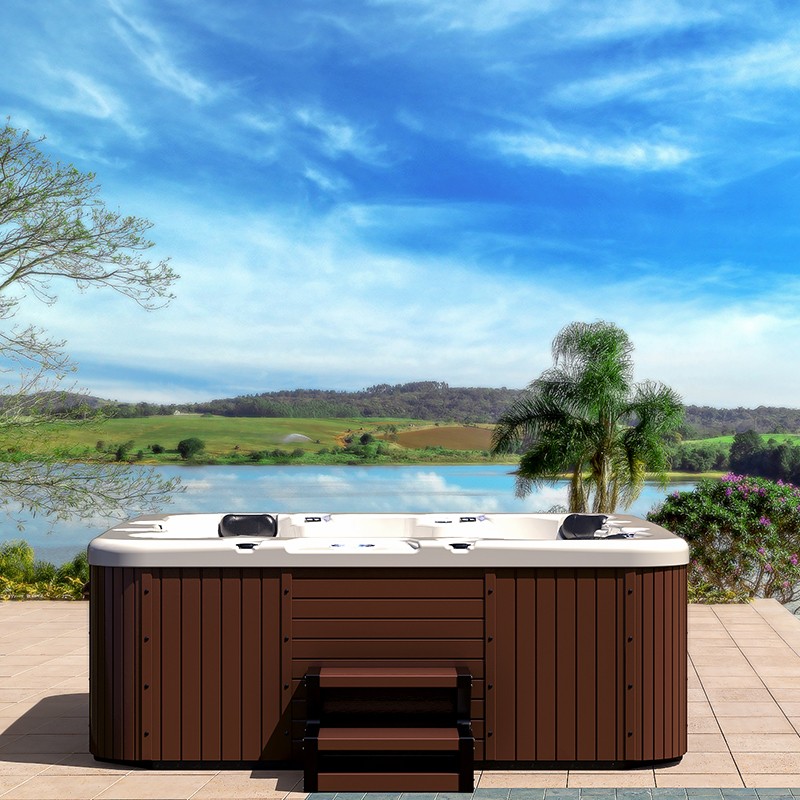
What exactly does "Sleep Mode" mean for an outdoor spa hot tub?
In terms of control logic, Sleep Mode can be understood as a "low-demand operating mode" or an "energy-saving mode for extended inactivity." It does not mean completely shutting down the spa hot tub or halting all operations; rather, it reduces the energy required to maintain high water temperatures during periods when the tub is not being used. In "Standard Mode," an outdoor hot tub continuously monitors the water temperature. When the actual temperature drops below the user's setting, the circulation pump and heating system activate according to the control program to bring the water back to the target temperature. For instance, if a user sets the hot tub to 38°C, the primary goal of Standard Mode is to maintain the water temperature as close to 38°C as possible at all times. Some control systems determine whether to activate the low-speed circulation pump and heater based on periodic temperature checks.
"Sleep Mode" operates differently.
In many common control systems, Sleep Mode only checks the temperature and heats the water during preset filtration cycles; it also allows the temperature to drop a certain amount below the set point before applying limited heating. For example, some systems allow the water temperature to remain approximately 20°F (about 11°C) below the set temperature while in Sleep Mode. If a user sets the spa hot tub to 100°F (approx. 37.8°C), a unit using this logic might only maintain the water at 80°F (approx. 26.7°C) in Sleep Mode, rather than constantly holding it at 100°F as in Standard Mode.
Therefore, the core concept of Sleep Mode can be summarized as follows: the unit maintains essential filtration, circulation, and system protection functions, but prioritizes reducing energy consumption during periods of prolonged inactivity rather than constantly maintaining the user's preferred, higher "comfort" temperature.
This makes Sleep Mode particularly suitable for situations where the whirlpool spa hot tub goes unused for days or even weeks. For example, a user might have a spa hot tub in their villa's garden but only use it on weekends due to a busy work schedule, or own a spa hot tub at a vacation home that remains unoccupied for weeks at a time; in these cases, keeping the unit constantly heated to the usage temperature of 37°C–40°C is not necessarily the most efficient approach to energy management. Sleep Mode allows the unit to lower the temperature requirement during idle periods and return to normal operation when the user is ready to use it again.
Why do outdoor spa hot tubs need a Sleep Mode?
One of the key differences between an outdoor spa hot tub and an indoor bathtub is that the former is constantly exposed to the outdoor environment. Even if the hot tub shell features excellent thermal insulation, heat is still lost to the surroundings through the shell, piping, equipment compartment, and water surface. Fluctuations in ambient temperature—particularly during winter, at night, or in regions with significant day-night temperature differences—can noticeably impact heat loss.
Consider an outdoor whirlpool spa hot tub with a capacity of approximately 1,000 liters. Heating the water from 15°C to 38°C requires a theoretical amount of energy calculated using the specific heat capacity formula:
Q = m × c × ΔT
Given that the specific heat capacity of water is approximately 4.186 kJ/(kg·°C), raising 1,000 kg of water by 23°C requires about 96.3 MJ of heat energy, equivalent to approximately 26.8 kWh. In practice, however, actual power consumption differs from this theoretical figure due to factors such as heat loss, heater efficiency, piping heat dissipation, and environmental conditions.
This implies that reheating the whirlpool spa hot tub from a low temperature to the desired operating temperature consumes a significant amount of energy. Consequently, "Sleep Mode" is not merely a "power-off" function; rather, it aims to minimize the heat loss that occurs when the unit maintains a high temperature during periods of inactivity.
An important energy management trade-off exists between maintaining temperature and reheating, especially for infrequent users. If a user only utilizes the whirlpool spa hot tub four to six times a month, keeping the water constantly at 38°C forces the heater to continuously compensate for temperature drops caused by nighttime conditions, cold weather, and natural heat dissipation. Conversely, using a Sleep Mode—aligned with the unit's control logic—allows the water temperature to drop during idle periods, thereby reducing the energy required to maintain heat.
However, it is crucial to highlight a frequently overlooked fact:
Sleep Mode does not imply that "lower temperatures always save more energy, so Sleep Mode should be used indefinitely." For users who utilize the spa hot tub daily, allowing the temperature to drop significantly and then reheating it frequently is not necessarily more energy-efficient than maintaining a steady, reasonable temperature. Some manufacturers explicitly advise that for users who soak several times a week, it is more efficient to maintain the operating temperature through effective insulation and a thermal cover rather than allowing the temperature to drop and then reheating; Sleep Mode is better suited for scenarios where the hot tub remains unused for several weeks. Therefore, Sleep Mode specifically addresses the issue of "standby energy consumption during periods of infrequent use" rather than serving as a universal energy-saving solution for all outdoor spa hot tub scenarios.
How do Sleep Mode, Standard Mode, and Economy Mode differ?
To truly understand Sleep Mode, it helps to compare it within the context of the entire whirlpool spa hot tub control system. While naming conventions vary by brand, many systems feature operating modes such as Standard, Economy, and Sleep.
Standard Mode prioritizes comfort and immediate availability.
If a user sets the whirlpool spa hot tub to 38°C, the system periodically monitors, circulates, and heats the water to maintain it as close to the target temperature as possible. This mode is highly convenient for daily use, households with frequent users, or commercial spa settings, as it eliminates the need to wait hours—or even a full day—for the water to reach the desired temperature. In Standard Mode, some systems continuously maintain the set temperature, automatically activating the low-speed pump and heater whenever the water temperature drops.
Economy Mode generally falls somewhere between Standard and Sleep modes.
Heating typically occurs only during scheduled filtration cycles, meaning the water temperature may drop below the target value outside of these times. Compared to Standard Mode, Economy Mode reduces energy consumption, though the water temperature may decrease. Users who plan to use the spa hot tub at specific times can schedule filtration cycles to run just prior to use, ensuring the water temperature is closer to the target when they get in.
Sleep Mode is designed primarily for periods of prolonged inactivity.
Some systems not only restrict heating to filtration cycles but also allow the water temperature to drop significantly—by approximately 20°F (about 11°C)—below the set temperature.
These three modes can be viewed as distinct operational strategies:
Standard Mode prioritizes "readiness for immediate use," Economy Mode focuses on "scheduled operation," and Sleep Mode aims to "minimize operational demands during long periods of inactivity."
It is important to note that definitions vary by brand and controller. For instance, in some systems, Sleep Mode is designed to reduce pump activity at night rather than strictly following the "20°F below set temperature" rule; other systems may define Sleep Mode simply as heating only during filtration cycles. Therefore, when evaluating the "Sleep Mode" of a specific outdoor whirlpool spa hot tub, one must refer to the device's controller manual; simply because different products share the name "Sleep Mode" does not mean they operate in the exact same way.
How much does the water temperature drop when an outdoor hot tub's Sleep Mode is activated?
This is a primary concern for consumers, yet there is no single answer that applies to every outdoor spa hot tub.
For control systems utilizing a typical "20°F low-temperature threshold," if a user sets the target temperature to 100°F, Sleep Mode might allow the water temperature to drop to approximately 80°F; if the set temperature is 102°F, the corresponding low-temperature limit might be around 82°F. In Celsius terms, if the target temperature is approximately 38.9°C, the system might allow the water temperature to fall to about 27.8°C.
However, this "20°F" figure is a programmed setting specific to certain control systems and is not an industry-wide standard for all outdoor spa hot tubs. Some devices employ different temperature logic for sleep modes; some products may simply limit heating duration, while others implement Sleep Mode by silencing the unit at night and reducing pump operation. Consequently, seeing "SL" on the control panel does not automatically mean a specific hot tub will experience an 11°C drop in temperature.
Additionally, factors such as ambient temperature, insulation thickness, cover seal integrity, wind speed, humidity, and water temperature all influence the actual rate of cooling. An outdoor whirlpool spa hot tub equipped with high-density insulation and a high-performance thermal cover may experience a significantly slower rate of temperature drop in Sleep Mode compared to a unit with inferior insulation.
This is also a crucial factor when evaluating the quality of an outdoor whirlpool spa hot tub. Simply comparing heater wattage—such as 3kW, 5.5kW, or 6kW—is insufficient to determine a unit's energy efficiency. Heating power dictates "heating capacity," whereas the insulation structure determines the "rate of heat loss." If insulation performance is inadequate, even a powerful heater may end up merely compensating for continuous heat loss.
Can an outdoor spa hot tub's Sleep Mode actually save electricity?
It is possible, and the benefits are particularly noticeable with infrequent usage; however, it is impossible to promise a specific percentage of energy savings that applies universally to all outdoor whirlpool spa hot tubs. From a thermodynamic perspective, the rate of heat loss from a whirlpool spa hot tub is closely linked to the temperature difference between the water and the surrounding environment. The higher the water temperature—and thus the greater the differential relative to the outside air—the stronger the driving force for continuous heat loss. Consequently, if an outdoor hot tub is maintained at 38°C–40°C while the ambient temperature is only 10°C–15°C, the system must continuously compensate for significant heat loss.
When "Sleep Mode" allows the water temperature to drop, the temperature differential between the water and the environment decreases, thereby reducing the rate of heat loss over time. At the same time, because the equipment no longer frequently activates the heater to maintain the maximum set temperature, energy consumption during standby is reduced.
FAQ: Common Questions About Outdoor Hot Tub Sleep Mode
FAQ 1: What does "Sleep Mode" mean on an outdoor spa hot tub?
Sleep Mode is typically a low-energy operating mode for outdoor spa hot tubs. Unlike "Standard Mode," which continuously maintains the set temperature, many control systems in Sleep Mode only check and heat the water during filtration cycles and allow the water temperature to drop below the set point by a certain margin. Some common systems allow the temperature to drop by approximately 20°F (about 11°C). Specific logic varies by brand and controller, so always refer to the product manual.
FAQ 2: Does Sleep Mode turn off the outdoor whirlpool spa hot tub?
No. Sleep Mode generally does not mean the unit is completely powered off. Whether functions like filtration, circulation, and freeze protection continue to operate depends on the specific control system. Many units still perform filtration cycles while in Sleep Mode; the mode simply reduces heating demands during periods of non-use.
FAQ 3: Can I keep my outdoor whirlpool spa hot tub in Sleep Mode if I use it every day?
It is generally not recommended to simply leave it set this way for the long term. For households that use the tub daily, "ready-to-use" convenience is often a priority, making Standard Mode more practical. Allowing the water temperature to drop significantly each day—only to reheat it before use—can increase waiting times, and the actual energy costs may not necessarily be lower.
FAQ 4: Can I use Sleep Mode on my outdoor spa hot tub during winter?
You should consult your specific equipment manual. Some manufacturers explicitly advise against using Sleep Mode when the ambient temperature drops below 40°F (approx. 4°C), as cold conditions may increase the need for freeze-protection operations. In cold regions, it is crucial to verify whether the unit has automatic freeze protection and to check the manufacturer's specified minimum operating conditions.