


How to solve the problem of water turning yellow in outdoor hot tubs?
2026-09-02 15:35For outdoor spa hot tub owners, one of the most puzzling water quality issues isn't necessarily the water becoming extremely cloudy, but rather the sudden appearance of a pale yellow, yellow, yellow-green, or even yellowish-brown tint in water that was previously clear. This is particularly common right after a water change: the tap water looks normal when first filled, but begins to yellow after the heating and circulation systems have run for a few hours; in some cases, the water only starts to turn noticeably yellow after sanitizer has been added.
In reality, yellowing water in an outdoor spa hot tub cannot simply be dismissed as a normal occurrence, nor should it be immediately equated with contamination. The yellow discoloration may stem from metal ions—such as iron or manganese—present in the water source, or it could be linked to factors like pH fluctuations, alkalinity imbalances, oxidation caused by sanitizers, sediment buildup in the plumbing, reduced filtration efficiency, or residues from personal care products.
Troubleshooting guides from Master Spas explicitly link high iron or manganese levels to brown water, noting that high iron or copper levels can result in clear green water; meanwhile, Jacuzzi points out that fresh water added to the tub may already contain dissolved minerals and metals, meaning a fresh fill does not automatically guarantee ideal spa water quality.
Therefore, the accurate answer to the question "Is yellowing water in an outdoor spa hot tub normal?" is this: while slight, temporary discoloration can sometimes result from the oxidation of minerals or metal ions in fresh water, persistent yellow, yellowish-brown, or yellow-green hues—especially when accompanied by odors, cloudiness, sediment, or scale—should not be considered normal. The correct approach is not to blindly add more chlorine or repeatedly drain and refill the tub, but rather to identify the source of the discoloration and apply a targeted solution.
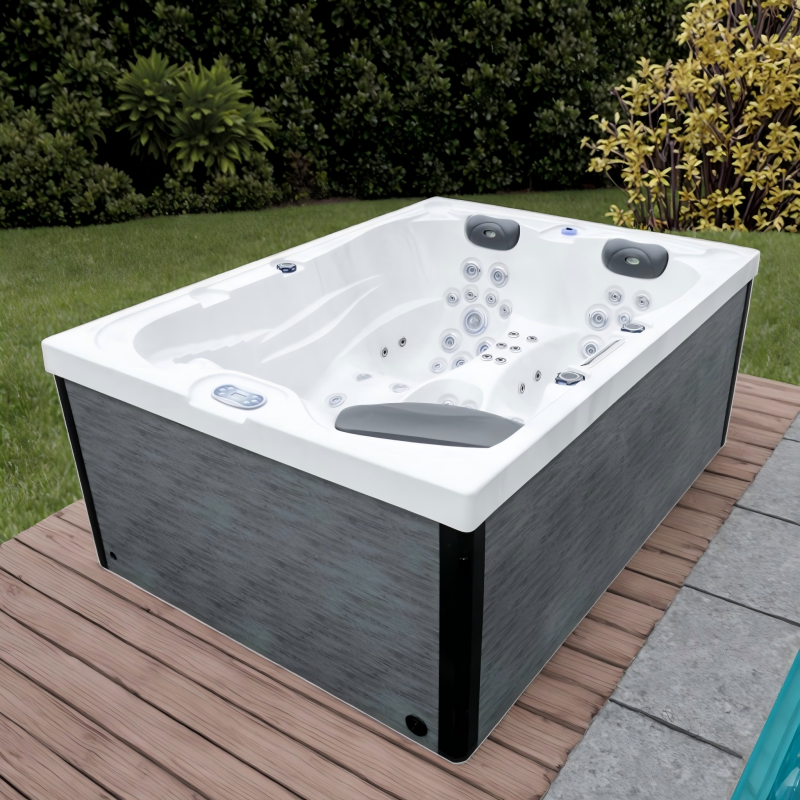
Why is yellowing water such a common issue for outdoor hot tub owners?
One of the key differences between an outdoor spa hot tub and a standard household bathtub is that the spa hot tub is not a "fill-use-drain" single-use fixture; instead, it is a closed-loop water system requiring continuous circulation, filtration, heating, and sanitization. Users often keep the same water in the tub for days or even weeks, making water quality management a decisive factor in the overall hot tub experience.
This is precisely where the problem arises. Many first-time outdoor whirlpool spa hot tub owners assume that as long as the tap water looks clear, they can simply fill the tub, set the temperature to between 37°C and 40°C, and activate the circulation and massage systems. However, "visual clarity" and "SPA-quality water" are two entirely different concepts. Water may contain invisible substances such as iron, manganese, calcium, magnesium, and other dissolved solids. Jacuzzi explicitly notes that tap water can contain dissolved minerals, metals, and varying pH levels; therefore, newly filled water still requires chemical balancing.
Conditions change further once this water enters the outdoor spa hot tub. First, rising temperatures alter the rate of chemical reactions within the water. Second, the circulation pump continuously drives water through filters, heaters, and plumbing lines. Third, the addition of chlorine, bromine, oxidizers, and pH adjusters alters the water's chemical environment. Metal ions that were initially dissolved may form colored compounds or precipitates due to oxidation or pH fluctuations, causing the water in the whirlpool spa hot tub to turn yellow, brownish-yellow, or even yellowish-green.
Consequently, when an outdoor spa hot tub's water "suddenly turns yellow," the color does not appear out of nowhere; rather, substances already present in the water have undergone changes due to the new temperature and chemical conditions.
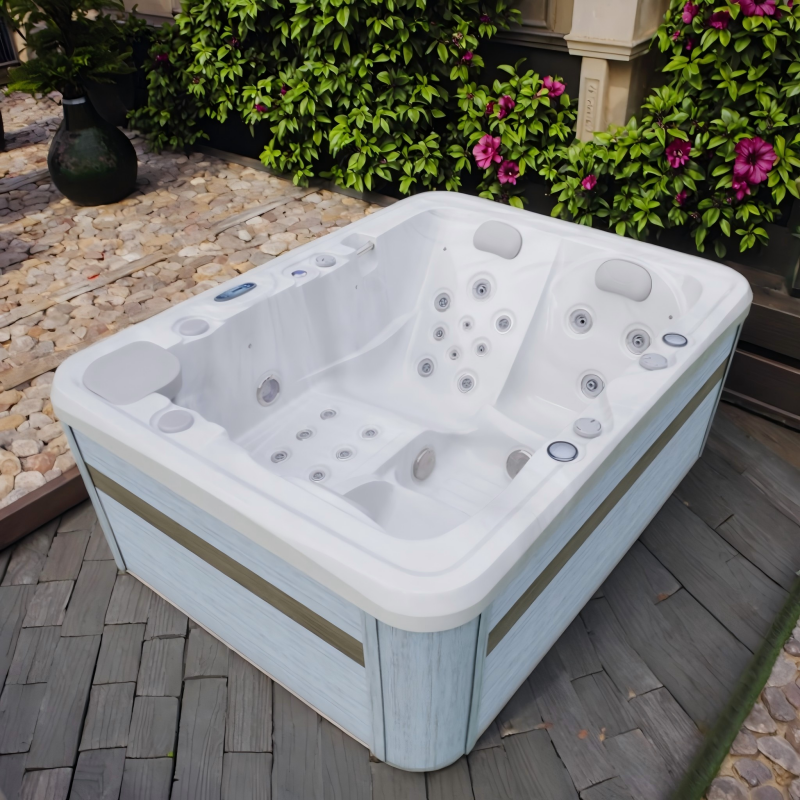
What are the most common causes of outdoor hot tub water turning yellow?
Based on practical maintenance experience and water chemistry principles, several areas should be investigated first when spa hot tub water turns yellow—with metal ions like iron and manganese being the primary concerns.
1. High iron content in the water source
Iron is a common culprit behind spa hot tub water turning yellow, brownish-yellow, or tan. Iron levels can be significantly higher than standard municipal supplies, particularly in areas relying on well water, groundwater, or tap water with high mineral content.
When the tub is first filled, the water may appear perfectly clear because the iron exists in a dissolved state. As the spa hot tub heats up and oxidizing sanitizers are added, the iron can oxidize to form insoluble iron compounds, gradually causing the water to take on a yellow or brownish-yellow hue.
This explains a common phenomenon reported by users: why the water is crystal clear immediately after a refill but turns yellow after chlorine is added. In reality, chlorine may not be the direct cause of the yellowing; instead, it promotes the oxidation of iron already present in the water, making the discoloration more apparent.
2. High manganese levels
Manganese can also cause discoloration and frequently co-occurs with iron in groundwater. Master Spas identifies both high iron and high manganese levels as potential causes of brown whirlpool spa hot tub water.
If the water in your outdoor spa hot tub appears yellowish-brown or brown, and rust-colored deposits form on the tub walls or filter, you should consider the presence of metal ions rather than simply assuming the filter is dirty.
3. Metals like copper causing yellow-green water
Copper typically produces a blue-green or green hue, but the visual color can become complex due to reactions with other metals, pH fluctuations, and sanitizers. Master Spas notes that high levels of iron or copper can result in clear green water.
If the water in your outdoor spa hot tub appears yellow with a greenish tint rather than a pure yellow, testing for metal content is crucial.
4. Imbalance in pH and total alkalinity
When users notice the water turning yellow, their first instinct is often to add more sanitizer, while overlooking pH and total alkalinity.
This is the wrong approach.
pH levels directly affect sanitizer effectiveness, mineral precipitation, equipment corrosion, and scale formation. Excessively high pH can lead to scale and staining, while low pH can cause corrosion of equipment components.
Master Spas recommends the following water quality ranges for residential spas: pH 7.2–7.6, total alkalinity 80–150 ppm, and calcium hardness 180–250 ppm. The CDC’s guidelines for public hot tubs/spas specify a pH range of 7.2–7.8 and recommend free chlorine levels of 3–10 ppm or bromine levels of 4–8 ppm. For specific home outdoor spa hot tubs, priority should be given to the manufacturer's recommendations and local regulations.
Persistently high pH levels make mineral precipitation more likely, whereas low pH can increase the risk of metal component corrosion and chemical instability. Consequently, yellow water is rarely caused by a single factor; it is usually the result of a combination of metal ions, oxidation, and pH fluctuations.
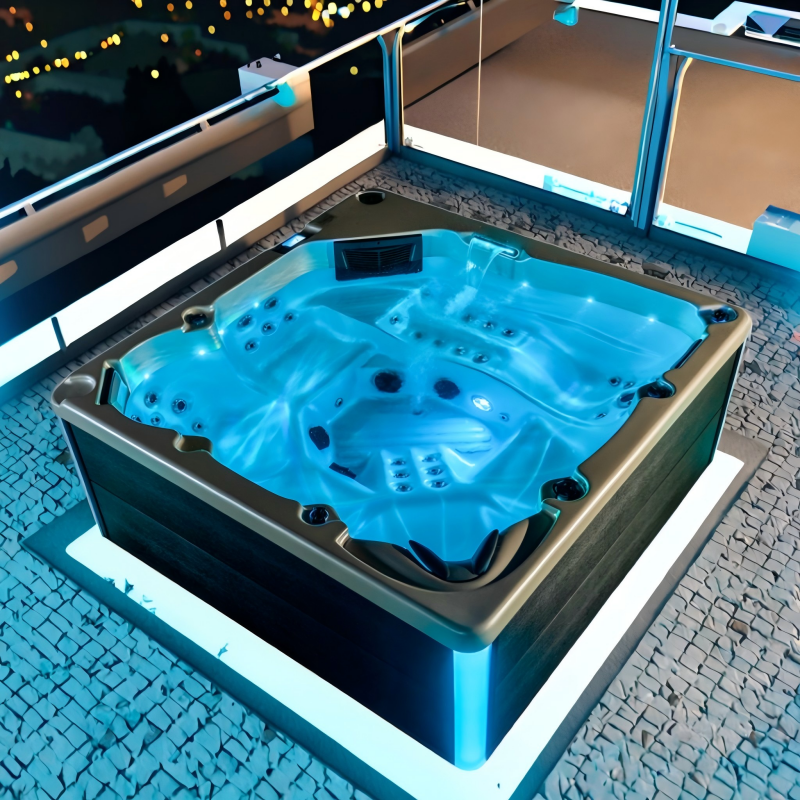
How can you resolve the issue of yellowing water in your outdoor hot tub?
If testing confirms that the primary cause is iron, manganese, or other metal ions, the focus should not simply be on adding more sanitizer. Instead, the priority is to control metal entry, minimize metal deposition, and remove the metals through filtration or water replacement.
1. Treat metal ions with metal sequestrants
For water sources with high levels of iron, copper, or manganese, use spa-compatible metal sequestrants or metal control products as recommended by the whirlpool spa hot tub manufacturer.
If the source water contains iron, copper, or manganese, metal sequestrants can help prevent these metals from staining the spa shell and internal plumbing.
It is important to note that sequestrants do not "make the metal disappear"; rather, they use chemical complexation to reduce the tendency of metal ions to precipitate and form stains. Dosage should be calculated based on the product label and the spa hot tub's actual water capacity, rather than added by estimation.
2. Install a pre-filter during the filling stage
If the issue of yellow water recurs every time the water is changed, one of the most effective long-term strategies is to address the problem at the source.
For example, using an inlet filtration system designed to target iron, manganese, suspended solids, or other specific contaminants can reduce the load of metals and particulates before the water enters the spa hot tub.
This is a more proactive approach than treating the water only after it has turned yellow.
Users relying on well water, in particular, are advised to conduct a comprehensive test of their source water first. If the source water has a high iron content, relying solely on the whirlpool spa hot tub's standard internal filter is often not the most cost-effective solution.
3. Clean or replace filters
Once iron or manganese oxidizes into particles, significant amounts of this material can become trapped in the filter. If the spa hot tub continues to operate under these conditions, the filter will rapidly accumulate yellow or brown deposits.
Therefore, cleaning the filter is crucial when dealing with yellow water issues.
LOVIA recommends that users clean their filters regularly and recognizes filter contamination as a common cause of water quality problems.
However, since filter materials and designs vary—with some cartridges being washable while others require direct replacement—it is essential to follow the specific instructions for your equipment.
4. Adjust pH and total alkalinity
If the water's pH is significantly too high or too low, adjust it gradually within the manufacturer's recommended range rather than adding large amounts of pH adjusters all at once. A common reference range for residential spas is a pH of 7.2 to 7.6 and total alkalinity of 80 to 150 ppm.
However, variations exist depending on the specific outdoor spa hot tub, sanitization system, and local water quality; therefore, you should ultimately defer to the equipment manufacturer's manual and local water quality guidelines.
Why is pH so important? Because pH affects not only user comfort but also the effectiveness of sanitizers and the likelihood of mineral precipitation.
5. Perform shock oxidation when necessary
If the yellow discoloration is accompanied by significant organic contamination, unpleasant odors, or insufficient sanitizer levels, consider an oxidation treatment (shocking).
However, shock treatment is not a cure-all.
If the root cause is iron in the source water, simply adding more chlorine will not solve the problem; in fact, it may accelerate iron oxidation, making the yellowing even more pronounced.
Therefore, you should identify the source of the problem before proceeding with oxidation according to product instructions.
Adjust pH and total alkalinity to the proper ranges before applying sanitizer, and perform shock oxidation based on actual usage.
6. If the water is severely yellowed, draining and refilling may be more effective
If the outdoor whirlpool spa hot tub shows severe yellowing, sediment buildup, or odors—and clarity cannot be restored despite testing and treatment—then draining, cleaning, flushing the plumbing, and refilling is often more practical than continuously adding various chemicals to the old water.
When water is chronically contaminated or difficult to restore, draining and refilling helps re-establish a stable water chemistry environment.
However, you must address any issues with the source water when refilling; otherwise, you risk falling into a cycle where the water turns yellow again immediately after the change.
Can yellow water damage outdoor whirlpool spa hot tub equipment?
Long-term water quality imbalance can indeed increase the risk of equipment damage.
For example, high pH and high mineral levels can lead to scale buildup, while low pH can accelerate the corrosion of metal components. Imbalanced alkalinity and pH can cause corrosion, staining, and scaling, potentially affecting parts such as heaters, pump seals, and plumbing connections.
This is why yellowing water should not be viewed merely as an aesthetic issue.
If the yellowing is caused by iron, manganese, or other metals and remains untreated for a long period, deposits may gradually accumulate in the filters, plumbing, jets, and even the heating assembly. In particular, the co-existence of limescale and metal deposits can reduce water circulation efficiency and make filters more prone to clogging.
Therefore, maintaining water quality in outdoor whirlpool spa hot tubs is not merely about aesthetics; it is also essential for extending the equipment's lifespan.
How can outdoor hot tub manufacturers help users address the issue of yellowing water?
For manufacturers, water quality issues should not be left entirely to the consumer to resolve. High-quality outdoor whirlpool spa hot tubs should incorporate a holistic approach to water circulation, filtration, treatment, and user maintenance right from the design stage.
When designing products, OEM/ODM manufacturers like LOVIA® can integrate "water quality diagnostics" into the user experience, rather than simply focusing on increasing the number of massage jets. For instance, clearly stating in the manual that "yellow water requires checking for iron, manganese, copper, pH, total alkalinity, and sanitizer levels" demonstrates greater professionalism than simply telling users to "add sanitizer if the water turns yellow."
This is particularly important for export-oriented spa hot tubs, as the mineral composition of tap water, well water, and groundwater varies significantly across different countries and regions. The same spa hot tub model may encounter completely different water quality issues depending on the market. Consequently, OEM/ODM solutions should allow for the selection of different pre-filtration, water treatment, and maintenance configurations based on local water sources.
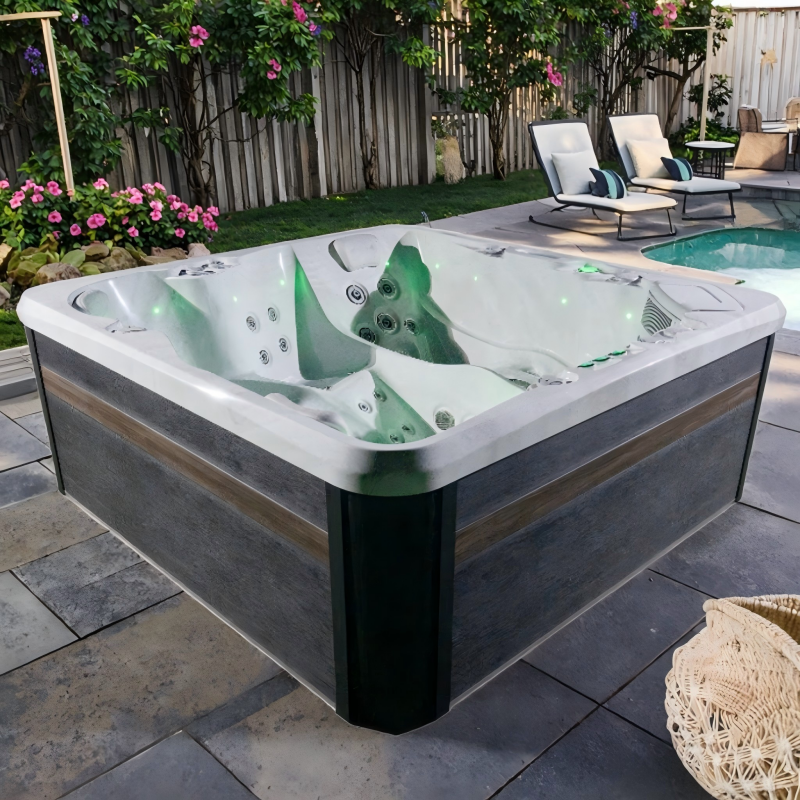
Professional Troubleshooting Process for Yellowing Hot Tub Water
To condense this entire topic into a practical troubleshooting workflow, one can follow this sequence: Water Source → Color → Parameters → Equipment → Treatment → Re-inspection.
Step 1: Take a sample of fresh water and test it directly to determine if the source water itself has a yellow or rusty tint.
Step 2: Test the spa hot tub water for pH, total alkalinity, and free chlorine or bromine, adjusting these levels to the appropriate range according to the equipment manual. Common reference values for residential spas include a pH of 7.2–7.6, total alkalinity of 80–150 ppm, and free chlorine of 2–4 ppm; however, specific requirements may vary based on the equipment and local regulations.
Step 3: If the water appears distinctly yellow, yellowish-brown, or brown—especially after a water change—prioritize checking for iron and manganese. If the water has a blue-green or yellow-green tint, investigate the presence of metals such as copper.
Step 4: Check the filter. If it has turned noticeably yellow or brown, clean or replace it.
Step 5: If a metal-related issue is confirmed, use a spa-compatible metal chelating agent according to the product instructions and keep the filtration system running.
Step 6: If the water is heavily contaminated, the discoloration persists, or water quality parameters are difficult to restore, consider draining the water, cleaning the tub and associated piping, and refilling with fresh, treated water.
Step 7: Address the root cause when refilling. If the source water has a high iron content, install an appropriate filtration system at the inlet; otherwise, you will face a recurring cycle of "change water—water turns yellow—change water again."
FAQ: Common Questions About Yellowing Water in Outdoor Hot Tubs
FAQ 1: Is it normal for outdoor spa hot tub water to turn yellow?
Slight, temporary discoloration can occur when minerals like iron or manganese in fresh water oxidize; however, water that remains yellow, yellowish-brown, or yellow-green—or is accompanied by cloudiness, odors, or sediment—should not be considered normal. You should test the water quality first rather than continuing to use it immediately.
FAQ 2: Why does the water in my outdoor whirlpool spa hot tub turn yellow right after a refill?
One of the most common causes is the presence of metals like iron or manganese in the source water. When the water first enters the tub, these substances may be in a dissolved state, making the water appear clear to the naked eye; however, after heating and adding oxidizing sanitizers, the metals oxidize, potentially resulting in a distinct yellow or brownish-yellow hue. Jacuzzi explicitly notes that newly filled water may contain dissolved minerals and metals, requiring water balancing after filling.
FAQ 3: Why does the water turn even yellower after adding chlorine?
If the water contains oxidizable metals like iron, chlorine can accelerate their oxidation, making the yellow color more pronounced. Therefore, yellowing after adding chlorine does not necessarily mean there is a problem with the chlorine itself.
FAQ 4: Can I simply add more chlorine if the spa hot tub water turns yellow?
This is not recommended. You first need to identify the source of the yellowing. If the issue is caused by metals like iron or manganese, simply adding more chlorine will not solve the root cause and may actually intensify the discoloration resulting from metal oxidation. You should test the water quality first and choose a solution—such as metal control agents, filtration, or a water change—based on the specific cause.
FAQ 5: Can a filter solve the problem of yellow water in an outdoor spa hot tub?
Filters can trap particles and sediment that have already formed, but standard mechanical filters have limited effectiveness against fully dissolved metal ions. If the yellow water is caused by iron or manganese in the source water, a more effective approach usually involves a combination of source water pre-treatment, metal control agents, and subsequent filtration.