


How to Choose the Best Outdoor Swim Spa for Residential Projects?
2026-11-07 15:30With the growing demand for home fitness, outdoor leisure, and wellness-oriented living, outdoor swim spas have become a popular feature for villas, high-end residences, and garden projects. Compared to traditional swimming pools, outdoor swim spas typically have a smaller footprint and integrate features such as counter-current swimming, heated soaking, and hydrotherapy—making them an ideal choice for households looking to combine exercise and relaxation within a limited space.
For residential developers, architects, and homeowners, selecting an outdoor swim spa hot tub involves more than just considering its appearance, dimensions, or price. It requires a careful assessment of usage needs, installation requirements, energy consumption, water quality management, and long-term maintenance costs. If the unit is improperly sized, the counter-current system is ill-suited for actual training, or the installation space lacks adequate access for servicing, the product’s utility may be compromised—regardless of how many features it offers.
Therefore, the key to selecting the best outdoor swim spa lies in tailoring the product configuration to the specific residential space and the needs of the household, while comprehensively evaluating performance, safety, and the total cost of ownership over the product's lifecycle.
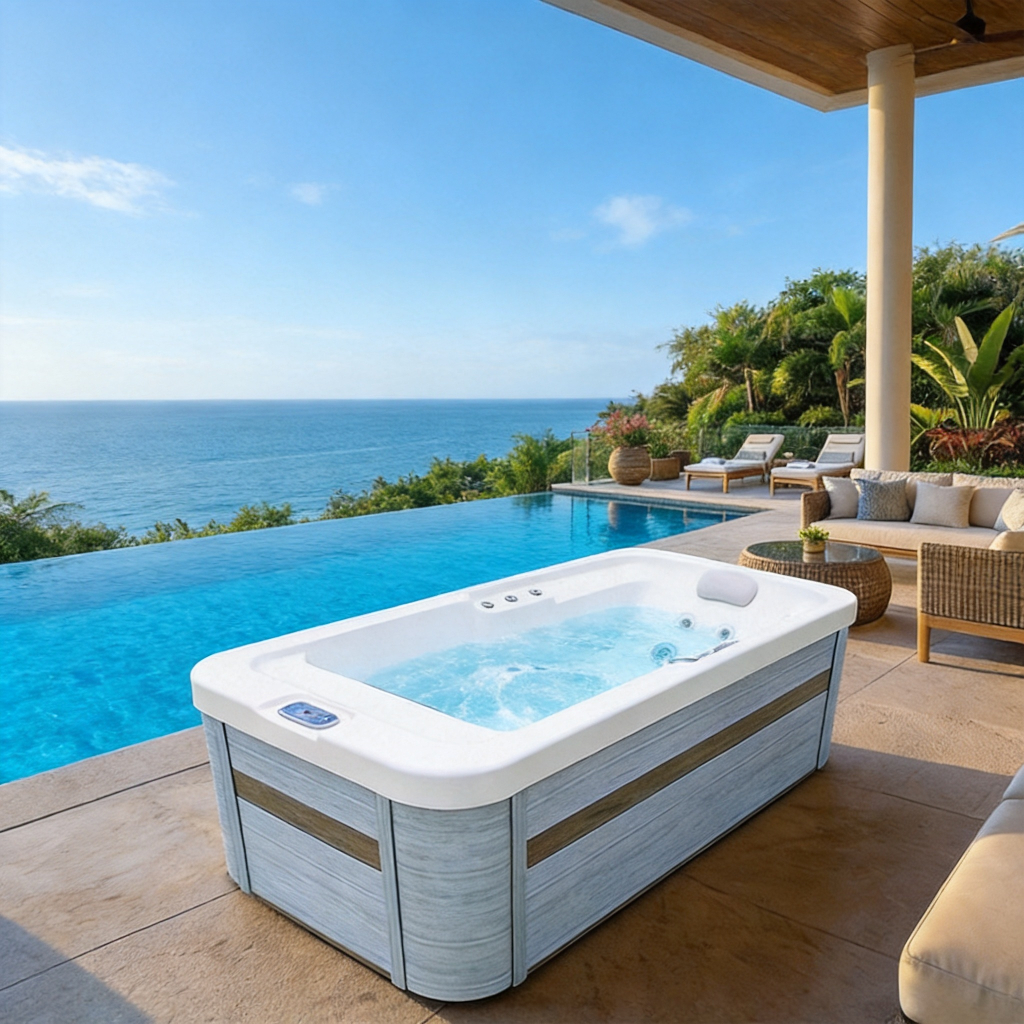
What factors should be considered before choosing an outdoor swim spa?
1. Define the primary purpose
Outdoor swim spa hot tubs are primarily designed for swimming training, family leisure, or comprehensive hydrotherapy—each with distinct requirements.
If the primary focus is swimming training, prioritize the stability and adjustability of the counter-current system, the effective swimming space, and the water depth. Since users need to maintain their swimming stroke from a relatively fixed position, it is essential to look beyond the unit's total external length and focus on the actual, usable swimming area.
If the primary focus is family leisure, prioritize the number of seats, the layout of massage jets, temperature control, and ease of entry and exit. For households with elderly members or children, consider features such as non-slip steps, handrails, and additional safety measures.
If you wish to accommodate both swimming and hydrotherapy, consider a dual-zone outdoor swim spa hot tub combo. These models typically separate the exercise area from the spa/relaxation area. However, they often come with a larger footprint, a higher price point, and increased maintenance complexity; before purchasing, verify how the heating, filtration, and control systems are configured for each zone.
2. Choosing Based on Family Members and Usage Frequency
Outdoor swim spas are often used by multiple people; therefore, factors such as the height, swimming proficiency, age, and usage habits of family members should be taken into account. For instance, adults might prioritize robust counter-current features for training, while other family members may prefer warm-water soaking and hydrotherapy (massage) experiences.
Usage frequency is equally important. If the unit is used daily for training, the heating, circulation/filtration, and counter-current systems will require longer operating hours. If it is primarily used for weekend leisure, a more tailored operating schedule—aligned with the manufacturer’s recommendations—can be established.
Before purchasing, it is advisable to estimate the weekly frequency of use, the duration of each session, and the desired water temperature. You should also request energy consumption data for specific models from the supplier, ensuring that long-term operating costs are considered alongside the initial purchase price.
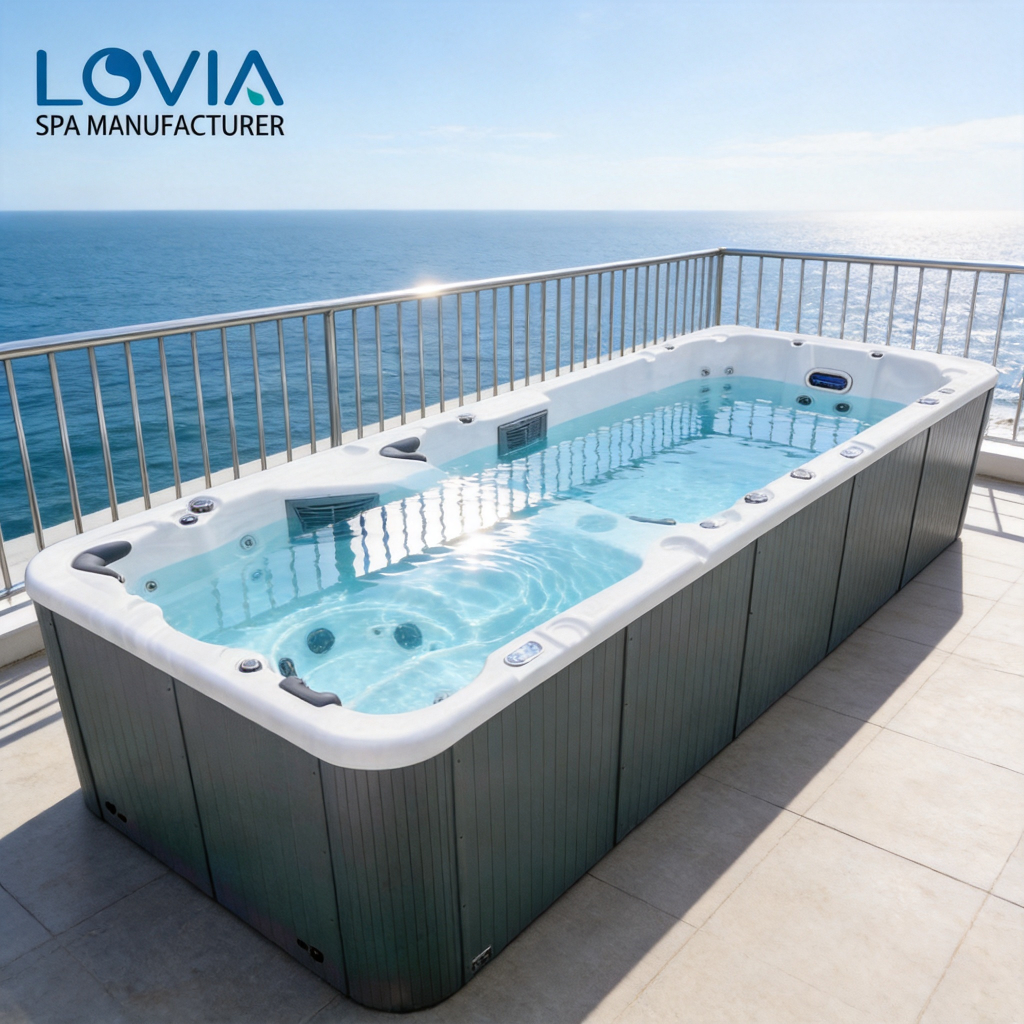
How to Choose the Right Size for an Outdoor Swim Spa?
The size directly impacts the swimming experience, backyard layout, and installation costs. For residential projects, one must consider the unit’s external dimensions, the effective swimming space, and the surrounding area required for maintenance.
While some residential outdoor swim spa hot tubs measure approximately 4.5–6 meters in length and 2.2–2.4 meters in width, dimensions vary by brand, model, and functional layout; always refer to the official product specifications.
1. Focus on Effective Swimming Space
The total length of the unit does not equate to the actual swimming length, as structural elements at the ends, seating, and hydrotherapy zones may occupy part of the space. If the user intends to engage in regular swim training, it is essential to verify that the effective swimming area is sufficient. A trial swim is recommended to evaluate the stability of the water current and ensure proper body positioning.
2. Allocate Space for Installation and Maintenance
The actual footprint of an outdoor swim spa hot tub combo includes not only the unit itself but also steps, access paths, clearance for opening the thermal cover, and space for equipment maintenance.
For example, a 5.5m × 2.3m swim spa has a footprint of approximately 12.65 square meters; however, residential installations typically require additional surrounding space. Before purchasing, create an installation layout plan to ensure that maintenance personnel have adequate access to the pumps, heaters, and filtration systems.
| Selection Factor | Compact Swim Spa | Larger Swim Spa | Dual-Zone Swim Spa |
| Primary Use | Fitness and casual swimming | More spacious swimming | Swimming and hydrotherapy |
| Space Requirement | Relatively low | Higher | Usually higher |
| Main Advantage | Space efficiency | Greater swimming area | Separate swimming and spa zones |
| Cost Consideration | Potentially lower | Higher purchase and installation costs | Potentially higher system and maintenance costs |
| Best Suited For | Small residential yards | Dedicated exercise spaces | Families with multiple needs |
How Should You Choose a Counter-Current System for an Outdoor Swim Spa?
The counter-current system is one of the core features of an outdoor swim spa hot tub combo. It uses a water pump to generate a current, allowing users to swim in place within a limited space. The quality of this current directly impacts the swimming experience, so it is important to evaluate several key aspects.
First, consider the stability of the water flow. If the current is too concentrated or unevenly distributed, it can negatively affect your swimming posture. You should examine the water outlet structure, the direction of the flow, and the available adjustment options—ideally by testing it out in the water yourself.
Second, do not rely solely on pump power or the number of nozzles; these metrics alone do not determine the actual swimming experience. Factors such as the flow pattern, the design of the water outlets, the configuration of the pump system, and the system's adjustability are equally important. If a supplier provides data on water speed or flow rate, be sure to verify the testing conditions and measurement methods used.
Finally, check whether the counter-current system and any integrated massage features can function well together. If an outdoor swim spa hot tub includes massage jets, inquire about any operational limitations, energy consumption, or noise levels that may occur when multiple features are used simultaneously.
For home fitness purposes, a counter-current system that is easy to adjust and offers stable, consistent flow is generally more practical than one that simply boasts high power.
What should you keep in mind when installing an outdoor swim spa?
Installation requirements are a common source of unexpected costs in residential projects. Because an outdoor swim spa becomes very heavy once filled with water, you must carefully assess the foundation's load-bearing capacity, the transport route, electrical requirements, and drainage arrangements well in advance.
1. Verify the load-bearing capacity of the foundation
An outdoor swim spa hot tub combo can be installed on a concrete base or a structurally engineered platform. The specific approach must be determined based on the equipment's weight, the volume of water, the weight of the users, and site-specific conditions.
While some installation guides may suggest a concrete pad approximately 4 inches (102 mm) thick, this is not a universal standard for all units. Larger models, sites with unique soil conditions, or installations on elevated decks require assessment by a structural professional.
Before purchasing, ask the supplier for the unit's dry weight, maximum water capacity, and installation specifications. Ensure that the foundation is level and capable of supporting the required load to prevent uneven stress on the equipment or difficulties with future maintenance.
2. Plan for transport and hoisting in advance
Outdoor swim spa hot tub combos are large and may not fit through standard side doors or narrow passageways. For residential projects, the width of transport routes, turning radii, and vertical clearance should be measured in advance, and potential obstacles—such as trees, eaves, or power lines—must be identified.
If a crane is required for installation, factors such as equipment weight, lifting distance, operational positioning, and necessary permits must be confirmed. Conducting a thorough site survey beforehand helps minimize costs associated with ad-hoc lifting operations or construction rework.
3. Provision for Drainage and Maintenance Access
Components such as water pumps, heaters, filters, and control systems require regular maintenance. If equipment is installed in an integrated or recessed manner, removable access panels must be included to ensure technicians can reach internal parts.
Drainage paths should also be planned in advance to prevent maintenance-related water runoff from reaching the building’s foundation, electrical equipment, or neighboring properties. In areas prone to heavy leaf fall, frequent rain, or snow, considerations should also be made for equipment protection and ease of routine cleaning.
How can energy consumption and maintenance costs for an outdoor swim spa be managed?
The long-term costs of an outdoor swim spa primarily include heating, circulation and filtration, operation of the counter-current (swim-against-the-current) system, water quality maintenance, and equipment repairs. When purchasing, it is important to evaluate these total costs rather than focusing solely on the initial purchase price.
1. Assessing Actual Energy Consumption
The power rating of a heater does not equate to the total power consumption of the entire unit. Actual electricity usage is influenced by factors such as ambient temperature, target water temperature, insulation effectiveness, frequency of use, and the runtime of water pumps.
For example, if an outdoor swim spa hot tub combo has a heater with a rated power of 3 kW and it operates for a total of 4 hours, the energy consumption for heating would be approximately 12 kWh. At a local electricity rate of $0.20 per kWh, this would amount to roughly $2.40. Please note that this is merely an illustrative calculation and does not represent the unit's total daily energy consumption; actual operation would also involve the heater's duty cycle and the power usage of other integrated systems.
It is recommended to request energy consumption data for the specific model from the supplier, while also verifying the ambient temperature, target water temperature, and operating mode used during the testing process.
2. Prioritizing Insulation Performance
High-quality insulation, a well-sealed thermal cover, and proper pipe insulation are essential for minimizing heat loss. Insulation performance is particularly critical for residential projects located in regions with cold winters. When the equipment is not in use, the thermal cover should be placed on promptly, and heating schedules should be managed based on actual usage frequency. In cold climates, it is also essential to follow the manufacturer’s anti-freeze requirements to prevent pipes from freezing—an issue that can arise when attempting to save energy.
3. Establish a Water Quality Maintenance Plan
Outdoor swim spa hot tub combos require regular filtration and disinfection to control contaminants and microbial risks. Routine maintenance includes monitoring disinfectant levels and pH, cleaning filters, inspecting jets and plumbing, and performing draining and cleaning as specified by the manufacturer.
When purchasing, verify that the filters are easy to clean, disinfection supplies are readily available, and reliable after-sales service is accessible locally. For units subject to frequent use by multiple people, water quality testing and maintenance record-keeping should be intensified.
4. Compare Total Life-Cycle Costs
| Cost Category | Key Considerations | Recommended Action |
| Initial Purchase | Size, pumps and optional features | Compare equivalent configurations |
| Site Preparation | Foundation, drainage and landscaping | Obtain a site-specific quotation |
| Delivery | Access and crane requirements | Confirm the delivery route |
| Electricity | Heating and pump operation | Request model-specific energy data |
| Water Care | Filters and sanitizers | Check maintenance requirements |
| Repairs | Parts, labor and warranty | Verify local service availability |
By comparing the costs of procurement, installation, transportation, electricity consumption, and maintenance, owners can more accurately assess the long-term value of different outdoor swim spa hot tub products.
How to Choose Safety Features and Smart Functions for Outdoor Swim Spas?
For residential projects, priority should be given to electrical safety, temperature control, anti-slip design, and child safety measures. Electrical wiring, grounding, and residual-current protection (RCD/GFCI) must comply with local regulations and be installed by qualified professionals. Refer to the technical documentation for the specific model to determine the required supply voltage and rated current.
The area surrounding the equipment should feature appropriate anti-slip surfacing, steps, and lighting. Additionally, check local regulations to determine if protective measures—such as fencing or safety gates—are required. Children must be under constant adult supervision when using the unit; filtration systems and safety covers should never be considered absolute protective measures.
Regarding smart functions, prioritize features such as digital temperature control, programmable filtration schedules, fault alerts, and remote status monitoring. While these functions enhance operational convenience, they cannot entirely replace manual water quality testing and routine maintenance.
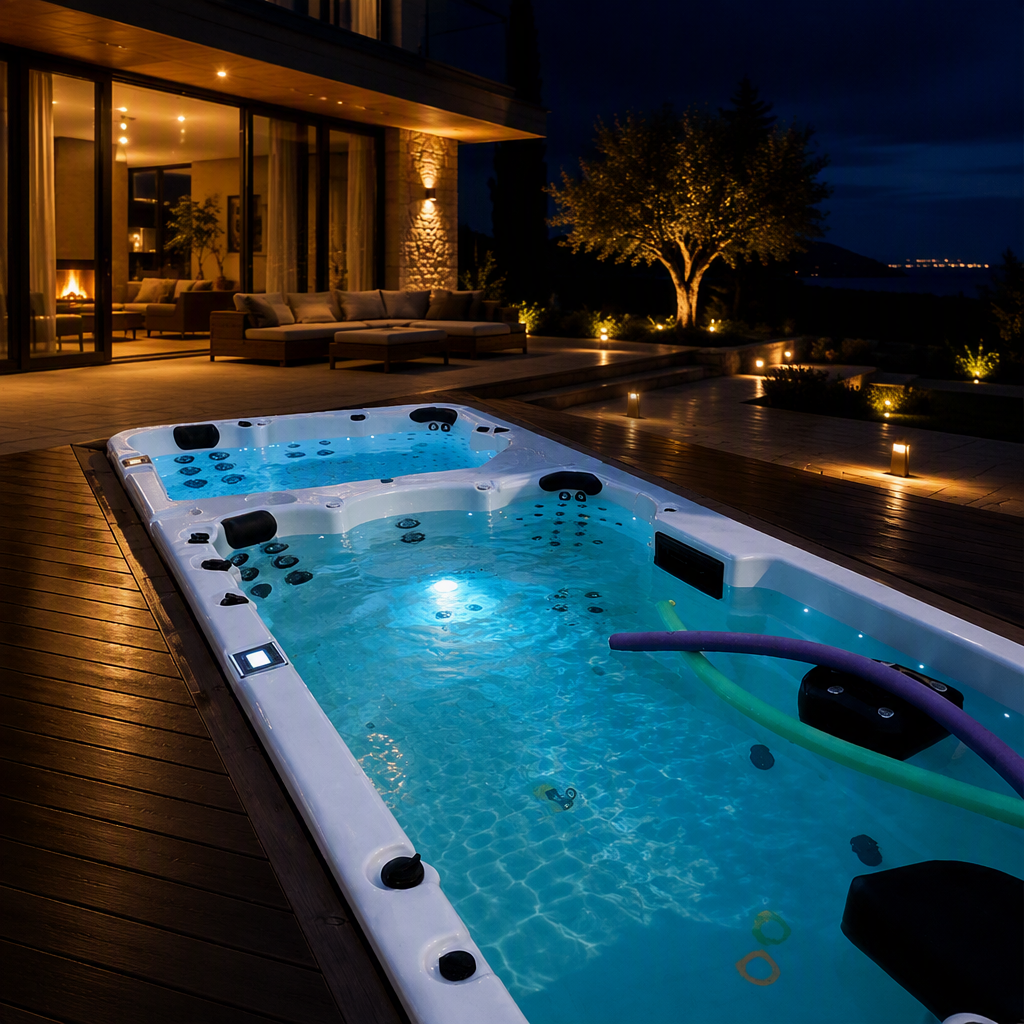
Common Issues and Solutions for Purchasing Outdoor Swim Spas for Residential Projects
Issue 1: The equipment is too large and takes up too much space in the yard. Solution: Create a comprehensive site plan before purchase, marking the equipment, maintenance access areas, the clearance required for opening the thermal cover, and pathways, before finalizing the model selection.
Issue 2: The counter-current (swim-against-the-current) system is not suitable for actual training needs. The solution is to arrange a trial session to evaluate the stability of the water current and the range of adjustment. Additionally, request technical specifications for the specific model from the supplier, rather than relying solely on the pump’s power rating.
Issue 3: Construction and hoisting costs exceed the budget. The solution is to conduct a site survey before signing the contract, ensuring that costs for foundations, electrical work, drainage, transportation, and hoisting are all included in the total quote.
Issue 4: High winter operating costs. The solution is to select equipment with excellent thermal insulation, plan heating schedules efficiently, and estimate annual operating costs based on local electricity rates.
Issue 5: Difficulties with after-sales maintenance. The solution is to verify the scope of the warranty, the availability of local service support, the lead time for spare parts, and labor costs in advance, so as to avoid prolonged downtime in the event of an equipment failure.
Frequently Asked Questions (FAQ)
FAQ 1: What size outdoor swim spa hot tub should be chosen for a residential project?
The size should be determined based on swimming requirements, the available area in the yard, and installation conditions. Some residential models are approximately 4.5–6 meters long, though the actual swimming space varies by product. Before purchasing, confirm that there is sufficient access for maintenance and space for opening the thermal cover.
FAQ 2: Can an outdoor swim spa completely replace a traditional swimming pool?
Not necessarily. While outdoor swim spas are well-suited for stationary swimming and hydrotherapy/leisure, traditional pools generally offer a longer continuous swimming distance. Families requiring specific training or accommodating multiple swimmers simultaneously should choose based on their actual intended use.
FAQ 3: Do outdoor swim spa hot tubs consume a lot of electricity?
This depends on thermal insulation, the target water temperature, the local climate, and the frequency of use. It is recommended to ask the supplier for energy consumption data for the specific model and estimate long-term costs based on local electricity rates.
FAQ 4: Can an outdoor swim spa hot tub combo be installed on a terrace or deck?
It may be possible, but the load-bearing capacity of the terrace must be assessed by a structural professional. Once filled with water, the total weight of the unit can reach several tons; therefore, suitability cannot be determined based on the surface area alone.
FAQ 5: What is the difference between single-zone and dual-zone outdoor swim spas?
Single-zone models typically prioritize space efficiency and integrated functionality, whereas dual-zone models separate the swimming area from the hydrotherapy/spa area. Dual-zone units cater to diverse usage needs but generally come with larger dimensions, higher prices, and greater system complexity.