


How Much Water Does a 6-Person Spa Hot Tub Hold?
2026-05-25 15:35When purchasing or using a spa hot tub, many people frequently ask a very specific—yet critical—question:
Exactly how much water can a 6-person spa hot tub hold?
While this question may seem simple, it actually involves a multitude of technical factors, including the hot tub's structural dimensions, effective water depth, internal seating design, water line height, and operational safety requirements. Relying solely on external dimensions can easily lead to inaccurate—or even erroneous—conclusions.
This article will focus on the LOVIA® 6-person spa hot tub (measuring 2000 × 2000 × 880 mm). From a professional perspective, we will systematically analyze its actual water-holding capacity, the key factors that influence this capacity, and why "theoretical volume ≠ actual water usage."
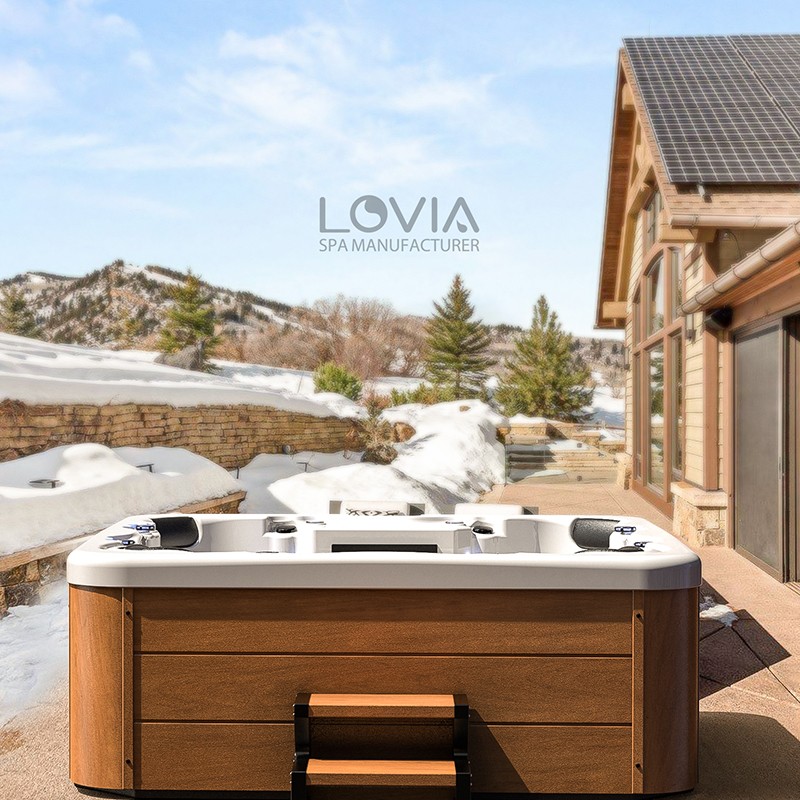
What Does the "Water Capacity" of a 6-Person Spa Hot Tub Refer To?
Before discussing how much water a spa hot tub can hold, we must first clarify a fundamental concept:
"Water capacity" is not synonymous with the "geometric volume of the spa hot tub."
In the industry, the water capacity of a spa hot tub typically carries three distinct meanings:
1. Theoretical Volume:
The maximum spatial volume calculated strictly based on the external dimensions.
2. Maximum Operational Capacity:
The highest volume of water that can be filled into the spa hot tub without overflowing or compromising the proper functioning of the equipment.
3. Actual Usage Capacity:
The true volume of water required to maintain a comfortable water level when the hot tub is occupied (either fully or partially).
When users ask, "How much water does a 6-person spa hot tub hold?" what they are typically most interested in are the second and third definitions of water capacity.
Can You Calculate a Spa Hot Tub's Water Capacity Based Solely on Its Dimensions?
Many people's first instinct is to apply a direct mathematical formula:
Length × Width × Height = Water Capacity
However, when it comes to spa hot tubs, this method of calculation is inaccurate. The reasons include:
•The interior of a spa hot tub is not a perfect rectangular prism.
•Seats, footrests, and backrests occupy a significant amount of internal space.
•The actual water level is always situated below the rim of the tub.
•The placement of jets and overflow outlets determines the safe maximum water level.
Therefore, the external dimensions serve only to estimate the theoretical upper limit and do not directly represent the actual water-holding capacity.

What is the theoretical volume of a 6-person spa hot tub measuring 2000 × 2000 × 880 mm?
Let us begin by calculating the theoretical volume to establish a baseline reference.
Converting dimensions to meters:
•Length: 2.0 meters
•Width: 2.0 meters
•Height: 0.88 meters
Theoretical volume calculation:
2.0 × 2.0 × 0.88 = 3.52 cubic meters
Converting to water volume:
1 cubic meter = 1000 liters of water
Theoretical maximum water volume ≈ 3520 liters
Note:
This figure represents only the geometric upper limit of the internal space; it does not reflect the actual usable water volume of the spa hot tub.
Why can't a spa hot tub's capacity be calculated based on a completely full tub?
During the design phase, spa hot tubs are strictly designed not to be filled to the very top of the shell. The reasons include:
1. Preventing Overflow
When a spa hot tub is in operation:
•The jet system is activated.
•The water circulates at high velocity.
•The water level rises when people enter the tub.
If the water level is too high, overflow is highly likely to occur.
2. Ensuring Proper Jet Functionality
Most spa hot tub jets require the water level to fall within a specific range to function correctly; a water level that is either too high or too low will compromise the jet performance.
3. Safeguarding Electrical and Structural Integrity
Maintaining an appropriate water level is a fundamental prerequisite for the safe operation of a spa hot tub.
Consequently, the effective water line is typically positioned 10–20 centimeters below the top rim of the tub shell.
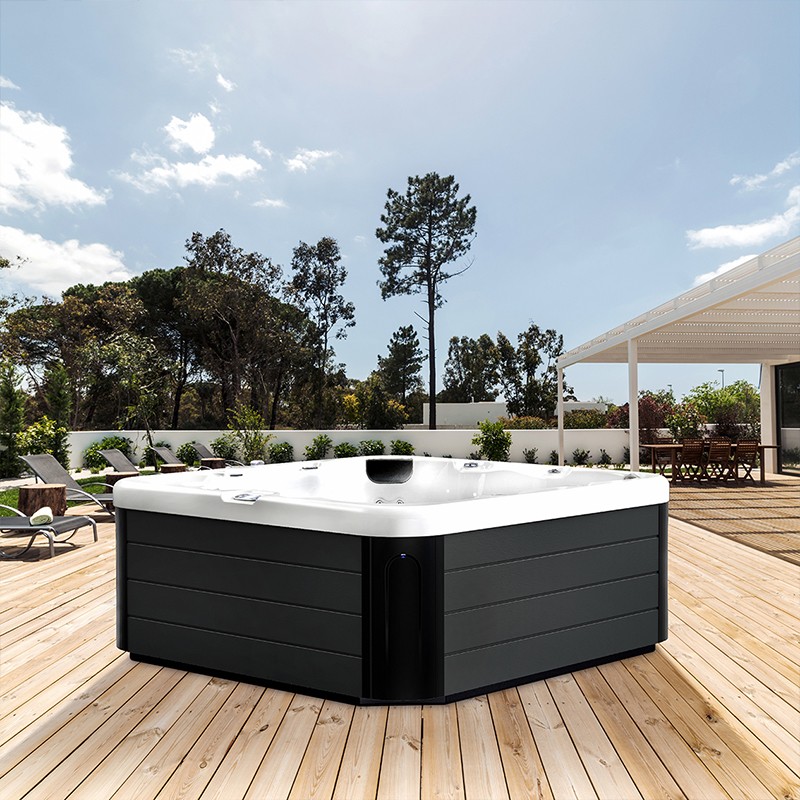
How does the effective water line impact the actual water-holding capacity of a spa hot tub?
Let's take a spa hot tub with a height of 880 mm as an example:
•The actual recommended water level is typically:
650–750 mm
We will use 700 mm (0.7 meters) as our median reference value.
Adjusted water volume:
2.0 × 2.0 × 0.7 = 2.8 cubic meters
Water quantity after adjusting the level ≈ 2,800 liters
However, this is still not the final, actual water quantity used.
How much water capacity does the internal seating structure displace?
One of the most significant differences between a spa hot tub and a standard bathtub is its complex, ergonomically designed seating structure.
The interior of a 6-person spa hot tub typically features:
•6 individual seats
•Backrests of varying heights
•Leg massage zones
•A central footwell or foot jet zone
These structures inherently occupy a substantial amount of space.
Industry Empirical Data:
In a 6-person spa hot tub:
•Internal structures typically occupy 25%–35% of the total volume.
We will use the median value of 30% for our estimation.
What is the actual usable water capacity of a 6-person spa hot tub?
Based on the step-by-step adjustments outlined above:
1.Theoretical Volume: 3,520 liters
2.After lowering the water level: ≈ 2,800 liters
3.After deducting the volume of the internal seating (approx. 30%):
2,800 × 70% ≈ 1,960 liters
Conclusion (Reference Range):
For a 6-person spa hot tub measuring 2000 × 2000 × 880 mm:
•The actual water fill volume typically falls between 1,800 and 2,200 liters.
•The commonly stated nominal water capacity is approximately 1,900–2,100 liters.
This range represents the true water volume required for the spa hot tub to operate normally and provide a comfortable user experience.
Does the water volume in a spa hot tub change depending on the number of users?
The answer is: Yes, it does.
The water volume in a spa hot tub is closely correlated with the number of people using it. The reasons include:
•When people enter the tub, they displace a certain volume of water.
•The more people using the tub, the more noticeable the rise in the water level becomes.
•When initially filling the tub, space must be reserved to accommodate the water displacement caused by the users.
Therefore:
•The water volume required for an empty tub fill > The actual water volume required for full-capacity use.
•When six people are using the tub simultaneously, the initial fill volume should be slightly below the maximum operating water level.
This is also why the water volume figures provided by manufacturers are typically listed as "reference volumes."
What is the relationship between a spa hot tub's water volume and its heating time?
The larger the water volume, the more energy is required to heat it.
For a 6-person spa hot tub:
•It holds between 1,800 and 2,200 liters of water.
•Raising the temperature of every single liter of water by 1°C requires additional energy.
•The water volume directly impacts both the initial heating time and the efficiency of maintaining the water temperature.
Therefore, accurately understanding a spa hot tub's water capacity helps you reasonably assess its heating performance, rather than blindly making assumptions about the equipment's capabilities.
The Impact of Water Volume on Spa Hot Tub Operating Costs
A spa hot tub's water volume also affects:
•The cost of the initial fill.
•The frequency of water changes.
•The quantity of sanitizers required.
•The workload on the circulation and filtration system.
Because a 6-person spa hot tub holds a relatively large volume of water, its daily maintenance and management are closely tied to that volume; however, this falls within the normal range of operation and does not indicate an abnormal maintenance burden.
Why do water volume specifications often vary among manufacturers?
You may notice that different manufacturers often provide water volume figures that do not exactly match, even for spa hot tubs of similar dimensions.
The reasons include:
•Differences in the standards used to calculate the water level.
•Variations in the internal seating structure.
•Whether the calculation is based on a full-capacity load (with users) or an empty tub.
•Whether the figure listed represents the "maximum capacity" or the "recommended capacity."
Consequently, the water volume specification for a spa hot tub should be viewed as a range rather than an absolute, fixed value.
Common Misconceptions When Assessing a Spa Hot Tub's Water Capacity
Misconception #1: Larger dimensions always mean a larger water volume.
Differences in internal structural design can lead to significant variations in water volume, even among tubs of the same external dimensions.
Misconception #2: Calculating water volume based on the maximum tub height (brim-full).
This is the most common—and least accurate—method of calculation.
Misconception #3: Ignoring the impact of the number of users on the water volume.
The volume of water displaced by human bodies is a factor that cannot be overlooked.
How should one correctly interpret the water capacity of a 6-person spa hot tub?
For a 6-person spa hot tub measuring 2000 × 2000 × 880 mm, the reasonable, realistic, and usable water capacity typically falls within the range of 1800 to 2200 liters.
When interpreting the water capacity of a spa hot tub, the focus should not be on chasing the "highest possible figure," but rather on understanding:
•Structural design
•Effective water level
•Safety operational requirements
•Actual usage conditions
Only in this way can one truly grasp the underlying significance of the parameters associated with a spa hot tub.
Is Lovia Spa suitable for bulk purchasing?
Lovia Spa is highly suitable for bulk purchasing due to its strong production capacity and stable supply system. As a large-scale factory, our company can efficiently handle wholesale orders of spa hot tub and swim spa tub products while maintaining consistent quality. Buyers benefit from competitive prices, reliable delivery, and flexible order arrangements. This makes Lovia Spa an ideal partner for distributors, retailers, and project buyers.