


Which chemicals keep outdoor spa hot tub water clear?
2026-07-09 15:30With the rising popularity of backyard living and wellness-focused home lifestyles, outdoor spa hot tubs have become a sought-after feature in high-quality homes. More and more families are installing them in gardens, on terraces, or in courtyards, seeking a relaxing spa experience on cold winter nights or after a busy day at work. However, after using them for a while, many owners encounter a challenge far trickier than the installation itself: how to keep the water consistently clear and transparent.
Many people share a similar experience: fresh water looks crystal clear at first, but after just a few days of use, it turns cloudy or milky, and may even develop foam, an oily film, or unpleasant odors. Some owners mistakenly believe that simply adding more sanitizer will solve the problem; in reality, water clarity is not determined by a single factor but depends on a systematic approach involving chemical balance, mechanical filtration, usage habits, and environmental management.
Maintaining water quality in an outdoor spa hot tub is actually more challenging than in a standard swimming pool. First, the water temperature is typically kept between 37°C and 40°C. While this high temperature is comfortable, it creates ideal conditions for the proliferation of bacteria and microorganisms, as well as the breakdown of organic contaminants. Studies show that in environments approaching 40°C, certain bacteria can reproduce more than twice as fast as they do at room temperature. Second, outdoor hot tubs have a relatively small water volume—most residential units hold only 1,000 to 1,800 liters—yet they may accommodate two to six people at a time. This means the pollution load per liter of water is far higher than that of a standard swimming pool.
Furthermore, outdoor spa hot tubs are exposed to additional contaminants from the outdoor environment. Fallen leaves, pollen, dust, insects, minerals from rainwater, and airborne particulates constantly find their way into the water. When combined with sweat, sebum, sunscreen, skincare products, and cosmetic residues introduced by bathers, these substances accumulate rapidly, causing the water quality to deteriorate. According to industry statistics from the Pool & Hot Tub Alliance, a single adult introduces over 0.5 grams of organic contaminants into the water upon entering a hot tub; after an hour of continuous use by multiple people, the contamination load can equal that of a single person using it for several hours. Therefore, to keep an outdoor hot tub clear over the long term, one must understand which chemicals are at work and the conditions required to maintain water clarity.

Which chemicals keep outdoor spa hot tubs clear?
Maintaining a clear outdoor whirlpool hot tub relies on five key categories of chemicals: sanitizers, balancers, oxidizers, clarifiers, and maintenance aids. Each addresses a different aspect of water quality, and the absence of any single component can lead to rapid water quality deterioration.
Sanitizers are the core chemicals for maintaining clarity
If one had to choose the single most important category of chemicals, the answer would undoubtedly be sanitizers. For outdoor spa hot tubs, sanitizers not only kill bacteria and microorganisms but—more importantly—break down organic contaminants in the water, preventing turbidity at the source.
Chlorine is the most common sanitizer. Its advantages—rapid disinfection, relatively low cost, and a well-established maintenance framework—make it widely used for outdoor spa hot tubs. Ideally, the free chlorine concentration in an outdoor spa hot tub should be maintained between 3 and 5 ppm. If the concentration drops below 2 ppm, disinfection efficiency drops significantly; conversely, excessively high concentrations can irritate the skin and eyes. Chlorine effectively oxidizes ammonia, urea, and other organic contaminants found in sweat, making it highly effective at preventing cloudy water.
Bromine is another common choice. Compared to chlorine, bromine is more stable in high-temperature environments, making it particularly well-suited for outdoor whirlpool hot tubs. Because outdoor hot tubs operate at high temperatures, chlorine dissipates relatively quickly, whereas bromine retains its disinfecting efficacy for longer periods. It is generally recommended to maintain bromine levels between 4 and 6 ppm. Many users of high-end outdoor whirlpool hot tubs prefer bromine systems because they produce less irritating odor and are relatively gentle on the skin.
In recent years, saltwater systems have also gained popularity. A saltwater system does not eliminate the need for chlorine entirely; instead, it continuously generates chlorine through the electrolysis of salt. This method helps maintain a more stable sanitizer concentration in the outdoor whirlpool hot tub and reduces the frequency of manual dosing, making it particularly suitable for users looking to lower maintenance costs.
pH Adjusters Determine Sanitization Efficiency
Many users find that the water in their outdoor hot tub remains cloudy even after adding sufficient chlorine. This situation is often not due to a lack of sanitizer, but rather a pH imbalance that reduces sanitization efficiency.
pH measures the acidity or alkalinity of the water. For outdoor whirlpool hot tubs, the ideal pH range is between 7.2 and 7.8. When the pH is too low, the water becomes acidic; this can corrode heating elements, jets, and metal fittings, and may also irritate the skin. Conversely, high pH levels lead to more common issues: reduced sanitizer efficiency, mineral precipitation, and increased calcium deposits, ultimately causing the water to turn cloudy or milky white.
Experimental data shows that when pH rises from 7.5 to 8.0, the effective germ-killing power of chlorine can drop by more than 40%. This means that even if chlorine levels appear normal, the actual sanitizing effect may be severely compromised. Therefore, it is essential to regularly test the pH of an outdoor whirlpool hot tub and adjust it using specific pH adjusters. Common agents for raising pH include sodium carbonate, while sodium bisulfite is typically used to lower it.
Total Alkalinity and Calcium Hardness Determine Water Stability
Two other critical—yet often overlooked—parameters in outdoor whirlpool hot tub maintenance are total alkalinity and calcium hardness.
Total alkalinity can be understood as the water's buffering capacity against pH fluctuations. The ideal range is generally 80 to 120 ppm. If total alkalinity is too low, the pH will fluctuate frequently—swinging between acidic and alkaline—making it difficult to maintain stable water quality. If it is too high, the water may appear dull or cloudy, and the risk of scale formation increases. Sodium bicarbonate is commonly used to raise total alkalinity.
Calcium hardness relates to the mineral balance of the water. For outdoor spa hot tubs, a level between 150 and 250 ppm is recommended. If calcium hardness is too low, the water becomes "aggressive" (or "hungry"), potentially corroding metal components and mineral surfaces within the equipment; if it is too high, it can lead to scale formation and cloudy, milky water. This situation is particularly common in areas with hard water and is a primary cause of the cloudy, milky appearance often seen in outdoor hot tubs.
Shock Treatment Quickly Restores Clarity
Even with excellent routine maintenance, organic contaminants inevitably accumulate in outdoor spa hot tubs. Levels of sweat, body oils, and skincare residues rise significantly—especially after use by multiple people—often exceeding the capacity of standard sanitizers to break down all contaminants quickly.
This is where "shock treatment" comes in. Shocking is essentially a powerful oxidation process that rapidly breaks down organic contaminants while reactivating the sanitizer. For outdoor spa hot tubs, shocking is virtually essential for maintaining clear water.
For typical households, a weekly shock treatment is recommended; however, if the spa hot tub sees heavy use—such as after a family gathering or consecutive sessions by multiple people—it is best to shock the water immediately that same day. Many users find that water which appeared slightly cloudy becomes noticeably clear again within just a few hours of shocking.
Clarifiers and Enzymes Help Address Fine Contaminants
Sometimes, an outdoor whirlpool hot tub may appear slightly cloudy even though all test readings are within normal ranges. In such cases, the issue often stems from suspended particles that are too small for the filtration system to capture effectively.
Clarifiers work by causing these tiny particles to clump together into larger ones, making them easier for the filter to trap. They are highly effective for treating water that is mildly cloudy or has a milky appearance.
Additionally, enzyme products are becoming increasingly common in the maintenance of high-end outdoor spa hot tubs. Enzymes actively break down oils, lotions, sunscreen, and cosmetic residues, thereby reducing the impact of these organic substances on water quality. For spa hot tubs prone to foaming or oily surface films, enzymes can significantly improve the water's visual clarity.
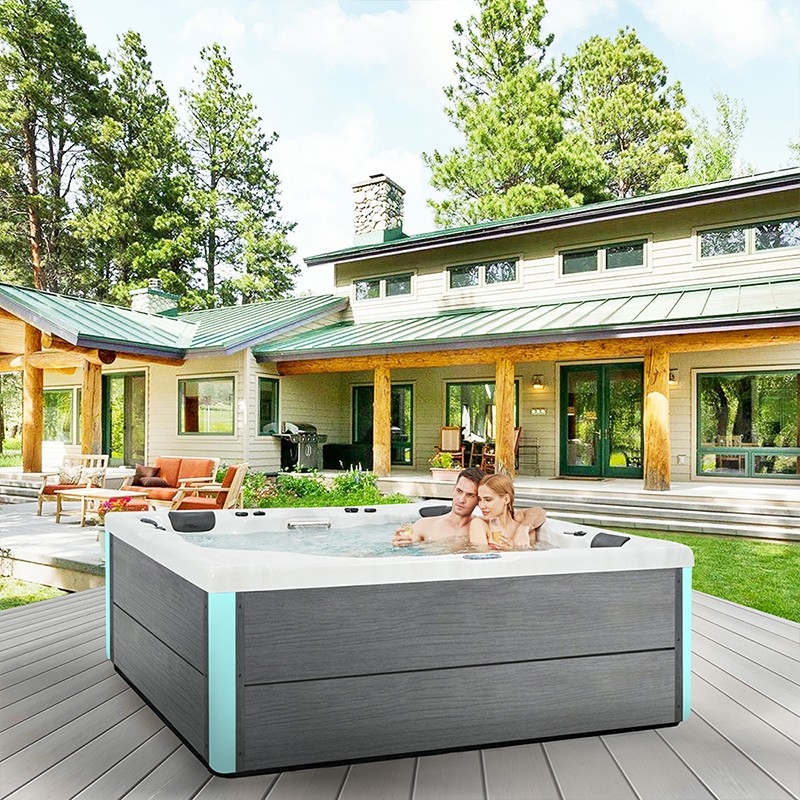
What Conditions Are Required for a Crystal-Clear Outdoor Hot Tub?
While chemicals are important, they are only one part of maintaining clear water. A truly clear outdoor whirlpool hot tub requires several conditions to be met simultaneously.
Condition 1: Stable Chemical Balance
A clear outdoor whirlpool hot tub begins with chemical parameters falling within a healthy range. Ideally, pH, total alkalinity, calcium hardness, and sanitizer levels should all remain stable. If any of these deviate significantly, water quality can deteriorate rapidly.
Many cloudiness issues are not caused by a deficiency in a single chemical, but rather by a combined imbalance of multiple parameters. Therefore, regular testing is essential. Industry guidelines generally recommend testing the water quality of outdoor whirlpool hot tubs at least two to three times a week, or daily if usage is frequent.
Condition 2: The filtration system must be highly efficient
While chemical treatment breaks down contaminants, the filtration system physically removes them; both are indispensable.
Industry recommendations suggest running the filtration system for at least 4 to 8 hours daily, or 8 to 12 hours for households with high usage. If the filter cartridge becomes clogged, the water may turn cloudy even if the chemical balance is correct. Oils and particulates accumulating on the filter surface significantly reduce filtration efficiency; therefore, it is recommended to rinse the cartridge weekly, deep-clean it monthly, and replace it annually.
Condition 3: Users must maintain healthy habits
Many water quality issues in outdoor spa hot tubs stem from poor usage habits. People often overlook the fact that the contaminants on their bodies before entering the tub far exceed expectations. Sweat, skincare products, sunscreen, perfume, and even laundry detergent residue can all end up in the water.
Data shows that showering before entering an outdoor spa hot tub can reduce the contaminant load by more than 50%. This is one of the simplest and most cost-effective ways to improve water quality.
Condition 4: Manage usage intensity
Although an outdoor spa hot tub may be rated for four or six people, this does not mean it can be used at full capacity for extended periods without affecting water quality. The more users there are, the faster contaminants accumulate and disinfectants are depleted.
Experience suggests that for every additional user, the demand for disinfectant may increase by 10% to 20%. Consequently, replenishing disinfectant and performing a "shock treatment" is almost mandatory after the spa hot tub has been used for a gathering involving multiple people.
Condition 5: Regular water replacement is mandatory
Many people mistakenly believe that the water in an outdoor spa hot tub can be used indefinitely simply by continuously adding chemicals. This is not the case.
Over time, the total dissolved solids (TDS) in the water—including minerals, salts, and residual contaminants—will steadily increase. These substances cannot be fully removed through filtration alone. A common industry rule of thumb indicates that outdoor spa hot tubs in typical households require a complete water change every two to four months. The higher the usage frequency, the shorter the interval between water changes should be.
Condition 6: Use a hot tub cover to minimize external contamination
For outdoor whirlpool hot tubs, a cover is not merely an accessory but an essential maintenance tool. A high-quality cover significantly reduces the entry of fallen leaves, dust, and insects, while also protecting sanitizers from UV degradation.
Data shows that a high-quality cover can reduce external contamination entering the water by over 70%, while also minimizing heat loss and improving energy efficiency. The importance of a cover in maintaining clear water in an outdoor spa hot tub is often underestimated.
FAQ
How often should sanitizer be added to an outdoor spa hot tub?
It is generally recommended to replenish sanitizer after each use and test the water at least every 2 to 3 days; daily testing is advisable during periods of frequent use.
How long does it take for cloudy outdoor spa hot tub water to clear up?
Mild cloudiness usually clears up within 6 to 24 hours after adjusting water parameters and performing a "shock" treatment; severe cases may require a water change.
Which is better for outdoor whirlpool hot tubs: chlorine or bromine?
Bromine is generally more stable than chlorine in high-temperature environments, making it better suited for outdoor whirlpool hot tubs that operate at high temperatures for extended periods.
Why does the water in my outdoor hot tub look clear but have an unpleasant odor?
This usually indicates an accumulation of combined chlorine or organic contaminants, requiring a "shock" treatment.
Are outdoor spa hot tubs more prone to water quality issues in winter?
While bacterial growth slows down in winter, fallen leaves, dust, and condensation can still affect water quality, so maintenance frequency should not be significantly reduced.