


What Does Grounding an Outdoor Spa Hot Tub Mean?
2026-08-17 15:35In the wake of modern living, more and more households, hotels, resorts, and commercial leisure places choose to install outdoor spa hot tubs and spas. In comparison to ordinary bathtubs, an outdoor hot tub soaking experience includes a warm water bath as well as a range of added facilities from massage jets, water circulation with filtration to heater maintaining constant temperature, LED lights, and intelligent control systems that create an even more delightful and relaxing environment for spa users.
Though hot tubs have become a regular sight in today's landscape, a question rarely asked is about what does grounding an outdoor spa hot tub or spa really mean?
One of those questions which is a bit of riddle and mystery is why outdoor spa equipment has to be well grounded.
Also, the safety risks that can happen if an electric system is not properly grounded are what should be considered.
Sadly, the majority of the consumers only think of size and the way a whirlpool spa hot tub looks when buying one. In some cases, they overlook the safety electrical system. For example, a buyer may not care about grounding and a salesperson may not even inform a buyer what is grounding of whirlpool spa hot tub and that a reliable grounding system makes the purchase safe to the user and that a failure to ground the equipment results in dangerous electric shocks to a human body.
Some of the components which constitute an outdoor spa hot tub electric system are circulation pump, massage jets, heater, electric control panel, and the lighting system. Water being a good conductor of electricity poses a threat in the presence of a fault as leakage current is likely to make a loop through the water, a person, and a metal part in the absence of efficient protection system.
In the first place, “Grounding of Outdoor Hot Tub” is not merely an installation part but a vital safety step to prevent hazards to users, ensure device performance stability, and meet international electrical standard rules. Outdoor spa hot tub companies that have a proper safety mechanism are most likely a professional one. Their product is designed with proper grounding measures, electrical insulation, leakage current protection, and control systems safety, rather than only addressing these features during installation.
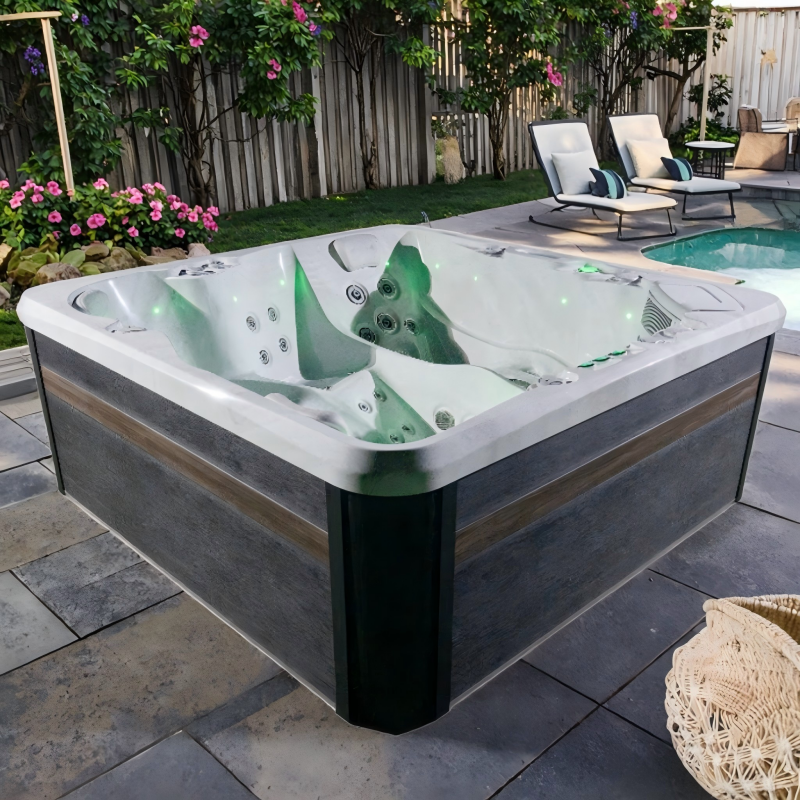
What is Grounding Of Outdoor Hot Tub? Simple Explanation
Outdoor spa hot tub grounding basically consists of the interconnection of the metallic parts (e. g. a casing of an electric component), electrical equipment housings, and conductive structures of the hot tub (e. g. metal framework, water pipes) that are made to reach ground via conducting wiring. Through such a connection, the fault current that gets released during a fault is quickly guided to the earth and also, if applicable, safety devices that cut off the power can get activated.
Generally, there shall be no current inside the outdoor spa hot tub that would not follow through the planned route of the circuit board, as the energy source goes into the control system, the heater, the water pump and lighting system. The outer casing of the appliance and human skin will be at a higher electrical potential to be able to carry away any electrical current.
Nonetheless, a faulty situation will be a situation where electricity gets leaked. For example, a heating water element may go wrong, a water pump circuit may be broken, or water may have entered the control box and made the circuits moist leading leakage.
This part of the operation is the task of the grounding system. By employing a path of low resistance to ground, the fault current or any unwanted electric current will be safely drained without damaging anything. The grounding connection is at the one-point that a residual current (ground) circuit breaker or a differential circuit breaker detects it and disconnects the power supply.
A full and complete set-up of outdoor hot tub electrical safety can be a combination of these four elements from an engineering standpoint:
Firstly, a protective earth lead. One part of it connects to the metal parts of the outdoor spa hot tub, another part to the earth system.
Second, residual current device (GFCI) or RCD. It continuously monitors the current flowing into and out of the appliance and cuts off the power as soon as it detects a deviation from the normal operating condition due to a leakage current.
Third, equi-potential bonding. It is used to connect different parts of the metal structures to the same reference point to eliminate any potentially dangerous differential voltages between different metal structures that may be caused due to fault paths of current.
Fourth, a method of electric installation that is in line with the norms set by regulations in the region. For example, the North American market normally needs that the whirlpool spa hot tub equipment is provided with GFCI protection whereas, in some parts of Europe, such devices are RCDs that are IEC standards-compliant and that protection schemes have been used for them.
Hence, to be safe, the grounding of an outdoor spa hot tub is not just a matter of laying down an earth wire but one that is part of a comprehensive safeguarding against electrical risk system.
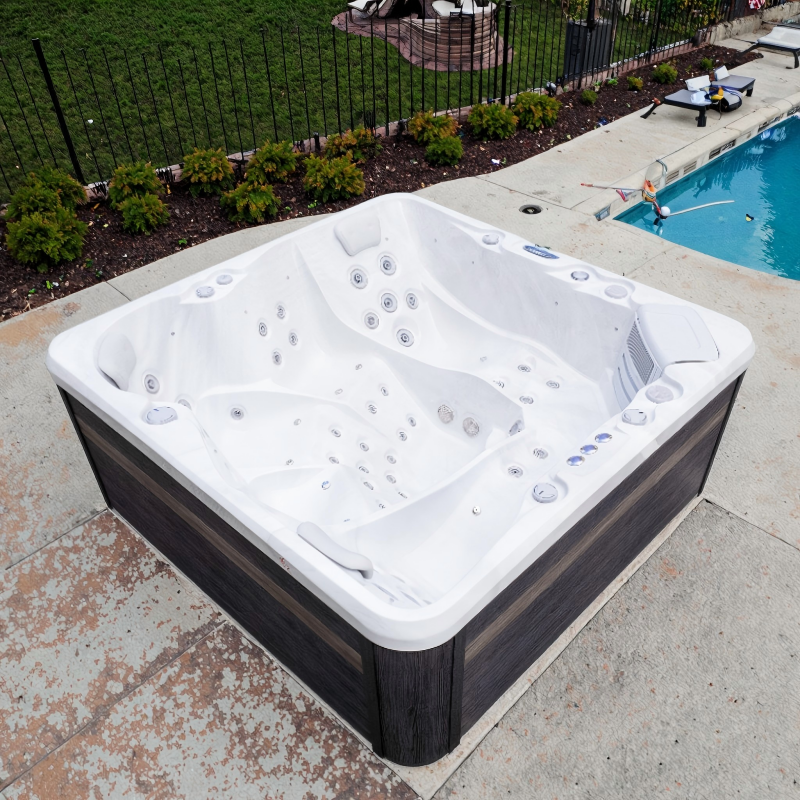
Why are electrical connections necessary for outdoor spa hot tubs?
Outdoor spa hot tubs are completely different appliances from regular household ones in terms of operating conditions. Besides being constantly in a humid environment, users also get completely wet while using it, which naturally causes the need for electrical safety of hot tub to be much more strict as compared to electrical appliances at home.
Firstly, the presence of water significantly escalates the risk of electric shock. The human body's resistance in a dry environment is capable of reaching tens of thousands of ohms, but with completely wet skin, the body's resistance may drop down to 1000 ohms or below. In these conditions, the body may be even affected by a very small leakage current. For instance, from electrical safety research data: when the alternating current passing through the human body is in the range of 10mA to 30mA, the person could lose muscle control and have breathing difficulties. As a result, various countries set strict standards that outdoor spa equipment should have very responsive leakage protection units.
Second, outdoor hot tubs have a number of constantly running electrical parts. In fact, today's outdoor spas are usually equipped with the following components:
• A circulating water pump: The power of such a pump generally varies from roughly 100W to 500W;
• A water pump for jet massage: Some big outdoor tubs might even reach 3 HP power output;
• A heating system: Usually operates with a range of 2kW and 6kW;
• LED lighting and control panel: Power levels vary from tens to hundreds of watts.
While all those devices are running non-stop, they also face variations in temperature, presence of moisture, chemical agents as well as environmental influences that they are exposed to. Should the insulating properties of the electric wires be damaged, then a risk of electrical fault will increase as a leakage is possible.
Thirdly, the outdoors is the least controllable place for whirlpool spa hot tub installation. That means outdoor spa hot tubs can be found in many places like garden lawns, back terraces (in countries with a temperate climate), beside swimming pools, or courtyard setups where they are exposed to rain, humidity, soil (if buried at least in part, a problem can arise there), as well as metal structures. The installation of proper grounding systems is therefore critical that in case of a breakdown the dangerous voltage can quickly be discharged from the equipment instead of being kept there on the surface for a long time.
In summary, the main reason why one should ground the outdoor hot spa is to provide a secure channel through which the fault current will go. By doing that, one ensures the fault current does not pass through the body of humans and thus poses less danger.
What are the key components of an outdoor hot tub grounding system?
A professionally designed outdoor spa hot tub requires not only a ground wire but also a comprehensive electrical protection system.
I. Protective Grounding Wire: The First Line of Defense for Equipment Safety
The protective grounding wire typically connects the outdoor spa hot tub's control box, pump housing, motor housing, and other potentially conductive metal components.
When an insulation fault occurs inside the equipment, such as a broken power cord causing a live wire to contact the metal casing, the grounding wire provides a low-impedance path, allowing the fault current to quickly return to the power source.
Without grounding, the equipment casing may remain energized for extended periods, potentially creating a current path when a user touches the equipment.
During actual installation, the specifications of the grounding conductor need to be determined based on the equipment's rated current, line length, and local electrical codes. For large outdoor whirlpool spa hot tubs, higher-specification copper conductors are typically required to reduce line impedance and improve protection efficiency.
II. Residual Current Device (RCD): Detecting Dangerous Current Changes
While grounding is crucial, modern outdoor spa hot tubs typically incorporate a residual current device (RCD) in addition to grounding protection.
For example, the GFCI (Ground Fault Circuit Interrupter), commonly found in the North American market, can monitor for abnormal current fluctuations. When the system detects a leakage current at the milliampere level, it will quickly disconnect the power supply.
For example, when an outdoor spa hot tub is operating normally, the current entering the equipment and the current returning to the power supply should be approximately the same. If some current is lost through the water, the equipment casing, or a person, the GFCI (Grounding Current Interchange) will determine that there is a leakage risk and immediately cut off the power supply.
Therefore, grounding provides a safe discharge path, while the residual current device (RCD) quickly detects abnormalities; together, they constitute a safety system.
III. Equipotential Bonding: Preventing Voltage Differences Between Metals
Equipotential bonding is also a crucial part of large outdoor whirlpool spa hot tub installation projects.
For example, an outdoor spa area may simultaneously contain:
• Hot tub metal frame;
• Water pump metal components;
• Nearby metal railings;
• Swimming pool equipment;
• Metal pipes.
If these components have different potentials, a dangerous voltage difference may occur. Therefore, equipotential bonding keeps these metal structures at approximately the same potential, reducing the risk of electric shock.
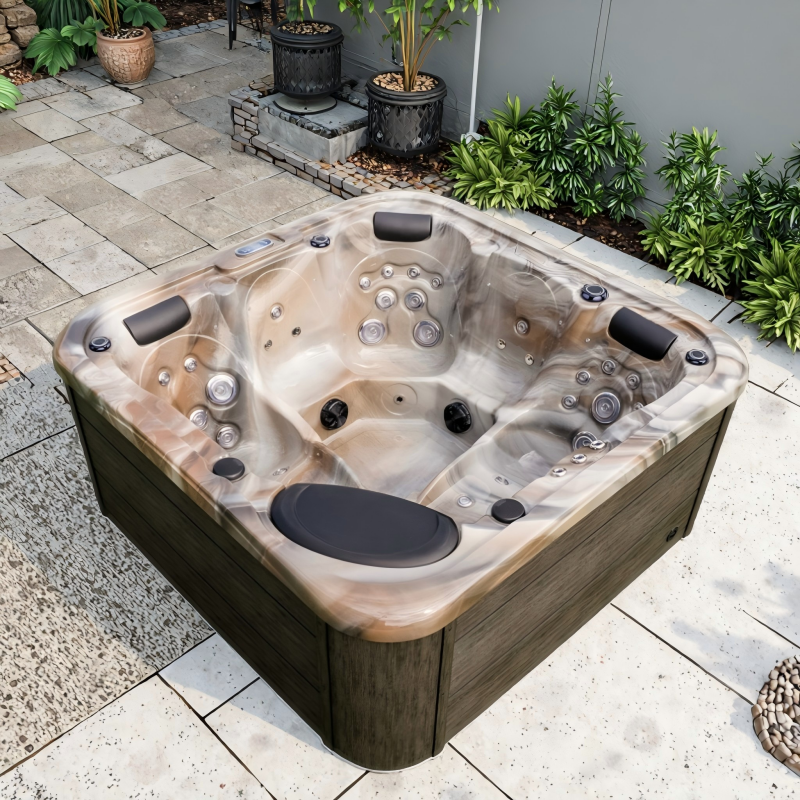
What are the risks of an outdoor hot tub not being properly grounded?
Many users believe, "My outdoor spa hot tub has always worked fine, so there shouldn't be any problems." However, a key characteristic of electrical safety is that risks often lurk beneath the surface of normal operation.
The most direct risk is electric shock. When an internal leakage occurs and the grounding and leakage protection systems fail, a user entering the water may come into contact with a live area.
Secondly, improper grounding can damage the equipment. Leakage not only affects human safety but can also impact the control system. For example, abnormal voltage can lead to:
• Damage to the control board;
• Burnout of the water pump motor;
• Heater malfunction;
• LED system malfunction;
• Intelligent control module failure.
Furthermore, long-standing electrical problems can increase the risk of fire. Especially in cases of long-term operation of outdoor hot tubs, aging wiring, or improper installation, abnormal heating can damage the wiring.
For commercial settings such as hotels and resorts, electrical safety issues also involve operational responsibility. If an outdoor whirlpool spa hot tub lacks a compliant grounding system, it not only affects the user experience but may also create safety management risks.
How to determine if an outdoor hot tub is properly grounded?
Ordinary consumers typically cannot visually determine the reliability of grounding, so it is recommended to check the following aspects:
First, confirm whether the equipment uses an independent protective grounding line. Professional installations should not simply rely on water pipes, building structures, or other non-standard paths as grounding methods.
Second, check whether a residual current device (RCD) is installed. Requirements vary by country and region, but power supplies for outdoor whirlpool spa hot tubs usually need to have RCD protection.
Third, review the installation instructions provided by the manufacturer. Reputable outdoor hot tub manufacturers usually provide detailed electrical requirements, including:
• Operating voltage;
• Rated current;
• Power cord specifications;
• Grounding requirements;
• Protective device requirements.
For example, some large outdoor whirlpool spa hot tubs may use 220V to 240V power systems with heating power exceeding 3kW, thus requiring a professional electrician to design the wiring according to the load.
Fourth, conduct regular safety inspections. Commercial establishments are advised to regularly check grounding continuity, RCD functionality, and wiring condition. Residential users should also avoid unauthorized modifications to electrical systems.
How do outdoor spa hot tub professionals make sure it is earthed properly?
If you think of people's increasing concern about safety, then the outdoor spa manufacturers will also pay more attention to the safety issues. Apart from massage effects and beauty, the manufacturers nowadays are embedding systematic safety features right from the design phase itself.
To cite an instance, premium outdoor spa hot tub brands use fully waterproof electrical control boxes that separate internal electronic components from damp environments. Also, well-planned placement of the pump, electrical heater and wiring helps to prevent water from entering these areas as much as possible.
What's more, well-established manufacturers adjust their product designs to suit the diverse market regulations across countries. For example, equipment manufactured in a country for export to the North American market has to comply with the country's own electrical safety standards while items exported to Europe have to be CE-certified.
Sufficiently professional ODM/OEM outdoor hot tub/spring/spa/spring manufacturers usually provide various configuration options based on the customer's voltage standards, electrical specifications, and installation environment, including:
• 110Volts/220 Volt; power source options;
• Electric heater with varying wattages;
• Control system customized;
• Degree of waterproof design;
• Commercial grade safety solutions.
Therefore, people buying an outdoor hot tub should look at the differences in prices only to a small extent, and rather pay the most attention to whether the manufacturer is capable of product development and has a solid safety certification system.
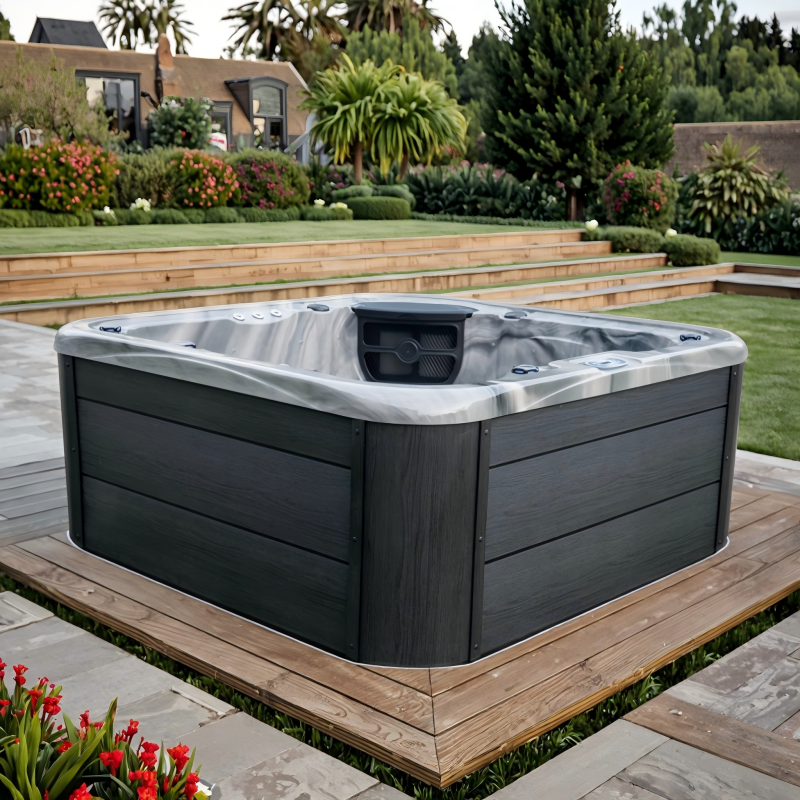
What measures should be considered when grounding the outdoor hot tub?
The outdoor whirlpool spa hot tub electrical grounding installation should be done by qualified persons only. The differences exist regarding different countries in terms of the voltage standards and the requirements for the building environment, so the methods of other projects cannot be directly copied.
During the installation the following mistakes can be the causes of accidents:
One is simply making direct installation of using a regular socket with a high-powered outdoor whirlpool spa hot tub. Large spa machines may require an independent power supply.
The other is solely relying on metal water pipes for grounding. The method can't guarantee a level that satisfies the safety codes.
The third point is that the environmental factors are being completely ignored. For instance, the whirlpool spa hot tub when installed beside a swimming pool, a backyard with lots of moisture from rain or a seaside area, requires more advanced rust and moisture proofing measures。
The fourth is neglecting safety equipment inspection. Besides checking if there is a problem with a grounding wire, one also needs to be careful in the periodic examination and adjustment of a residual current device (RCD).
FAQ: Common Questions about Grounding Outdoor Hot Tubs
1. Does an outdoor hot tub always need to be grounded?
Yes. Outdoor whirlpool spa hot tubs are considered electrical equipment in a water environment, and grounding is a basic safety requirement. Whether for residential or commercial use, installation should be carried out in accordance with local electrical codes.
2. What is the difference between grounding and a residual current device (RCD) for an outdoor hot tub?
Grounding primarily provides a path for fault current discharge, while a residual current device (RCD) detects anomalies and cuts off the power. Their functions are different and they cannot replace each other.
3. Can an outdoor whirlpool spa hot tub without grounding still be used?
It is not recommended. Although the equipment may function normally temporarily, the lack of grounding protection increases the risk of electric shock should an internal leakage occur.
4. Does installing an outdoor hot tub require a professional electrician?
It is recommended. Especially for large outdoor whirlpool spa hot tubs, commercial spa equipment, or high-power heating models, installation should be completed by professionals in accordance with local regulations.
5. How often should the grounding system of an outdoor hot tub be checked?
Residential users are advised to regularly check the RCD function and wiring condition, while commercial establishments should conduct more frequent checks based on equipment usage frequency and safety management requirements.