


What Should Be Included in a Quote from an Outdoor Hot Tub Manufacturer?
2026-11-13 15:35With the growth of outdoor leisure, home spa, and hospitality/resort sectors, the market demand for modern outdoor jacuzzi tubs is steadily increasing. For international buyers, a price quote serves as a crucial reference for evaluating product specifications, procurement costs, and the professionalism of a manufacturer.
However, quotes can vary significantly from one manufacturer to another. Some may list only the unit price without specifying details such as water pumps, massage jets, heaters, insulation, packaging, or after-sales support. Buyers who focus solely on the total price may overlook differences in configuration—or worse, discover unexpected additional costs only after placing an order.
Therefore, a professional quote for an outdoor whirlpool hot tub should go beyond just the price; it must include product specifications, a detailed list of components, customization requirements, certifications, lead times, payment terms, and warranty policies. This article outlines the essential elements of a quote, common procurement risks, and how to address them, helping international buyers evaluate suppliers more accurately.
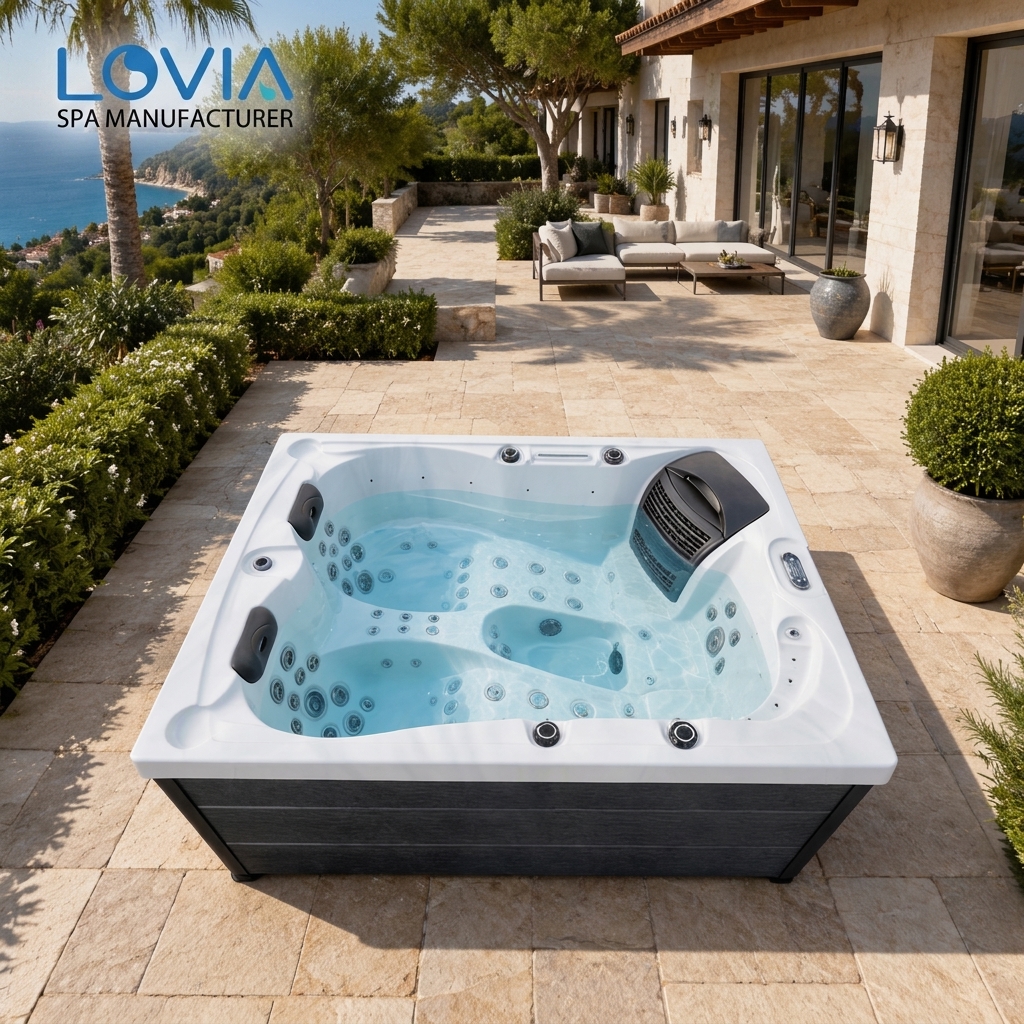
Why Is an Outdoor Hot Tub Quote So Important?
An outdoor whirlpool hot tub typically consists of a shell, a support structure, a circulation and filtration system, a heater, water pumps, massage jets, a control system, and insulation. Even when products from different manufacturers look similar, they may differ significantly in terms of materials, power specifications, energy efficiency, and service life.
For instance, two five-seater hot tubs might be priced differently due to variations in the number of pumps, jet layout, insulation design, or the control system used. Without clear information in the quote, it is difficult for a buyer to determine whether a price difference is justified.
In cross-border procurement, trade terms (Incoterms) and logistics costs are equally critical. Terms such as EXW, FOB, CIF, and DAP dictate the allocation of costs and delivery responsibilities; a lower unit price does not necessarily mean a lower total procurement cost.
Consequently, buyers should focus on three key questions: exactly what is included in the product, which costs are covered by the quote, and what delivery and after-sales responsibilities the manufacturer assumes.
What Essential Information Must Be Included in an Outdoor Hot Tub Quote?
A comprehensive quote should include the manufacturer’s name, company address, contact person, quote number, date of issuance, validity period, and the buyer’s information. At the same time, the product name, model, quantity, unit price, total price, and the currency of the quotation (e.g., USD) must be clearly specified.
If an order includes multiple models, prices and configurations should be listed individually rather than providing only a single total amount. For bulk purchases, it should also be stated whether quantity discounts are available, along with the conditions under which such discounts apply.
The validity period for a quotation is typically set at 15–30 days, depending on factors such as raw material costs, exchange rates, and supply chain conditions. The quotation should also reference the specific product specifications or drawing versions used, ensuring that subsequent contracts, production, and final acceptance are all based on the same technical standards.
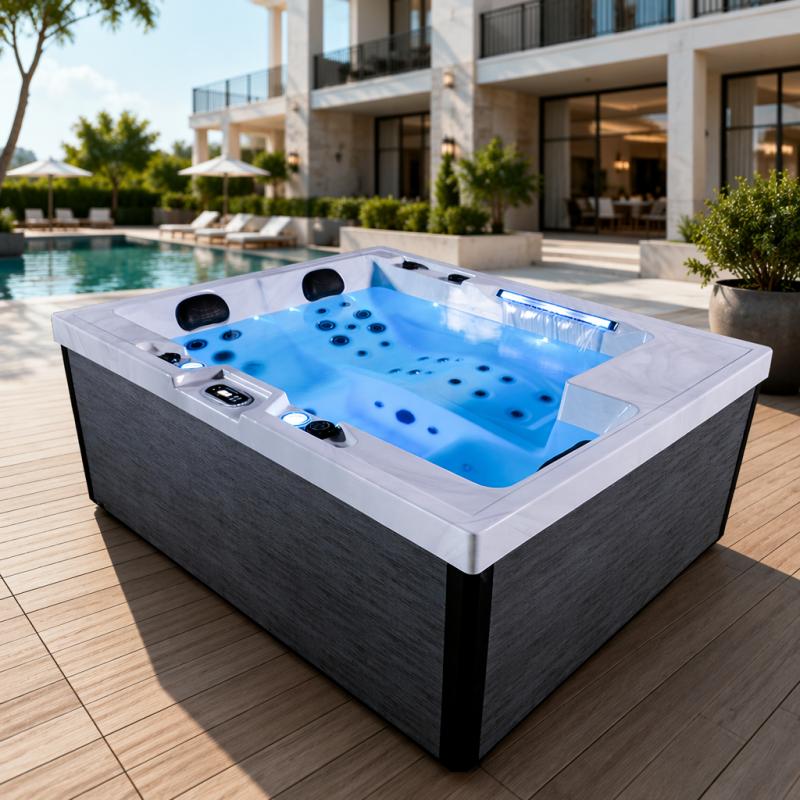
Technical Specifications of Outdoor Hot Tubs Are the Core of a Quotation
The technical specifications of an outdoor whirlpool hot tub directly influence its functionality, user experience, and manufacturing costs. A professional manufacturer should provide clear, verifiable parameters, avoiding vague descriptors like "high quality" or "powerful performance."
1. Dimensions, Seating Capacity, and Volume
The quotation should detail the product’s length, width, and height, the number of seats and loungers, and the rated water capacity, while distinguishing between the dimensions of the tub shell itself and the overall dimensions. For export orders, packaged dimensions and weight should also be provided to help the buyer calculate shipping and storage costs.
Typical residential outdoor whirlpool hot tubs are designed for 2–7 people; however, the number of seats does not always accurately reflect the actual usable space. Buyers should also consider the seating layout, footwell space, and jet placement. For hotel or commercial projects, the appropriate model should be selected based on expected usage frequency and maintenance requirements.
2. Shell Material and Support Structure
The shell of a modern outdoor jacuzzi tub may be made of acrylic or other composite materials. The quotation should specify the exact material, surface finish, reinforcement structure, and the design of the base support; material data sheets or test reports should be provided if necessary.
Buyers should verify that the shell is suitable for long-term outdoor use, that the exterior skirting offers adequate weather resistance, and that the support structure can withstand the load of the water and multiple users. Simply labeling a product as "high-quality acrylic" is insufficient to guarantee quality; an assessment should also consider the structural design, manufacturing processes, and inspection results.
3. Water Pumps and Massage Jets
Water pumps and massage jets are key components that influence both the price and the user experience of a modern outdoor jacuzzi tub. The quotation should specify the number of pumps, their rated power, the quantity and type of jets, and whether features such as zoned massage or air-water mixing are included in the base price.
For instance, while one model might feature 30 jets and another 45, a higher number of jets does not necessarily guarantee a better massage experience. Pump performance, plumbing design, jet layout, and water flow distribution are equally critical.
Buyers should also verify whether the pumps can operate independently, determine the total power demand when all equipment is running simultaneously, and confirm the long-term availability of replacement pumps and jets to help manage future maintenance costs.
4. Heaters, Filtration Systems, and Control Panels
The heater determines the unit’s heating capacity. The quotation should detail the heater’s rated power, electrical requirements, temperature control range, and safety features. Many residential outdoor whirlpool hot tubs use electric heaters with a capacity of approximately 2–3 kW, though the actual configuration depends on the product design, voltage standards, and intended use environment.
The filtration system section should specify the type and number of filters, the configuration of circulation pumps, and whether auxiliary water treatment systems—such as ozone generators or UV sterilizers—are included. The control system section should outline features like temperature adjustment, lighting control, timers, and remote control capabilities. If smart control functionality requires additional modules, the associated costs should be clearly stated.
5. Insulation Structure and Energy Consumption
Insulation performance directly impacts the operating costs of a modern outdoor jacuzzi tub, especially in colder climates. The quotation should describe the types of insulation materials used, the areas being insulated, the design of the base insulation, and the specifications of the thermal cover.
For products marketed as "energy-efficient," buyers should inquire about the testing conditions—such as ambient temperature, set water temperature, and the duration of the test. Since actual energy consumption is influenced by factors like outside air temperature, frequency of use, the seal quality of the cover, and temperature settings, one should not rely solely on "energy-efficient" claims to estimate operating costs.
How should prices and additional charges be presented in an outdoor hot tub quotation?
The procurement cost of an outdoor whirlpool hot tub encompasses more than just the unit itself; it may also include expenses for accessories, customization, packaging, testing, and shipping. Manufacturers should provide itemized quotations to help buyers understand how each cost component is calculated.
1. Unit Price and Bulk Discounts
The quotation should specify the product model, unit price, order quantity, applicable discounts, and the total order value. For bulk purchases, manufacturers of outdoor whirlpool hot tubs may offer tiered pricing based on order volume; however, they should clearly state the product configuration and delivery terms associated with each discount level.
2. Accessories and Customization Costs
A base quotation may not include all accessories. Common optional items include thermal covers, steps, cover lifters, spare filters, and maintenance tools.
For OEM/ODM orders, additional costs may arise from branding (logos and nameplates), packaging design, user manuals, sample production, and mold development. The quotation should distinguish between one-time development costs and per-unit charges, and clearly specify the Minimum Order Quantity (MOQ).
3. Packaging and Logistics Costs
Export quotations should detail the packaging method—such as cartons, wooden crates, or wooden pallets—and, where applicable, provide dimensions, gross weight, and net weight. Proper packaging helps minimize the risk of impact damage, scratches, or structural issues during transit.
Regarding logistics, the quotation should clarify whether it covers origin port charges, ocean freight, insurance, destination port fees, and local delivery costs. It should also be confirmed in advance whether import duties, VAT, and customs clearance fees are included.
| Cost Item | What the Quotation Should Specify |
| Product price | Model, configuration, quantity and unit price |
| Optional accessories | Included items and additional charges |
| Customization | Logo, color, packaging and development fees |
| Packaging | Packaging type, dimensions and weight |
| Inspection | Factory testing and third-party inspection costs |
| Freight and insurance | Included services and responsible party |
| Import charges | Duties, taxes and customs clearance |
| Spare parts | Initial spare-parts package and replacement prices |
Buyers should pay close attention to terms like "to be determined" or "subject to change." If a cost cannot be finalized immediately, the manufacturer should at least outline the basis for calculation, identify which party is responsible for the expense, and specify when the final cost will be confirmed—thereby preventing unexpected charges after an order has been placed.
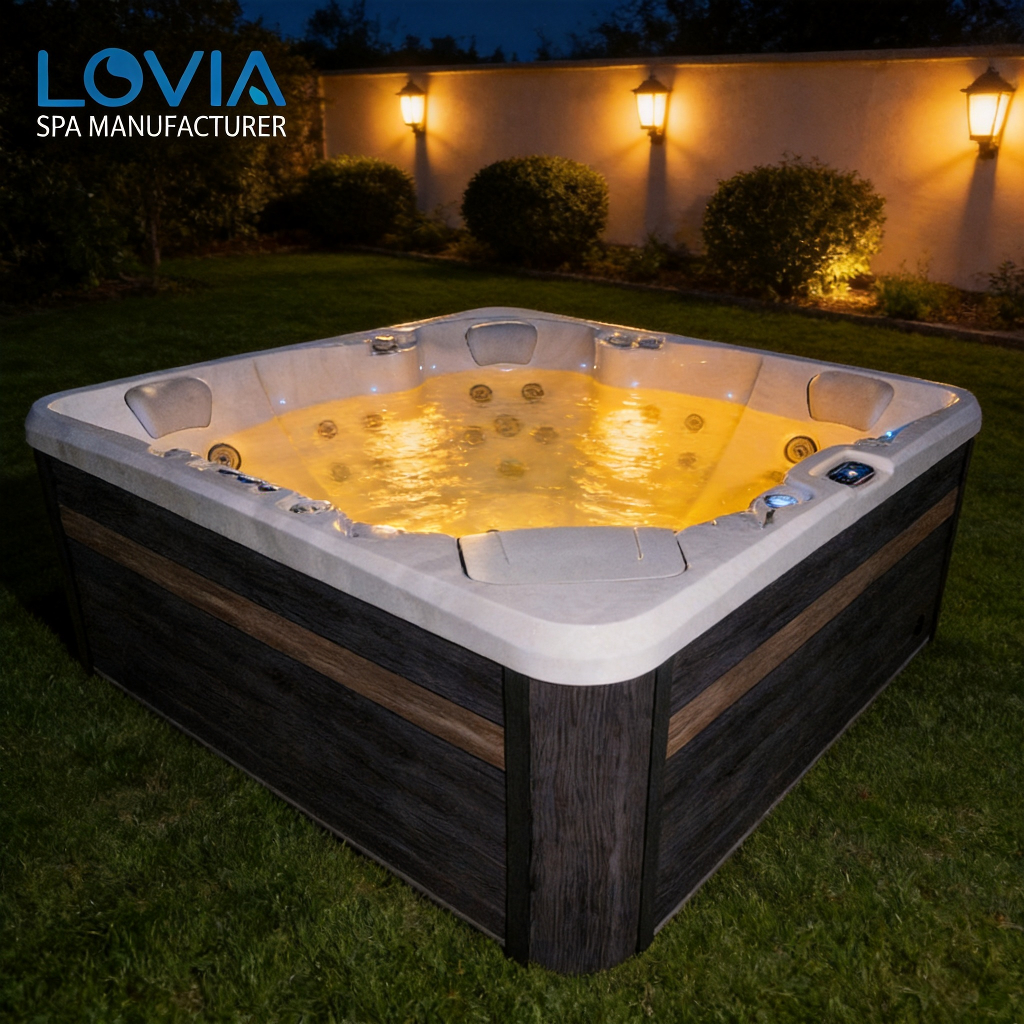
Customization Requirements for OEM/ODM Outdoor Hot Tubs Must Be Clearly Defined
For brands and distributors, a manufacturer’s customization capabilities directly influence product competitiveness. The quotation should explicitly state which elements can be customized and whether such customizations affect costs, lead times, or certification requirements.
Common customization options include the shell color, exterior skirting, jet layout, lighting configuration, control panel language, branding, packaging, and user manuals. Any modifications involving water pumps, heaters, or electrical systems require an assessment of both technical feasibility and compliance requirements in the target market.
The quotation should clearly outline the processes for drawing approvals, sample confirmation, color sign-offs, and mass production. Buyers should provide written confirmation of the final configuration prior to production to ensure the delivered product aligns with expectations. Should design changes be required after an order is confirmed, both parties must agree on how such changes will affect costs and lead times.
Certifications, Testing, and Quality Standards
Outdoor whirlpool hot tubs incorporate electrical equipment, heating systems, and water circulation systems; consequently, safety standards and compliance requirements may vary by target market. The quotation should specify which certificates, test reports, and technical documents the manufacturer can provide, and whether the associated costs are included in the quoted price.
Buyers should verify the certificate holder, the applicable model numbers, and the scope of testing; relying solely on certification marks is insufficient to determine whether a product meets the requirements of a specific market.
Regarding quality inspection, confirm whether the quotation includes factory-based functional testing, leak testing, electrical safety checks, and packaging inspections. For large-volume orders, it is advisable to establish terms for third-party inspections, sampling ratios, and the handling of non-conforming products.
It is recommended to include acceptance criteria—covering appearance, heating functionality, massage systems, and plumbing/water circuit performance—as an attachment to the quotation or within the formal contract to minimize potential quality-related disputes.
Lead Times, Payment Terms, and Trade Terms
The quotation should clearly state the production lead time, payment methods, and delivery terms. It should specify the starting point for the lead time—whether it begins upon receipt of the deposit, finalization of specifications, or approval of samples—and distinguish between the time required for sample development, mass production, and shipment preparation.
Payment terms should detail the deposit percentage, the timing for balance payments, the currency, and the allocation of bank charges; these arrangements should be negotiated based on the scale of the order and the nature of the business relationship.
Regarding trade terms (Incoterms), options such as EXW, FOB, CIF, and DAP entail different allocations of costs, delivery responsibilities, and risk transfer. The quotation should specify the applicable version of the Incoterms and the precise location (e.g., the designated port of shipment or destination) to avoid ambiguity.
Buyers should conduct a comprehensive comparison of product pricing, lead times, payment terms, and logistics responsibilities. A quote with a lower unit price may not necessarily offer better overall procurement value if it entails high upfront payment requirements, ambiguous lead times, or opaque logistics costs.
Warranty, Spare Parts, and After-Sales Service
Long-term use of an outdoor whirlpool hot tub involves components such as pumps, heaters, control systems, and filters. Therefore, a quote should clearly define the scope of the warranty, rather than providing only a vague, blanket warranty period for the entire unit.
Manufacturers should specify the warranty duration for individual components, the start date of coverage, applicable conditions, and exclusions, as well as clarify who is responsible for repair costs, labor, and shipping expenses. The definitive terms should be outlined in a formal, written warranty policy.
International buyers should also pay close attention to the availability of spare parts. It is advisable to request a list of common spare parts, their prices, and estimated lead times—paying particular attention to critical components like pumps, jets, control panels, and seals.
For products intended for export, the inclusion of English-language user manuals, installation guides, troubleshooting/error code documentation, and access to remote technical support is essential. A robust after-sales system helps alleviate the burden of repairs and enhances a distributor’s ability to provide quality customer service.
FAQ: Common Questions Regarding Outdoor Hot Tub Quotes
1. What should be included in an outdoor whirlpool hot tub quote?
At a minimum, it should include supplier information, product model, technical specifications, a list of configurations, unit and total prices, customization costs, packaging and shipping fees, payment terms, trade terms (Incoterms), lead times, certification documentation, and the warranty policy. For OEM/ODM orders, the quote should also detail the specific customization requirements and the Minimum Order Quantity (MOQ).
2. Why do quotes for outdoor hot tubs vary significantly between manufacturers?
Differences often stem from factors such as the materials used for the tub shell, the configuration of pumps and jets, heater capacity, insulation structure, control systems, included accessories, the scope of the warranty, and logistics terms. Buyers should standardize product specifications and delivery conditions before comparing prices.
3. How can one avoid hidden costs in an outdoor whirlpool hot tub quote?
Request that the manufacturer provide an itemized breakdown of costs—covering the product itself, accessories, customization, packaging, shipping, and related services—and clearly state who is responsible for taxes, customs clearance, and destination port charges. For any costs that cannot be determined immediately, the basis for their calculation and the timeline for when they will be finalized should be clearly noted.