


What is "Shock" treatment for outdoor spa hot tubs?
2026-08-25 15:30Many outdoor spa hot tub owners notice that while the water is crystal clear immediately after a refill, after a few days of continuous use, issues arise: the water becomes slightly cloudy, foam increases, unpleasant odors or a strong chlorine smell develop, and an oily film may even form around the massage jets. Simply increasing the daily dosage of chlorine or bromine often fails to solve the root problem. This is because the issue isn't merely a lack of sanitizer; rather, an accumulation of organic contaminants and combined disinfection by-products has compromised the water's effective sanitizing capacity.
This is precisely where "Shock" treatment comes into play.
"Shocking" is not simply a matter of dumping a large amount of sanitizer into the tub; it is a water treatment process designed to rapidly oxidize contaminants, boost sanitizing power, and eliminate organic pollutants and certain combined sanitizers. The US EPA notes that terms such as "Shock," "Super-chlorination," and "Non-chlorine Shock" refer to different types of products and functions. Consequently, consumers must follow specific product labels and manufacturer guidelines rather than treating all shock products as identical.
Therefore, understanding shock treatment for outdoor whirlpool spa hot tubs requires looking beyond the simple question of "how often should I shock?" It involves a systematic analysis of factors such as the causes of water quality changes, oxidation principles, the differences between chlorine and non-chlorine shocks, correct operating procedures, and the appropriate waiting time before using the tub again.
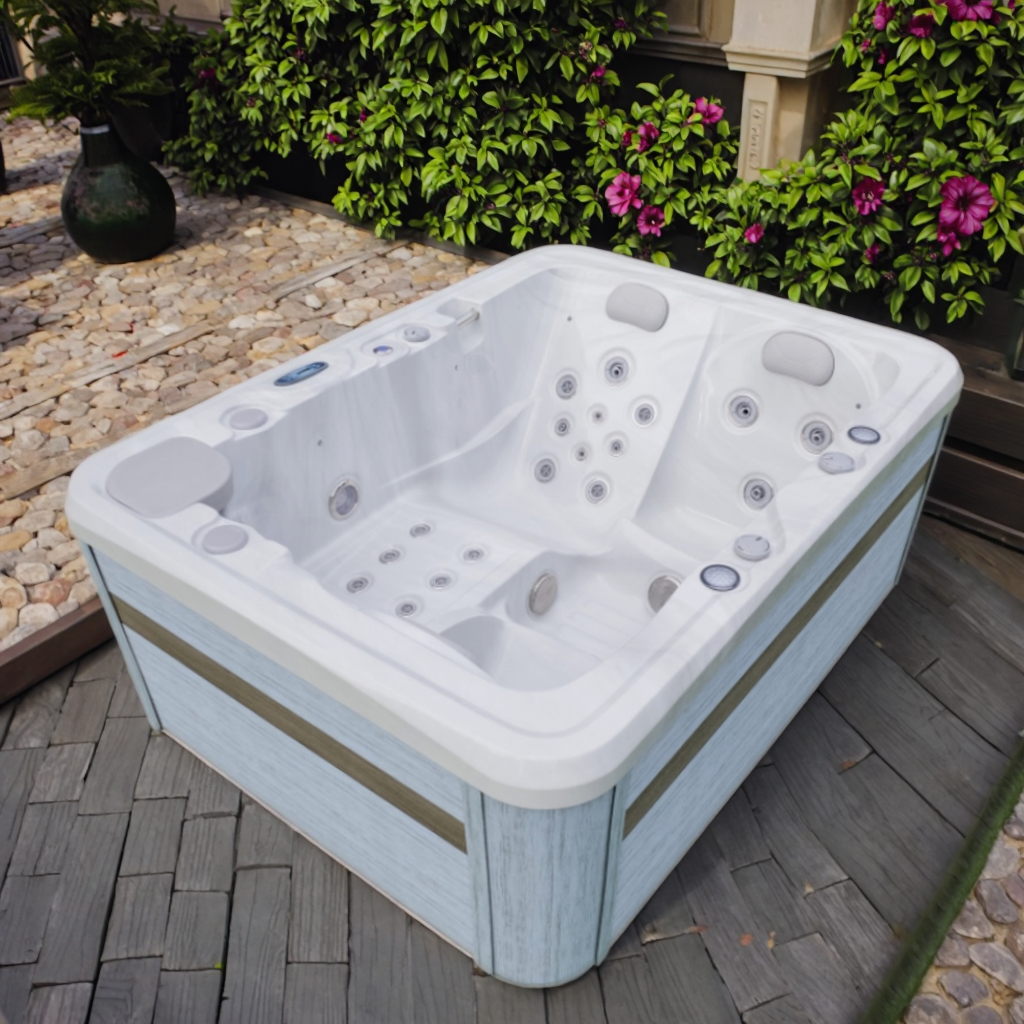
Why do outdoor spa hot tubs specifically require shock treatment?
To understand shock treatment, one must first grasp why outdoor whirlpool spa hot tubs are more prone to water quality issues than standard household bathtubs.
A standard bathtub is typically drained after a single use, allowing sweat, sebum, bath products, and other organic matter introduced by the bather to be flushed out of the system. outdoor spa hot tubs operate quite differently. To conserve water, maintain temperature, and facilitate frequent use, the water circulates within a relatively closed system. A circulation pump continuously drives the water through a filter, a heater, and the massage system before returning it to the tub. While filters can trap some particulate contaminants, mechanical filtration alone cannot fully remove substances dissolved in the water—such as sweat, oils, urea, and other organic matter.
At the same time, outdoor spa hot tubs typically maintain high water temperatures. The CDC advises that hot tub water temperatures should not exceed 104°F (40°C); the combination of high temperatures, low water volume, and heavy usage loads makes operating and managing water quality in hot tubs particularly challenging.
This means that when the same person uses both a swimming pool and an outdoor spa hot tub, the relative concentration of contaminants they introduce into the water can differ significantly. Consider an outdoor spa hot tub with a volume of 1,200 liters: if four people use it simultaneously, the sweat, sebum, and other organic matter introduced by each individual become concentrated within that 1,200-liter volume. Compared to large swimming pools containing tens or even hundreds of thousands of liters of water, the pollution load per unit volume in a hot tub is clearly much higher.
These organic substances consume chlorine or bromine. In other words, the "total chlorine" detected in the water does not necessarily consist entirely of "free chlorine"—the active form that provides rapid disinfection. Some of the disinfectant reacts with organic matter to form combined chlorine compounds, such as chloramines. Consequently, users may encounter a common phenomenon: despite the presence of chlorine in the water, there is a noticeable "chlorine odor," and water quality continues to deteriorate.
Therefore, water treatment for outdoor spa hot tubs cannot be viewed simply as the continuous addition of chlorine. While routine disinfection maintains a basic level of residual disinfectant, "shocking" the water serves a different purpose: rapidly oxidizing accumulated contaminants and restoring water quality.
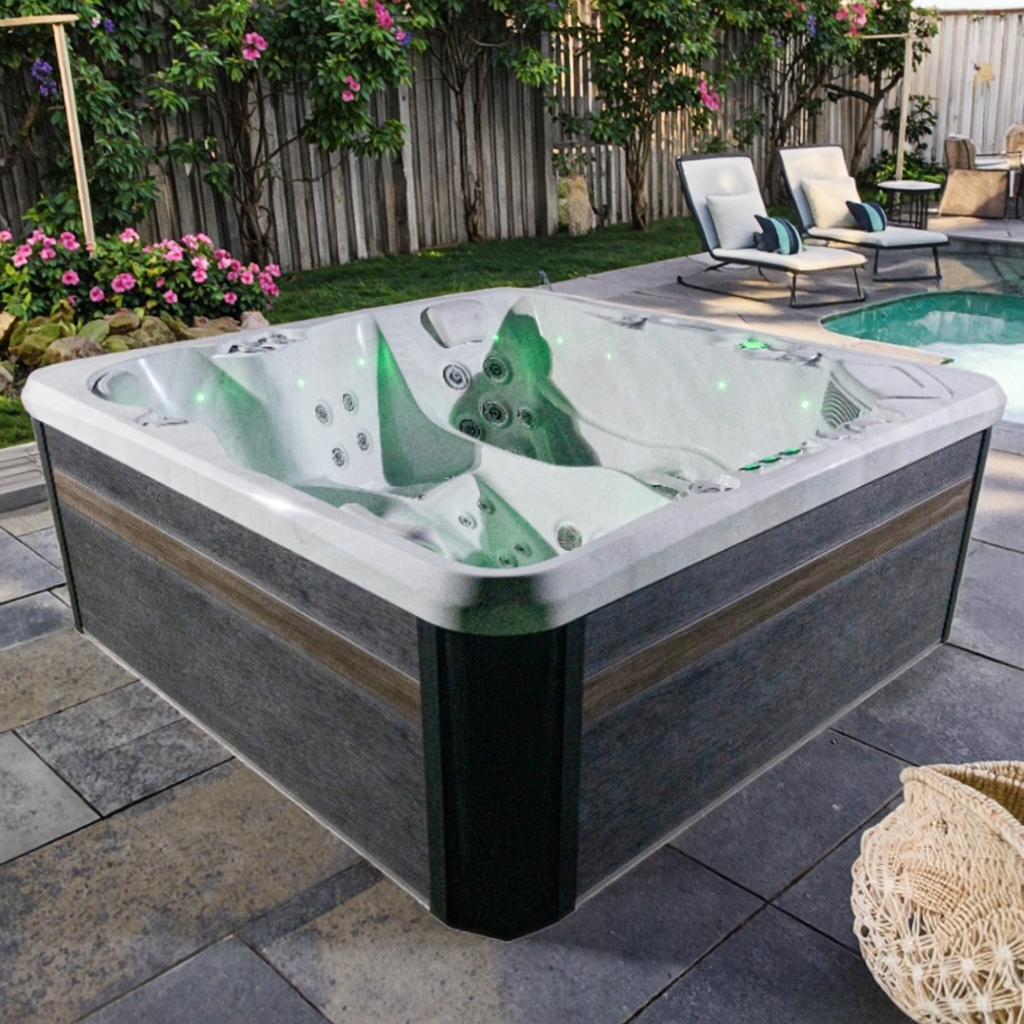
What exactly does "shocking" an outdoor spa hot tub mean?
From a water treatment perspective, "shocking" refers to a process of temporarily intensifying the oxidation treatment.
During normal operation, outdoor whirlpool spa hot tubs require a specific level of residual disinfectant. For instance, CDC guidelines for public hot tubs recommend a free chlorine level of 2–4 ppm or a bromine level of 4–6 ppm, while maintaining a pH between 7.2 and 7.8 and performing periodic biocidal shock treatments based on usage intensity. The core purpose of "shocking" is not to maintain an extremely high disinfectant concentration indefinitely, but rather to apply a single, relatively high-intensity oxidation treatment at specific intervals to eliminate accumulated organic contaminants and certain combined disinfection by-products.
In traditional chlorine shock treatments, the common approach involves briefly raising free chlorine levels. Historical CDC guidelines for public spas describe "superchlorination" (or shock treatment) as raising residual chlorine levels—for instance, to 10 ppm for a set duration—to help clarify the water, remove ammonia and combined chlorine, and treat algae.
However, it is crucial to emphasize that 10 ppm is not a universal dosage standard applicable to all modern residential outdoor spa hot tubs, all chlorine products, or every usage scenario. The actual shock dosage must be determined based on the product's active ingredient concentration, the hot tub's actual water volume, the equipment manufacturer's instructions, and local regulations. Since chemical concentrations vary across products—and products of the same weight may yield different levels of available chlorine—one cannot simply apply a fixed formula like "grams per 1,000 liters."
This is precisely why professional outdoor spa hot tub water treatment prioritizes a "test–calculate–dose–retest" workflow rather than simply pouring in chemicals based on guesswork.
The core function of shocking is not just "making water cleaner," but oxidizing organic contaminants
Many consumers view shocking as merely an "extra-strength disinfection" step, but this understanding is not entirely accurate.
While the disinfectant in an outdoor spa hot tub plays a vital role in inactivating microorganisms, one of the shock treatment's most important functions is to handle the organic matter and disinfection by-products that continuously accumulate in the water.
When people use an outdoor whirlpool spa hot tub, they release sweat, sebum, dead skin cells, urea, cosmetics, sunscreen, and other organic substances into the water. Additionally, if users do not shower before entering, residues from toiletries, skincare products, and fabrics on their bodies can also end up in the water.
These substances lead to three consequences:
First, they consume the disinfectant, reducing the level of effective residual sanitizer.
Second, they increase the water's chemical oxygen demand, making the water increasingly prone to unpleasant odors, foaming, and cloudiness.
Third, they generate combined disinfection by-products. Take chlorine-based systems as an example: some chlorine reacts with nitrogen-containing organic compounds to form chloramines. These substances not only produce a noticeable odor but can also negatively affect the user's perception of water quality.
Therefore, when an outdoor whirlpool spa hot tub exhibits issues such as "water looks clear but has excessive foam," "a sudden increase in chlorine odor," "unpleasant smells," or "noticeable deterioration in water quality after heavy use," a "shock" treatment is often more effective than simply adding small amounts of daily sanitizer.
What is the difference between chlorine shock and non-chlorine shock for outdoor spa hot tubs?
This is an area where consumers are most easily confused.
Chlorine shock primarily involves raising the level of available chlorine to achieve strong oxidation and disinfection. It boosts the water's disinfecting capacity, making it highly effective for restoring residual sanitizer levels and addressing significant water quality issues.
Non-chlorine shock typically utilizes MPS (potassium peroxymonosulfate), an oxidizer often referred to simply as a "non-chlorine oxidizer." Its primary role is to oxidize organic contaminants rather than simply increasing the free chlorine concentration.
While their functions overlap, they are not entirely interchangeable.
For instance, if the water quality is generally good but organic contaminants have accumulated after heavy use—and the goal is to quickly oxidize these contaminants—some systems might recommend MPS. Hot Spring’s water care guidelines, for example, describe MPS as a fast-acting, non-chlorine oxidizer suitable for shock treatment in spa water.
However, if water quality has seriously deteriorated, sanitizer levels are critically low, or a specific contamination event has occurred, one cannot simply assume that "adding a little non-chlorine shock will solve everything." In such cases, a more comprehensive treatment approach is required, based on the nature of the contamination and the manufacturer's recommended water care procedures.
Additionally, a crucial point is that different hot tub water care systems have varying compatibility requirements. Water care strategies differ significantly across salt-water, ozone, mineral, traditional chlorine, and bromine systems. Consumers should prioritize the water care regimen provided by the hot tub manufacturer rather than simply applying spa maintenance tips found online to their own equipment.
When might an outdoor spa hot tub require a shock treatment?
Shock treatment is neither an emergency measure reserved only for when a problem arises, nor a routine procedure that must be performed mechanically every day. The specific frequency should be determined based on the number of users, frequency of use, water volume, the water treatment system, and water quality test results.
CDC guidelines for public hot tubs suggest that biocidal "shock" treatments can be performed at intervals ranging from daily to weekly, depending on water quality and the frequency of water replacement. For residential outdoor whirlpool spa hot tubs, however, the actual frequency should be determined by combining manufacturer instructions with actual usage patterns; operational standards for public facilities cannot simply be applied to home equipment.
Generally, if there is a noticeable change in the water quality of an outdoor whirlpool spa hot tub, one should first test the water before deciding whether a shock treatment is necessary.
Indicators that the organic load in the water has become high include: a rapid deterioration in water quality following a sudden increase in the number of users; visible foaming; unpleasant odors; an unusually strong chlorine smell; slight turbidity; a marked increase in the rate of daily sanitizer consumption; or difficulty restoring water quality after use by multiple people in succession.
Additionally, if proper oxidation treatment is neglected over a long period, organic matter may gradually accumulate, even if the water appears normal on the surface.
Therefore, professional maintenance of outdoor spa hot tubs should not rely solely on visual clarity; instead, a routine testing and maintenance schedule should be established.
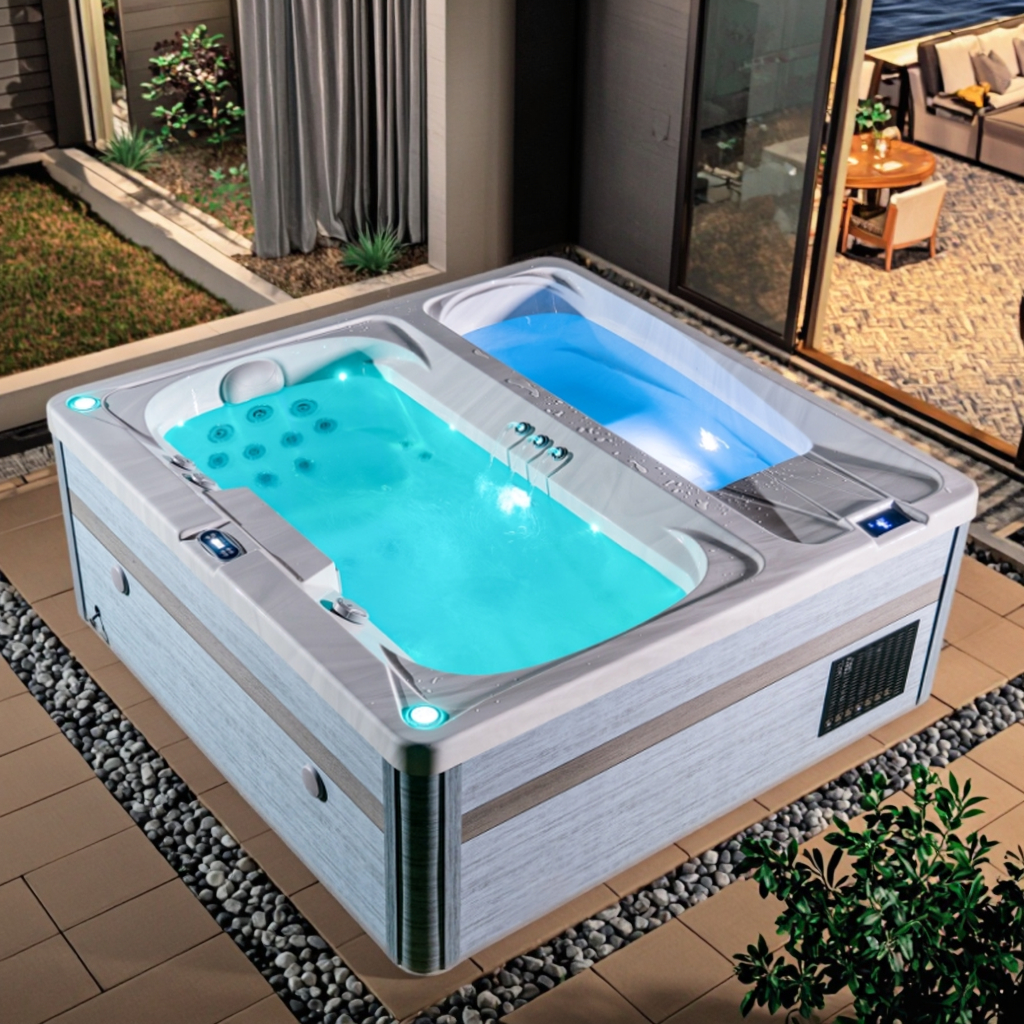
What is the standard operating procedure for shocking an outdoor spa hot tub?
A professional shock treatment process can generally be summarized as follows: test water quality → adjust baseline parameters → select the appropriate shock product → dose precisely based on actual water volume → circulate → wait → retest → confirm safety before resuming use.
First, verify the actual water volume of the outdoor spa hot tub. Even if the equipment has a nominal capacity of 1,500 L, it may not always be filled to the same level during use; therefore, dosage calculations should be based on the actual volume of water present. It is not advisable to dose any chemical based on a visual estimate.
Next, test the pH, free chlorine or bromine levels, and any other parameters specified by the manufacturer. If the pH deviates significantly from the normal range, adjust it first.
Then, turn off or adjust specific equipment functions as required by the manufacturer and activate the circulation system to ensure the shock treatment is evenly distributed throughout the water. Requirements regarding jets, circulation pumps, and filtration systems vary by product, so always follow the product label and equipment instructions.
Finally, add the shock product according to the dosage specified on the label. It is crucial to emphasize here that you should not rely on generic online formulas—such as "add X grams per 1,000 liters"—to replace the instructions on the product label, as the concentration of active ingredients varies significantly between products.
After dosing, allow the circulation system to run fully to ensure the chemical is evenly distributed throughout the water, and wait for the reaction time specified in the product instructions.
Finally, you must re-test the water quality. This is especially important after a chlorine shock treatment; simply because "a few hours have passed" does not mean it is safe to enter the outdoor spa hot tub. You must verify that the levels of free chlorine or other disinfectants have returned to the safe operating range specified by the equipment manufacturer.
How long should you wait after a shock treatment before re-entering the outdoor spa hot tub?
This is a top concern for consumers, yet there is no single answer that applies to every shock product.
The reason is simple: different shock products vary in chemical composition, dosage concentration, intended treatment intensity, and reaction speed.
For instance, non-chlorine MPS oxidizers often require a different approach than chlorine shocks. Some products may allow for a quicker return to use, while others require a specific waiting period. The ultimate criteria for judgment should be the product label and actual water quality test results.
Particular caution is required with chlorine shocks. If the free chlorine concentration remains above the manufacturer's recommended operating range after the shock, you should not enter the tub immediately just because the water looks clear.
Therefore, a more scientific approach is not to ask, "Do I wait four hours or eight hours after shocking?" but rather, "How long does the product label require me to wait, and has the water quality returned to the normal range before reuse?"
This is also a point that outdoor whirlpool spa hot tub manufacturers should clearly highlight in their user manuals.
Shock treatments cannot solve every water quality issue
If the hot tub water is severely aged, the filter has been clogged for a long time, there is significant biofilm buildup inside the plumbing, or water quality has been out of balance for an extended period, a shock treatment alone may only provide a temporary fix for surface-level issues.
For example, if the filter is heavily clogged with oils and particulates, contaminants may remain in the system even after shocking. Hot Spring’s troubleshooting guides identify dirty filters, excessive oils and organic matter, improper sanitization, and aged water as major causes of cloudy water, recommending a combination of solutions such as filter cleaning, shocking, replenishing sanitizer, adjusting pH levels, or even draining and refilling the tub. Therefore, if the water consistently exhibits turbidity, unpleasant odors, or foaming, or if water quality repeatedly falls out of balance, the true solution is likely a combination of "shock treatment, deep cleaning of the filter, plumbing maintenance, and partial or total water replacement" rather than the continuous addition of shock products.
This is precisely why high-quality outdoor whirlpool spa hot tubs require a comprehensive water circulation system. A well-designed system should not rely solely on chemicals; instead, it should alleviate the burden on water quality through the combined action of circulation pumps, filters, efficient plumbing design, supplementary ozone or UV treatment, and proper user maintenance.
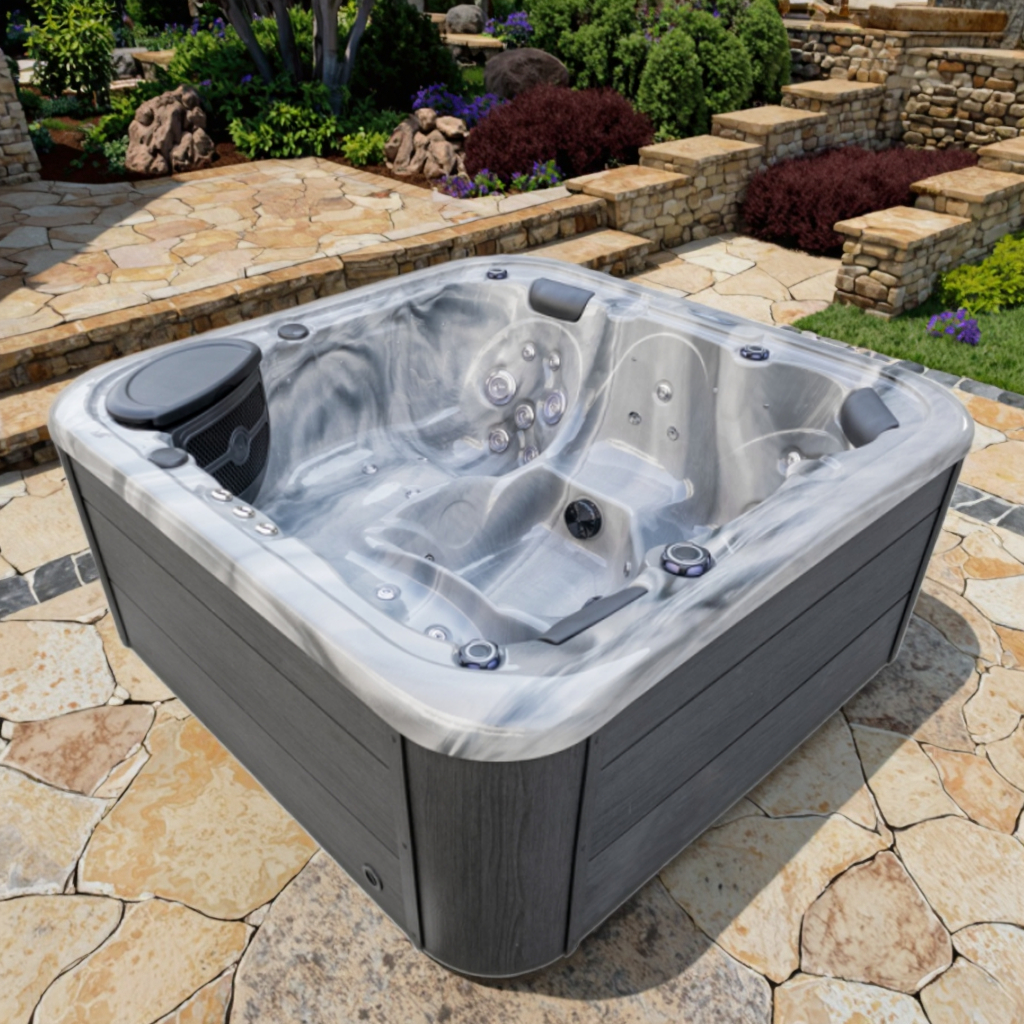
FAQ: Outdoor Hot Tub Shocking
1. Why do outdoor hot tubs need shocking?
During daily use, substances such as sweat, body oils, sunscreen, cosmetics, and other organic matter constantly enter the water and deplete the sanitizer. Shocking—an intensive oxidation process—helps eliminate accumulated organic contaminants and certain combined sanitizer by-products, thereby improving water quality. It is not a substitute for routine sanitization but rather a vital supplement to the overall water treatment regimen.
2. How often should an outdoor hot tub be shocked?
There is no one-size-fits-all schedule. For residential tubs, the frequency depends on usage patterns, water test results, and manufacturer guidelines; commercial tubs with high usage rates may require more frequent treatment. The CDC notes that for public hot tubs, the shocking frequency can range from daily to weekly, depending on water quality and water replacement schedules.
3. Which is better: chlorine shock or non-chlorine shock?
Neither is inherently "better" than the other. Chlorine shock boosts sanitizing power while providing strong oxidation and disinfection; non-chlorine shocks (such as MPS) are primarily used to oxidize organic matter. The choice depends on the hot tub's water treatment system, current water quality, and specific product instructions.
4. Can I use the hot tub immediately after shocking?
You cannot rely solely on the passage of time. You must adhere to the waiting period specified on the shock product label and verify that water quality has returned to the manufacturer's recommended range before use. This is particularly important after using chlorine shock; if free chlorine levels remain excessively high, you should not enter the tub.
5. Can shocking solve all water quality issues in an outdoor hot tub?
No. If the filter is clogged, the water is severely aged, the plumbing is contaminated, or total dissolved solids (TDS) have accumulated over time, shocking alone is usually insufficient to resolve the problem. In such cases, you may also need to clean the filter, maintain the plumbing system, and drain and refill the water. Professional maintenance requires targeted measures based on the specific source of the problem.