


What do different colors of water in outdoor hot tubs represent?
2026-09-17 15:30Color changes in outdoor spa hot tub water can have completely different underlying causes. Iron, copper, and manganese ions, after heating or oxidation, can turn water yellow, brown, orange, or blue-green. Insufficient disinfectant concentrations can lead to microbial growth, algae development, and greening of the water. Accumulation of human sweat, cosmetics, skincare products, and other organic matter can gradually turn the water yellow and cloudy. Clogged filters, abnormal total alkalinity, and pH levels that are too high or too low can also significantly alter the water's clarity and color. Therefore, "discoloration of outdoor whirlpool spa hot tub water" is not a single problem, but a comprehensive issue that requires consideration of the water's color, clarity, odor, surface condition, usage history, and water quality testing results.
More importantly, color is merely a "symptom" and cannot determine the cause in isolation. When professionally addressing outdoor whirlpool spa hot tub water quality issues, three questions should be answered first: Is the water changing color from clear or cloudy? Did the color appear after adding chlorine, bromine, a shock agent, or after a water change? What is the current state of pH, free chlorine or bromine, total alkalinity, and the filtration system? Only by considering all these factors can we avoid inefficient treatments like "removing algae whenever it's green" or "changing the water whenever it's brown."
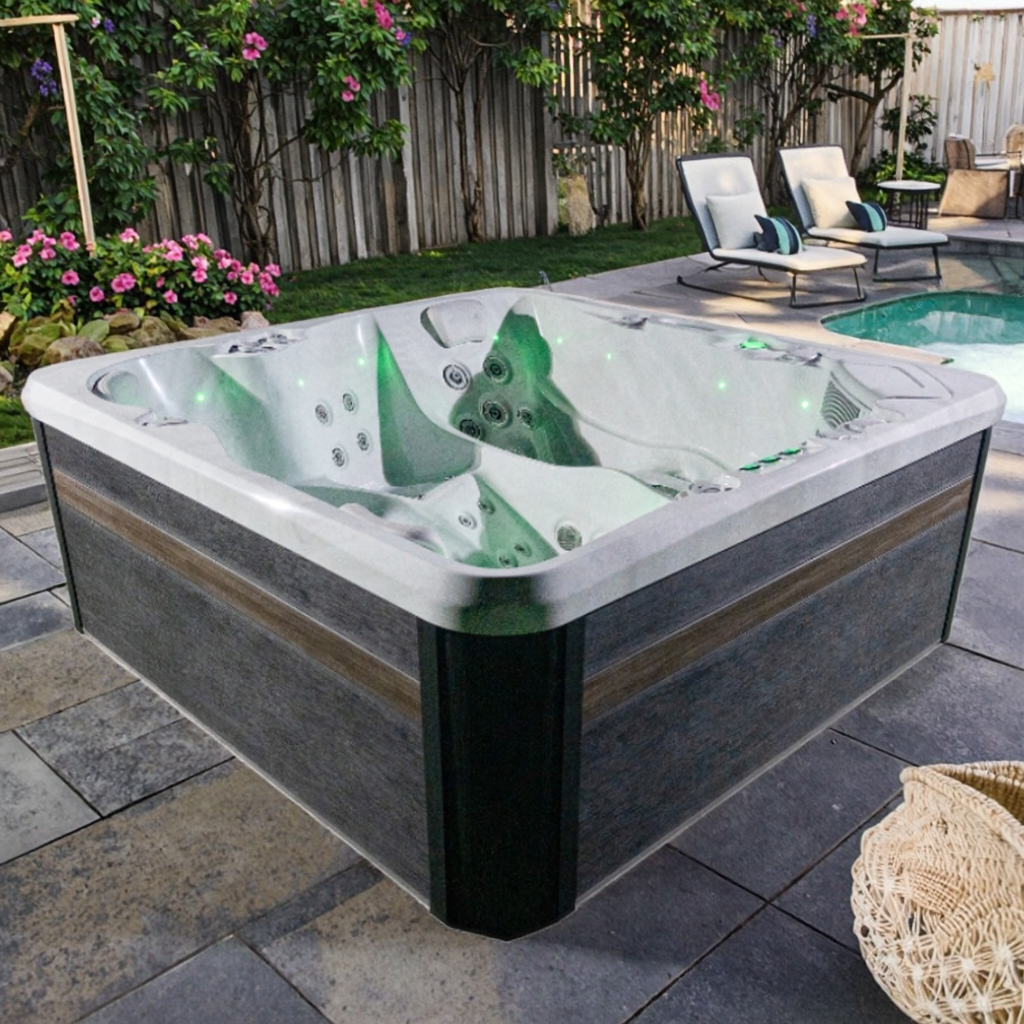
What color should an outdoor spa hot tub normally be?
Strictly speaking, there isn't a single "standard blue" that all equipment in an outdoor whirlpool spa hot tub must present. The visual color of the water is affected by the color of the tub's liner, ambient light, water depth, and the concentration of minerals in the water. However, from a maintenance perspective, the ideal state is clear, transparent water without obvious abnormal hues, persistent turbidity, or noticeable suspended matter, oil film, or abnormal sediment.
From a water quality management perspective, what's truly important isn't "whether the water is blue," but rather "whether the water has suddenly changed." For example, if an outdoor hot tub consistently displays a slightly blue tint, remains stable, has no odor or turbidity, and its pH and disinfectant levels are within the normal range, then there's usually no need for excessive treatment based solely on its visual color. Conversely, if previously clear water suddenly turns yellowish-green, brownish, or bluish-green within hours of adding disinfectant, even if the water remains clear, chemical factors such as metal ion oxidation should be considered.
The CDC recommends regular testing of pH and disinfectant concentration in home swimming pools and outdoor spa hot tubs, specifying that the recommended pH for home hot tubs is 7.0–7.8, with at least 3 ppm free chlorine; if using bromine, 4–8 ppm is generally recommended. The CDC also recommends testing at least twice daily, with increased frequency when multiple people use the water frequently.
Therefore, for outdoor hot tubs, "water discoloration" should be considered a signal requiring further testing, rather than a direct judgment of water quality based solely on color.
Outdoor spa hot tub water turning green: algae or copper?
Green is one of the colors most easily misinterpreted by users because "green" can represent at least two completely different possibilities: algae growth and color changes caused by metal ions.
If the water in an outdoor whirlpool spa hot tub turns a cloudy green, and the tub walls feel slippery, sediment appears at the bottom, the filter is noticeably dirty, and there has been a persistently low level of free chlorine or bromine, then microbial growth or algae should be suspected. Outdoor hot tubs are constantly exposed to air and sunlight, allowing dust, organic matter, and microorganisms to continuously enter the water. Normal disinfection systems can control these contaminants, but if disinfectant is insufficient for a prolonged period, the risk increases significantly.
The CDC points out that improper maintenance of whirlpool spa hot tubs can lead to microbial problems such as Pseudomonas and recommends maintaining at least 3 ppm of free chlorine or 4 ppm of bromine, while keeping the pH between 7.0 and 7.8.
However, if the water in an outdoor whirlpool spa hot tub is "clear green," meaning that even if the water turns green, the nozzles, bottom, and inner tank are still clearly visible, then it cannot be simply attributed to algae. Copper ions are a very concerning cause. Copper may come from the top-up water or may be related to corrosion of the metal parts of the equipment. Especially when the water is chronically acidic, corrosion of metal components can release metal ions into the water. The subsequent addition of chlorine or other oxidizing agents can then cause these metals to oxidize, resulting in a sudden and noticeable color change.
CDC technical data on aquatic facilities also indicates that copper in the water may come from copper-containing products or corroded pipes, while iron and manganese often come from the makeup water.
Therefore, when looking at a green outdoor spa hot tub, the most important first judgment is: if it's green and turbid, prioritize checking disinfection, filtration, and organic contamination; if it's green but clear, consider factors such as copper, iron, and manganese.
What does yellow water in an outdoor spa hot tub usually mean?
Yellow or pale yellow outdoor whirlpool spa hot tub water should not be simply interpreted as "dirty water."
A common cause is iron ion oxidation. Some groundwater, well water, or makeup water with high mineral content may contain a certain amount of dissolved iron. When first poured into the tub, these substances may not cause a noticeable color change because some iron is still in a dissolved state. However, as the outdoor whirlpool spa hot tub is heated and chlorine or other oxidizing agents are added, the iron may oxidize, forming more noticeable yellow, orange, brown, or rust-colored substances. This is why some users find that "the water was clear when first filled, but turned yellow after heating and disinfection." In reality, the disinfectant may not be "creating the yellow color," but rather causing a visible oxidation reaction of metals already present in the fill water.
If the yellow water is accompanied by brown sediment, rust-like marks near the waterline, or a rapidly dirty filter, then the iron and manganese content in the fill water should be checked, rather than blindly adding disinfectant.
This is especially important for outdoor hot tub users using well water. Each water change can reintroduce minerals like iron and manganese into the system. Simply cleaning the discolored water without addressing the water source issue may result in the same problem recurring after each refill.
What causes outdoor hot tub water to appear brown, orange, or even "rust-colored"?
Brown and orange are often more likely to give the impression of "severe water contamination" than light yellow, but in actual outdoor spa hot tub maintenance, metal oxidation remains a significant possibility.
Iron is one of the most typical contributing factors. When iron-containing water enters an outdoor whirlpool spa hot tub, the combined effects of oxygen, heat, and disinfectants can cause the iron to transform into forms that more easily form suspended solids or precipitates. The water may ultimately appear tea-colored, yellowish-brown, orange, or reddish-brown.
If the outdoor whirlpool spa hot tub was completely clear before adding water, and then quickly turned brown after chlorine or a shock agent was added, the likelihood of metal oxidation is relatively high. Conversely, if the water is cloudy and brown from the beginning, accompanied by a large amount of particulate matter, sludge, or a noticeable odor, further investigation is needed to determine if there is contamination in the replenishment water, pipes, or the filtration system.
In such cases, continuously adding chlorine is not recommended. If the real problem is iron, manganese, or other metals, adding more oxidants will not fundamentally address the metal source and may even make the color more pronounced in a short time.
The professional approach is to first identify the source of the metal, and then implement metal control, filtration, or water replacement according to a water treatment plan. For areas where the water source itself has a high mineral content, testing and pre-treating the replenished water before changing it is usually more effective than trying to salvage the situation only after browning occurs.
What does blue or blue-green outdoor hot tub water indicate?
Many outdoor whirlpool spa hot tubs naturally use blue, white, or light-colored liners, so a slight blue tint doesn't necessarily indicate an abnormality. However, if the water suddenly turns a noticeable blue-green, especially if the water was previously clear and colorless, it's necessary to consider metal factors such as copper.
Copper can exhibit blue, blue-green, or even green hues under different water chemistry conditions. Especially in acidic water, corroded metal parts, or when the top-up water contains copper, copper can react further after entering the water. Adding chlorine, bromine, or non-chlorine shock agents may suddenly make the color more pronounced.
If the water remains clear, but blue-green streaks appear on the tub's inner walls, around the nozzles, or near the waterline, the likelihood of a metal problem increases further.
Here's an easily overlooked point: **water discoloration caused by metals and water discoloration caused by algae require completely different treatments.** The former primarily requires addressing the source of the metal and water chemistry issues, while the latter requires focusing on checking the disinfection system, filtration system, and hygiene. Mistaking metal discoloration for algae may lead to excessive and repeated chemical additions without resolving the problem.
What if the water in your outdoor hot tub is milky white or grayish-white?
If the water in your outdoor spa hot tub isn't yellow, green, or brown, but instead turns milky white, grayish-white, or cloudy like "milk," the problem is often not simply a metallic color. It's more likely related to suspended particles, calcium carbonate precipitation, air bubbles, inadequate filtration, or water quality imbalance.
For example, high calcium hardness, along with high pH and total alkalinity, can increase the risk of calcium carbonate precipitation under high temperatures. Outdoor hot tubs operate at around 37–40°C for extended periods, making them more susceptible to changes in water chemical balance than ordinary cold water environments. Adding large amounts of baking soda, high total alkalinity, or hard water as filler can further exacerbate this, potentially resulting in white sediment or milky-white turbidity.
Another possibility is an overloaded filter. When there are large amounts of fine particles, organic matter, or metal oxides in the water, and the filter is clogged or the circulation flow is insufficient, these substances cannot be removed from the water in time, potentially causing the water to remain grayish-white or cloudy for a long time.
Therefore, milky-white water cannot be simply solved by "adding more disinfectant." It's necessary to check pH, total alkalinity, calcium hardness, filter condition, and circulation flow rate simultaneously.
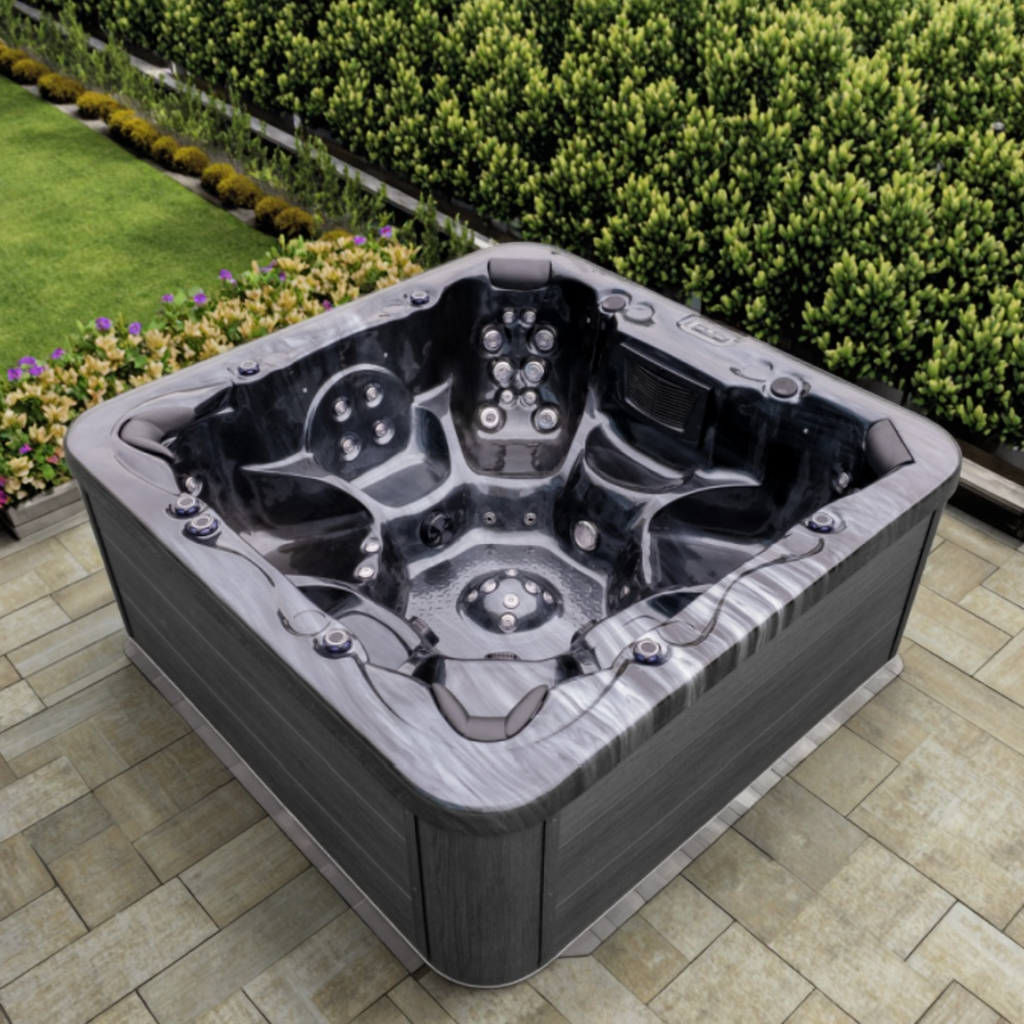
Does black or dark gray water indicate severe contamination in an outdoor hot tub?
Black water is relatively rare, but it should be addressed seriously if it appears. Black, dark gray, or noticeably dark water may be related to manganese, metal oxides, severe organic contamination, pipe deposits, or a contaminated filtration system.
If users haven't cleaned the filters and pipes of their outdoor whirlpool spa hot tubs for a long time, organic matter, minerals, and biofilms may accumulate inside. When these deposits re-enter the water under water flow, temperature changes, or impact treatments, they can cause a sudden darkening of the color.
The CDC recommends regularly checking the circulation system for slime or biofilm during spa hot tub operation and maintenance, and maintaining the filter and changing the water according to the manufacturer's recommendations.
Therefore, if black or dark gray water is accompanied by a slimy surface, odor, or a severely contaminated filter, normal bathing should not continue. The tub should be stopped, and the filtration system, inner tank, nozzles, and circulation pipes should be inspected and treated according to the equipment manufacturer's deep cleaning procedures.
When should the water in an outdoor hot tub be changed when it turns discolored?
Not all discoloration requires immediate drainage, but not all discoloration is suitable for "continuing to add chemicals."
If it's just a slight metallic discoloration and the water quality parameters are generally normal, it may gradually recover with proper metal control and filtration. If it's just a case of high filter load, cleaning or replacing the filter may also improve the situation.
However, if an outdoor spa hot tub hasn't had its water changed for a long time, total dissolved solids accumulate, and there's severe turbidity, foam, odor, metallic contamination, or repeated water quality imbalances, then continuing to add various chemicals may only make the water more complex. In this case, draining, cleaning the tub, cleaning or replacing the filter, and then refilling with properly treated water is usually more reasonable.
The CDC's maintenance recommendations for public whirlpool spa hot tubs state that all or part of the water should be drained and replaced periodically depending on usage frequency and water quality, and the filter media should be cleaned or replaced before refilling, depending on the filter type.
For residential outdoor whirlpool spa hot tubs, the specific water change interval should be based on the manufacturer's instructions, usage frequency, and actual water quality, rather than mechanically following a fixed number of days.
FAQ: Common Issues Regarding Color Changes in Outdoor Hot Tubs
1. Does green water in an outdoor spa hot tub necessarily indicate algae growth?
Not necessarily. If the water is green and cloudy, with low disinfectant levels and a slippery surface, algae or microorganisms should be considered. However, if the water remains clear but has a bluish-green tint, copper or other metal ions should be considered. The treatment methods for these two situations are completely different.
2. Why does the water in my outdoor spa hot tub turn yellow immediately after a change?
If the water gradually turns yellow after heating and disinfection following a water change, one common reason is the oxidation of iron or manganese in the added water. This is especially important when using well water or water sources with high mineral content; the added water should be tested, rather than simply adding chlorine.
3. Why does the water in my outdoor spa hot tub turn brown after adding chlorine?
Oxidizing agents such as chlorine can promote the oxidation of iron, manganese, or copper in the water, making previously subtle metallic colors more pronounced. Therefore, chlorination may be a factor that "triggers color development," not necessarily the actual source of pollution.
4. Is bluish-green water in an outdoor spa hot tub dangerous?
Color alone cannot determine whether it is dangerous. A blue-green color may originate from metals such as copper, or be influenced by the color of the bathtub liner and ambient light. pH and disinfectant levels should be tested, and the metal content should be checked depending on the water source and equipment.
5. Can I continue using an outdoor whirlpool spa hot tub after the water has changed color?
It is not recommended to continue using it if the cause is unknown. If cloudiness, unusual odors, a slimy surface, insufficient disinfectant, or a significantly abnormal pH also occur, use should be discontinued immediately. The CDC recommends maintaining a pH of 7.0–7.8 in home spa hot tubs and keeping free chlorine at least 3 ppm or bromine at 4–8 ppm.