


Does Baking Soda Increase Calcium Hardness in Outdoor Hot Tubs?
2026-09-16 15:30For frequent outdoor whirlpool spa hot tub users, water quality maintenance isn't as simple as "testing the pH and adding a little chlorine." Especially when the water becomes cloudy, develops white deposits, increases in scale, the pH rises, or scale forms on the heater surface, many users start to worry about calcium hardness, total alkalinity, and the relationship between various water treatment agents. Among these, "Does baking soda increase calcium hardness in outdoor whirlpool spa hot tubs?" is a question that's easily misunderstood.
The answer is clear from the outset: Under normal circumstances, baking soda does not directly increase calcium hardness in outdoor whirlpool spa hot tubs. The chemical name for baking soda is sodium bicarbonate (NaHCO₃). It's primarily used to increase the total alkalinity of water, not to add calcium ions. Calcium hardness mainly reflects the content of dissolved calcium ions in the water, usually expressed in mg/L or ppm (calculated as CaCO₃). In other words, adding baking soda to an outdoor whirlpool spa hot tub increases the bicarbonate system and the water's buffering capacity, not directly adding calcium to the water.
However, this issue is easily confused because there is a clear correlation between total alkalinity, pH, calcium hardness, and carbonate balance. Baking soda itself doesn't "add" calcium hardness, but if large amounts of baking soda are used, leading to persistently high total alkalinity, coupled with a high pH, high water temperature, and already high calcium content in the source water, the risk of calcium carbonate precipitation and scale formation may increase. This is especially important for outdoor whirlpool spa hot tubs that operate under high temperatures, strong circulation, and high aeration.
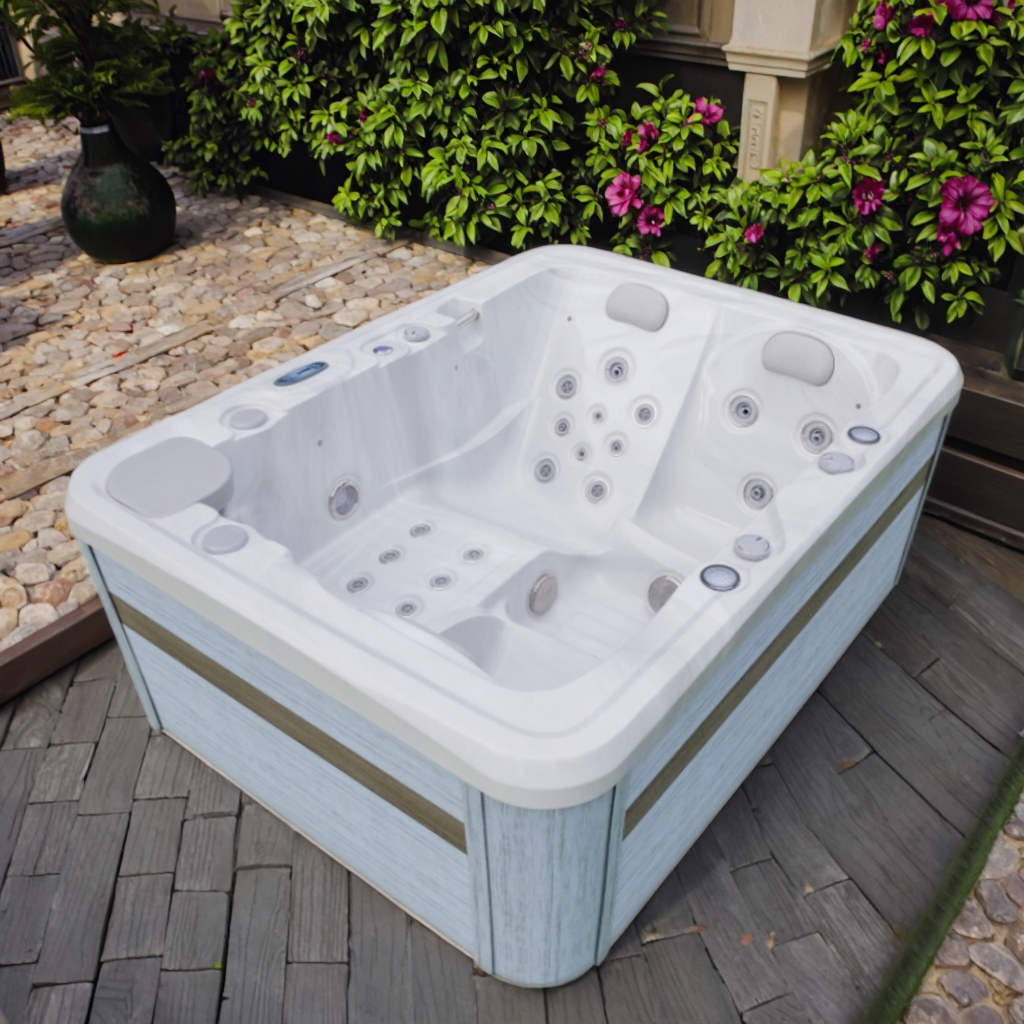
Why are "adding baking soda" and "increasing calcium hardness" often confused?
Many home users, when maintaining outdoor whirlpool spa hot tubs, often only focus on pH and disinfectant concentration, neglecting total alkalinity and calcium hardness. In reality, while these indicators influence each other, they serve different functions.
pH reflects the acidity or alkalinity of the water. For home outdoor whirlpool spa hot tubs, the CDC recommends maintaining the pH within the range of 7.0–7.8, while maintaining a sufficient disinfectant concentration; for hot tubs, the CDC recommends at least 3 ppm of free chlorine, and typically 4–8 ppm when using bromine. High pH levels not only affect disinfection effectiveness but may also increase the risk of scaling.
Total Alkalinity (TA) acts as a buffer system for water, primarily resisting rapid pH changes. Low TA can cause significant pH fluctuations due to chemical additives, human sweat, aeration, and other factors; high TA can make pH adjustment difficult and increase the risk of turbidity and scaling. The CDC's historical guidelines for public spas used a common reference range of approximately 60–120 ppm TA, noting that high TA can lead to turbidity, scaling, and a tendency towards high pH.
Calcium Hardness (CH), on the other hand, focuses on the concentration of calcium ions in the water and is an important indicator of whether the water is "too soft" or "too hard." Low CH can make certain materials more susceptible to corrosion or erosion; high CH can easily combine with carbonate systems to form calcium carbonate precipitates, causing scale, turbidity, and increased strain on filters.
CDC data has used 200–400 ppm as a typical balancing reference range for some spa systems, and its Model Aquatic Health Code also indicates that the suitable range for calcium hardness in whirlpool spa hot tubs and spas with higher water temperatures may need to be adjusted based on factors such as temperature.
Therefore, the most important concept is: total alkalinity is not calcium hardness, nor is pH; baking soda primarily affects total alkalinity.
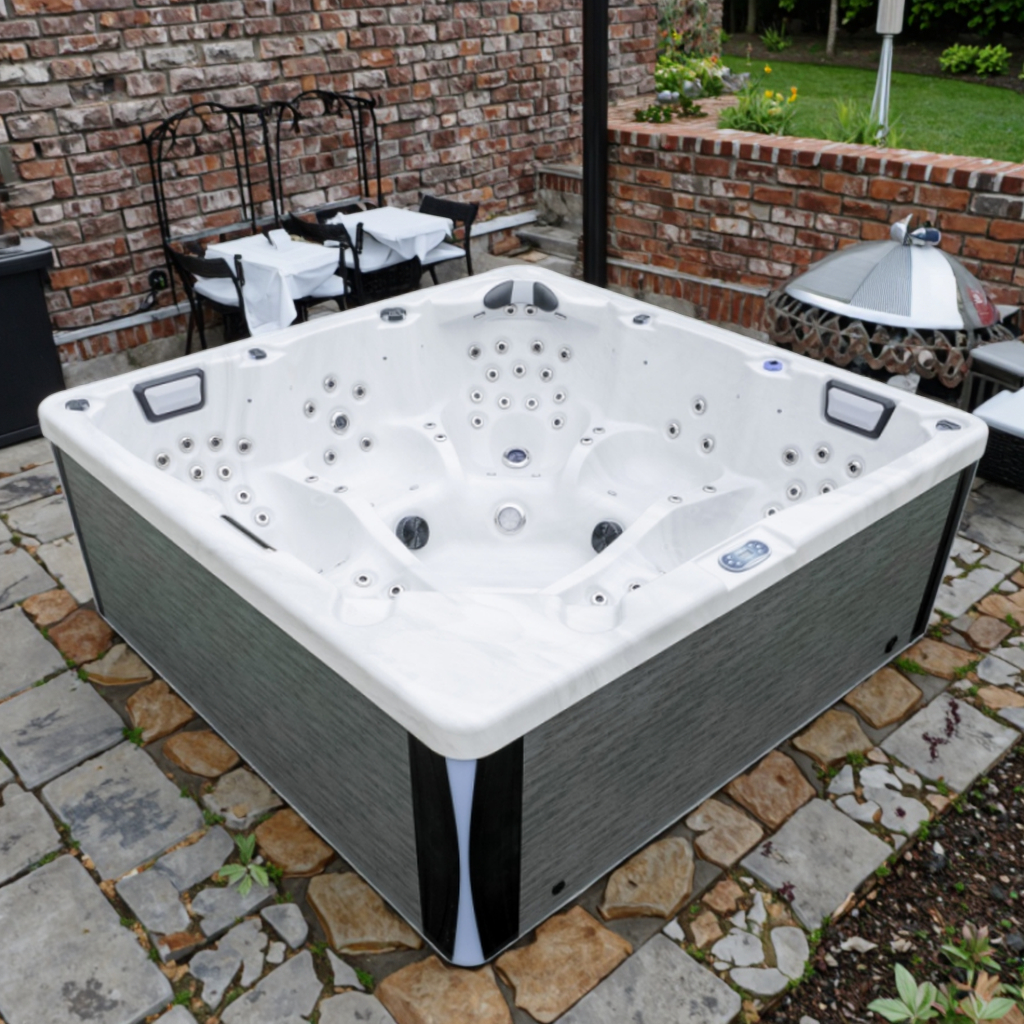
What exactly does baking soda change in outdoor spa hot tubs?
The main component of baking soda is sodium bicarbonate (NaHCO₃). After entering the water, it does not directly provide a large amount of Ca²⁺ like calcium chloride. Therefore, from a water quality testing perspective, baking soda is not the primary chemical used to increase calcium hardness.
The main function of baking soda in outdoor whirlpool spa hot tubs is to increase total alkalinity. When the total alkalinity of the water is low, adding an appropriate amount of sodium bicarbonate can enhance the water's buffering capacity against pH changes, preventing drastic pH fluctuations due to small amounts of acidic substances or other water chemical changes. According to Model Aquatic Health Code documentation, sodium bicarbonate can be used to increase total alkalinity. A common calculation is that adding approximately 1.4 pounds of sodium bicarbonate per 10,000 US gallons of water can increase total alkalinity by about 10 ppm.
For typical outdoor spa hot tubs, the water volume is often only a few hundred gallons, so the actual amount of baking soda needed is far less than in a swimming pool. For example, for an outdoor hot tub of about 500 gallons (approximately 1,900 liters), roughly calculated using the above ratio, the amount of baking soda needed to increase total alkalinity by 10 ppm would be about 0.07 kg, or about 70 g. The actual dosage still needs to be calculated based on product purity, actual water volume, and test results, and cannot be simply added based on a "nearly" figure.
This is also a common mistake many outdoor whirlpool spa hot tub users make: finding the pH low, they add large amounts of baking soda; finding the pH still unsatisfactory, they continue adding; ultimately, the water chemical balance between pH, total alkalinity, and calcium hardness is disrupted, leading to turbidity and scale buildup.
Therefore, the correct classification of baking soda should be "total alkalinity regulator," not "calcium hardness increaser."
Why doesn't baking soda increase the calcium hardness of outdoor hot tubs?
From a chemical composition perspective, the answer is quite straightforward.
Baking soda is NaHCO₃, containing sodium (Na), hydrogen (H), carbon (C), and oxygen (O), but not calcium. Therefore, adding baking soda to an outdoor spa hot tub under normal circumstances will not create new Ca²⁺.
Calcium hardness primarily depends on the concentration of calcium ions in the water. Water treatment products actually used to increase calcium hardness are usually calcium-containing compounds, such as calcium chloride. Relevant water treatment materials also treat "increasing total alkalinity" and "increasing calcium hardness" as two completely different dosing objectives. For example, in common water treatment dosage tables, sodium bicarbonate is used to increase total alkalinity, while calcium chloride is used to increase calcium hardness.
Therefore, if your outdoor spa hot tub's test results show a calcium hardness of only 100 ppm, while the goal is to increase it to 150–200 ppm, simply adding baking soda will not solve the problem.
A more reasonable approach is to first determine the calcium hardness of your local tap water, and then decide whether a specialized calcium hardness regulator is needed based on the whirlpool spa hot tub manufacturer's recommended range. Conversely, if the calcium hardness of your outdoor whirlpool spa hot tub already reaches 300–400 ppm, you shouldn't add excessive amounts of various carbonate products without careful calculation simply because the total alkalinity seems low.
Why are outdoor hot tubs more prone to limescale buildup than regular cold water tubs?
The operating environment of outdoor hot tubs makes them more sensitive to changes in water chemistry.
First, there's the temperature.
The CDC recommends that spa hot tub water temperature not exceed 104°F, or 40°C. Compared to a regular cold water environment, outdoor hot tubs operate at higher temperatures over extended periods, resulting in more significant gas exchange, evaporation, and changes in mineral balance.
Second, there's the strong water flow and aeration.
Outdoor whirlpool spa hot tubs are typically equipped with numerous massage nozzles, circulation pumps, and air systems. High-speed water flow and bubbles accelerate gas exchange between water and air, potentially pushing CO₂ out. When CO₂ in the water decreases, the carbonate balance may change, and the pH may tend to rise. Meanwhile, if there is already a high concentration of calcium and bicarbonate in the water, the chance of calcium carbonate precipitation may increase.
Thirdly, there is evaporation.
Outdoor whirlpool spa hot tubs typically maintain a high water temperature. With the lid open, water continuously evaporates, but non-volatile substances such as calcium, magnesium, and carbonates do not escape with the steam. This means that if water is only replenished regularly and only partially changed, minerals and total dissolved solids may gradually accumulate.
Fourthly, the water volume is small.
An outdoor whirlpool spa hot tub may only hold about 1,500–2,000 liters of water, but the concentration change after adding tens or even hundreds of grams of chemicals each time can be much more significant than in a large swimming pool. Therefore, an outdoor whirlpool spa hot tub is not a "miniature swimming pool"; its water volume is smaller, the temperature is higher, and the human load is more concentrated, so water quality management requires greater precision.
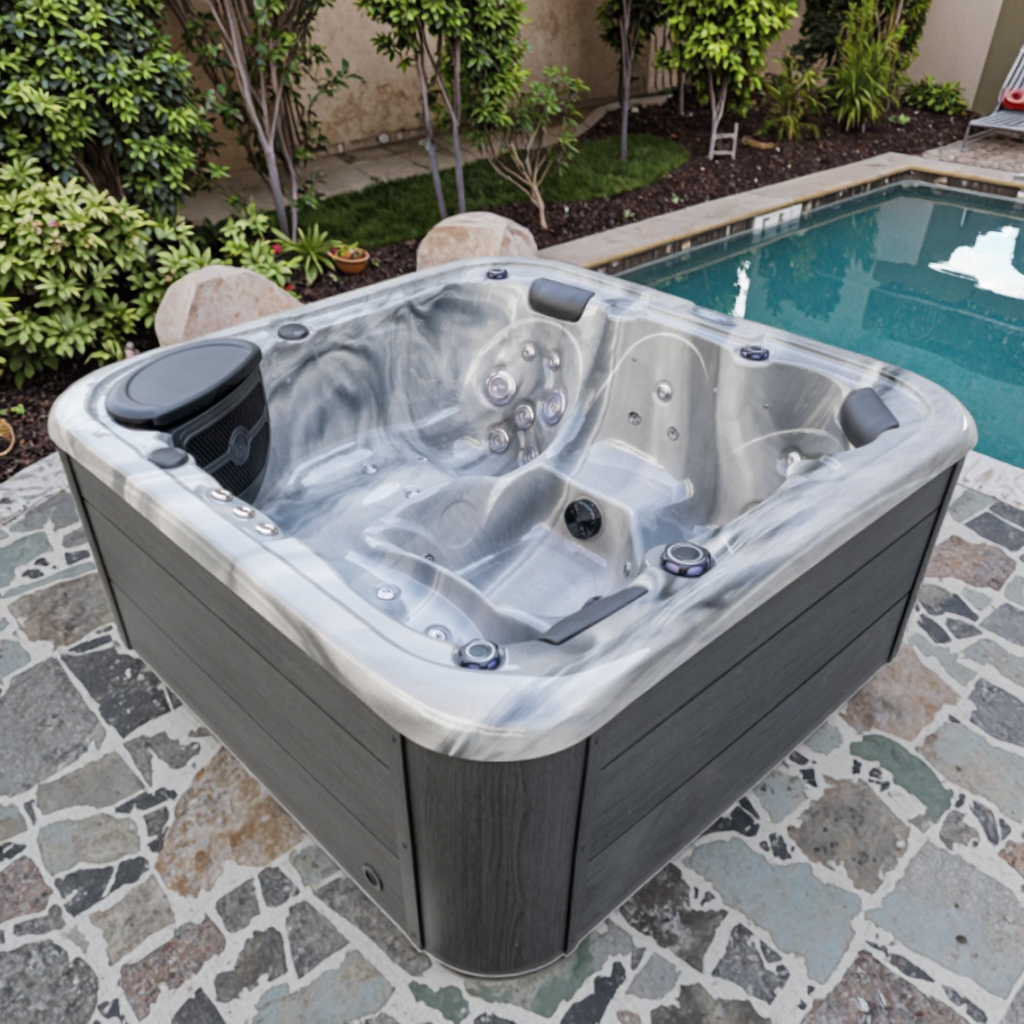
What should the total alkalinity of an outdoor hot tub be maintained at?
It is important to emphasize here that a single number cannot be mechanically applied to all outdoor whirlpool spa hot tubs.
Different brands, different disinfection systems, different water sources, and different equipment materials may result in different target ranges for total alkalinity. Historically, the CDC guidelines for spas used 60 ppm as a minimum reference value, providing typical ideal ranges such as 80–100 ppm, while noting that some disinfection systems may require higher total alkalinity.
For residential outdoor whirlpool spa hot tubs, it's crucial to prioritize the water quality parameters provided by the equipment manufacturer during actual maintenance. For example, some systems may recommend maintaining a total alkalinity (TA) of approximately 50–80 ppm, while some traditional spa systems may use a range of 80–120 ppm. It's not simply a matter of "higher is safer."
If total alkalinity is too low, pH may change too quickly; if total alkalinity is too high, pH may become difficult to lower and may increase the risk of turbidity and scaling. CDC data clearly states that higher total alkalinity can lead to high pH, turbidity, and a tendency to scale.
Therefore, it's best to test the TA before using baking soda, rather than just looking at the pH.
What is the correct procedure for adding baking soda to an outdoor hot tub?
If testing confirms low total alkalinity, and the manufacturer permits the use of sodium bicarbonate, the dosage can be calculated based on the actual water volume and target volume increase.
A common reference value is: Adding approximately 1.4 pounds (about 635 grams) of baking soda per 10,000 US gallons of water can increase the total alkalinity by about 10 ppm. Based on this ratio, approximately 32 grams of baking soda are needed to increase the alkalinity by 10 ppm in a 500-gallon outdoor spa hot tub; and approximately 25 grams in a 400-gallon system. This is only a calculation example; the actual dosage must be adjusted according to product instructions, test results, and equipment manufacturer recommendations.
When adding, it is not recommended to pour a large amount into a small area at once. A more reasonable approach is to start the circulation system and add the calculated amount of agent in stages, ensuring thorough mixing. For larger adjustments, it is advisable to do so in stages rather than adding the entire dose at once.
After adding, allow the system sufficient circulation time before retesting the total alkalinity and pH. If the target result has been achieved, do not continue adding baking soda simply because you want the pH to be higher.
It is especially important to note: Do not treat baking soda as a universal pH adjuster. It's more suitable for increasing total alkalinity, and its effect on pH is usually relatively mild. If the real problem is low pH while total alkalinity is already appropriate, continuing to add large amounts of baking soda may lead to increasingly higher total alkalinity (TA), ultimately making subsequent water quality adjustments more difficult.
FAQ: Common Questions about Outdoor Hot Tubs, Baking Soda, and Calcium Hardness
1. Can baking soda increase the calcium hardness of outdoor whirlpool spa hot tubs?
No. Baking soda is sodium bicarbonate, and its main function is to increase total alkalinity; it does not directly increase calcium ions in the water. When calcium hardness is low, a suitable calcium-containing water treatment agent should be used according to the equipment manufacturer's requirements, not as a substitute for baking soda.
2. Will baking soda cause scale buildup in outdoor whirlpool spa hot tubs?
Baking soda itself is not a direct cause of scale formation, but if the original water has high calcium hardness, and excessive amounts of baking soda are added over a long period, resulting in high total alkalinity and pH, it may increase the risk of calcium carbonate precipitation. This water quality imbalance is particularly concerning in high-temperature outdoor whirlpool spa hot tubs (around 37–40℃).
3. What is the ideal calcium hardness for an outdoor whirlpool spa hot tub?
There is no absolute number applicable to all systems. Some spa water quality management guidelines use approximately 150–250 ppm as a common reference range, while other spa systems may use different ranges. CDC data also indicates that calcium hardness needs to be assessed in conjunction with water temperature, pH, and total alkalinity. Therefore, the water quality requirements provided by the outdoor whirlpool spa hot tub manufacturer should be the primary reference.
4. Can I add baking soda directly if the pH of my outdoor whirlpool spa hot tub is low?
The total alkalinity should be tested first. If the pH is low and the total alkalinity (TA) is also low, baking soda may help; however, if the TA is already normal or even high, continuing to add baking soda is not a reasonable approach. pH and total alkalinity must be considered together.
5. Why does the water in my outdoor spa hot tub become cloudy after adding baking soda?
This may be related to excessively high total alkalinity, increased pH, high calcium hardness, and calcium carbonate precipitation. It could also be due to filter contamination, insufficient disinfectant, or other organic contaminants. If turbidity occurs, pH, TA, calcium hardness, and disinfectant should be retested, rather than blindly adding baking soda.