


What happens if soap gets into an outdoor spa hot tub?
2026-09-14 15:30One of the most common water quality problems in outdoor spa hot tubs isn't bacteria or algae, but rather contamination from the user themselves. Many people habitually use shower gel, soap, shampoo, or body lotion to clean themselves before entering an outdoor hot tub. However, if these products aren't rinsed thoroughly, residue can enter the tub along with skin, hair, and swimwear. Some users even use soap directly in the outdoor whirlpool spa hot tub, considering it a "big bathtub," which can rapidly alter the water's condition.
So, what happens if soap gets into an outdoor spa hot tub? The most obvious phenomenon is usually increased foaming. Previously clear water may quickly produce a large amount of white foam after the nozzles, aeration system, or circulation pump are turned on, and this foam doesn't disappear as quickly as bubbles in normal clear water. Simultaneously, problems such as oily films, odors, turbidity, accelerated filter contamination, and increased disinfectant consumption may also appear.
More importantly, soap itself doesn't necessarily mean "the water immediately becomes toxic," but it increases the organic pollutant load in the outdoor hot tub, placing additional stress on the filtration and disinfection systems that need to maintain balance. The CDC clearly states that spa hot tub water quality management requires simultaneous attention to disinfectants, pH, filtration, and circulation systems. It recommends maintaining free chlorine at least 3 ppm, bromine at 4–8 ppm, and pH between 7.0 and 7.8.
Therefore, the real issue when soap is added to an outdoor whirlpool spa hot tub isn't simply about creating unsightly foam, but rather how to quickly reduce the organic load and allow the filtration, circulation, and disinfection systems to stabilize.
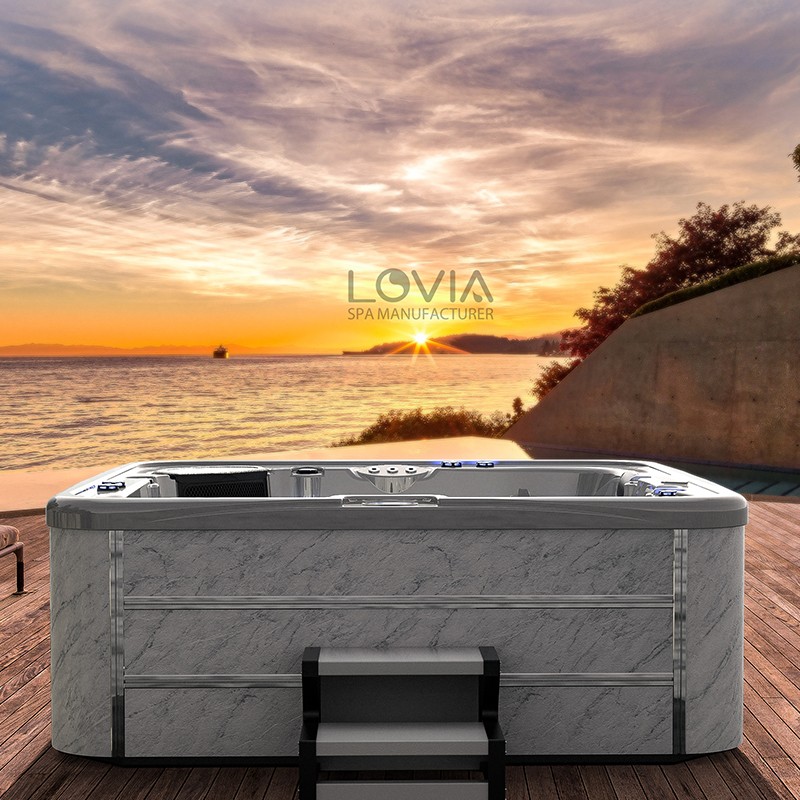
Why does soap produce so much foam in an outdoor hot tub?
Soap, shower gel, shampoo, and some cleaning products typically contain surfactants. Surfactants reduce the surface tension of water, making it easier for the water to form stable bubble structures. When the nozzles, circulation pump, or air injection system of an outdoor spa hot tub is activated, the water is constantly agitated and comes into full contact with air, making it easier for these surfactants to form a large amount of foam.
This is why the same small amount of soap can behave completely differently in a regular bathtub and an outdoor whirlpool spa hot tub. Water in a regular bathtub is usually static or only flows briefly, while outdoor hot tubs typically have continuous circulation, jetting, and bubble agitation. The stronger the water flow and the more thoroughly air is mixed in, the easier it is for foam to form.
This is especially true for outdoor spa hot tubs, where the water temperature is typically high. The CDC recommends that hot tub water temperature should not exceed 104°F, or 40°C. The combination of high temperature, jetting, and aeration makes various dissolved substances and organic contaminants in the water more likely to produce noticeable sensory changes.
Therefore, when users find that their outdoor whirlpool spa hot tub starts producing a lot of foam as soon as the nozzles are turned on, their first thought shouldn't be "insufficient disinfectant," but rather checking if anyone has recently used soap, shower gel, shampoo, body lotion, sunscreen, or other personal care products.
What is the most direct effect of soap entering an outdoor hot tub?
The most direct effect is foam.
If only a very small amount of soap remains, for example, if a user enters an outdoor whirlpool spa hot tub without thoroughly rinsing their body after showering, only a small amount of foam may be produced. This usually doesn't cause immediate serious problems, but if contamination continues to accumulate, the foam will become increasingly noticeable.
If soap, shower gel, or shampoo is brought directly into an outdoor whirlpool spa hot tub, especially when the water temperature is high and multiple nozzles are turned on, a large amount of foam can form within minutes. Foam may cover the water surface and even overflow from the rim of the tub.
It's important to note that foam itself is not the sole indicator of water quality. Some outdoor spa hot tubs may have accumulated significant amounts of organic contaminants even with minimal foam; conversely, some tubs with normal water quality may temporarily produce foam due to small amounts of surfactants.
Therefore, foam should be considered a "warning sign," not a standalone indicator of water quality.
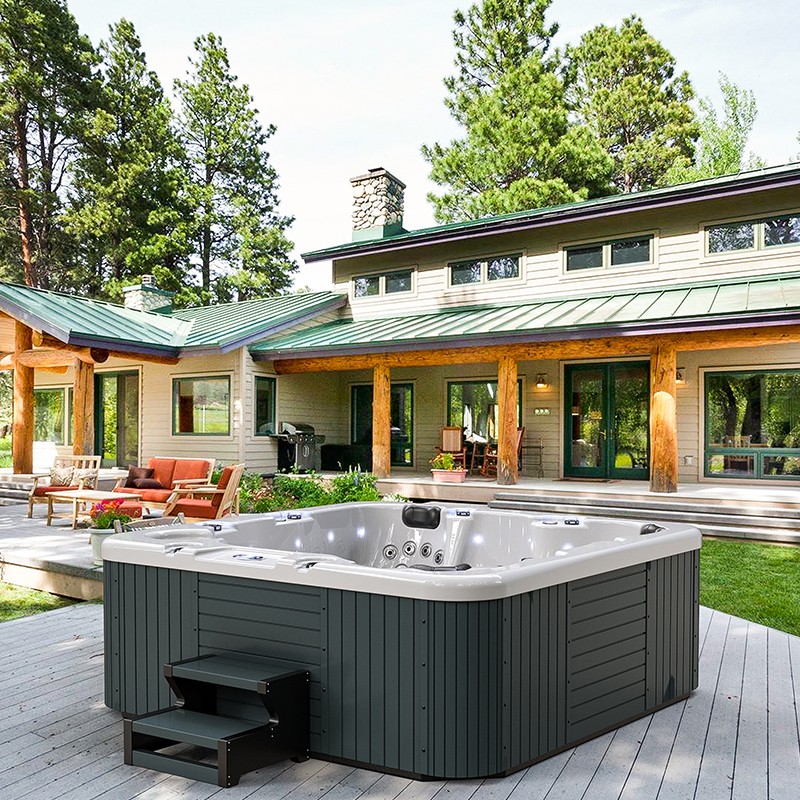
Does soap affect the chlorine levels in outdoor spa hot tubs?
This is a more pressing question.
The chlorine in outdoor spa hot tubs is not infinitely effective. It constantly reacts with various contaminants entering the water, and sweat, sebum, dust, bodily secretions, and personal care products can all increase the contamination load on the water.
The CDC clearly states that various human-derived contaminants, including sweat, urine, feces, and bodily waste, can reduce the chlorine concentration in hot tubs.
Soap and other personal care products entering outdoor spa hot tubs can also increase the load of organic and chemical substances that need to be treated. Therefore, if multiple people use an outdoor hot tub consecutively, and each person does not rinse thoroughly before entering, the rate of disinfectant consumption may increase significantly.
This is why you can't simply assume, "I've added chlorine, so soap is fine."
Chlorine's role is to control microorganisms, not to automatically eliminate all personal care products entering the water. Filtration systems primarily remove suspended particles, not specifically dissolved surfactants. Therefore, when soap is added to an outdoor whirlpool spa hot tub, the solution involves three aspects: controlling the source of contamination, adjusting water quality, and necessary water changes.
Will soap change the pH of an outdoor whirlpool spa hot tub?
Possibly, but the specific change depends on the soap or cleaning product's formula, the amount added to the water, and the buffering capacity of the original water. Therefore, you can't simply say, "Soap will definitely raise the pH by a certain amount."
Traditional soaps are usually alkaline, and the formulas of different shower gels, shampoos, and liquid cleaning products vary greatly. Therefore, when actually added to an outdoor hot tub, it may cause some degree of pH or total alkalinity change.
Why is pH so important? Because it not only affects human comfort but also the disinfection efficiency of chlorine and the long-term stability of equipment materials. The CDC recommends maintaining the pH of outdoor spa hot tubs between 7.0 and 7.8, noting that chlorine's ability to kill microorganisms decreases when the pH rises, especially above 8.0; a low pH may increase the risk of corrosion to pipes and equipment.
Therefore, if a large amount of soap enters an outdoor whirlpool spa hot tub, the correct approach is not to add "pH+" or "pH-" based on intuition, but to test the pH first and then decide whether adjustment is necessary.
Why does soap make outdoor hot tubs increasingly cloudy?
Substances from soap and personal care products can interact with minerals, body oils, and other organic pollutants in the water. Simultaneously, the constant agitation from the nozzles recirculates pollutants that were previously deposited or attached to the surface.
If the filtration system in the outdoor whirlpool spa hot tub is functioning properly, some particulate pollutants can be intercepted by the filter cartridge. However, filters cannot directly remove all dissolved substances; therefore, as soap, oils, and other organic pollutants continue to enter, the water may gradually become cloudy.
If foam, an oil film, and cloudiness occur simultaneously, it indicates that the problem is no longer just "a little soap in the water," but rather that the overall pollution load is increasing.
For families who frequently use outdoor whirlpool spa hot tubs, this is why a quick shower before use is so important. The CDC recommends that hot tub users maintain good personal hygiene and reduce the risk of contamination through proper water quality management.
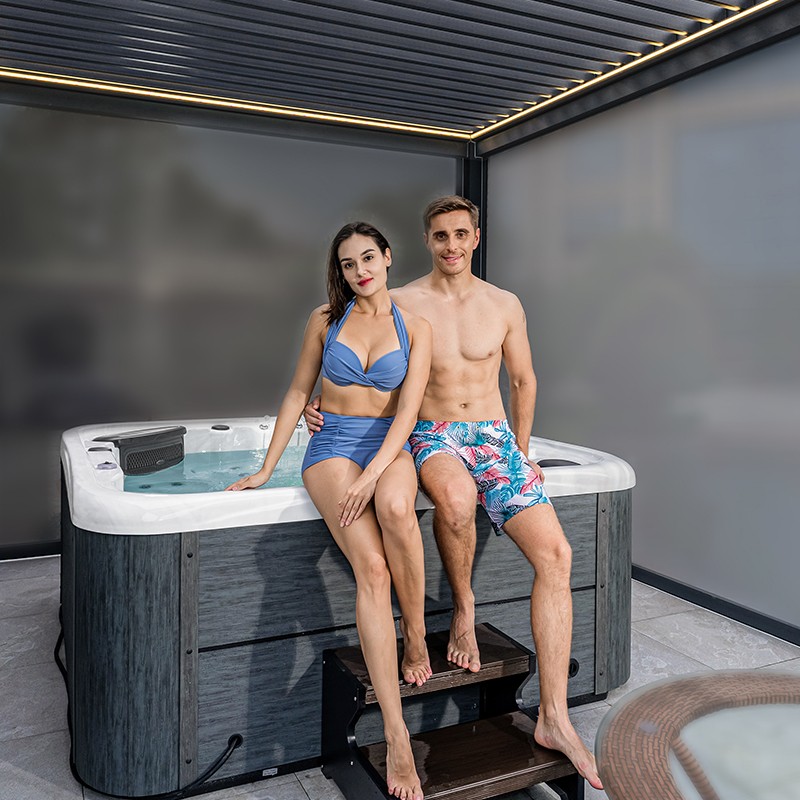
Will soap in an outdoor spa hot tub clog the filter?
It will increase the filter's contamination load, but it's not accurate to say that "soap will definitely clog the filter cartridge."
Filters are best at handling suspended particles in water, such as hair, dander, dust, fine particles, and other insoluble contaminants. Soap itself may be dissolved, but when it combines with body oils, dust, and other organic matter, it can form even more contaminants that can be trapped by the filtration system.
If a family's outdoor spa hot tub has a capacity of approximately 1000–1500 liters and is used daily by multiple people, each bringing in a certain amount of skincare products, sweat, and cleaning products, then the actual contamination load on the filter will be much higher than that of a single person using it less frequently.
As contaminants gradually accumulate in the filter cartridge, filtration resistance increases, and the circulation flow may decrease. Users may notice a weaker water flow from the nozzles, longer circulation times, or a noticeably oily feel on the filter cartridge surface.
The CDC recommends maintaining whirlpool spa hot tub filtration and circulation systems according to the manufacturer's specifications, and regularly cleaning or replacing the filters. For cartridge filters, maintenance is especially important according to the manufacturer's recommended schedule and the actual level of contamination.
What are the correct water quality parameters for outdoor hot tubs?
For residential outdoor whirlpool spa hot tubs, the most important basic parameters are free chlorine or bromine and pH.
According to the CDC's current recommendations for residential swimming pools and spa hot tubs, the free chlorine level should be at least 3 ppm, 4–8 ppm when using bromine, and the pH should be maintained between 7.0 and 7.8.
For more stringent operating environments, the CDC also provides operating reference ranges for Legionella control: 3–10 ppm free chlorine, 4–8 ppm bromine, and 7.2–7.8. However, actual use must comply with local regulations and the equipment manufacturer's requirements.
It is important to note that chlorine should not be added to excessively high levels simply to "treat soap." The CDC also warns that when chlorine concentrations exceed 10 ppm, some tests may exhibit a bleaching effect, resulting in inaccurate readings.
Therefore, water quality management for outdoor whirlpool spa hot tubs should follow the logic of "detection-judgment-adjustment," rather than relying on the amount of foam to determine the amount of chemicals to add.
When should you consider changing the water in an outdoor hot tub?
The problem can be divided into three levels.
The first is mild contamination.
A small amount of soap residue causes slight foaming, the water remains clear, there is no obvious oil film or odor, and pH and disinfectant levels are normal. In this case, you can usually stop the source of contamination, increase the circulation and filtration, and continue to observe the water quality.
The second is moderate contamination.
There is noticeable foaming, the filter shows a lot of oily contamination, and the water begins to become cloudy, but it may recover after cleaning and water quality adjustment. At this time, filter maintenance should be performed, and appropriate water treatment should be carried out according to the equipment instructions.
The third is severe contamination.
A large amount of soap or bath products enters, forming continuous foam on the water surface, with obvious oil film, odor, and turbidity. Water quality parameters cannot be stabilized for a long time, or abnormalities quickly reappear after treatment. In this situation, instead of constantly adding chemicals, it's better to drain the water, clean the tub, maintain the filter, and refill the tub.
The CDC's maintenance recommendations for whirlpool spa hot tubs also explicitly state that a full or partial water change should be performed depending on usage and water quality, and the filter should be maintained before refilling.

FAQ: What if soap gets into an outdoor spa hot tub?
1. Will soap immediately produce a lot of foam in an outdoor hot tub?
Not necessarily. A small amount of soap residue may only produce slight foam, but a large amount of soap, shower gel, or shampoo entering the tub can quickly produce a large amount of stable foam due to the nozzles, bubbles, and circulating water. The amount of foam also depends on the product formulation, water temperature, and water quality.
2. Does foam in an outdoor whirlpool spa hot tub mean there's too little chlorine?
Not necessarily. One more common cause of foam is the presence of surfactants, grease, and other organic contaminants in the water. The correct approach is to test for free chlorine, bromine, and pH, rather than simply adding chlorine based on the amount of foam. The CDC recommends at least 3 ppm free chlorine, 4–8 ppm bromine, and a pH of 7.0–7.8 for outdoor spa hot tubs.
3. Can I use shower gel directly in an outdoor whirlpool spa hot tub?
Not recommended. Outdoor spa hot tubs require continuous water circulation and disinfection. Shower gel, shampoo, and soap increase the surfactant and organic pollutant load in the water, easily leading to foam, water quality fluctuations, and filter contamination.
4. Do I need to drain the tub immediately after soap gets in?
Small amounts of contamination may not require immediate drainage. However, if a large amount of soap has entered, causing persistent foam, oil film, turbidity, or odor, you should consider thoroughly draining the tub, cleaning the tub, maintaining the filter, and refilling. The actual assessment should be based on the degree of contamination, water quality test results, and the equipment manufacturer's recommendations.
5. Can defoamers solve the problem of foam in outdoor whirlpool spa hot tubs?
They can be used as an adjunct in some systems, but defoamers do not actually remove the soap, surfactants, and organic pollutants that cause foam. Therefore, defoamers should not be considered the primary method for water quality remediation.