


What causes pH levels to drop in outdoor spa hot tubs?
2026-11-16 15:30For outdoor spa hot tub users, water quality management is a very important part of routine maintenance. Among them, a drop in pH value is a common problem. Users will obviously find that after just adjusting the water quality, the pH value will be low again after a few days of use. Even if pH raising agents are added repeatedly, it is difficult to keep water quality stable for a long time.
So why does the pH of an outdoor spa hot tub continue to drop? Is it improper use of disinfectant, insufficient total alkalinity, or is it the impact of rain, human sweat and the external environment? If we pay attention to this issue for a long time, what impact will it have on tap water, pipes and filtration systems?
In fact, changes in the pH value of an outdoor hot tub are not a water quality problem in the open air, but a symptom of changes in the chemical balance of the water. Compared with ordinary swimming pools, outdoor spa hot tubs usually have concentrated characteristics such as smaller water volumes, higher water temperatures, and frequency of use, so water quality parameters are more likely to fluctuate.
This article will analyze in detail the key factors of pH decline in modern outdoor jacuzzi tubs, and provide practical solutions to help users establish a scientific and stable water quality management system.

Why is the pH of an outdoor spa hot tub so important?
The pH value is an important indicator of the acidity and alkalinity of slow water, ranging from 0 to 14. A pH of 7 usually represents neutral, a pH below 7 represents acidic, and 7 represents alkaline.
For outdoor hot tubs, the pH value not only affects the acid-base balance of the water, but is also directly related to the efficiency of the disinfectant, the service life of the equipment and materials, and the comfort of the human body when in contact with the water.
Generally, it is recommended that the pH value of a modern outdoor jacuzzi tub be maintained between 7.2 and 7.8. Some water quality management plans set 7.2-7.6 as daily control targets. The specific scope will also need to be determined based on the disinfection system, equipment manufacturer requirements and local water quality management regulations.
Common water quality management reference parameters for outdoor hot tubs:
| Water Quality Parameter | Recommended Range | Main Function |
| pH | 7.2–7.8 | Maintains water balance |
| Total Alkalinity | 80–120 ppm | Stabilizes pH |
| Free Chlorine | 3–5 ppm | Controls microorganisms |
| Bromine | 4–6 ppm | Provides disinfection |
| Calcium Hardness | 150–250 ppm | Helps manage water balance |
| Water Temperature | Maximum 40°C | Reduces overheating risks |
Note: These are general reference values. Actual targets should follow the spa hot tub manufacturer's instructions and applicable local standards.
The importance of outdoor hot tub pH is mainly reflected in three aspects:
First, it affects the sterilization efficiency of disinfectants. For outdoor hot water baths that use chlorine for disinfection, pH affects the ratio between hypochlorous acid (HOCl) and hypochlorite ions (OCl⁻). Hypochlorous acid has the ability to disinfect. When the pH value increases, the proportion of effective hypochlorous acid usually decreases, thus affecting the disinfection efficiency. , pH value that is too high or too low is not conducive to nutritional management.
Secondly, it affects the service life of the equipment. If an outdoor hot tub is in an acidic environment for a long time, the risk of water corroding some metal materials may increase. Antennas, metal connections, water pump parts, and pipe fittings can all be affected, leading to equipment failure and increased repair costs in severe cases.
Finally, acid affects the human body’s experience. Abnormal water alkalinity may cause eye irritation, uneven skin and other problems. Therefore, maintaining a reasonable pH value is not only a need to protect the equipment, but also an important condition for ensuring the experience of using an outdoor hot tub.

What are the main causes of pH drops in outdoor hot tubs?
A continued drop in the pH of your outdoor spa hot tub is usually not caused by a single factor, but rather by a combination of factors. If it is treated only by adding a pH raising agent and analyzing the root cause, water quality problems can easily reoccur.
8 Common Reasons Your Outdoor Hot Tub’s pH Drops:
1. The total alkalinity is sufficiently low and the water body lacks buffering capacity
Total Alkalinity (TA) is a key parameter that affects the pH stability of outdoor spa hot tubs, and it is also a factor that many users tend to ignore.
Simply put, total alkalinity is like a stabilizer for water, helping it resist changes caused by external acids and alkalis. When the total alkalinity is within the acceptable range, the pH value will not easily fluctuate even if a small amount of disinfectant is added or is affected by the human face.
However, if the total alkalinity is too low, the buffering capacity of the water body will be weakened, and a small amount of acidic substances entering the water may also cause significant pH changes.
For example, if the total alkalinity of a building with a 1,200-liter modern outdoor jacuzzi tub is only 30 ppm, and the daily management goal is 80-120 ppm, then the water may be more sensitive to acidic substances.
It should be noted that low total alkalinity does not mean that the pH value must be low, but insufficient total alkalinity makes the pH value more likely to fluctuate.
Solution: When the pH value of an outdoor hot tub drops repeatedly, you can't just check the pH value, but you also need to check the total alkalinity simultaneously. If the total alkalinity is obviously insufficient, it can be adjusted using a sodium bicarbonate product according to the tub and product instructions.
2. Long-term use of acidic disinfectants leads to the gradual acidification of water bodies
Disinfectants are an important part of outdoor spa hot tub water quality management, but different types of disinfectants have different effects on pH.
For example, trichlorine disinfection products have obvious acidic characteristics. If used for a long time and irrationally, the pH value of the water may gradually decrease. In addition, some non-oxidizing chlorine products, such as potassium monopersulfate (MPS), may also lower the pH value.
In order to keep their outdoor hot tubs clean, some users add disinfectants to their outdoor spa hot tubs without simultaneously testing the pH and total alkalinity. This operation can easily cause the chemical balance of the water to be restored.
It is important to emphasize that not all chlorine disinfectants lower pH. For example, calcium hypochlorite is usually relatively alkaline, and the chemical characteristics of different products vary.
Solution: Choose products that match your outdoor hot tub’s disinfection system and avoid blindly using pool disinfectants instead of hot tubs by selecting specialized products. At the same time, record the type and amount of medicine added each time to avoid excessive use.
3. Rainwater enters the outdoor hot tub and changes the chemical composition of the water
Compared with indoor equipment, outdoor hot tubs need to face a more complex natural environment. New technology is an easily overlooked factor.
Rainwater may contain dissolved carbon dioxide and other acidic substances, which will also have an impact on the original water body after entering the outdoor hot tub. If the total alkalinity of the bathtub is relatively low, it may further increase the buffering capacity of the water body.
For example, if 50 liters of rainwater enters a 1,000-liter modern outdoor jacuzzi tub, the original water volume will increase by 5%. If the total alkalinity of rainwater is significantly lower than that of raw water, it may have an impact on the water quality balance.
In addition, rainwater may bring moisture, leaves, pollen and other organic pollutants into the bathtub, increasing the burden on the filtration and disinfection system.
Solution: When your outdoor spa hot tub is not in use, install a special insulated protective cover to reduce the ingress of rainwater and external flooding. After encountering continuous variation or heavy rain, the pH value and total alkalinity should be re-tested, and the water quality should be adjusted if necessary.
4. Human sweat, sebum and other cardiovascular factors increase the burden on water bodies
The human body is also an important factor affecting the water quality of your outdoor spa hot tub.
When a user enters a hot bath, sweat, sebum, skin care products, sunscreen, cosmetics, and other organic materials enter the water body. These will increase the workload of the disinfection system and lead to faster consumption of disinfectants.
Especially when multiple people are using it at the same time, or when family members are using the modern outdoor jacuzzi tub continuously, the bathtub accumulation rate will increase significantly.
It should be noted that sweat itself does not mean that the pH value will necessarily drop. In fact, it affects the composition of the kidneys, the type of disinfectant and the buffering capacity of the water body. But kidney storage increases the risk of water imbalance.
Solution: It is recommended that users rinse their bodies before entering the outdoor spa hot tub and minimize the entry of skin care products and sunscreen products into the room. After multiple people use it, the disinfectant concentration should be tested in time and the water quality should be adjusted according to the actual situation.
5. The total alkalinity of the supplementary water source is too low
Many users use tap water directly to refill their outdoor spa hot tubs after the water level drops. However, there are large differences in water quality in different regions, especially total alkalinity and calcium expansion.
For example, the total alkalinity of tap water in some areas may be 120 ppm, while in others it may be only 35 ppm. Even if the final pH of two water sources is close, their impact on modern outdoor jacuzzi tub water stability can be completely different.
If you use a water source with low total alkalinity for long-term rehydration, the buffering capacity of the bathtub may eventually gradually decrease, making the pH value more susceptible to fluctuations.
Solution: First, it is recommended to test the pH value, total alkalinity and calcium filling level of the water source when filling water and subsequent replenishment. If the total alkalinity of the water source is obviously low, adjustments should be made based on the actual situation instead of directly adding a large amount of water.
6. Adding amount of pH lowering agent
pH reducers are used to solve the problem of excessively alkaline water in outdoor spa hot tubs. Common ingredients include sodium bisulfate.
However, in actual maintenance, users do not add certain amounts based on bath calculations, but directly add chemicals based on experience. This can cause the pH to drop quickly from a high to a low state.
As a result, users failed to add pH-increasing agents, resulting in repeated water quality and a vicious cycle.
Adding solutions: Any water conditioner should be tested for pH and total alkalinity first, and formulated according to the actual dosage for your modern outdoor jacuzzi tub and the product instructions. Use small and frequent adjustments to avoid adding too much at one time.
7. Filtration system pollution and pipeline biofilm accumulation
After long-term operation of an outdoor spa hot tub, the filter and circulation pipes can accumulate grease, dander, and other organic contaminants.
If the filter is not cleaned for a long time, the water circulation efficiency may decrease. At the same time, biofilm may also form inside the pipeline, increasing the risk of value addition and disinfectant consumption.
Biofilm does not necessarily directly cause a drop in pH, but it will increase the complexity of modern outdoor jacuzzi tub water quality management and may cause abnormal disinfectant consumption, odor, and repeated deterioration of water quality.
Solution: Clean the filter regularly and check the circulation system and nozzles according to the equipment instructions. For outdoor spa hot tubs that have been used for a long time, the pipes should be cleaned regularly if necessary, and the inner wall of the tub should be thoroughly cleaned after draining the water from time to time.
8. Quality inspection tools are inaccurate
Sometimes the pH level of an outdoor bathtub does not actually drop, but rather the tray that detects the presence of the tool.
For example, using mid-term test paper, the test paper getting damp, incorrect colorimetric judgment, or the electronic pH meter is not adjusted in time may cause inaccurate test results.
In addition, some high-concentration disinfectants may interfere with some colorimetric detection methods, causing distortion of results.
Solution: It is recommended to use a professional water testing kit suitable for outdoor spa hot tubs. Electronic pH meters should be adjusted regularly using standard buffer solutions. Common adjustment points include pH 4.00 and 7.00. The specific instructions are the same as the instrument instructions.
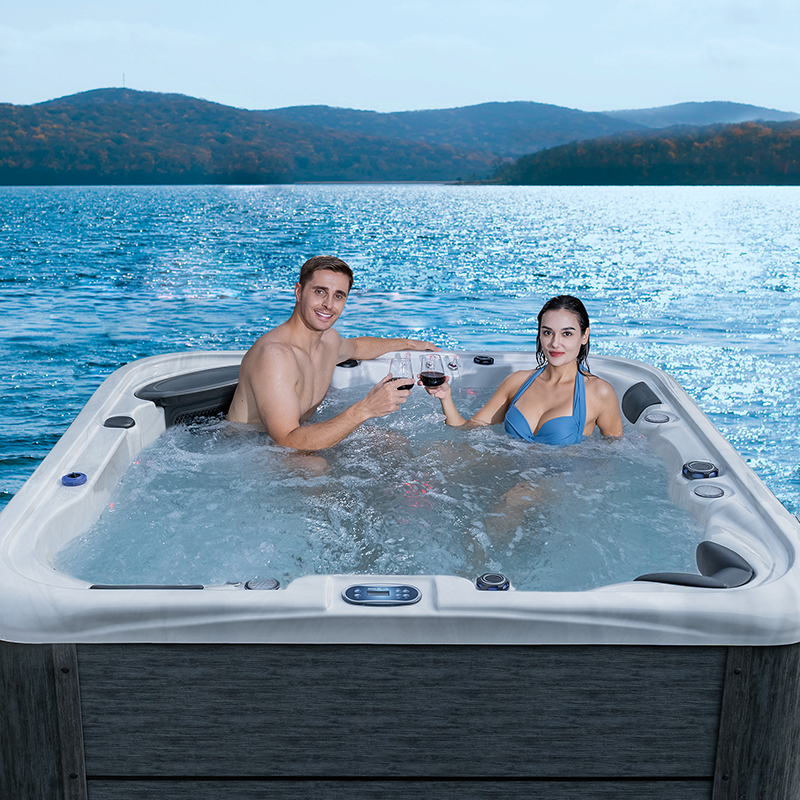
If the pH value of an outdoor hot tub is too low, what kind of waste water will it bring?
A drop in pH not only means the water is more acidic, it can also have long-term effects on the equipment and experience of your outdoor spa hot tub.
1. Accelerate corrosion of metal parts. In a low pH environment for a long time, some metal materials may suffer from corrosion or pitting. Heaters, water pump internal parts, metal connections, and pipe fittings may all be affected, leading to equipment repair or even replacement in severe cases.
2. Affect the disinfection effect. pH changes the chemical balance of a chlorine disinfection system. While a lower pH will increase the proportion of hypochlorous acid present, over-acidification may pose a risk of disinfectant loss and chlorine gas formation. Therefore, it cannot be considered that the lower the pH value, the better the disinfection effect of outdoor hot baths.
3. Reduce the comfort of use. A pH value that is too low may cause uneven eyes and skin tone, affecting family members’ experience. For hotels, B&Bs and commercial spa establishments, it may also affect customer reviews.
4. Increase equipment maintenance costs. If taken seriously over the long term, the risk of equipment corrosion, wiring damage and heating system failure may increase. For commercial operators, in addition to repair costs, there is also the operational loss caused by equipment failure.
Therefore, when the pH value of an outdoor spa hot tub is significantly lower than the normal range, use should be suspended, the water quality should be detected and adjusted in a timely manner, and the parameters should be confirmed to return to the specified range before reopening.
Frequently Asked Questions (FAQ) about pH Drops in Outdoor Hot Tubs
FAQ 1: What is a normal pH level for an outdoor spa hot tub?
Generally maintained between 7.2 and 7.8, the specific requirements should be determined according to the recommendations of the disinfection system and equipment manufacturers. If the pH value is lower than 7.0, it means that the water body is obviously acidic and should be detected and adjusted in time.
FAQ 2: Why did the pH of the outdoor hot tub drop again the next day after adjusting it?
Common causes include insufficient total alkalinity, excessive use of acidic disinfectants, excessive addition of pH lowering agents, and coconut accumulation. It is recommended to check the pH value and total alkalinity at the same time, and give priority to solving the problem of insufficient buffering capacity.
FAQ 3: The pH value of the outdoor hot tub is too low. Can baking soda be added directly?
Yes, but you need to check the total alkalinity first. The main purpose of baking soda is to increase the total alkalinity and possibly increase the pH level. If the total alkalinity is already normal, other pH adjustment products need to be selected based on actual test results.
FAQ 4: Will rainwater cause the pH of an outdoor spa hot tub to drop?
It's possible. When rainwater enters the bathtub, it may take away the original water body and bring in acidic substances and external minerals. It is recommended to cover the bathtub cover when not in use and retest the water quality later.
FAQ 5: The pH value of the modern outdoor jacuzzi tub is too low, can it still be used?
Not recommended. When the pH value is significantly lower than the normal range, use should be suspended, water quality should be adjusted first, and dietary concentration and other key parameters should be confirmed to return to normal before reopening.