


How Does the Counter-Current System in an Outdoor Swim Spa Work?
2026-11-14 15:35With the growing demand for home fitness, outdoor leisure, and aquatic rehabilitation, outdoor swim spas have emerged as a compelling alternative to traditional swimming pools. By utilizing a counter-current system to generate a continuous flow of water, these units allow users to swim in place, perform aerobic exercises, and engage in aquatic training within a compact space—eliminating the need for constant turns.
However, the performance of a counter-current system is not determined solely by pump power. Factors such as water velocity, flow width, uniformity, and adjustability all play a critical role in the overall swimming experience.
This article explores how counter-current systems in outdoor swim spas function—covering their operating principles, core technologies, key parameters, common issues, and tips for selecting a model that meets your specific needs.
What Is a Counter-Current System in an Outdoor Swim Spa?
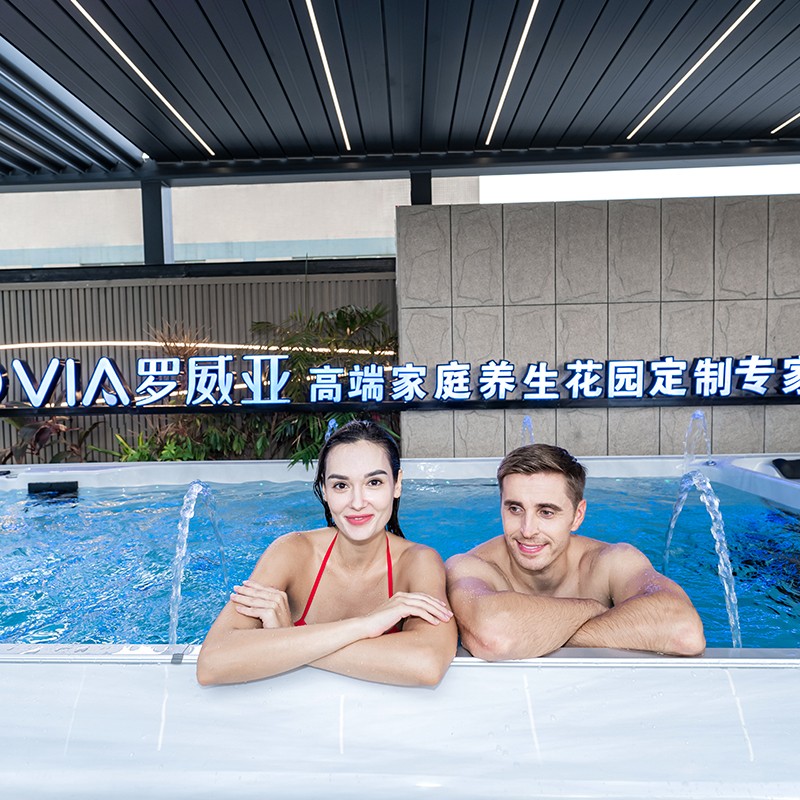
The countercurrent system in outdoor swim spas, also known as a swimming countercurrent system, mainly functions to generate a water flow that is opposite to the direction of the swimmer's movement, allowing the user to swim continuously in a relatively fixed position.
As the swimmer strokes forward, the system delivers a steady stream of water, creating constant resistance. When the swimmer’s forward propulsion reaches a dynamic equilibrium with the resistance provided by the water flow, they are able to maintain their swimming movements within a confined area.
Unlike standard hot tubs, which primarily feature massage jets designed to apply localized water pressure, a swim spa’s counter-current system is engineered to produce a broad, stable, and consistent flow of water capable of supporting continuous physical activity.
Therefore, when evaluating whether an outdoor swim spa hot tub combo is suitable for swim training, one should look beyond the mere number of jets and instead consider factors such as actual water volume, flow velocity, the width of the current, and the ability to adjust the intensity of the flow.
How the Counter-Current System Works
A counter-current system in an outdoor swim spa hot tub combo typically consists of water intakes, a pump, a motor, plumbing, water outlets (jets or propulsion units), and a control system. While the specific architecture may vary between products, the fundamental operating process remains consistent.
1. Water Intake and Circulation
Once the system is activated, pool water enters the plumbing circuit through the intake. The design of the intake affects both flow resistance and operational safety. If the intake area is insufficient or becomes obstructed by debris, the system may experience issues such as reduced flow rates or increased noise.
In some outdoor swim spas, the counter-current system is designed separately from the filtration and circulation system, while in others, certain plumbing components are integrated based on the overall structure. The counter-current system is primarily responsible for generating a powerful current, whereas the filtration system focuses on maintaining water quality; these two functions should not be conflated.
2. Power Generation via Water Pumps
Water pumps use an electric motor to drive an impeller, converting mechanical energy into the kinetic energy of moving water, which then propels the water through the plumbing to the discharge outlets.
The actual performance of a pump depends on its rated power, flow rate, head (pressure), and the resistance within the plumbing system. Even if two outdoor swim spas use pumps with the same power rating, differences in pipe length, the number of elbows, and nozzle design can lead to significant variations in the resulting water current.
Therefore, when purchasing, one should not simply assume that a higher motor power guarantees a better swimming experience; the compatibility between the power unit and the plumbing design is equally critical.
3. Creating a Counter-Current via Discharge Outlets
After traveling through the plumbing, the water enters the swimming area through nozzles or wide-aperture outlets. The design of these outlets determines the direction, velocity distribution, and coverage of the water current.
If the nozzles are too concentrated, the water may strike specific parts of the body, making it difficult for the swimmer to maintain a stable posture. A well-designed outlet system, however, optimizes water distribution, providing the swimmer with a more natural exercise experience.
Some products utilize multiple nozzles to generate a counter-current, while others employ wide-aperture outlets or specialized propulsion mechanisms. Each technical approach has its own advantages, but the ultimate performance depends on the overall hydraulic design.
4. Dynamic Equilibrium Between the Swimmer and the Current
Once the counter-current is established, the swimmer counteracts the force of the water by stroking, kicking, and adjusting their body position. When the intensity of the current is well-suited to the user, they are able to swim continuously while remaining in a relatively fixed position. If the water current is too weak, the user may gradually drift forward; if it is too strong, maintaining a proper swimming posture can become difficult. Therefore, a high-quality outdoor swim spa hot tub combo should offer an appropriate range of intensity adjustments to accommodate everyone from beginners and casual fitness enthusiasts to experienced swimmers.
Primary Technical Types of Counter-Current Systems for Outdoor Swim Spas
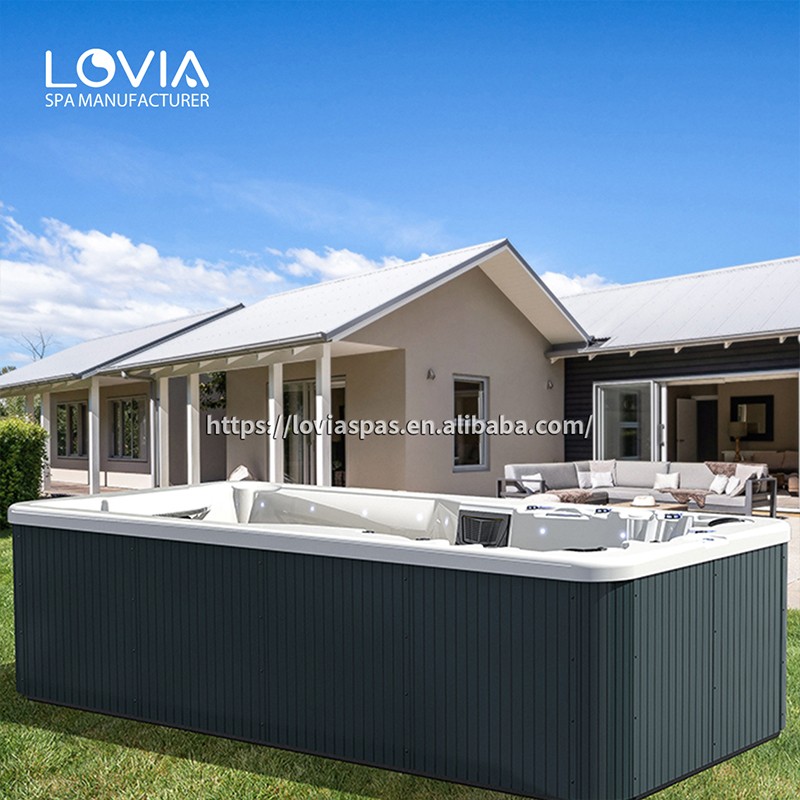
Currently, the most common counter-current systems for outdoor swim spa jacuzzi combos are pump-and-nozzle systems and turbine-propulsion systems. These two types differ in how they generate water flow, their structural design, and their maintenance requirements.
1. Pump-and-Nozzle Systems
Pump-and-nozzle systems use a pump to circulate pool water, which is then directed through one or more nozzles to create a focused current. This technology is well-established and offers flexible layout options, making it easy to integrate into outdoor swim spa jacuzzi combos of various sizes.
While suitable for a wide range of home swimming and fitness activities, the user experience can be significantly influenced by the number of nozzles, the size of the outlet openings, and the direction of the flow. If the nozzles are not configured correctly, issues such as overly concentrated currents, excessive localized impact, or insufficient flow velocity at the edges may occur.
2. Turbine-Propulsion Systems
Turbine-propulsion systems utilize a specialized propulsion unit to move a larger volume of water. The design focuses on expanding the effective cross-sectional area of the current, thereby improving water coverage throughout the swimming zone.
For users engaged in freestyle swimming, endurance training, or sustained lap swimming, a broad and stable current helps minimize lateral body drift. However, these systems place higher demands on the propulsion mechanism, flow-guiding structures, safety shielding, and control systems.
| Comparison Item | Pump-and-Jet System | Turbine Propulsion System |
| Working Principle | Pumps water through directional jets | Uses a turbine to propel a larger volume of water |
| Flow Characteristics | May produce concentrated jets | Designed to provide broader water coverage |
| Main Advantages | Mature design and flexible installation | Potentially wider and more uniform flow |
| Key Challenges | Localized pressure and uneven flow | More complex design and maintenance |
| Selection Priorities | Jet layout, flow rate, and swimming comfort | Flow width, stability, and safety |
It is important to note that a system’s performance cannot be judged solely by its technical classification. A well-designed pump-and-nozzle system can provide an excellent swimming experience, while a turbine-propulsion system must be validated through practical testing to ensure the quality of its water flow.
Key Parameters Determining Counter-Current Performance in Outdoor Swim Spas
When evaluating an outdoor swim spa hot tub combo, it is advisable to focus on flow rate, water velocity, flow field uniformity, motor power, and adjustability. These parameters should be analyzed in combination to accurately determine whether a system is well-suited for the intended user.
1. Flow Rate
Flow rate refers to the volume of water moved per unit of time; common units of measurement include L/min (liters per minute) and m³/h (cubic meters per hour). The conversion factor is: 1 m³/h is approximately equal to 16.67 L/min. For instance, a counter-current system with a nominal flow rate of 60 m³/h delivers roughly 1,000 liters of water per minute.
However, a high flow rate does not necessarily guarantee a better swimming experience. Once water exits the nozzle, it disperses; the flow is further influenced by the pool’s shape, the design of the outlets, and the water return path. Consequently, consumers should verify whether the stated flow rate refers to the actual operational flow or merely a theoretical parameter of the pump under specific, idealized conditions.
2. Flow Velocity
Flow velocity, typically measured in m/s, is a key indicator of the intensity of the counter-current. It is important to note that the velocity at the nozzle outlet is not the same as the velocity experienced by the swimmer, as the water stream mixes with the surrounding body of water as it travels.
For example, product documentation for the "PowerSwim 3.5" by the German company Ospa states that water velocity in the optimized swimming zone can exceed 1.5 m/s. This figure is specific to that particular product and should not be taken as a universal performance standard for all outdoor swim spa jacuzzi combos.
For beginners, a steady, easily adjustable current is generally more important than simply chasing high velocity; for experienced swimmers, the focus should be on whether the system can provide sufficient resistance for effective training.
3. Flow Field Uniformity
Flow field uniformity refers to the consistency of water velocity and direction across different areas of the swimming zone. This directly affects a swimmer's ability to maintain a stable body position.
If the current is very strong in the center but significantly weaker on the sides, a swimmer may be forced to constantly adjust their orientation, which disrupts their stroke rhythm. Manufacturers can improve flow uniformity by optimizing nozzle placement, adjusting outlet angles, refining internal flow channel structures, and managing water return paths.
For high-performance outdoor swim spas, it is advisable to evaluate flow characteristics across various zones using fluid dynamics simulations and empirical velocity testing, rather than relying solely on the maximum velocity measured at the outlet.
4. Motor Power and Energy Consumption
Motor power determines the energy supply capacity of the propulsion system; however, the actual water flow performance also depends on pump efficiency, pipeline resistance, and the specific operating point of the system. For example, if a device has an actual electrical input power of 3 kW—assuming this power remains constant during operation—it will consume approximately 3 kWh of electricity over one hour of continuous use, or about 1.5 kWh over 30 minutes.
This is merely an example calculation for the counter-current system; it does not account for the energy consumed by the heating, filtration, or standby functions of the entire outdoor swim spa hot tub combo. Furthermore, if a product’s specifications list the motor’s rated output power rather than its electrical input, the actual power consumption may differ.
5. Water Flow Adjustment Range
An ideal outdoor swim spa jacuzzi combo should offer smooth intensity adjustment, allowing users to vary the water flow strength to suit their specific training needs.
For instance, beginners can start at a low intensity and gradually increase the resistance; those performing aerobic workouts can adjust the intensity according to their exercise regimen; and when the unit is shared by multiple family members, such flexibility enhances its overall utility.
Variable-frequency drives and electronic control systems can improve the adjustment experience, though the actual performance will still depend on the device’s overall design.
How to Choose the Right Outdoor Swim Spa?
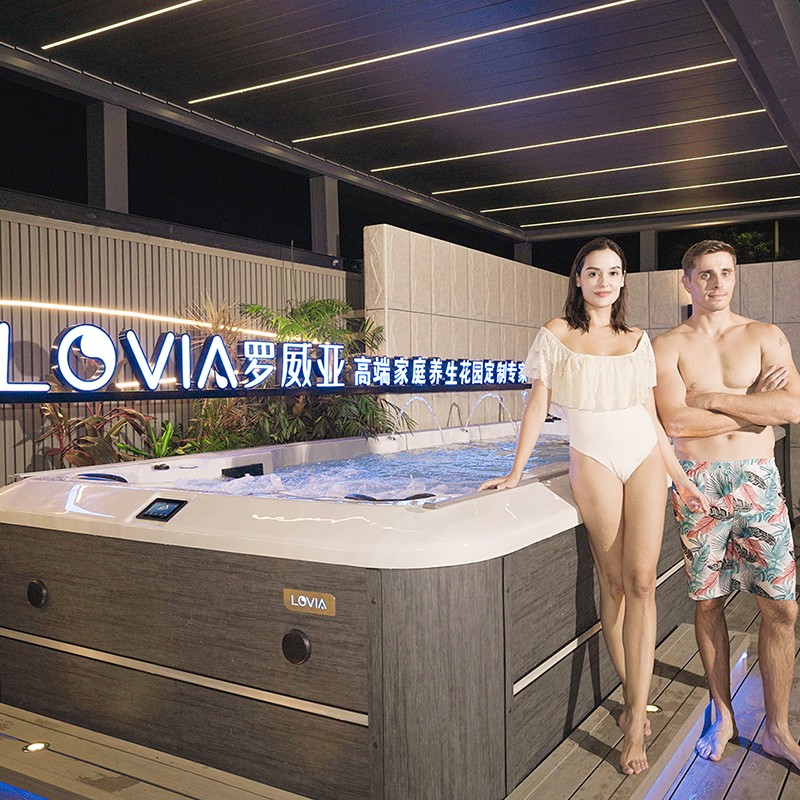
When selecting an outdoor swim spa hot tub combo, consider factors such as the intended use, the dimensions of the unit, the performance of the counter-current system, and the available after-sales support.
If the primary purpose is family leisure or entry-level fitness, prioritize systems that are easy to operate, offer stable low-intensity flow, and produce a reasonable, unobtrusive level of noise. If the unit is intended for regular swimming or endurance training, focus instead on the effective width of the water flow, the uniformity of the flow field, and the range of intensity adjustment.
The dimensions of the unit also significantly impact the user experience. Even with a powerful counter-current system, a swimming area that is too narrow—or jets that are poorly positioned—can make the space feel cramped. Therefore, when making a purchase, verify the length, width, and depth of the effective swimming area, as well as the recommended positioning for the swimmer.
| Evaluation Item | Key Questions |
| Power System | What are the pump type and rated input power? |
| Water Flow | What are the actual flow rate and velocity? |
| Flow Uniformity | Is the current stable across the swimming area? |
| Control System | Can users adjust the current smoothly? |
| Energy Consumption | What is the power consumption at different settings? |
| Safety | Are suction protection and electrical safeguards provided? |
| Maintenance | Are spare parts and technical support available? |
For manufacturers and distributors, it is advisable to request that suppliers provide water pump performance curves, details on the conditions under which flow rates were tested, the specific locations where flow velocity was measured, maintenance schedules, and information regarding spare parts. Clear technical data and hands-on testing of the actual unit can help mitigate procurement risks.
Frequently Asked Questions (FAQ) About Outdoor Swim Spa Counter-Current Systems
FAQ 1: Can an outdoor swim spa completely replace a traditional swimming pool?
Outdoor swim spas are well-suited for stationary swimming, daily fitness, and endurance training—making them an excellent choice for households with limited space. However, it cannot fully replace the advantages of a traditional swimming pool when it comes to long-distance swimming, practicing flip turns, or accommodating multiple swimmers in separate lanes.
FAQ 2: Is a stronger counter-current in an outdoor swim spa always better?
Not necessarily. A current that is too strong can make it difficult for beginners to maintain proper form. When choosing a unit, focus on the range of intensity adjustment, the uniformity of the water flow, and the actual swimming experience, rather than simply chasing the highest possible flow rate.
FAQ 3: What flow rate is required for a counter-current system to be suitable for swimming?
There is no universal minimum flow rate standard that applies to all outdoor swim spa jacuzzi combos. The suitability of the flow depends on a combination of factors, including nozzle area, propulsion technology, water velocity, and the effective swimming area. It is recommended to consider both the technical specifications and the results of an actual trial swim.
FAQ 4: How long can an outdoor swim spa’s counter-current system run continuously?
Always refer to the rated operating conditions provided by the manufacturer. Since different units vary in terms of motor temperature rise, duty cycles, and protective mechanisms, you should not assume that every system is designed for unlimited continuous operation.
FAQ 5: Why might the counter-current in an outdoor swim spa suddenly weaken?
Common causes include insufficient water levels, blocked suction inlets, increased resistance from filtration components, pump malfunctions, or issues with the control system. You should first perform basic checks according to the user manual; if the problem persists, contact a professional technician.