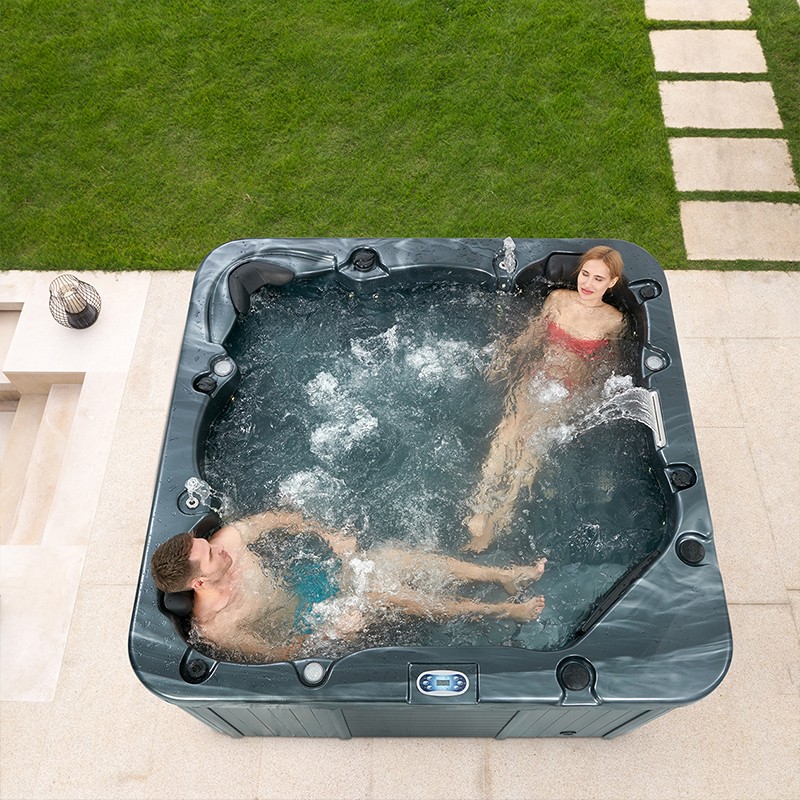


What Causes Limescale Buildup in Outdoor Whirlpool Hot Tubs?
2026-08-05 15:30In the wake of the increasingly popular outdoor living lifestyle, more outdoor whirlpool spa hot tubs are being included in villas, homestays, resorts, and private gardens. Outdoor hot tubs offer a year-round spa-like relaxation experience that standard bathtubs cannot, thus enhancing the overall quality of living. More consumers are now being attentive to the maintenance and operating costs of their equipment. However, one common problem which whirlpool spa hot tub users get is that of white deposits inside the tub. First off, it might only be minor white marks on the inside of walls but over time it becomes more severe as heaters, jets, circulation piping, and filtration systems are covered in varying degrees of scale with potential equipment malfunction even being the consequence in serious situations.
Many users relate limescale buildup to poor water supply, but the truth is that water supply alone is never the main cause. The formation of limescale is a result of various factors - water quality, temperature, circulation systems, evaporation rate, maintenance routines, and use habits. In fact, the operating conditions of outdoor whirlpool spa hot tub water are much harsher compared to those of conventional bathtubs, as they are generally heated to around 38 degree Celsius to 40 degree Celsius. Limescale problems become more apparent, as hot water encourages precipitation of minerals, leading to faster scaling.
This article delves into a thorough understanding of whirlpool spa hot tub scaling problems - the various causes, contributing factors, potential dangers, and practical prevention and maintenance methods. One of our main goals is to raise awareness of effective water quality management for whirlpool spa hot tubs and help in extending the life of the equipment with significantly reduced maintenance and operating costs.
Why outdoors hot tub is more vulnerable to limescale than the standard bath?
Mineral deposits in lamescale are caused by precipitation of minerals from water under certain conditions on the surface of machinery; the main components typically contain calcium carbonate, magnesium carbonate, silicates, as well as small amounts of other minerals such as iron and manganese. If you have a water supply like the tap water or underground water with elevated levels of calcium and magnesium ions, the gradual reduction in the solubility of these minerals will result in their deposition on surfaces of inner walls of tubs, heaters, pumps, filters, and jets as a slow process through the combined phenomena of heating, evaporation, and continuous circulation. As such, if there remains enough water and minerals, it's possible to keep going and gradually form white, hard-to-see mineral deposits.
Operating conditions for a jacuzzi outdoor spa hot tub are really unique in comparison to those of standard bathtubs.First, the whirlpool spa hot tubs tend to be constantly heated at a temperature range of about 38°C to 40°C for a significant portion of the day every day.
Second, the jacuzzi outdoor spa hot tubs also feature a very active circulation system that runs nearly round the clock with a constant series of heating, filtration, and water jet functions.
In addition to the above, the effect of environmental factors such as sunlight, wind, and changing room temperatures results in speeding up the evaporation of a water surface.
All those factors together lead to the minerals to reach the saturation and precipitation stage much sooner. Hence, the rate of deposit formation is much faster than what you see in a normal bathtub. For example, if regular bathing water is clear to the nude eye and does not carry large amount of dissolved minerals, after prolonged and repeated use without regular check-up and maintenance, the equipment could even be found to be blocked due to buildup of scale on its inside parts.
What are the Primary Causes of Build-up of Limescale in Outdoor Hot Tubs?
1. Over-hard water is the main cause
The main reason a whirlpool spa hot tub tends to accumulate calcium and magnesium scale is the type of hard water supply in the area. Hard water is water rich in calcium and magnesium ions, measured in terms of their total calcium equivalent concentration expressed in calcium carbonate. International standards identify total hardness below 60 mg/L as soft water and total hardness exceeding 180 mg/L as being in a hard water area. Tap water hardness is generally high in some northern cities as well as limestone regions and areas with rich groundwater resources. So jacuzzi outdoor spa hot tubs installed in these areas are more apt to get scaled.
As hardwater is put into the tub, minerals are completely soluble initially. But after repeated heating and circulation cycles, water comes to a saturation state and minerals start to precipitate in deposits. Therefore, regardless of the whirlpool spa hot tub brand, long-term hard water use is going to create scale formation without softening, if there is no water softener.
2. Constantly heated operation over a long time leads to mineral deposition at a higher rate
One of the main reasons why people install an outdoor whirlpool spa hot tub is for the convenience of having it ready at a perfect soaking temperature at any time. Thus many people maintain a water temperature of between 38 to 40 degree Celsius on their hot tub continuously. But on the other hand, such high temperatures do promote breaking down of calcium bicarbonate and consequently, calcium carbonate deposits forming quite faster.
According to chemical principles, heating can change many of the dissolved minerals in the water from soluble forms into insoluble ones, thereby these new forms of crystals are most likely to settle in the hottest components – heater and heat exchanger surfaces. In fact, publicly available papers on the chemical engineering of water show that when a rising temperature of water goes from 20 degree Celsius to 40 and more, calcium carbonate deposition rate increases by an estimate of two to four folds. As such, jacuzzi outdoor spa hot tubs – operated at a high temperature for long hours – inherently suffer high scaling.
In case one unit keeps a constant temperature even through the winter without any routine descaling work, scale will form much more rapidly than in standard bathtubs that are operated sporadically.
3. Continuous Mineral Concentration Due to Water Circulation and Evaporation
Consumers sometimes believe that the presence of a circulated filtration system in a whirlpool spa hot tub helps to maintain water quality and so the water can remain safe over time with no scaling being a problem. But in fact, filters mostly eliminate suspended solids and some organic contaminants, they cannot get rid of the calcium and magnesium ions that are still present in the water. As the circulation system continues to operate, water gets lost in evaporation from the spa. Because water only evaporates, all the dissolved minerals remain in the water. As more and more hours pass, the mineral concentration becomes increasingly higher. When that happens, it's a matter of mineral precipitation and deposits.
The phenomenon is particularly pronounced in very hot days outdoors or in windy areas. A typical outdoor whirlpool spa hot tub has a capacity ranging from 1,200 liters to 1,800 liters. However, such a jacuzzi outdoor spa hot tub can lose several liters or even ten liters of its water daily through evaporation. This further speeds up the scaling process.
Therefore, even with continuous introduction of fresh water, the mineral concentration keeps rising if the total amount of water in the spa is periodically never completely replaced.
Other Factors Which Make Hot Tubs Outdoor more Prone to Scaling?
Besides, hard water and high temperature are factors affecting the scaling rate, certain details in daily use have also their effect. For example, if the pH in the water is constantly maintained high, the precipitation of the calcium carbonate becomes easier.
If not regularly cleaning filer, the filter's ability of the pump and water to move around the spa becomes low. That is, there will be more deposition of minerals over time. If you go to the whirlpool spa hot tub without rinsing off you will have sweat, body oils, skincare products, sunscreen, and cosmetics to leave your traces in the water of the whirlpool spa hot tub. Actually, you don't know that these are the kind of substances that have the power of adsorbin minerals, and they can form more stable, harder scale deposits if not prevented timely.
If jacuzzi outdoor spa hot tub water is not replaced for a long time, TDS levels rise continuously in the water. That leads to the formation of thick scale which, if the water cannot be adequately sanitized, is even difficult to maintain. We can refer to operational practices of commercial hot springs, spas in hotels, guesthouses, which show that the outdoor whirlpool spa hot tubs used a lot without standardized water testing and care will get scaled really sooner than residential units with normal frequency of use. Therefore, scaling is highly dependent on the jacuzzi outdoor spa hot tubs' usage levels.
What Are the Consequences of Scale Formation in an Outdoor Hot Tub?
One might think of limescale as only an aesthetic issue but it can bring about far more problems than just making the whirlpool spa hot tub look dirty. In fact, the effects on equipment performance and maintenance cost are way more severe than people imagine. First, scale that's adhered to a heater surface creates a barrier to heat transfer which makes the heater work harder to reach the set temperature resulting in increased electricity consumption. According to industry figures, a coating of only 1 mm of scale on a heater can reduce heating efficiency by 5 -10 %. The higher the buildup is, the more the energy consumption goes up.
Second, scale buildup in the nozzles, pumps, and the circulation piping over time results in flow resistance and reduced massage experience, which, if continued, can cause the water jets to become uneven and the circulation being weaker. It is also possible that a hot spot is generated at the heater due to continuous scaling and that would put the appliance in jeopardy. In hotel, guesthouse, commercial spa businesses with several whirlpool spa hot tubs on premises operating outdoors it means that besides increasing maintenance and electricity bills you also loose some amount of efficiency of operations.
How to Effectively Minimize Limescale Accumulation in an Outdoor Hot Tub?
It is better financially to prevent limescale and scale in general from forming than to remove them once formed. The use of a water softening system is the most direct and effective remedy for customers coming from hard water zones in the case of installation. Ion-exchange is the principle by which mineral removal devices are designed to reduce the amount of calcium and magnesium present in the water and so prevent scale formation from these. As an additional measure to that of water softener installation, keeping track of pH, total alkalinity, calcium hardness, and sanitizer levels in an outdoor whirlpool spa hot tub is an indication that a well-brought-up hot tub can stay healthy for years without getting any scaling problem at all as long as all mentioned parameters have remained in ranges recommended by manufacturers.
On the water changing side, users can change the water in the jacuzzi outdoor spa hot tub regularly by considering the usage frequency. The water change cycle for residential whirlpool spa hot tubs is generally 2 - 12 months. Commercial or high-use hot tub facilities will likely have to shorten the interval, but will simultaneously have greater need for cleaning the filtration system and piping. Filters must follow the manufacturer's instructions for cleaning frequency to ensure that the best filtration efficiency is sustained in the circulation system. If the equipment is in a stage showing just some scale, the user is advised to use professional scale removal agents to prevent hardening up of the scale that will be very difficult to remove at later stages.
Regular maintenance is the heart of the jacuzzi outdoor spa hot tub's longevity
In the end, a well-planned and executed maintenance process will be more valuable and durable to you than descaling of any one particular spot. Regular maintenance schedule includes the following: daily checking of waters' visibility and function of equipment; weekly testing of waters and cartridge cleaning; monthly inspection of nozzles, piping, and circulation system for scale; periodic water changing - depending on how often you use it, deep cleaning of tub's interior and circulation lines with professional cleaners after the complete water change. Commercial establishments need to implement standardized maintenance procedures and, on a regular basis, to document water quality, operational data, so that it could detect and prevent problems as early as possible and significantly reduce equipment failure rates.
FAQ
Q1: At what point does scale start to form in the outdoor whirlpool spa hot tub?
Sometimes it takes only few weeks or months for the formation of the first sign of the scale to occur even when a jacuzzi outdoor spa hot tub is constantly used with very hard water at a temperature higher than 38 degree Celsius.
If the water from the locality is soft and the regular maintenance of the bathing water is not neglected, however, the formation rate will be so significantly lowered that scale is only a very remote concern.
Q2: Does the scale buildup result in increased power consumption?
Undoubtedly, it does. The scale covers the heat element reducing the thermal conductivity of the heater forcing it to work more time and, hence, to consume more electricity. The overall performance of the appliance might get affected in the course of this situation as well.
Q3: Even after installing a water softener, is it necessary to descale a water body?
Yes. Although a water softener makes scaling highly unlikely, other external factors such as airborne dust and traces, bathers, etc. still lead to a certain amount of mineral scaling even in water. Therefore regular inspection and cleaning remain very essential.
Q4: How Often should You Change the Water in Your Outdoor Hot Tub?
Home users: Generally, 1 full-water change every 2-4 months would be adequate.
High-intensity use or commercial operations: If conditions so require, such whirlpool spa hot tubs can have water changed and filtration system cleaned more often.
Q5: How do I determine if scale is forming in my outdoor whirlpool spa hot tub?
Telltale signs include seeing white deposits on the tub walls, decrease in pressure from the jets, slower heating, frequent clogging of filters, and higher than normal power consumption. It's the time for immediate checks and descaling of the jacuzzi outdoor spa hot tub in order to avoid any more wear and tear.