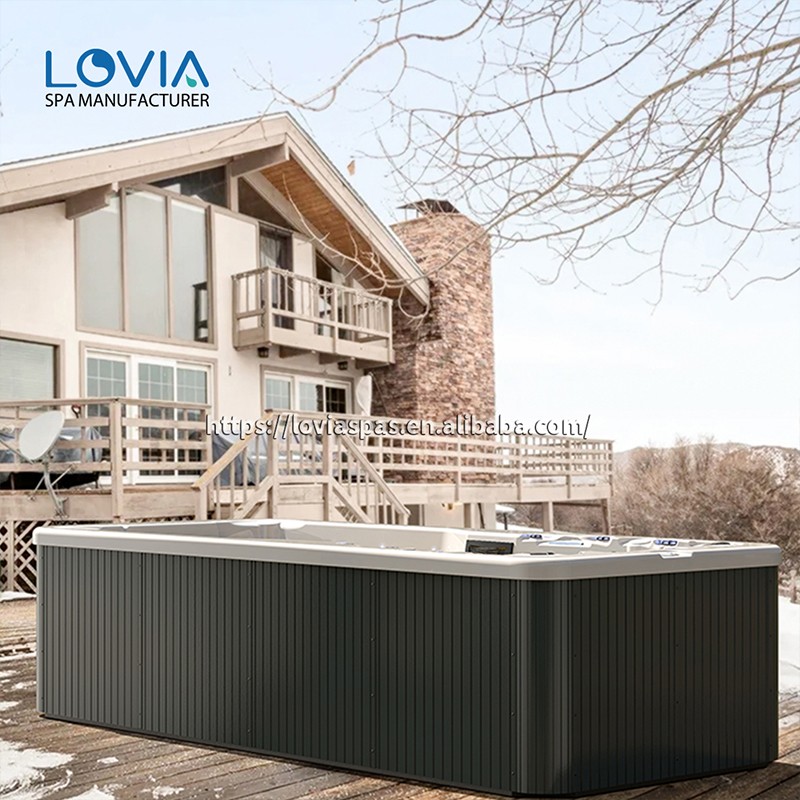


Why does the yellow algae show up in outdoor swim spa tub?
2026-08-03 15:35Owning a swim spa is nowadays a symbol of modern and luxurious lifestyle. The popularity of outdoor swim spas as a leisure amenity for private homes, villas, resorts, wellness centers, and vacation rentals has been on the rise. In this regard, swim spa tubs seem to be a better choice than regular swimming pools. Swim spa tubs deliver an incredible swimming, hydroMassage, relaxation therapy, and fitness training experience, all-in-one, and they have a smaller footprint.
The fact of the matter is that swim spa tubs can be used all-year-round, thus making consumers very attached to them. However, after a certain period of the swim spa hot tub combo usage, users usually report water quality problems. The most serious problem from the list is the appearance of yellow algae which leads to yellow or yellowish-brown stains on pool walls, steps, around jets, and even within the filtration system. Such stains not only spoil the appearance of the spa, but can also prevent the water circulation system to work properly.
When users, for example, first encounter some yellow spots, they usually misidentify them with dust, pollen, or silt. Yet, even after they scrub the area, the yellow substance reappears and, at times, extends throughout the spa. As a matter of fact, such spots are not just ordinary dirt; they could be due to several causes such as proliferation of algae, water chemistry imbalance, or formation of biofilms. Once you get your water chemistry balanced, it will reduce the need for your water to be chlorinated quite as much, it will help protect the filters, reduce the chances of the water turning cloudy after being chlorinated, and will prevent the growth of bacteria and other microorganisms.
Accordingly, in order to be able to enjoy the advantages of a swim spa tub for the rest of your life, it is vital that you take on board a proper water management routine.
We believe this article, which focuses on yellow algae problems in outdoor swim spa tubs, explaining why they appear, how they differ from common dirt, what the main conditions for their emergence are, which treatments should one consider, and which techniques can keep one safe the longest time from these organisms will definitely offer great insight on how to manage one's outdoor swim spa hot tub combo better. Our main goal is that you can benefit from reading the article to adopt a complete and thorough maintenance mindset for your swimming facilities.
Why do outdoor swim spa tubs tend to show green algae more?
A typical reaction when seeing yellow substances on spa surface is that it is a manifestation of yellow algae, but not always is the case. Experience gained by service department says that the majority of yellow substances found in outdoor swim spa tubs other than yellow algae can be: pollen, rust, mineral deposit, or biofilm bacteria formation. Of course, the hardest to be rid off is the yellow algae. Even though the name includes “algae”, yellow algae is more than a simple form of green algae since it takes much longer to get rid of.
Yellow algae form on the side walls, cracks or crevice, and spa jets surfaces, and the inside of filtration systems of swim spa hot tub combo, and then they build up a hardy protective coat, which prevents disinfectants from getting through to the organisms. That is, the higher the resistance of yellow algae against disinfectants, the greater its chances of survival, even the presence of an adequate level of free chlorine.
Compared to public swim pools, private swim spa tubs operate year round, at constant low water temperature.
Also, since outdoor swim spa hot tub combo equipment is outside the house, it will probably absorb a lot of the natural debris like leaves, wind-blown dust, flying dirt, pollen, etc. If water balance has not taken care of correctly in time, all these factors create a perfect habitat for yellow algae growth.
Why Are Outdoor Swim Spa Tubs So Susceptible to Yellow Algae?
Outdoor swim spas are more likely to be contaminated with yellow algae due to several reasons, which users need to keep in mind:
1. Insufficient Disinfectant Level
The main reason for developing yellow algae in outdoor swim spa tubs is the lack of a minimum disinfectant level. Be it chlorine, bromine, or other water treating chemical methods, in all cases, keeping the sanitizer levels sufficient to kill germs and the pathogens is vital to the prevention of algae and bacteria growth. When for a long time the concentration of disinfection agents stays below the recommended range, algae take nutrients from water and multiply rapidly, eventually attaching the walls and the equipment.
Industry recommends that at home, outdoor swim spa tubs should maintain proper residual chlorine level (or other disinfection agents) and refilling should follow the frequency of usage. In case the disinfectant level is not adjusted quickly enough during peak hours, continuous showers, or high temperatures, - all the factors hastening the depletion of disinfectants, yellow algae will start growing in no time.
2. Waterflow Reduction
The purification and sanitization of the swim spa hot tub combo is done via the circulation system, continuously.
Should circulation time be too short, pump efficiency get too low, or filters left uncleared and uncleared for long time, the water would have higher amounts of floating organic matter and microorganisms which in turn would act as a nutrient base for the algae.
It is quite usual for yellow algae to first become visible in areas where there is the worst filtration or the weakest water flow such as under the seats, behind the jets, near the ladders, in the corners - those which are left without proper circulation for a long time are very conducive to localized algae growth.
3. Environmental Factors like Sunlight and Weather
Outdoor swimming pools and, therefore, swimming spas, which are situated outside and are usually covered or not, are exposed to environmental hazards such the UV rays from the sun, which not only will damage the surfaces of your pool and spa but can also greatly increase your disinfection chemical consumption, as the sun causes these chemical agents to break down faster thus, reducing the effective life of disinfection agents. If there are many trees nearby, then leaves, pollen, insects, and air suspended organic particles constantly drop down into your pool and that supplies the required nutrients for algae growth.
A good example for such cases is the spring and summer months where a large load of pollen drifting on the water surface looks like yellow algae; however, the presence of such pollen increases the organic load in the water, thus causing sanitizers to spend most of their effort on the oxidation of organic matter. Consequently, the sanitizing power is diminished, which allows yellow algae to proliferate easily.
4. Long Standing Water Quality Imbalance Problems
The cleanliness of an outdoor swim spa hot tub combo cannot be only attributed to using disinfectants as the most important thing is water equilibrium. If the values of such parameters as pH, total alkalinity, and calcium hardness are out of the healthy range for a while, the efficiency of sanitizers is reduced and the performance of the filtration system is also hampered. For instance, if the water pH is constantly kept between 7.0 and 7.8, the effectiveness of the bactericidal property of chlorine as a sanitizer is greatly reduced; even though the test results can indicate an acceptable level of residual chlorine, the practical disinfecting capability can be very weak. Under such conditions, yellow algae will have a much easier way of thriving.
Why do you keep seeing yellow algae in your outdoor swim spa tub even after thorough scrubs?
You've surely had the experience - once you've given your indoor/outdoor swim spa tub a full cleaning the yellow deposits seem to be gone only to reappear a few days or a few days only. The reason is that yellow algae are very resistant and have various means of protection. They don't limit themselves to being present on the surface, as they can also hide inside jets, piping, filtration systems, and equipment crevices, where cleaning is difficult even for maintenance personnel.
If the walls are just cleaned, whereas the circulation system and the filters are not also disinfected at the same time, the leftover microscopic algal spores can pass back through the water circulation loop of your spa and will then multiply. Besides that, yellow algae have a capability to generate biofilms, i.e., these films act like shields and reduce the strength of disinfectants' penetration thus, it is difficult to finish off even the yellow algae at a standard chlorine concentration which would usually be enough to kill other types of algae; therefore, yellow algae outbreaks are mostlikely to happen.
What effect does the presence of yellow algae have on your outdoor swim spa tub?
You wouldn't usually think of yellow algae as your enemy but it could definitely spoil the ambiance of the environment that you've got your outdoor swim spa tub installed in and that's just the first of the issues! Apart from that, they constantly consume your pool chemicals (you will therefore see that your pool chemicals bill will get higher and higher) and your filter will have to do work to trap more particulate than it is supposed to as the population of algae grows. With the increasing filtration load and decreasing circulation efficiency, you will end up with a situation similar to a pressure vessel in terms of water level. Moreover, it is a strain not only on the heating system and water pumps but in terms of water treatment as the filter has to be maintained more often, or even replaced as it becomes blocked with fine particulate matter.
In addition, algae serve as a medium for the growth of microorganisms and if that is allowed to happen, the surface layer of the yellow algae film itself will promote the growth of bacteria, biofilms, and even mold, leading to the outdoor swim spa tub being a dirty and unhygienic place.
What are the best ways to thoroughly get rid of the yellow algae from your outdoor swim spa tub?
When the yellow algae have been diagnosed, scrubbing or vacuuming is not sufficient to get rid of them. A correct way is to follow the sequence of first testing water chemical parameters and adjusting them so that pH, total alkalinity, and sanitizer levels get back to normal; secondly, raising and killing them by raising the sanitizer levels on the entire spa during an intense disinfection treatment or the so-called "shock treatment", thirdly, cleaning your wall with a particular brushing, cleaning the steps, the jets, the wall, areas with the algae, and cleaning the filter as well as the extension of the filtration/ circulation cycle after the treatment.
The presence of the algae for a long period means that we should not neglect the internal piping of the system where biofilms can develop; therefore, it is essential to clean the pipes with suitable cleaners designed for spas without causing damage and following the maintenance instructions for a successful inspection and removal of all kinds of dirt that may have accumulated in the circulation system.
How will you make sure that your outdoor swim spa tub's yellow algae issue is not recurring?
Compared to repeated treatments, a proactive maintenance can save you more money and make you happier. Besides, the users should establish a consistent water quality maintenance routine such as monitoring the pH, residual chlorine, and total alkalinity levels regularly to make sure all the parameters are within the recommended ranges of the manufacturer. Likewise, it is important to guarantee that the filtration system is running for a sufficient number of hours each day so that it can effectively clean the water. You should clean or replace the filter cartridges regularly so that dirty or worn-out ones that may cause blockage or reduce water circulation are not left. You shall increase the sanitizer content at any time after having been heavily used, shock treating the water when necessary. And you shall clean your cover to avoid the coming in of dust, leaves, and pollen through it into the water.
Even for outdoor swim spa hot tub combos that remain out of service for a longer while or are only used during the season, a weekly minimum circulation schedule needs to be planned so that the water doesn't stagnate. This, in turn, would keep the bacteria or other microorganisms that thrive on stagnated water away.
Additionally, deep cleansing once in a while should be carried out. As part of such a deep cleansing, the jets should be cleaned, the circulation system checked, the filters washed and water balance checked.
With the adoption of a proper and well-planned regular maintenance programme, the appearance of yellow algae and other similar water issues can be considerably reduced and the overall life span of the equipment can be further extended.
Maintaining a Stable Water Quality Is a Regular, Essential Job That Needs To Be Done
Household maintenance of an outdoor swim spa tub should not wait to a certain time only when there is yellow algae; rather, it should be a regular task.
Examples of weekly chores include water chemical parameter tests, filter change at least every two to four weeks, and complete or partial water exchange depending on the usage pattern and frequency, besides regularly checking the outdoor environment to see whether the sources of excess leaf fall or pollen should be tackled.
With early and consistent maintenance, you can substantially reduce the chances of yellow algae, biofilms, and other major problems with your water quality coming back to haunt your swim spa or at least prevent them from getting too big.
The result is that your outdoor swim spa tub will stay clear, clean and most importantly safe and comfortable to use.
FAQ
Q1: What differentiates the appearance of yellow algae and pollen if you are an swim spa hot tub combo user?
Biofilm of the yellow algae usually sticks to the spa surfaces such as walls, stairs, or areas around jets, when scrubbed, it can leave a powdery like substance and regro. In short, it is very persistent. Pollen on the other hand is light weight and will float on top of the water, it is the wind that carries it away, and it does not settle.
Q2: Why do the algae, or yellow algae specifically, appear in my outdoor swim spa tub even though there is the presence of normal level of free chlorine?
This may result from the situation where free chlorine has not been able to neutralize the algae, because for instance, a high PH level would hinder the killing effect of free chlorine on the target organism or there could be an insufficient filtration system or the formation of biofilm which is a very tough kind of microbial community that is very resistant to the disinfecting agent. Also, the water may be stagnating in some parts of the circulatory system, such that it creates a dead spot where algae can grow even though disinfectant levels on tests show normal levels. It all depends on your level of disinfection efficiency that is being actualized and not on the mere level of residual chlorine. So, even though you read free chlorine level as normal, your yellow algae could still continue their proliferation if your disinfecting power as a result is actually lower than you think.
Q3: Is it possible for yellow algae to cause physical deterioration of outdoor swim spa tub equipment?
It is generally the case that yellow algae themselves do not directly cause equipment break down, however, their presence has some indirect effects on the system. They are increasing the work done by your filtration system as more of their tiny parts will get stuck in there, hence leading the filtration system to perform badly, which means the level of sanitation in the pool or spa water will be poor. Also, they are increasing the need for your sanitizers, that is, more sanitizers will be consumed and at the same time, will promote the occurrence of a biofilm, which can affect pump efficiency as well.
Q4: What is the frequency of testing water quality of outdoor swim spa tubs?
For a typical residential user, it's recommended that you check the levels of pH, sanitizer, and total alkalinity at least once a week. However, during hot seasons or a period of heavy usage, you will need to increase your testing intervals so that any necessary water quality adjustments can be made in a timely manner.
Q5: What are the effective ways to prevent the recurrence of yellow algae in outdoor swim spa tubs?
Keeping the levels of disinfectant stable and balanced, making sure that all the waterquality parameters are within the proper range, giving sufficient time to the filtration and circulation, doing the routine cleaning of the filters as well as scrubs of the walls, and, also, performing maintenance of thecirculation system are all great ways of preventing yellow algae from coming back.