


Standing Water at the Bottom of an Outdoor Hot Tub—Where Is the Leak?
2026-06-13 15:30Many people encounter a frustrating dilemma when using their outdoor spa hot tubs: upon removing the side access panels, they discover standing water at the bottom of the unit, yet they are completely unable to pinpoint exactly where the water is leaking from.
Sometimes the ground is merely slightly damp; other times, the insulation material at the base has begun to absorb water; in severe cases, one might even find significant pooling across the entire chassis of the unit. However, the truly baffling part is that users often cannot see any obvious leak points. The jets aren't dripping, the pipe surfaces appear dry, and no visible cracks are evident near the water pump—yet the volume of water continues to slowly increase.
Consequently, many people begin to wonder:
•Has the bottom of the spa hot tub cracked?
•Could it be a leak in the plumbing?
•Have the jet seals aged and failed?
•Is the water pump broken?
•Why is there clearly standing water, yet no leak point can be found?
•Could it simply be condensation?
•Does a leak necessarily indicate a serious problem?
•If the leak point remains undiscovered, could it cause irreparable damage to the entire spa unit?
In reality, for outdoor spa hot tubs, the situation of "standing water at the bottom with no visible leak point" is actually a very common issue. This is because the internal structure of a spa hot tub is far more complex than many people imagine; the vast majority of the plumbing, pump connections, jet fittings, and heating components are typically concealed within the outer shell and the insulation layer.
This implies the following:
Even if there is only a single, tiny leak point, the water may travel along the internal framework and eventually pool at the lowest point of the unit. Consequently, the actual source of the leak is often located nowhere near the area where the water has accumulated.
Therefore, the "location of the standing water" that users observe is often merely the final destination where the water has settled, rather than the actual origin of the leak.
Furthermore, spa jacuzzi hot tubs are prone to various instances of "intermittent leaking." Some issues only manifest under specific conditions, such as:
•When the massage jets are activated;
•When the water pump is running at high speed;
•When the unit is in heating mode;
•When the water level reaches a specific height;
•When the pressure within the plumbing lines increases.
As a result, in many instances—even after removing the side panels for inspection—it may not be possible to immediately identify the source of the problem. This article will provide a comprehensive analysis of why standing water often accumulates at the bottom of outdoor spa hot tubs, why the actual source of a leak is often difficult to locate, and exactly where the most common leak-prone areas within a spa hot tub are situated.
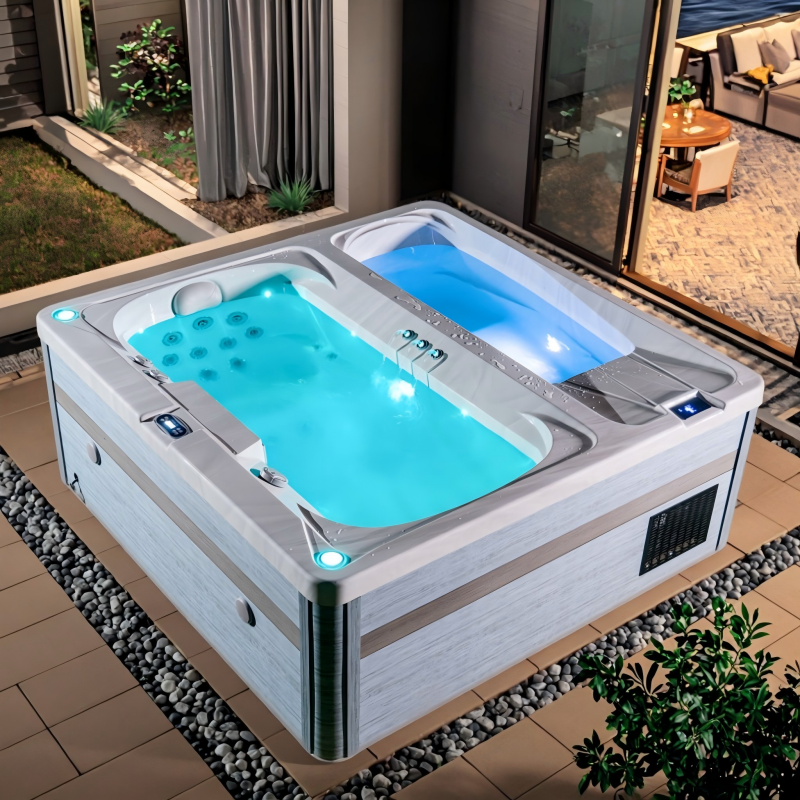
Why is standing water most frequently discovered at the bottom of a spa hot tub?
Many users wonder why leaks are almost always detected at the very bottom of the unit. The reason is actually quite simple: regardless of where the water initially escapes, gravity will inevitably pull it downward, causing it to slowly flow toward the lowest point of the equipment. In the case of a spa jacuzzi hot tub, the internal chassis—or base—typically constitutes the lowest area of the entire system.
Consequently, even if the actual source of the leak is located at:
•The vicinity of the jets;
•Above the plumbing lines;
•A pump connection;
•Around the heater;
•The rim of the tub shell;
the water may still trickle down along the internal structural components, insulation material, or support frame, eventually pooling at the bottom.
Therefore, the presence of standing water at the bottom does not necessarily indicate that the leak itself originates from the bottom of the unit. This explains why many users struggle to pinpoint the actual source of the leak despite extensive searching.
Why is it often so difficult to locate a leak in a spa hot tub?
Unlike standard bathtubs, outdoor spa hot tubs contain a multitude of hidden internal components and structures.
These include:
•Circulation plumbing lines;
•Massage jets;
•Heating systems;
•Water pumps;
•Air injection/mixing systems;
•Diverter valves;
•Insulation layers;
•Foam-filled cavities.
Many of these components are not fully exposed; instead, they are encased within insulating materials. Consequently, even if a slow leak is occurring at a specific location, the escaping water may be absorbed by the foam insulation or simply flow away through internal crevices and gaps. To complicate matters further, some spa jacuzzi hot tub leaks fall into the category of "pressure-induced leaks."
This means the leak only manifests when the system is actively running.
For instance:
•When water pressure rises after the pump is activated;
•When the massage mode is engaged;
•When a specific set of jets begins operating;
•When internal water pressure within the plumbing lines increases;
it is only at these moments that water begins to seep out.
As soon as the equipment is shut down, the leak temporarily ceases. Consequently, many users spend a considerable amount of time inspecting the unit while it is in a static, idle state, yet remain completely unable to see where the water is coming from.
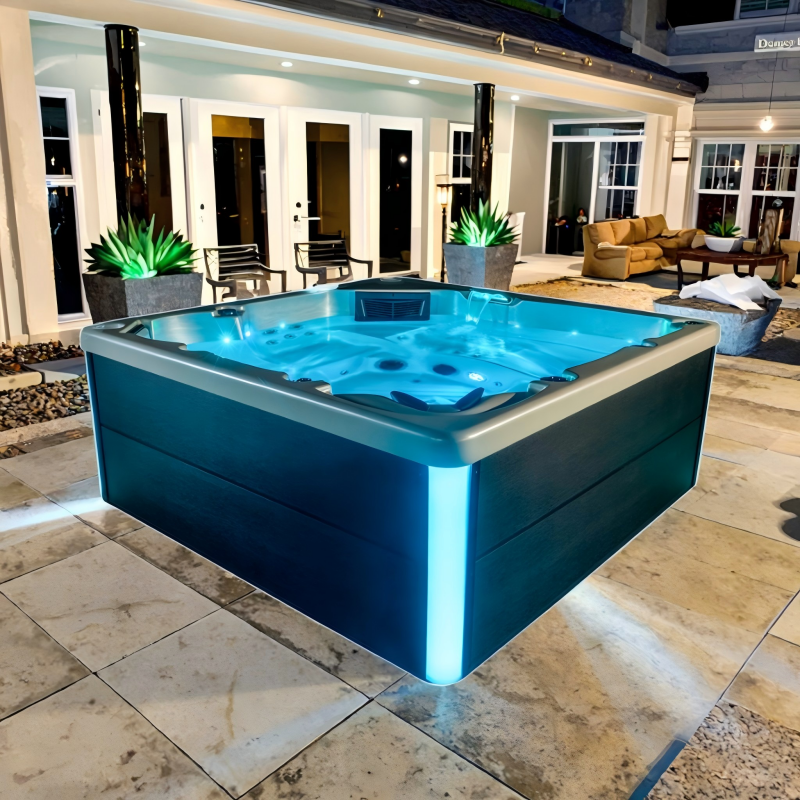
Does standing water at the bottom necessarily indicate a serious leak?
Not necessarily. This is a common misconception among users.
In some instances, the water found at the bottom of a spa jacuzzi hot tub may not actually be the result of a ruptured pipe or plumbing failure.
For example:
•Condensation;
•Residual water after draining;
•Water ingress during cleaning;
•Rainwater seepage;
•Steam condensation;
All of these can potentially lead to moisture accumulating at the bottom of the unit.
Particularly during winter or in environments characterized by high temperatures and high humidity, the temperature difference between hot and cold surfaces can cause condensation to form on the exterior of certain pipes. Over time, this accumulation may result in a small amount of standing water forming at the bottom.
However, if the following conditions occur, it is typically more indicative of an actual leak:
•The volume of water continues to increase;
•The water level drops noticeably;
•The insulation material remains damp for an extended period;
•Water repeatedly accumulates at the bottom;
•Water accumulation increases when the pump is running;
•The area fails to dry out even after a long time.
These signs usually indicate that there is indeed a leak within the spa or hot tub system.
Where are the most common leak points in a spa hot tub?
Many people assume that a leak must stem from a crack in the tub shell itself.
However, in reality, the likelihood of the actual tub shell cracking is not as high as one might imagine. Most leaks typically originate from connection points and within the circulation system.
1. The area surrounding the jets is a very common leak zone
Spa jacuzzi hot tubs typically feature numerous jets, and behind each jet lies a configuration consisting of:
•Seals or O-rings;
•Fittings;
•Pipe connections;
•Mounting structures.
Prolonged exposure to high temperatures, vibrations, and fluctuations in water pressure can cause these components to gradually deteriorate over time.
Specifically:
•Seals may harden;
•Fittings may loosen;
•Plastic components may degrade;
Once this occurs, water may begin to slowly seep out.
In many cases, a leaking jet in a spa hot tub does not result in water spraying directly outward; instead, the water slowly seeps inward into the insulation layer, making it difficult for users to detect the problem immediately. Eventually, the water will trickle down to the bottom of the unit.
2. The pump connection points are high-risk areas for leaks
The water pump is one of the components within a spa jacuzzi hot tub that is subjected to the highest internal pressure.
This is because it constantly endures:
•High-speed water circulation;
•The impact force of flowing water;
•Vibrations;
•Temperature fluctuations.
Over time, the area surrounding the pump connections becomes highly susceptible to issues such as:
•Deterioration of seals;
•Loose fittings;
•Micro-cracks;
•Damaged gaskets.
Particularly when the massage mode is activated, the water pressure rises significantly, making these specific areas more prone to leaks. Moreover, many pump-related leaks fall into the category of "dynamic leaks."
In other words, there is no leakage during normal operation; leaks only occur when the massage function is turned on. This is one of the primary reasons why many users struggle to pinpoint the source of the problem.
3. Why is the heater area also prone to leaks?
The heating systems in many spa hot tubs are integrated directly into the main circulation plumbing.
The heater is constantly exposed to an environment characterized by:
•High temperatures;
•Water pressure;
•Thermal expansion and contraction;
Consequently, the connecting components tend to degrade gradually over time.
Specifically:
•Heater fittings;
•Sealing rings (O-rings);
•Plastic connectors;
After prolonged use, these specific points may begin to seep water.
To make matters worse, the area surrounding the heater is often quite hot; if a small amount of water seeps out, it may evaporate almost immediately, making the telltale signs of a leak difficult to detect.
4. Why do pipe joints sometimes develop slow leaks?
Many users assume that leaks only occur when a pipe physically ruptures. In reality, however, the actual problem often lies with the "joints" (connections). Because spa hot tubs contain extensive internal PVC plumbing, these pipes are typically joined together using adhesive bonding.
After long-term use, factors such as:
•Thermal expansion and contraction;
•Vibration;
•Material aging;
•Plumbing stress;
can cause specific joints to develop minor seeps. This type of leakage is usually very slow but persists over a long period. The result is that the user discovers a small amount of standing water every day but remains unable to locate the specific, obvious leak point.
5. Why does the insulation layer make leaks harder to detect?
Many outdoor spa hot tubs feature an interior filled with insulating foam.
The functions of this foam are to:
•Retain heat (insulate);
•Anchor the plumbing;
•Enhance structural stability.
However, the problem is that this foam is also absorbent. Once an internal leak begins, the insulation layer can act like a sponge, soaking up a significant amount of water. Consequently, the area immediately surrounding the actual leak source may appear completely dry, while the water slowly spreads internally before eventually pooling at the bottom of the unit.
As a result, there are often instances where a large amount of water has accumulated at the bottom of the spa, yet the upper sections still appear to be "dry."
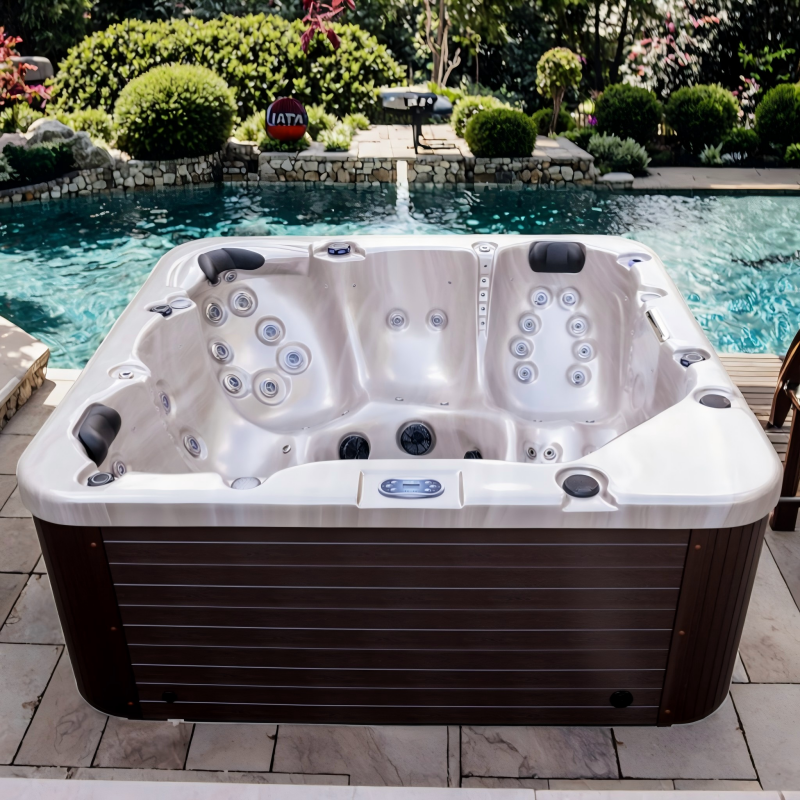
Why do some spa hot tubs only leak while they are running?
This is a classic example of a "pressure leak." Since many of the internal pipes typically operate under low pressure, leaks often go unnoticed until the massage system is activated. Once the system starts:
•The water pump begins running at high speed;
•Pressure within the pipes increases;
•Water flow through the jets intensifies;
Consequently, pre-existing hairline cracks or loose connections—which were previously insignificant—will begin to leak. As soon as the equipment is shut off, the pressure drops, and the leaking stops. For this reason, many users who inspect the unit while it is idle often find nothing amiss.
The truly effective method is to observe the unit while it is in operation.
Why do the actual leak source and the location where water pools often differ completely?
This is one of the most characteristic features of a spa massage bathtub.
Due to the highly complex internal structure, water rarely simply "drips straight down" from the source.
Instead, it may:
•Flow along the pipes;
•Spread through the foam insulation;
•Travel along the structural frame;
•Trickle down from a higher point to the very bottom of the unit.
Therefore, the actual source of the leak is often located above—or at a distance from—where the water eventually collects.
Many users focus their inspection solely on the area where water has pooled, making it naturally difficult for them to pinpoint the root cause of the problem.
How can you determine whether your spa massage bathtub is actually leaking?
The most direct method is simply to observe whether the water level is consistently dropping.
If:
•The unit has not been used for an extended period;
•Weather conditions have remained stable;
•There is no significant evaporation occurring;
yet the water level continues to decrease, it typically indicates that there is indeed a leak within the system.
Additionally, you can look for the following signs:
•Is the amount of pooled water steadily increasing?
•Are certain areas remaining damp over a prolonged period?
•Does the amount of pooled water increase after the pump has been running?
•Are there any accompanying irregularities in the water flow?
Observing these factors can help you diagnose the problem.
Why do some leaks suddenly become much more severe?
Many leaks actually begin as nothing more than a "slight seepage."
For instance, they may stem from:
•A hairline crack;
•A slightly loose connection;
•An aging or deteriorated seal.
However, as time goes by:
•The water pressure exerts constant stress on the components;
•Temperature fluctuations take their toll;
•The materials continue to age and degrade;
Consequently, what started as a minor issue can gradually escalate into a major problem.
This explains why many users initially notice only a hint of dampness, only to find later that it has suddenly turned into a significant pool of water.
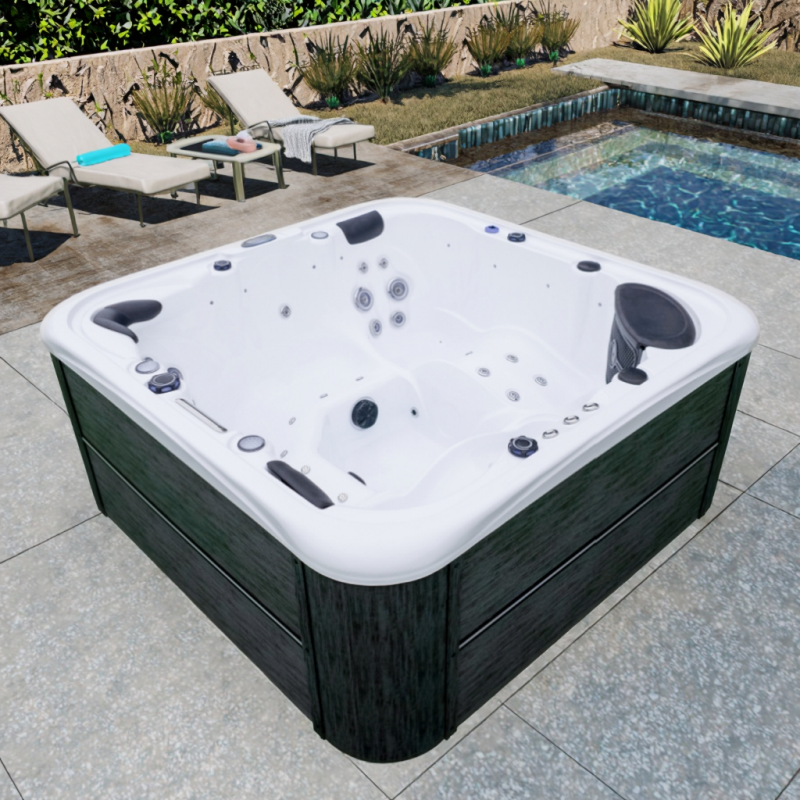
What are the long-term consequences of a persistent leak on a spa massage bathtub?
Many people tend to think, "It's just a minor leak."
In reality, however, prolonged leaking can lead to:
•Long-term saturation of insulation materials;
•Corrosion of metal components;
•Moisture damage to wooden structural elements;
•Abnormal strain on the water pump;
•Increased electrical safety risks;
•Higher energy consumption.
In particular, once insulation wool absorbs water, not only does its thermal efficiency diminish, but it can also cause the entire spa jacuzzi hot tub unit to become excessively damp.
Therefore, even if the leak is minor, it is strongly advised against ignoring it over the long term.
How can you minimize the risk of leaks in your spa jacuzzi hot tub?
For outdoor spa jacuzzi hot tubs, many leaks are actually linked to long-term maintenance practices.
For instance:
•Regularly inspecting connections and joints;
•Maintaining proper water chemistry balance;
•Preventing severe scale buildup caused by high calcium hardness;
•Protecting against freeze damage during winter;
•Addressing any persistent, abnormal vibrations from the water pump;
•Periodically checking the seals on the jets;
All of these measures can significantly reduce the likelihood of future leaks.
This is because many leak-related issues do not emerge suddenly; rather, they are the cumulative result of gradual aging over time.