


Outdoor Swim Spas: Why Is Water Quality Maintenance More Challenging?
2026-07-07 15:35Outdoor Swim Spas vs. Outdoor Hot Tubs: Why Is Water Quality Maintenance More Challenging for the Former?
As the market for residential backyard leisure facilities grows, more consumers are weighing the choice between outdoor hot tubs and outdoor swim spa hot tubs. Many first-time buyers assume that maintenance routines for both are largely the same—simply involving periodic water testing, adding sanitizers, and cleaning the filtration system. However, in practice, owners of outdoor swim spas quickly encounter a reality: managing water quality is significantly more difficult and often more costly compared to traditional outdoor hot tubs.
This difference is no coincidence. While both rely on circulating water systems and require the maintenance of proper sanitizer levels, pH, and total alkalinity, outdoor swim spa hot tubs face greater water quality control challenges due to differences in design objectives, usage patterns, water volume, circulation structures, and bather loads. With residential users increasingly focused on operating costs and maintenance efficiency, the question of whether "larger volume means harder-to-control water quality" has become a topic of significant interest.
So, why is water quality management for outdoor swim spa hot tubs generally more complex than for hot tubs? What specific impacts arise from increased volume? Does a large capacity inevitably mean increased maintenance difficulty? This article provides an in-depth analysis covering equipment structure, hydrodynamics, sanitization requirements, contamination loads, and operational management to help users fully understand the principles of water quality maintenance for outdoor swim spa hot tubs.
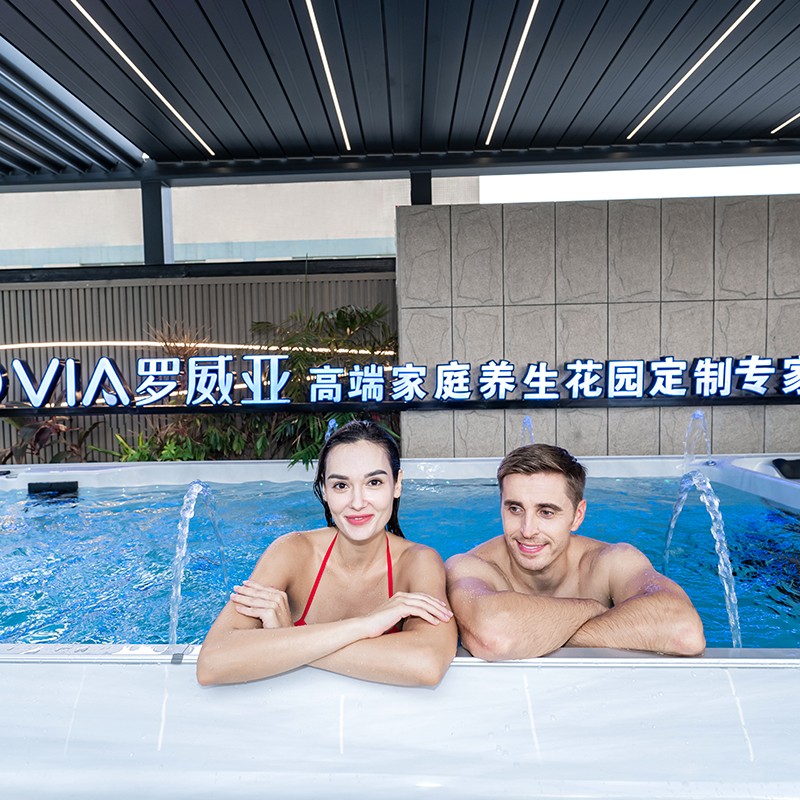
Fundamental Differences Between Outdoor Swim Spas and Outdoor Hot Tubs
Standard outdoor hot tubs are designed primarily for relaxation, massage, and short soaks; they typically accommodate 2 to 8 people and hold between 800 and 2,500 liters of water. Users generally remain relatively stationary with limited physical movement, resulting in a comparatively low contamination load on the water.
In contrast, outdoor swim spa tubs combine swimming training with hydrotherapy massage. They are typically equipped with high-power counter-current propulsion systems that generate a continuous flow, allowing users to engage in prolonged swimming workouts within a confined space. To accommodate swimming needs, outdoor swim spa hot tubs typically range from 4 to 8 meters in length, with water capacities commonly between 5,000 and 15,000 liters—and some large models exceeding 20,000 liters.
On the surface, it may appear to be merely a matter of increased volume, but the operational logic differs fundamentally between the two.
A standard outdoor hot tub functions more like a high-temperature soaking pool, whereas an outdoor swim spa hot tub is akin to a miniature, temperature-controlled swimming pool. This distinction in purpose dictates the different approaches required for water quality management.
Why are outdoor swim spas more prone to water quality issues?
Many users assume that a larger volume of water dilutes contaminant concentrations, making swim spa hot tubs easier to maintain than standard hot tubs. In reality, the opposite is true.
1. Significantly higher user activity levels
In a standard outdoor hot tub, most users simply sit, chat, or relax while receiving a massage; the amount of sweat produced per hour is relatively limited.
In contrast, users of outdoor swim spa tubs are typically engaged in continuous physical activity. Sports medicine data indicates that an adult performing moderate-intensity swimming can produce between 500 and 1,000 milliliters of sweat per hour. Even in cooler water, the body continues to regulate its temperature through sweating.
If two adults swim continuously for 45 minutes in a swim spa hot tub, the total amount of sweat introduced into the water can create a contamination load equivalent to that produced by dozens of users soaking briefly in a standard hot tub.
Sweat contains not only water but also urea, ammonia nitrogen, lactic acid, mineral salts, and various organic compounds. These substances continuously deplete sanitizers and disrupt the overall water quality balance.
Consequently, the rate at which contaminants are generated is often far higher in outdoor swim spa hot tubs than in standard outdoor hot tubs.
2. More "dead zones" in water circulation
Many people assume that larger equipment comes with more powerful circulation systems, resulting in more uniform water quality.
In reality, managing circulation becomes more complex as the volume increases.
A typical outdoor hot tub has a compact interior, allowing the water flow driven by the circulation pump to quickly reach all parts of the vessel. Due to their significantly greater length, outdoor swim spa hot tubs contain multiple internal zones, including:
•Swimming area
•Massage area
•Seating area
•Step area
•Water return area
•Propulsion jet area
These distinct zones create complex water flow paths.
Even if the overall circulation volume is sufficient, areas with inadequate local flow velocity may occur, resulting in so-called "low-circulation zones" or "dead zones."
In these areas:
•Disinfectant concentrations may be lower;
•Microorganisms proliferate more easily;
•Organic contaminants accumulate more readily;
•Biofilm forms more rapidly.
Consequently, the requirements for circulation design and filtration systems in outdoor swim spa hot tubs are far more demanding than those for standard outdoor hot tubs.
3. Higher filtration system pressure
The filtration system is crucial for maintaining stable water quality.
Standard outdoor hot tubs typically meet requirements with just one or two filter cartridges.
In contrast, outdoor swim spa tubs must handle much higher circulation flow rates.
For example:
•Hot tub circulation flow is approximately 5–10 cubic meters per hour;
•Swim spa hot tub circulation flow can reach 20–50 cubic meters per hour.
Higher flow rates mean:
•Filter cartridges clog faster;
•Backwashing frequency increases;
•Filter media ages more quickly;
•Fine particles are harder to remove completely.
If filtration efficiency drops, the water may become cloudy even if disinfectant levels remain adequate.
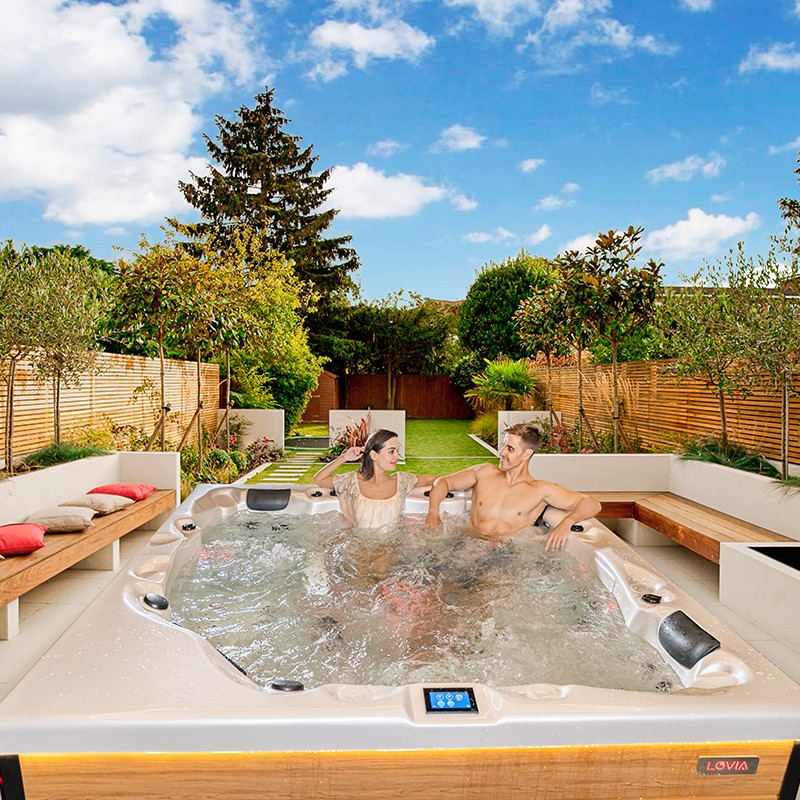
Is water quality truly harder to control as the volume of an outdoor swim spa increases?
This is a primary concern for many consumers planning to purchase an outdoor swim spa tub.
The answer is: a larger volume does not necessarily make control more difficult, but the management approach changes.
1. Advantages of large volume
First, it must be acknowledged that a large volume of water offers inherent advantages.
For instance, if 200 grams of contaminants are added to a 2,000-liter outdoor hot tub, the resulting change in concentration is very noticeable.
However, if the same amount of contaminants is added to a 10,000-liter outdoor swim spa hot tub, the increase in concentration is only one-fifth of that in the smaller tub. This implies:
•Slower temperature changes;
•Smaller pH fluctuations;
•More stable disinfectant concentration levels;
•Greater water quality buffering capacity.
Theoretically, a larger body of water is actually more stable.
2. Challenges posed by large volumes
The issue is that high-capacity systems often come with heavier usage loads.
Consider this scenario:
An outdoor hot tub with a 2,000-liter capacity.
Used by 4 people.
Water volume per person: 500 liters.
An outdoor swim spa hot tub with a 10,000-liter capacity.
Used by 4 people simultaneously.
Water volume per person: 2,500 liters.
On the surface, the latter appears to be under less strain.
However, the reality is:
Swimming workouts result in a multi-fold increase in the pollution load generated by each person.
Equipment runs for longer periods.
The circulation system faces a heavier load.
Disinfectant is consumed more rapidly.
Ultimately, while the water volume is five times greater, the generation of contaminants may increase eight- to ten-fold.
Therefore, maintenance difficulty does not decrease simply because the water volume is larger.
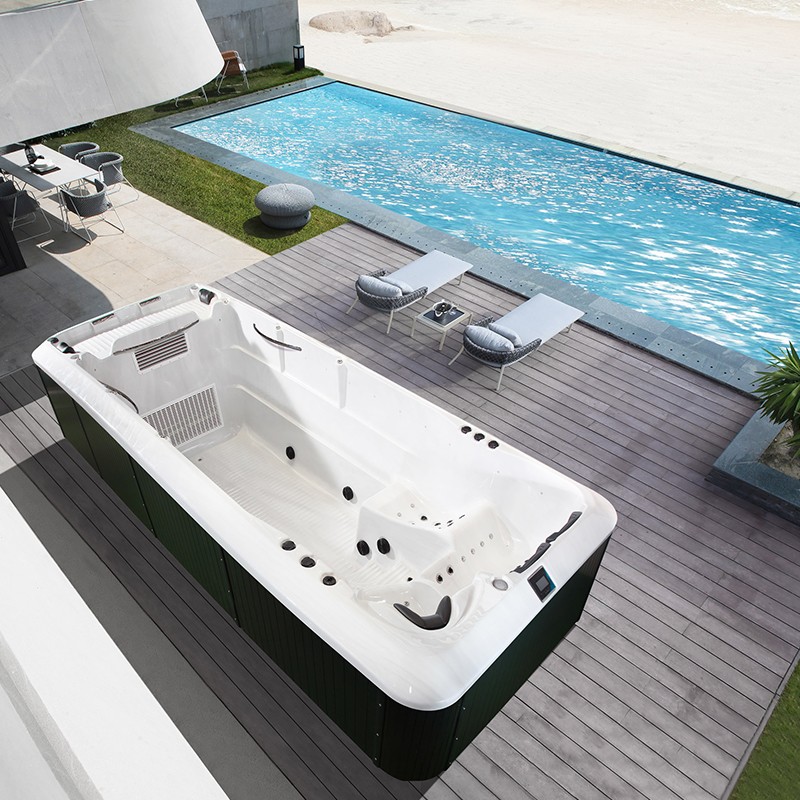
Water quality parameters most likely to go out of balance in outdoor swim spas
For outdoor swim spa tubs, the following parameters are typically the most problematic.
1. pH Level
During counter-current swimming, large amounts of air constantly enter the water.
Air agitation accelerates the escape of carbon dioxide.
As carbon dioxide levels drop, the water becomes more alkaline.
Consequently, many outdoor swim spa tub users notice that:
The pH level rises significantly faster than in standard outdoor hot tubs.
Some units even require pH adjustments multiple times a week.
2. Free Chlorine
Sweat and organic matter introduced during swimming workouts continuously deplete chlorine.
If testing is infrequent, free chlorine concentrations can drop rapidly in a short time.
Industry data shows that chlorine consumption rates in heavily used outdoor swim spa hot tubs are typically 30% to 100% higher than in standard hot tubs.
3. Total Dissolved Solids (TDS)
TDS is a key indicator of the total amount of dissolved substances in the water.
Due to factors such as:
•Sweat accumulation;
•Chemical residues;
•Mineral concentration;
•Water replenishment cycles;
TDS levels steadily rise. Once TDS levels exceed 1,500–2,000 ppm, water clarity and chemical stability are typically compromised.
For many outdoor swim spa hot tubs, regular water replacement is a key method for keeping TDS levels low.
How can the maintenance of outdoor swim spa tubs be simplified?
While managing outdoor swim spa hot tubs is indeed more complex, the difficulty can be significantly reduced through proper design and scientific maintenance practices.
First, establish a routine testing schedule.
It is recommended to test the following at least once a week:
•pH level;
•Free chlorine;
•Total alkalinity;
•Calcium hardness;
Testing may even be performed daily during periods of high usage.
Second, increase the frequency of filter maintenance.
Many manufacturers recommend cleaning filter cartridges monthly, but for outdoor swim spa hot tubs used frequently, inspecting the filtration system every two weeks is usually more appropriate.
Additionally, consider incorporating supplementary sanitization technologies.
Examples include:
•Ozone systems;
•UV (ultraviolet) systems;
•Saltwater chlorinator systems;
These devices can effectively reduce the reliance on traditional chlorine disinfection and improve overall water quality stability.
Finally, users should cultivate good usage habits.
Showering before swimming can significantly reduce the amount of the following entering the water:
•Sweat;
•Cosmetics;
•Skincare products;
•Sunscreen products;
Industry data shows that simply rinsing off before entering the pool can reduce the organic pollution load by more than 30%.
FAQ
How often should water quality be tested for an outdoor swim spa hot tub?
If used more than three times a week, testing two to three times weekly is recommended; for high-frequency training use, it is best to test free chlorine and pH levels daily.
Do outdoor swim spa tubs require more chemicals than standard outdoor hot tubs?
Generally, yes. Due to the increased sweat and organic contaminants generated by physical exercise, disinfectant consumption rates in outdoor swim spa tubs tend to be higher than in standard outdoor hot tubs.
Does a larger water volume in an outdoor swim spa tub mean a longer interval between water changes?
Not necessarily. Although a larger body of water offers greater buffering capacity, high usage frequency and heavy pollution loads mean the actual interval between water changes may not be longer than that of a smaller outdoor hot tub.
What are the most common water quality issues with outdoor swim spa hot tubs?
The most common problems include a continuously rising pH level, a rapid drop in free chlorine, cloudy water, and the accumulation of total dissolved solids (TDS).
Can installing an ozone system in an outdoor swim spa tub completely replace chlorine disinfection?
No. While ozone can serve as a supplementary disinfection method to improve water quality stability, in most cases, it is still necessary to maintain a certain level of residual chlorine or another residual disinfectant.