


Is poor water quality in an outdoor swim spa always a disinfection issue?
2026-09-21 15:30For outdoor swim spa hot tub users, "poor water quality" is arguably one of the most common and easily misdiagnosed problems during long-term use. When the water becomes cloudy, many people's first reaction is "insufficient chlorine"; when the water has an odor, their first reaction is "add disinfectant immediately"; when the water turns green, some immediately assume "algae growth." These approaches seem simple, but in practice, they often result in the following: adding disinfectant doesn't eliminate the cloudiness; increasing the chlorine concentration doesn't eliminate the odor; and adjusting the pH leads to increased limescale. The reason is that the water quality in an outdoor swim spa hot tub is a system determined by disinfection, filtration, circulation, water chemistry, and usage load, not simply a "chlorine concentration problem."
The CDC clearly states that chlorine and pH are crucial for controlling microorganisms in swimming pools and hot tubs, but also emphasizes that filtration, circulation, water quality management, and user behavior are equally important components of the overall maintenance system. For home hot tubs, the CDC recommends maintaining a pH of 7.0–7.8 and free chlorine of at least 3 ppm; if using bromine, the recommended level is typically 4–8 ppm, with testing recommended at least twice daily, increasing the frequency for more frequent use.
Therefore, in the context of an outdoor swim spa hot tub's actual operating environment, the answer is clear: poor water quality in an outdoor swim spa is not necessarily a disinfection issue. Insufficient disinfection can indeed lead to microbial growth, turbidity, and odors, but abnormal water quality can also stem from pH imbalances, abnormal total alkalinity, excessive calcium hardness, clogged filters, insufficient circulation, human organic contamination, and metal ions in the replenishment water.
A truly professional solution is not simply "adding chlorine when the water quality is poor," but rather first determining which stage of the water quality problem is at, and then taking targeted measures.
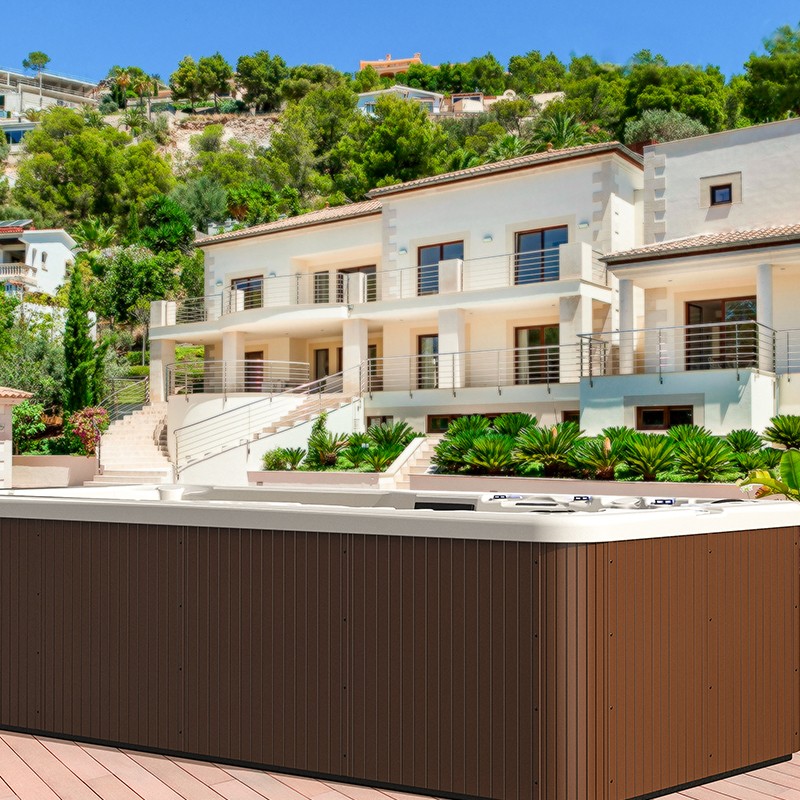
Why can't the water quality problem in an outdoor swim spa be simply attributed to "insufficient disinfection"?
While both outdoor jacuzzi swim spas and regular swimming pools involve water treatment, their operating environments differ significantly. Outdoor swim spa hot tubs typically combine swimming training, leisure spa treatments, massage, and wellness functions. The water may be equipped with circulation pumps, filters, massage nozzles, counter-current swimming systems, heating systems, and even auxiliary treatment equipment such as ozone or UV filters. The water temperature is usually significantly higher than in regular swimming pools, resulting in more pronounced effects from human contaminants, evaporation, aeration, and changes in chemical balance.
More importantly, outdoor hydropool swim spas are usually relatively closed-loop systems. Water is not completely drained after a single use; it continuously undergoes filtration, heating, circulation, and disinfection before returning to the pool. Therefore, a decrease in efficiency at any stage can ultimately result in poor water quality.
For example, even if the disinfectant concentration is normal, if the filter is severely clogged, human skin flakes, dust, hair, and other particles cannot be removed from the water in time, and the water may still be cloudy; if the pH is consistently above 8.0, even if the chlorine test value appears high, the bactericidal effect of chlorine will decrease; excessively high calcium hardness and total alkalinity may produce white scale even if disinfection is completely normal; high levels of iron, copper, or manganese in the makeup water may result in yellow, brown, or blue-green water; and long-term accumulation of TDS can make the overall chemical properties of the water increasingly difficult to control.
The CDC's Model Aquatic Health Code also considers pH, total alkalinity, calcium hardness, temperature, TDS, and the water treatment system as important components of water quality management, rather than focusing solely on disinfectants.
Therefore, for an outdoor swim spa hot tub, "poor water quality" is more accurately understood as one or more parameters in the water treatment system deviating from their optimal state.
First-line cause: Insufficient disinfectant; this is the most pressing issue to investigate
While not all water quality problems can be attributed to disinfection, the disinfection system remains the first line of defense for outdoor hydropool swim spa water quality management.
If free chlorine levels are consistently too low, the water's ability to control bacteria, viruses, and other microorganisms will decline. This is especially true in the high-temperature, high-humidity, and high-user environment of an outdoor hydropool swim spa, where sweat, sebum, urine, cosmetics, sunscreen, and other organic matter will continuously enter the water and consume available chlorine.
The CDC recommends at least 3 ppm free chlorine, 4–8 ppm bromine, and a pH of 7.0–7.8 for home hot tubs. It's important to note that these are CDC health protection reference values for hot tubs; specific outdoor swim spa products should be considered in conjunction with the manufacturer's requirements for water temperature, disinfection system, and disinfectants.
If an outdoor swim spa has only 0.5–1 ppm free chlorine, and the water temperature is high, the number of users is increasing, and foam or turbidity appears on the surface, then the possibility of insufficient disinfection is relatively high.
However, even if low chlorine levels are detected, it cannot be simply assumed that "adding a large amount of chlorine will solve the problem." The underlying cause of the low chlorine level needs to be investigated. If the problem stems from excessive human contaminant load, continuously increasing chlorine will only temporarily consume the contaminants. If it's a problem with the filtration system, the continuous accumulation of organic matter in the water will increase the chlorine demand. If a biofilm is present, simply maintaining normal disinfection levels may not solve the internal problems within the pipes.
Therefore, detecting low chlorine is a result, not a complete diagnosis of the cause.
Second type of cause: Abnormal pH, which may lead to "sufficient chlorine, but still poor water quality."
This is a very typical problem in Outdoor Swim Spa maintenance.
Many users only look at free chlorine when testing water quality; for example, if a reading of 3 ppm is found, they assume disinfection is definitely not a problem. However, in reality, chlorine disinfection efficiency is significantly affected by pH.
The CDC points out that a pH range of 7.0–7.8 provides a good balance between disinfection effectiveness, equipment lifespan, and user comfort; when the pH rises, chlorine's ability to kill microorganisms decreases, especially above 8.0.
For example, with the same 3 ppm free chlorine, if the pH of the outdoor swimmer is maintained within a reasonable range, the disinfection system will function normally. However, if the pH consistently reaches 8.0 or higher, users may find that "the chlorine level is not low, but the water is still prone to problems."
A low pH is also not good. While a low pH may enhance the disinfection effect of chlorine, it increases the risk of corrosion to metals, pipes, and equipment materials. Therefore, outdoor swimmers cannot "enhance chlorine" by indefinitely lowering the pH.
From a practical maintenance perspective, if an outdoor swimmer experiences water quality abnormalities, it is recommended to test both pH and free chlorine simultaneously, rather than testing only one.
Third type of cause: Total alkalinity imbalance, which may cause pH to fluctuate continuously
Total alkalinity is a parameter that many household users easily overlook.
Total alkalinity can be understood as the water's buffering capacity against changes in acidity and alkalinity. If the total alkalinity is too low, the pH of an outdoor hydropool swim spa can fluctuate rapidly; it might be adjusted to 7.4 one day, only to drop significantly the next. Conversely, if the total alkalinity is too high, the pH may remain persistently high and difficult to lower.
This is why some users experience significant frustration: "I adjust the pH every day, why is it abnormal again the next day?" The problem may not lie in the pH itself, but in the total alkalinity.
For example, an outdoor swim spa hot tub with a pH of 7.2 but significantly low total alkalinity may lack buffering capacity. Conversely, if the pH is 8.0 and the total alkalinity remains consistently high, adding large amounts of alkaline products may further exacerbate the problem.
Therefore, pH and total alkalinity should be observed as a set of parameters during water quality adjustments. The CDC's Model Aquatic Health Code explicitly includes total alkalinity as a separate water quality management item, encompassing the relationship between total alkalinity and pH, the effects of excessively high or low levels, and adjustment methods.
For outdoor jacuzzi swim spas, this means that "pH instability" itself is a signal requiring further monitoring.
Fourth Cause: Excessive Calcium Hardness, Scale Formation Even with Normal Disinfection
If the water in your outdoor jacuzzi swim spa appears whitish and milky, with white deposits around the nozzles and scale forming near the heater, the problem may not be disinfection.
Excessive calcium hardness is a typical cause.
Calcium ions in water are related to the carbonate system. When calcium hardness is high, and the pH, total alkalinity, and temperature are conducive to calcium carbonate precipitation, scale may gradually form. The high-temperature operating environment of outdoor hydropool swim spas further amplifies this problem.
This is why outdoor swim spas in hard water areas are more prone to heater scaling, nozzle clogging, and white deposits near the waterline.
If users find the hydropool swim spa water becoming increasingly cloudy, while chlorine and pH test results are generally normal, they should further test the calcium hardness instead of continuing to add disinfectant.
Especially when using high-mineral well water or tap water with high hardness, the water hardness should be considered during the initial filling and subsequent top-ups.
Fifth Cause: Filter Clog, possibly the real reason for "normal chlorine but still cloudy water"
The filtration system is a crucial yet often underestimated part of water quality management for outdoor swim spa hot tubs.
Disinfectants primarily control microorganisms, while the filtration system primarily removes particulate matter, suspended solids, and some organic contaminants from the water. They perform different tasks.
If the filter is clogged, the circulation flow decreases, and particulate matter in the water cannot be trapped in time, potentially leading to cloudiness. Even if free chlorine levels remain at 3 ppm or higher, the water may still not be clear.
The CDC's recommendations for public water facility management explicitly require maintaining filtration and circulation systems according to the manufacturer's recommendations and integrating filtration, circulation, and disinfection as part of the water quality management system.
For outdoor jacuzzi swim spas, a simple way to assess this is to observe the filter differential pressure, circulation flow, and filter cartridge condition. If the filter cartridge is noticeably blackened, yellowed, greasy, or has not been cleaned or replaced for a long time, the filtration system should be addressed first.
Especially in homes where outdoor jacuzzi swim spas are frequently used, the accumulation of sebum, sweat, sunscreen, and particulate contamination from multiple swimmers and spa users simultaneously can rapidly increase the filter's workload.
Sixth Cause: Insufficient Circulation System Flow – A Filter Doesn't Equal Effective Filtration
Many users believe that as long as a filter is installed, the water will be automatically filtered clean.
In reality, filtration effectiveness depends on the filter media, flow rate, filter area, circulation time, and system design.
If the circulation pump doesn't run long enough, or if there are blockages in the intake, filter, or piping, even if the filter itself is performing well, the actual water treatment capacity of the entire outdoor swim spa hot tub may decrease.
For example, an outdoor swim spa hot tub might be used for 8 hours a day, but the circulation system might only operate efficiently for a limited time, allowing particulate matter in the water to remain for extended periods.
Furthermore, counter-current swimming systems and spa nozzles generate very strong water and air mixing. If the system design is inadequate, some areas may have very strong water flow, while corners or low-flow areas may have weak circulation. In such cases, localized contaminants may not be able to quickly enter the filtration system.
Therefore, when judging the water quality of an outdoor jacuzzi swim spa, one cannot only look at the "filter model," but also whether the entire circulation system truly creates an effective water flow.
Seventh Cause: Too Many Human Contaminants May Cause "Abnormal Chlorine Consumption"
Another very real reason for poor water quality in outdoor jacuzzi swim spas is the users themselves.
Sweat, sebum, urine, dust, sunscreen, body lotion, cosmetics, and other personal care products can all enter the water. These contaminants consume disinfectants and may form byproducts such as chloramines.
The CDC clearly states that urine, feces, sweat, and bodily dirt all reduce the chlorine concentration in water; it also recommends that swimmers shower before entering the water to reduce the amount of contaminants entering the water.
This is why maintaining water quality is completely different for a 4-person family and a 10-person commercial spa area, even using the same disinfection equipment.
Outdoor jacuzzi swim spas are particularly vulnerable to this problem because they combine swimming and spa functions, and users typically spend a relatively long time in the water. If multiple people use it continuously, the contamination load can increase rapidly in a short period of time.
Therefore, if you find that "the water quality drops significantly after each gathering," the problem is likely not a sudden equipment malfunction, but rather that the pollution load exceeds the current water treatment system's capacity.
Eighth Cause: Foam and Odor Don't Necessarily Mean "Too Little Chlorine"
Many people, upon smelling a strong "chlorine smell" in an outdoor swim spa hot tub, immediately assume too much chlorine has been added.
In reality, a strong chemical odor doesn't necessarily indicate excessive free chlorine. The CDC points out that a properly disinfected hot tub should not have a noticeable pungent odor; a strong chemical odor may actually indicate a problem with water quality management.
Sweat, urine, sebum, and other organic contaminants react with chlorine to produce compounds such as chloramines. Users may then smell a distinct "pool odor."
Similarly, foam can also be related to body oils, skincare products, shampoo, shower gel, laundry residue, and other surfactants.
Therefore, the presence of foam and an odor in an outdoor jacuzzi swim spa should not be immediately attributed to "insufficient chlorine." The disinfectant, pH, number of users, human pollution load, filter condition, and water change frequency should also be checked.
Ninth Reason: Rising TDS Makes Water Increasingly Difficult to Maintain
Total Dissolved Solids (TDS) is a crucial indicator for long-term outdoor hydropool swim spa use.
As water evaporates, non-volatile substances don't leave with the steam; simultaneously, users add chemicals, human contaminants, and minerals, causing dissolved substances to accumulate.
Therefore, if an outdoor swim spa hot tub only tops up water without changing it, the following may occur: pH becomes increasingly difficult to stabilize, disinfectant requirements increase, foam becomes more pronounced, and color becomes harder to control. Even with filters and disinfection systems functioning normally, overall water quality continues to deteriorate.
This is because many dissolved contaminants cannot be effectively removed by ordinary mechanical filters.
The CDC's Model Aquatic Health Code specifically lists TDS as a water quality management item and emphasizes that certain dissolved contaminants require dilution by adding fresh water.
Therefore, a "clean filter" does not mean the water can be used indefinitely.
Tenth Cause: Metal Ions Can Cause Color Changes in Outdoor Swim Spas
If your outdoor swimmer has recently had its water changed and subsequently turns yellow, brown, orange, or blue-green, you should consider the presence of metal ions in the water source.
Iron can cause water to turn yellow, orange, or brown; copper can cause it to turn blue-green or green; and manganese can form dark deposits.
In such cases, users often mistakenly believe that "too little chlorine is causing the color change" and keep adding chlorine. However, if the real problem is that the add-in water contains high levels of iron or copper, adding chlorine may even cause the metals to oxidize, making the color more pronounced.
Therefore, if your outdoor swimmer shows abnormal coloring after the first fill or water change, it is recommended to test the quality of the add-in water. If your local water source is in an area with high hardness, high iron, high manganese, or high copper, treating the add-in water in advance is often more effective than trying to salvage the situation after each color change.

FAQ: Frequently Asked Questions about Outdoor Swim Spa Water Quality
1. My outdoor swimmer has poor water quality; can I just add chlorine directly?
Not necessarily. First, you need to test for free chlorine or bromine and pH. 1. If the disinfectant is indeed insufficient, adjustments can be made according to the manufacturer's requirements. However, if the problem stems from a clogged filter, insufficient circulation, excessive calcium hardness, TDS accumulation, metal ions, or human contamination, simply adding chlorine will not address the root cause.
2. What is the appropriate free chlorine level for an outdoor jacuzzi swim spa?
Specific targets should be based on the equipment manufacturer's and the instructions for the disinfectant products used. For hot tubs, the CDC currently recommends at least 3 ppm free chlorine, 4–8 ppm bromine, and a pH of 7.0–7.8. If the outdoor swim spa hot tub also functions as a pool and hot water spa, management should be based on the actual water temperature, disinfection system, and local regulations.
3. Why is the water still cloudy even though the chlorine level in my outdoor swim spa is normal?
First, check the filter and circulation system. Chlorine disinfects, but it doesn't mean it filters out all suspended particles. If the filter is clogged, circulation is insufficient, or there are many fine particles in the water, the water may still be cloudy. Additionally, check the pH, total alkalinity, calcium hardness, and TDS.
4. My outdoor swim spa has a normal pH and chlorine level, but it still smells bad. What could be the reason?
It may be due to a high organic pollutant load, such as sweat, sebum, urine, and personal care products. It may also contain chloramines. We recommend checking the number of users, showering habits, filter condition, water change frequency, and disinfection system, rather than simply adding more chlorine.
5. Does green water in my outdoor swim spa hot tub always indicate algae?
No. If the water is green and cloudy, you should focus on checking for insufficient disinfection and microbial problems. If the water is green but still clear, you should consider metal ions such as copper. Especially if the green color suddenly appears after a water change or after adding an oxidant, it's worth investigating the metals in the water source.