


How to Remove the Oil Film from an Outdoor Spa Hot Tub?
2026-08-19 15:30In the past few years, there has been a worldwide increase in the popularity of leisure, outdoor lifestyles and thus outdoor whirlpool spa hot tubs have become an integral part of family patios, villa terraces, hotel resorts, upscale guesthouses, and commercial spas, having started off just as a luxurious feature in a few select residences.Users who buy outdoor whirlpool spa hot tubs not only expect a warm and pleasant experience, but they also hope that through massage jets, a hydrotherapy function and a constant temperature system, they can create a beautiful outdoor area that will last years, one that is comfortable and will also be good for their health.Hence, the main reason people do not enjoy their whirlpool spa hot tub and also have to maintain the spa in the long-run is because they encounter this problem after some use: there starts forming a layer on the surface of the water that looks like oil, commonly referred in the industry as "an oil film". This phenomenon is not only an eyesore but also leads to a lot of maintenance expenses for these people who already invested so much in the whirlpool spa hot tub.
Although oil film looks like it is just a film formed on the water surface, actually, it is a problem with user experience which significantly affects both the water quality and maintenance cost of the whirlpool spa hot tub for the homeowners.Lots of buyers wonder why after adding disinfectants and cleaning filters regularly their "film" still appears on the surface.
They get worried after just a few uses that the edges around newly changed water look slick or oily. It turns out, however, oil film is not merely the appearance of oil in the water it rather consists of a mixture of human sebum, sweat, sunscreen, makeup residue, skincare products, dust, and organic pollutants in the water.
Compared with normal bathtubs and swimming pools, oil film problem has greater chances in outdoor whirlpool spa hot tubs and the reason is the fact that they often have the water kept at roughly 37°C to 40°C so that body temperature is raised which causes us to excrete both more sebum and sweat as well as sweat. Besides, there is a much smaller amount of water in an outdoor hot tub as compared with public swimming pools: one typical house-size whirlpool spa hot tub is 800-2 000 liters, whereas public pools are often of ten thousands of liters or more, even. Therefore, if the same amount of water pollutants enter an outdoor spa then the concentration per liter would be significantly higher than in the case of a public pool, and consequently, the development of observable water quality problems becomes quicker.
The other main factor is that nowadays spa hot tub manufacturers often supply outdoor whirlpool spa hot tubs equipped with advanced massage jets and circulation systems.
To be precise, the faster the water in the spa flows, the more the water is physically moved and stirred and the easier for oil-based wastes to form tiny bubbles and particles, which in time, can be seen floating up to the water surface and forming films along sides of the tub when the water cycles through. If ignored, these impurities not only look bad but might also make filtration systems work more which leads to a decline of disinfection efficiency besides potentially damaging essential components like water heaters and circulation pumps in the long term.
Consequently, getting rid of the oil film present in an outdoor whirlpool spa hot tub involves more than simply getting rid of surface pollutants it's about managing contaminants from the source, water chemistry, filtration systems, and day-to-day maintenance.
By doing such things properly, home users could significantly increase the quality of the whirlpool spa hot tub bathing experience; as hotels and resorts on one hand, it will be helpful for them to adopt scientific approaches to oil filmming not just to reduce cleaning costs but also to increase customer satisfaction with the service provided.
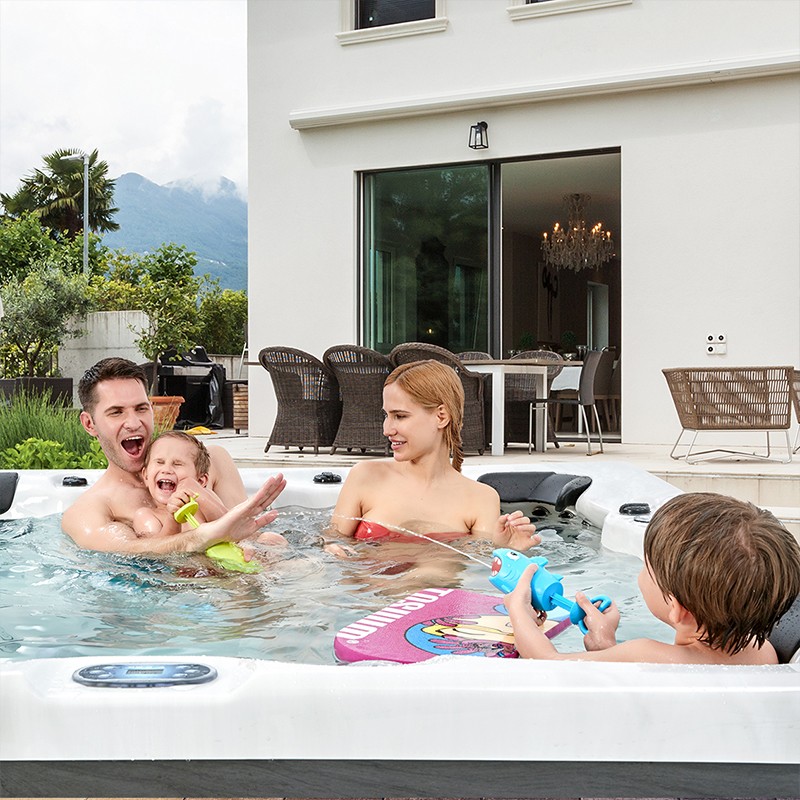
What is the oil film in outdoor whirlpool spa hot tubs?
A lot of people just think they see body oils floating up after a nice warm dip, but actually the accumulation over time of various organic pollutants is behind the formation of most of the oil films.
A major contributing source of oil film, in one way or another, is indeed human sebum. We all know the natural oils our skin produces from one day to the other. If these get into an outdoor spa hot tub when a user takes a bath, they mix with water minerals and disinfectants and other pollutants to form particles that float.
Sweat may contribute greatly to pollution as well. However sweat is mostly water, it has salt, urea and other wastes in its composition as a metabolic function, so that organic content in water is higher. Especially in hot environment where human body tends to sweat more, it is much easier for an oil film to form especially during summertime or if an outdoor whirlpool spa hot tub is shared by several people.
Moreover, customers are very fond of using sunscreen, body lotion and various skincare products at present. These products are quite high on oil content such as plant oils, silicones and emulsifiers. Once they get into an outdoor whirlpool spa hot tub, they go on the surface of the water and combine with other pollutants thus forming a much stronger oil film.
In fact, the oil film always tends to be gathered on the top layer because in general, oil is less heavy than water and so it tends to float. At the same time, the continuous pump circulation makes contaminated particles to gather on the sides of the tub, on the waterline and inside the filtration system.
If there is a visible layer of oil film on a whirlpool spa hot tub, it does not automatically mean it should be a case that is attributed to the lack in quality of the hot tub. It rather means that the content of the water in organic contamination surpasses both filtration and disinfection ability of the system, and targeted maintenance is required.
Why do outdoor spa hot tubs get oil film more frequently compared swimming pools?
Many of the outdoor spa hot tubs users are just puzzled asking a question like: “Swimming pools are not only large, but also they also used, so, then, why the formation ofoil film in hot tubs has been more common lately?”
Much smaller size of the spa hot tub means that there is less amount of water and therefore, the level of contamination in water can very quickly go up, for example, after people having enjoyed a bath, sweat, oil, sunscreen etc., have been left in the water from the skin while the water is only a certain volume as opposed to the case of a swimming pool where the contamination is spread over such a large volume of water that it hardly results in any noticeable change.
Another reason is higher temperature outdoors. A typical pool is about 25°C to 30°C but outdoor whirlpool spa hot tubs are kept around 38°C or even higher. Although the hotter climate adds to one's well-being and comfort through warm water exposure, it also stimulates a greater quantity of secretions of various contaminants, which increases the difficulty of keeping a swimming pool clean.
Outdoor whirlpool spa hot tubs have their specific way of use too: usually one lies there for 30 minutes or more while only swimming pool users move around all the time. In this context, the skin remains immersed in the water longer period of time thus resulting in more release of the contaminants by the body.
Oil film formation is also intensified to the point where it starts to form a very hard layer of the oil due to having bubbles of water produced through jet massages being created continuously. It is the jet outlets that are causing a very large number of bubbling and streaming actions which are physically stirring different kinds of oils and also the organic components making them emulsify and hence they do not immediately form surface contamination but they are gradually building up in the recirculation system to end up being a visible oil film.
In conclusion, the level of water quality required for an outdoor whirlpool spa hot tub is more complicated in terms of maintenance to compare it with that of a regular swimming pool.

What factors can help to identify to what extent the oil film is a problem in your outdoor hot tub?
The oil film doesn't form overnight. Usually it starts with a very subtle contamination until finally becomes the worst form of contamination.
The first and very faint sign of a slight oil film is a very light colored surface reflecting the light so that rainbow colors can get visible under a light. Also there can be a slim and slippery ring formed by the water around the tub's edges.
Oil film appearing in the stage of moderate development can be noticed when there is a noticeable layer floating on the surface; the tub's interior can be greasy to the touch, the filter can easily get clogged faster than it is normal and water transparency has a tendency to be reduced.
Sometimes if there is a really bad problem with an oil film that the user can clearly smell an oil smell coming out even when they take the water outside of the whirlpool spa hot tub, a dirty look of the water and an abnormally quick depletion of the disinfectants are also signs. When these symptoms are ignored it will only make the whirlpool spa hot tub work worse and the inside of the hot tub may start to get covered with a slimy stuff, a biofilm which may get on the machine parts and may cause it to malfunction.
Because of that users are advised not to let the surface of the whirlpool spa hot tub become very shiny to the extent that they see the oil shine only after they have cleaned the whole place or that they are the ones spotting yellow stains. As much as possible, they could fix that early.
Correct way of removing Oil film from your outdoor whirlpool spa hot tub?
Solution for removing oil film from the outside whirlpool spa hot tub would vary based on the extent of the contamination. Just wiping off oil on the surface of water will solve the only visible part, not dealing with the underlying issue where organic matter has been already mixed with the water in large amounts.
Primarily, you are advised to boost filtration and circulation. A filtration system should be regarded as a key factor of cleaning outdoor whirlpool spa hot tub. If you notice that there is an oil film on the surface of the water, you can slightly prolong the running time of the filtration system through which the water flows so that filtration is performed on a larger body of water. As an example, in an ordinary home, a filtration system is run for a few hours each day but to combat serious oil film problems, it is okay to keep the filtering system running longer just temporarily.
In parallel to this, you will have to also inspect how clean your filter is. Greed clogging the filter element may significantly lower down the efficiency of water circulation. So if the filtering system is working in the background without interruption, you won’t see any difference in the level of cleanliness of the water. Cleaning of the filter is enough if the dirt is very little but if the filter has become completely worn out you will need an entirely new replacement of a filtration element.
Another way is oxidation treatment which may also be helpful here. As oil films mostly are made up of organic substances then by using a kind of shocking technique you will be capable of breaking down and eliminating some substances. A few ways which are usually used for treating an outdoor spa hot tub include: making use of an appropriate level of oxidant and ozone system as a supplementary method for purification.
Remember, more disinfectant is not better. Outdoor whirlpool spa hot tubs must keep the water condition very stable. That is why, for example, the pH level in the water must stay at about 7.5 - 7.8. Disinfectant concentration should also be in accordance with specific equipment. If one is adding chemical products indiscriminately the effect can be that the quality balance is completely upset.
Also, you must carry waterline cleaning. A mistake made by many of the users is focusing only on oil film removal at surface level but forgetting to do the cleaning along the tub wall. The fact is that huge amount of grease sticks in waterline area so failure to clean it will only result that this grease continuously get back into the water.
We suggest the use of cleaners which have been specifically made to clean the equipment of spa ot tub. The regular household soap can foam a lot and it can interfere with cleaning of the water in the long term so that it should be not used.
How to avoid reappearance of oil film in outdoor spa hot tubs after removal?
Different things could cause your whirlpool spa hot tub oil film issue. Rather than dealing with the oil film over and over again it would be more efficient to find out the reason first and establish prevention measures as early as possible to make sure it won’t come back.
First of all users are encouraged to rinse quickly before stepping into the whirlpool spa hot tub that is located outside. A big percentage of oil film problems in the water are not because of the water treatment equipment or the hot tub system but because of body contaminants which include sweat, sunscreen, body lotion, and dust that come in with the users themselves. To a great extent, the contaminants get introduced in the water from the body itself so it goes without saying that the number of these should not be too high. Thus cleaning yourself up before jumping into the hot tub will be a great way to cut these sources down!
Second, the filtration system should be in good condition. For your outdoor whirlpool spa hot tub, filter is a critical component of your water purification process. The manufacturer suggests regular checks of filter for the standard household use every 2 - 4 weeks and you can change your schedule of maintenance according to the number of people and how often the tub is used.
Maintaining the balance of the water is extremely important as well. Outdoor whirlpool spa hot tubs don’t solely need the water to look clean but the chemical balance should be taken care of at the same time. If your hot tub maintains consistent pH and disinfection levels of water, it will help you minimize deposition of impurities and you will also experience much better overall performance of your equipment.
Your spa hot tub has a certain number of allowable users as stated on the label and that number is meant to be a minimum limit to avoid putting your water overuse. Once you start using a tub regularly for more people than recommended, the amount of organic waste in the water goes up rapidly that it might be difficult to treat it by the filtration system even after the system is running continuously.
In business whirlpool spa hot tub use cases like at hotels, resorts, and spas, it’s essential that maintenance procedures are strictly followed which includes checking and adjusting water chemistry parameters everyday, keeping the filtration system functional in good order by regular cleansing or replacement of filters, and doing partial and full water changes periodically.
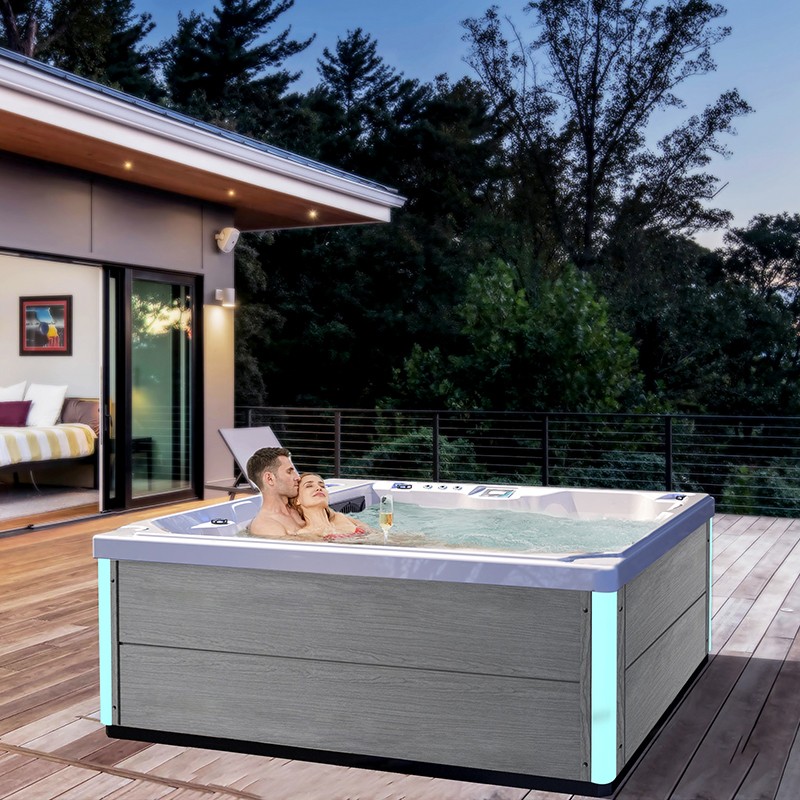
How outdoor hot tubs manufacturers use the technology to prevent oil film?
If you see in the field of whirlpool spa hot tubs, the competition level goes up day by day, and the manufacturers are not anymore solely focusing their efforts on providing great look and massage functions to customers only. Rather, the spotlight is being increasingly switched to water purification systems which ensure that the water is always kept pure even when there are many people coming in and out of the tub or they are sitting around for long periods of time.
Outdoor spa hot tubs of a premium category are likely to be equipped with much improved filtration systems that can efficiently handle water purification even through high levels of contaminants, as well as the circulating water circuits are well thought out, and, to get rid of various types of impurities in the water, they make use of different purification methods altogether. For example, ozone purification systems are capable of decomposing a range of organic contaminants, uv light sterilization contributes to a great extent to the purity of the water, and smart control features allow users to check how the devices perform.
Moreover, trustworthy factories put their efforts into optimizing interior piping systems in such a way that the water has no chances to get stuck in places where it could not circulate at all and get contaminated over time.
Clients from Europe and USA often are most concerned with the longevity of the product and the easiness to service the whirlpool spa hot tub after purchase, hence for future, the hot tubs outside have not only to keep the trend of including extra features but to make a breakthrough in being smart, saving energy, and managing water quality in a better way at the same time.
In the same way a good outdoor whirlpool spa hot tub will make life easier for its user but will not cause the need for a lot of maintenance on the part of the user!
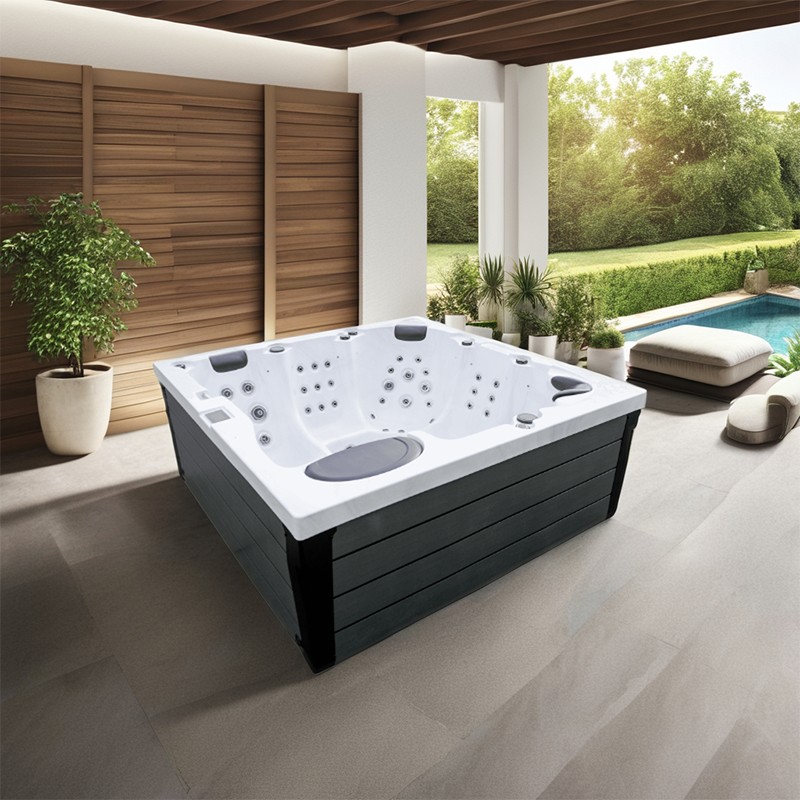
Outdoor Hot Tub Oil Film Issues FAQ
FAQ 1: Should I change the water immediately after an oil film appears in my outdoor spa hot tub?
Not necessarily. A slight oil film can usually be resolved by cleaning the filter, increasing circulation, and adjusting water quality parameters. If the water is severely turbid and has a noticeable odor, it is recommended to consider a partial or complete water change.
FAQ 2: Why does an oil film reappear in my outdoor spa hot tub shortly after a water change?
Common causes include users not rinsing their bodies before entering, sunscreen and skincare products entering the water, insufficient filtration system efficiency, or the number of users exceeding the equipment's capacity.
FAQ 3: Can I use dish soap to clean the oil film in my outdoor whirlpool spa hot tub?
Not recommended. Regular dishwashing liquid may produce excessive foam and disrupt the water balance. It is recommended to use cleaning products specifically designed for spa equipment.
FAQ 4: Can an ozone system completely eliminate grease film in outdoor whirlpool spa hot tubs?
It cannot completely replace maintenance. Ozone can help remove some organic pollutants, but it still needs to be combined with filtration, disinfection, and regular cleaning.
FAQ 5: How often should the outdoor spa hot tub filter be cleaned?
For typical households, it is recommended to check it every 2 to 4 weeks. If the equipment is used frequently, such as in hotels, guesthouses, or large households, more frequent maintenance is required.