


How Long Does It Take to Heat a 4-Person Hot Tub?
2025-12-11 15:35For users planning to purchase or already owning a 4-person spa hot tub, heating time is one of the most pressing concerns. Especially with a 3kW heater, how long does it take for the water temperature to rise from room temperature to the ideal operating temperature (typically 38–40°C)? What factors affect heating efficiency? Are there ways to heat it up faster?
This article will systematically analyze the core question of "How long does it take for a 4-person spa hot tub to heat up," providing you with professional, clear, and structured answers.
Whether you plan to install your spa hot tub indoors, on a patio, in your backyard, or in your garden, this article will provide key information to better prepare you for practical use.

What wattage heater is typically included with a 4-person spa hot tub?
Among the common spa hot tubs on the market, especially small or medium-sized home spa units with a standard capacity of 2–4 people, a 3kW heater is the most common and prevalent configuration.
The reasons include:
• Faster heating speed
• Stable power and moderate energy consumption
• More electricity-friendly for household use
• Suitable for most outdoor environments
• Matches water volume (a 4-person bathtub typically holds 800–1100 liters)
Therefore, when discussing "how long does it take for a 4-person spa hot tub to heat up," using a 3kW heater as a reference is the most representative and industry-standard approach.
How long does it actually take for a 4-person spa hot tub to heat to the desired temperature?
How much temperature can a 3kW heater raise per hour?
Generally speaking:
• The heating efficiency of a 3kW heater is: 1°C to 2°C per hour.
This range depends on:
• The water volume of the spa hot tub
• Ambient air temperature (especially in winter)
• Insulation system and piping structure
• Whether the cover is properly closed.
The larger the capacity and the lower the ambient temperature, the slower the heating speed.
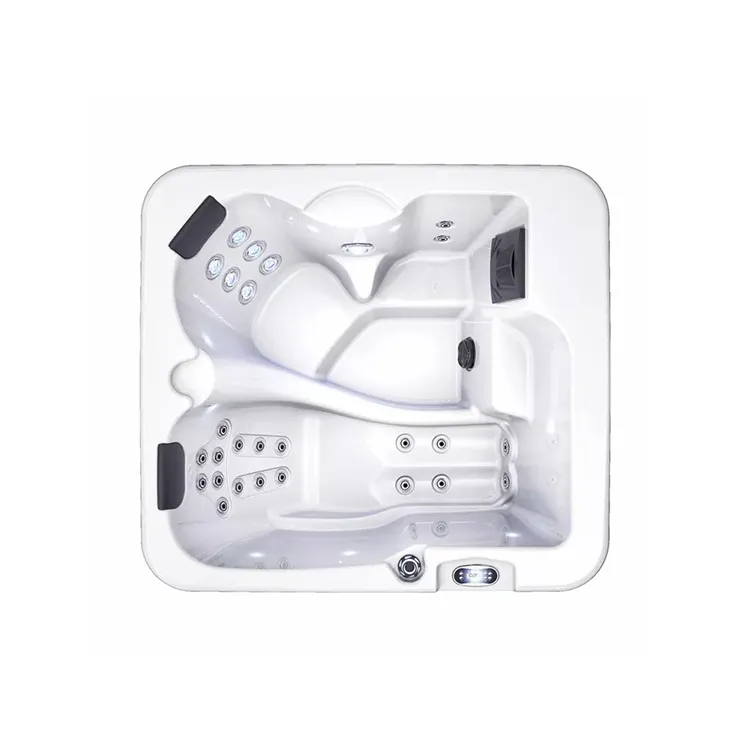
So how long does it take to heat a 4-person spa hot tub from room temperature to 38–40°C?
To provide a clear and reliable reference, we calculate based on common scenarios:
• Initial water temperature: 15–20°C (normal tap water temperature)
• Target water temperature: 38–40°C
• Temperature increase required: Approximately 18–22°C
Assuming a heating efficiency of 1.5°C–2°C/hour, then:
Total heating time: Approximately 9–14 hours
This is a typical estimate using a 3kW heater.
That is:
Initial water temperature | Target water temperature | Temperature difference | Estimated heating time |
| 15°C | 38°C | 23°C | 12–15 hours |
18°C | 38°C | 20°C | 10–13 hours |
| 20°C | 38°C | 18°C | 9–12 hours |
If the outside temperature is higher, such as in summer (tap water around 26–28°C), heating will be faster:
| Initial water temperature | Target water temperature | Temperature difference | Estimated heating time |
| 26°C | 38°C | 12°C | 6–8 hours |
| 28°C | 38°C | 10°C | 5–7 hours |
Therefore, in 95% of real-world usage scenarios, it typically takes 6–14 hours to heat a 4-person spa hot tub from cold water to a bathable temperature using a 3kW heater.

Why do different 4-person spa hot tubs have different heating times?
1. Does the water volume of a spa hot tub vary significantly?
Although all are labeled as "4-person" capacity, different brands and models of spa hot tubs have different internal layouts, resulting in water volume differences of 200-300 liters or more.
For example:
• Compact 4-person spa hot tub: Water volume approximately 750-900 liters
• Wide-body 4-person spa hot tub: Water volume up to 1000-1200 liters The larger the water volume, the longer the heating time.
2. Does the difference in the insulation system affect the heating speed?
Yes, it has a very significant impact.
The insulation of a spa hot tub includes:
• Foam insulation (Full foam or Partial foam)
• Internal insulation layer of the side panels
• Insulation of the bottom base
• Insulation layer of the pipes
• Thickness and sealing of the cover plate
Insufficient insulation will cause continuous heat loss, making it take longer for a 3kW heater to reach the set temperature.
3. Does ambient temperature significantly affect heating performance?
Very significantly.
The lower the ambient temperature, the more:
• The faster the side walls dissipate heat
• The faster the pipes dissipate heat
• The greater the load on the heater
Especially in areas where the temperature is below 10°C, the heating speed will be significantly slower. Therefore, it is more suitable for use in winter by:
• Preheating before turning on
• Keeping the cover sealed
• Avoiding complete evacuation before reheating
4. Does the heating speed slow down when the massage function is on?
Yes.
When the massage nozzles of the spa hot tub are turned on, they will:
• Create water circulation and pressure changes
• Accelerate heat diffusion into the air
• Increase airflow generated by the pump
Therefore, during the heating phase, you should:
❌ Not keep the nozzles on for extended periods
✔ Only run the circulation pump to avoid air mixing into the water
✔ Keep the cover completely closed
This will reduce the overall heating time.
5. Does the cover significantly affect the heating speed?
Extremely.
Without a cover, heating efficiency may:
• Decrease by 50–70%
• Increase heating time by 2–3 times
Therefore, any spa hot tub must:
✔ Ensure the cover is completely sealed
✔ Ensure it fits snugly on all sides
✔ Prevent drafts from entering gaps
A high-quality cover can even allow a 3kW heater to achieve an efficiency close to 2°C/hour.
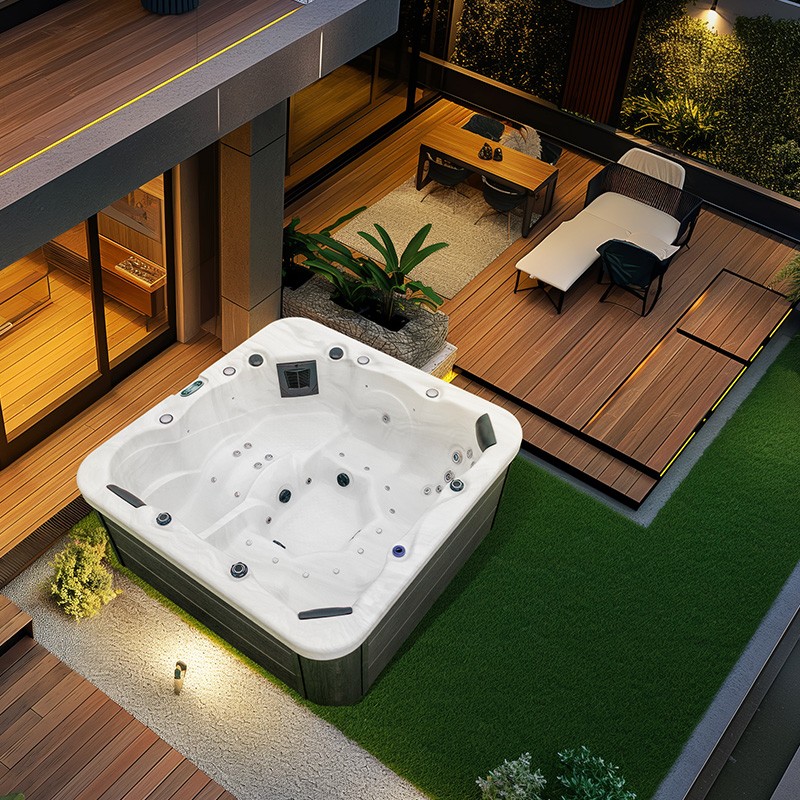
How to speed up the heating of a 4-person spa hot tub?
The following methods apply to any spa hot tub using a 3kW heater and can effectively reduce heating time:
1. Top up with hot water (most effective)
If hot water is permitted locally, consider:
• Adding some hot water
• Or setting the water temperature directly to above 30°C
This method can save 30%–70% of heating time.
2. Turn on circulation mode in advance
The circulation pump will:
• Ensure a more even water temperature
• Reduce localized heat loss
• Make the heater more efficient
Even when massage is not needed, circulation mode should be kept on.
3. Keep the lid tightly sealed
Every 1°C reduction in heat loss reduces heating time by approximately 30 minutes.
Especially at night or in winter, never open the lid while heating.
4. Do not turn on the massage nozzles
The nozzles agitate the air, causing significant heat loss.
Keeping the nozzles closed during the heating phase can increase heating efficiency by approximately 30–40%.
5. Ensure the spa hot tub is well insulated
This includes:
• Undamaged side panels
• A properly sealed lid
• No cold air backflow from the bottom
• External insulation for the tubing. Better insulation results in faster heating.

When using a 4-person spa hot tub, what heating method should be selected?
Should the tub be completely drained after each use?
Not recommended.
Reasons include:
• Refilling requires more heating time
• Reheating consumes more electricity
• Spa hot tubs are not designed to be emptied daily
• Causes unnecessary wear and tear on the pump and heater
Best practices:
✔ Keep the filtration system running continuously (as per manufacturer's settings)
✔ Add disinfectant weekly
✔ Change the water regularly (usually every 2–3 months)
Continuous heating vs. reheating before use? Which is more energy-efficient?
For a 4-person spa hot tub with a 3kW heater:
• Maintaining a continuous temperature of 35°C–38°C is generally more energy-efficient
• Heating from cold water to 38°C each time actually consumes more energy
Especially in cold regions, continuous heat maintenance is definitely more economical than recirculating heating.
Actual Heating Time for a 4-Person Spa Hot Tub with a 3KW Heater
6–14 hours (from cold water to 38–40°C)
Depending on:
• Water volume
• Ambient temperature
• Insulation performance
• Cover seal
• Whether the massage nozzles are on
• Whether air is introduced
Summer or higher outside temperatures: 5–8 hours
Winter or lower temperatures: May require 12–16 hours