


How Do Professional Factories Test Outdoor Hot Tubs Before Shipment?
2026-11-05 15:35An outdoor hot tub integrates an acrylic shell, water pumps, heaters, filters, jets, a control system, and various electrical components. A failure in any of these areas can compromise the user experience and lead to increased repair and after-sales costs once the product reaches an overseas destination. Therefore, professional factories must implement a standardized pre-shipment testing process to ensure that every outdoor whirlpool spa hot tub complies with product design specifications, procurement contracts, and the regulatory requirements of the target market.
For overseas importers, brand owners, and OEM/ODM buyers, understanding a factory’s pre-shipment testing process is essential for evaluating the supplier’s quality control capabilities and mitigating the risks associated with bulk procurement.
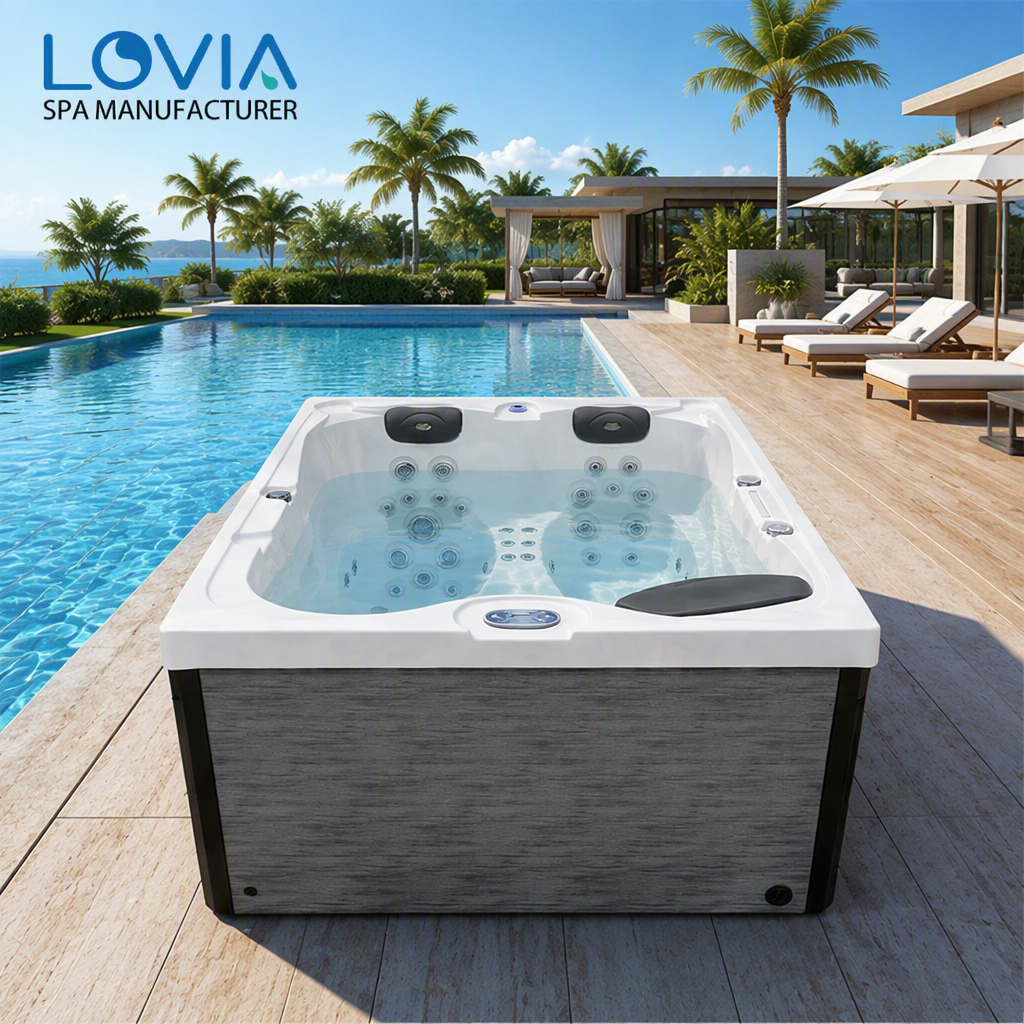
Why Is Pre-Shipment Testing Essential for Outdoor Hot Tubs?
1. Early Detection of Leaks
Outdoor whirlpool spa hot tubs contain an extensive network of plumbing, fittings, valves, and pump connections. Issues such as misaligned O-rings, loose fittings, or improper pipe connections during assembly can lead to leaks once the tub is filled with water or the pumps are activated.
If such issues are only discovered after the product arrives overseas, repairs—which might involve removing side panels, reconnecting plumbing, or replacing components—can result in significant additional costs for labor, logistics, and after-sales support. Consequently, factories should conduct both static (filled with water) and dynamic (operational) tests to ensure there are no visible leaks at critical connection points.
2. Verification of Core Functionality
The fact that a pump starts does not necessarily mean the circulation system is functioning correctly; similarly, a heater receiving power does not guarantee accurate temperature control. Factories must rigorously test components—including pumps, jets, heaters, control panels, and temperature sensors—to ensure the equipment operates as intended under specified conditions.
3. Mitigation of Export Quality Risks
Different markets may have distinct requirements regarding electrical safety, grounding, waterproofing, product labeling, and certification documentation for outdoor hot tubs. Factories must verify the applicable standards based on the specific product model and the intended sales region, ensuring that the final configuration matches the approved design. While pre-shipment testing can identify manufacturing defects, it is not a substitute for formal product certification.
What Specific Tests Should Be Performed on Outdoor Hot Tubs Before Shipment?
Professional manufacturing facilities typically integrate incoming material inspection, in-process inspection, and pre-shipment inspection to establish a comprehensive quality control (QC) process.
| Test Category | Key Inspection Items | Purpose |
| Appearance | Acrylic shell, color, scratches, surface finish | Verify cosmetic quality |
| Structure | Frame, base, cabinet panels, support points | Check structural integrity |
| Leakage | Pipes, pumps, valves, jets, drains | Detect water leaks |
| Pump and Jets | Startup, water flow, noise, vibration | Verify hydraulic performance |
| Heating | Heating response, temperature control | Confirm heating function |
| Electrical Safety | Grounding, insulation, leakage current | Verify electrical safety |
| Control System | Display, buttons, sensors, operating modes | Confirm control functions |
| Accessories | Lighting, air blower, ozone system, Wi-Fi | Verify configured options |
| Packaging | Protective materials, labels, accessories | Reduce shipping damage |
Test parameters should be tailored to the specific product configuration. For instance, models not equipped with Wi-Fi or ozone systems do not require testing for these features; however, it is essential to verify that the actual configuration aligns with the customer's order.
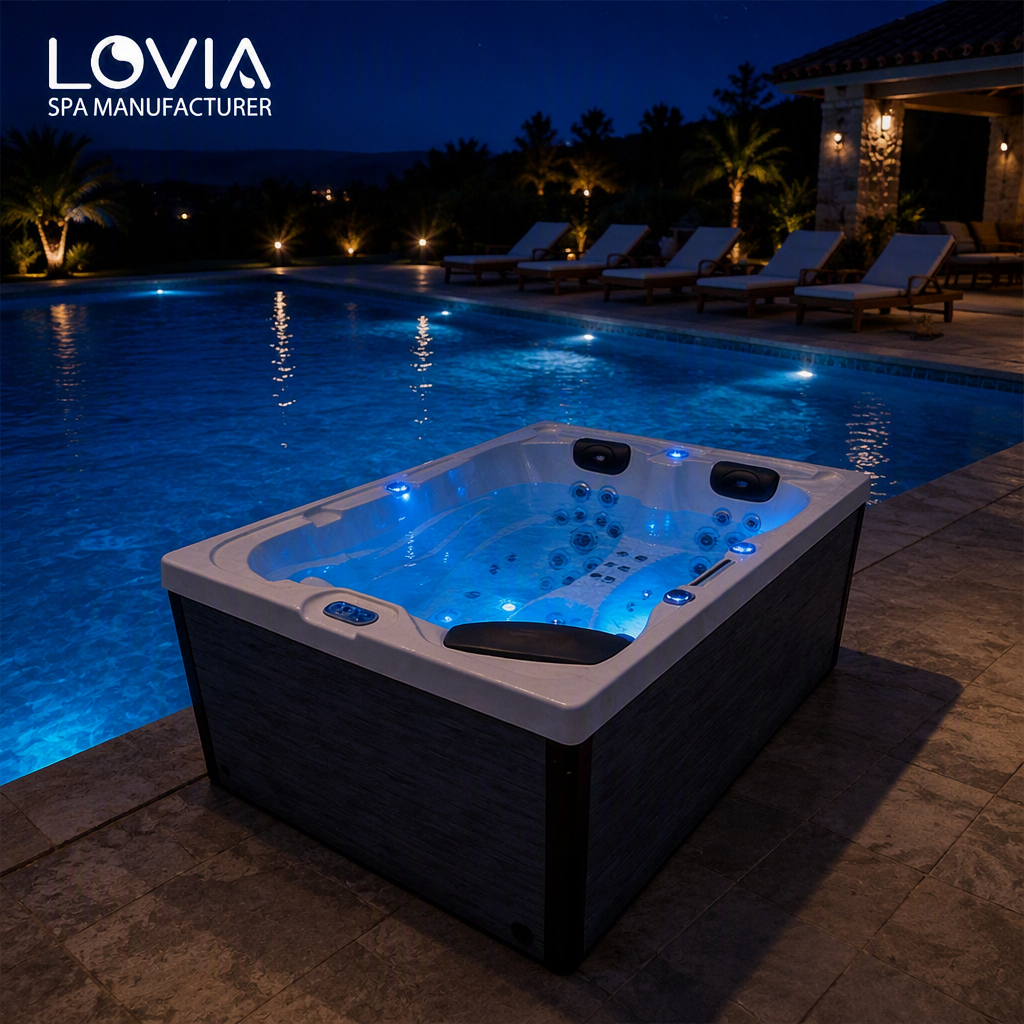
Core Test 1: Visual and Structural Inspection
Before shipment, outdoor whirlpool spa hot tubs must undergo a thorough inspection of the acrylic shell, skirting, base, and equipment compartment. The surface of the shell should be free from cracks, noticeable scratches, air bubbles, abnormal deformation, or significant color variations that could compromise product quality. Additionally, control panels and decorative components must be securely installed.
Structural inspection focuses on the base support, frame connections, equipment anchoring, and access panels. Given the substantial weight of an outdoor whirlpool spa hot tub when filled with water, the load-bearing structure must strictly adhere to design specifications; evaluating the product solely in an empty state is insufficient.
For the acrylic shell, the manufacturer must verify critical dimensions, mounting interfaces, and structural requirements against technical drawings or approved specifications. Since structural designs and allowable tolerances vary by model, the appropriate inspection standards must be applied for each specific unit.
Core Test 2: Water-Filling and Leak Testing
Leak testing is one of the most critical quality checks for outdoor whirlpool spa hot tubs prior to shipment. The unit should be filled with water in accordance with design specifications, followed by a thorough inspection of the shell, plumbing, jet connections, pumps, heaters, filters, valves, and drainage systems.
The testing process generally consists of two phases: a static check—observing the water level and all connection points to identify any seepage—and a dynamic check, which involves operating the pumps and circulation system to inspect the plumbing and fittings under actual working conditions.
Because certain issues may only manifest when pumps are running or plumbing is under pressure, a static check alone is inadequate. The manufacturer’s quality plan should clearly define the required water level, operating conditions, and test duration, with all results documented.
If a leak is detected, the specific source must be identified, followed by an inspection of the fittings, seals, pipe connections, and component installation. After repairs are completed, re-testing is mandatory; simply wiping away leaked water and clearing the unit for use is not permitted.
| Leakage Test | Inspection Focus |
| Static Water Test | Shell, joints, drains and visible connections |
| Pump Operation Test | Leaks under normal circulation conditions |
| Jet Connection Test | No leakage around jet fittings |
| Heater and Filter Connections | Seals and pipe connections |
| Retest After Repair | Confirm the problem has been resolved |
The specific duration for testing should be determined by the factory based on the product's structure and risk profile; there is no single, standardized duration applicable to all outdoor whirlpool spa hot tubs.
Core Test 3: Water Pumps, Circulation Systems, and Jets
Water pumps and jets directly influence the massage experience in an outdoor whirlpool spa hot tub. The factory must verify that the pumps start correctly, the water circulation is stable, and there is no abnormal noise or significant vibration during operation. Additionally, all jets must be checked to ensure they are dispensing water properly.
Common issues include pumps running while no water flows from the jets, low flow rates in certain jets, air trapped in the plumbing, incorrect valve positioning, or obstructions at the suction intake.
If an issue arises, the pump’s priming status, suction pathways, plumbing connections, and valve settings should be inspected—simply observing that the motor is spinning is not sufficient to deem the test successful.
| Pump and Jet Test | Acceptance Criteria |
| Pump Startup | Starts according to the approved design |
| Water Circulation | Stable flow without abnormal interruption |
| Jet Performance | All specified jets operate as intended |
| Noise and Vibration | No abnormal noise or vibration |
| Suction and Return | No visible blockage or abnormal restriction |
| Leakage | No visible leakage during operation |
| Control Response | Operating modes respond correctly |
For outdoor whirlpool spa hot tubs equipped with variable-speed pumps, multi-zone jet systems, or air-bubble (aeration) features, the factory must test each mode individually to ensure that control commands align with the actual operational state.
Core Test 4: Heaters and Temperature Control
Testing the heater involves confirming that the unit starts correctly, temperature sensor readings are accurate, the controller responds to set-temperature adjustments, and all safety/protection features function as designed.
The rate of temperature increase depends on factors such as the tub's volume, heater power, insulation, ambient temperature, and water circulation rate; therefore, a single, uniform heating-time standard cannot be applied to all models.
Factories should record the initial water temperature, ambient temperature, set temperature, and actual heating progress to evaluate whether the heating performance meets product specifications.
To estimate the heat required to raise the water temperature, the following simple formula can be used:
Heat (kJ) = Mass of water (kg) × 4.186 × Temperature rise (°C)
For example, 1,000 L of water has a mass of approximately 1,000 kg. If the water temperature needs to increase by 10°C, it would theoretically require approximately 41,860 kJ of heat. Actual heating time is influenced by heater efficiency and heat loss; therefore, this formula should be used for estimation purposes only and cannot replace full-system testing.
Factories must also verify features such as temperature sensors, low-flow protection, and overheat protection in accordance with the product design. Testing must never be conducted by arbitrarily short-circuiting sensors or bypassing protection circuits.
Core Test 5: Electrical Safety and Control Systems
Since outdoor whirlpool spa hot tubs involve the combination of water, electricity, and metal components, electrical safety must be assessed by qualified personnel using appropriate testing equipment. Specific test items and acceptance criteria should be determined based on the product’s construction, applicable standards, and certification requirements.
For instance, UL 1563 covers safety requirements for electric spa equipment and related components, while IEC 60335-2-60 addresses safety requirements for whirlpool tubs and spa equipment. Factories must identify the standards applicable to their specific products; a simple power-on test is not a substitute for a comprehensive electrical safety inspection.
| Electrical Test | Inspection Focus |
| Wiring Inspection | Correct wiring and terminal connections |
| Grounding Continuity | Protective grounding meets applicable requirements |
| Insulation Test | Meets the approved test specification |
| Leakage Current Test | Complies with applicable safety requirements |
| Protection Devices | Correct operation of safety protections |
| Enclosure Inspection | Electrical covers and compartments are correctly assembled |
| Functional Test | Pumps, heaters, lights and controls work as designed |
Control panel testing should encompass the display screen, buttons, temperature settings, pump speed adjustments, lighting modes, and fault notifications. For products equipped with features such as Wi-Fi, ozone generators, air blowers, or underwater lighting, each component must be tested according to the specific order configuration, and the associated control logic must be verified.
Packaging and Final Pre-Shipment Inspection for Outdoor Hot Tubs
Once a product has passed functional testing, it must undergo a packaging inspection. Impacts, vibrations, or compression during transit can lead to scratches on acrylic surfaces, damage to skirting panels, breakage of control panels, or the loss of accessories.
Factories must ensure that the product has been properly drained, cleaned, and dried; that detachable components are securely fastened; that protective cushioning materials are correctly installed; and that the outer packaging (carton or wooden crate) is suitable for the intended mode of transport.
| Final Inspection Item | Verification |
| Product Model | Matches the purchase order |
| Serial Number | Recorded and traceable |
| Accessories | Complete and correct |
| User Manual | Correct language and model |
| Product Labels | Required ratings and warnings are present |
| Packaging | Adequate protection against shipping damage |
| Shipping Marks | Correct destination and handling information |
| QC Records | Test results and corrective actions are filed |
For export orders, factories must also verify the product model, quantity, serial numbers, accessory lists, instruction manuals, and labels to ensure that the delivered configuration matches the order, even if the product itself is technically compliant.
Common Challenges and Solutions in Pre-Shipment Testing for Outdoor Hot Tubs
Performing only a basic power-on check without conducting a full-system operational test: This approach may fail to detect issues such as leaks in the plumbing, insufficient flow at the jets, or malfunctions in the heating control system. The solution is to establish a standardized testing process that covers static water-filling, dynamic operation, heating performance, and control functions.
Random sampling can replace 100% testing for certain non-critical items. However, for leak testing and core functionality, the factory should determine an appropriate testing coverage rate based on product risk, contractual requirements, and applicable regulations. Performing key functional tests on every unit helps prevent individual assembly defects from reaching the market.
Lack of re-testing after repairs. Whenever a water pump is replaced or piping is repaired, the relevant aspects must be re-verified. The root cause of the failure, the repair actions taken, and the final outcome must be documented. Products that fail re-testing must not be released for shipment.
Product configuration mismatches with orders. OEM/ODM orders may involve variations in jet layouts, pump specifications, control systems, or voltage requirements. Factories should confirm technical specification sheets prior to production and conduct a line-by-line verification during final inspection to ensure the actual product aligns with the order.
How can overseas buyers audit the testing capabilities of an outdoor hot tub factory?
Buyers should not judge quality management solely based on photos of equipment or certification marks displayed by the factory. Instead, they should request that the supplier provide inspection processes and records specific to the models being purchased.
Focus on four key areas: the existence of inspection processes for incoming materials, in-process production, and outgoing shipments; the performance of mandatory leak and functional tests on every unit; the capability to conduct necessary electrical safety testing; and the maintenance of traceable inspection records, including re-testing procedures for repaired units.
For new OEM/ODM partnerships, buyers may consider testing a sample—evaluating the tub material, jet configuration, heating performance, control system, and operational functionality—before committing to bulk procurement. Contracts should also clearly define acceptance criteria, testing standards, requirements for inspection documentation, and arrangements for third-party inspections.
Frequently Asked Questions (FAQ)
1. Is a water-filling test mandatory for outdoor whirlpool spa hot tubs before shipment?
For outdoor whirlpool spa hot tubs equipped with pumps, heaters, and circulation piping, a water-filling and operational test is a vital method for verifying system integrity (sealing) and the functionality of the water circuit. Specific test conditions should be determined based on the product design and quality inspection standards.
2. How long does pre-shipment testing for an outdoor hot tub typically take?
There is no fixed duration that applies to all models. The duration of testing depends on the bathtub’s volume, the rates of filling and draining, specific operational test requirements, and the scope of heating performance verification. Manufacturers should establish a clear testing plan; critical test items must not be omitted simply to meet delivery deadlines.
3. Does the fact that an outdoor hot tub’s pump starts up mean the product is qualified?
No. It is also necessary to verify water circulation, flow from the jets, operational noise levels, the integrity of plumbing seals, and the responsiveness of the control system. Furthermore, the heater and other features must be tested according to the specific product configuration.
4. Can pre-shipment testing of outdoor hot tubs completely eliminate post-sale issues?
Not entirely. While rigorous pre-shipment testing can significantly reduce risks stemming from manufacturing or assembly defects, issues may still arise due to transit damage, improper on-site installation, or inadequate long-term maintenance.
5. Can buyers request test reports from an outdoor hot tub manufacturer?
Yes. It is advisable to request inspection records corresponding to the specific order or product serial number. These should include results from leak tests, functional tests, electrical safety tests (where applicable), as well as documentation regarding the rectification of any identified anomalies and the subsequent re-testing results.