


What Size Generator Do You Need for an Outdoor Whirlpool Hot Tub?
2026-07-29 15:30When purchasing an outdoor whirlpool hot tub, beyond considering dimensions, jet count, insulation, and control systems, there is a crucial yet often overlooked factor: the power supply system and generator capacity. This is particularly relevant for locations off the municipal grid—such as mountain villas, campsites, rural guesthouses, island projects, and temporary event sites—where users frequently ask: "What size generator do I need for my whirlpool hot tub?" "What are the differences between 110V, 220V, and 380V models?" and "Is a higher-wattage generator always better?"
In reality, there is no one-size-fits-all answer, as selecting a generator involves more than just matching the whirlpool hot tub's rated power. Users must also account for starting current, heating systems, the number of pumps, circulation and control systems, and potential future electrical loads. An undersized generator can prevent the equipment from starting, slow down heating, cause frequent circuit breaker trips, or even damage the electronic control system. Conversely, an oversized generator increases procurement costs, fuel consumption, and long-term maintenance expenses.
Therefore, whether dealing with a 110V, 220V, or 380V outdoor spa hot tub, it is essential to understand the equipment's actual operating power and electrical requirements before selecting a generator. This article provides a comprehensive analysis covering power consumption components, voltage system differences, generator capacity calculations, real-world application examples, and energy-saving tips to help users make informed decisions about their power supply solutions.
Why Is Generator Capacity Critical for Outdoor Spa Hot Tubs?
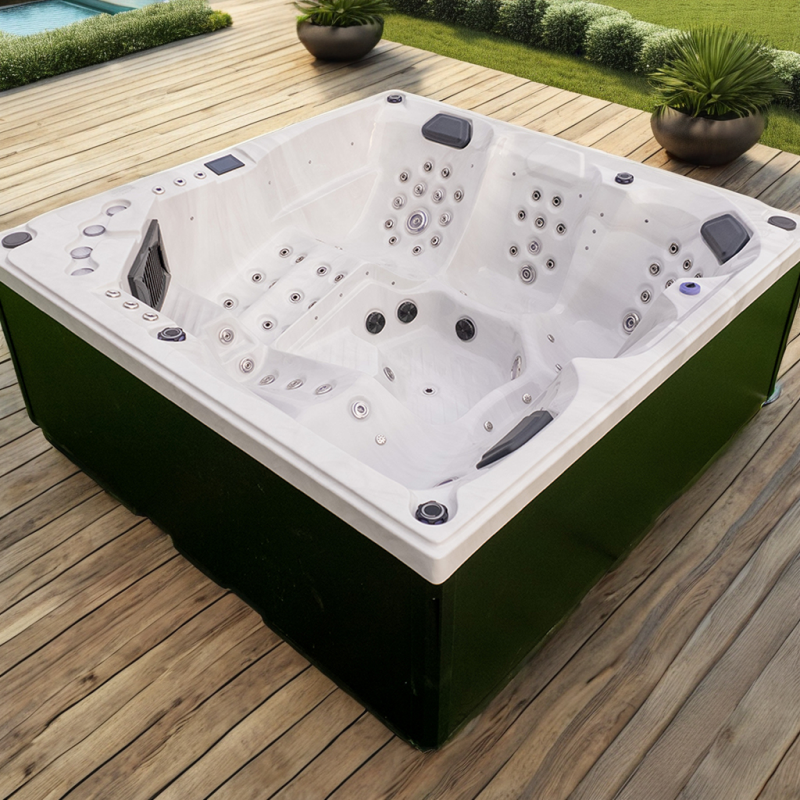
For outdoor spa hot tubs installed in urban residences, most users simply connect to the existing home electrical grid, so generator requirements are rarely a concern. However, as the use cases for outdoor spa hot tubs expand, more units are being installed in locations far from the public grid—such as forest cabins, lakeside guesthouses, campsites, farm estates, and temporary commercial event sites. In these settings, a stable power supply becomes a vital prerequisite for the equipment's proper operation. An outdoor whirlpool hot tub is not merely a single appliance but an integrated system comprising a heating system, hydrotherapy massage system, circulation and filtration system, smart control system, lighting system, and various entertainment features. During operation, different components create varying power demands based on their status; for instance, the heater requires sustained high power, while massage pumps draw a significant surge of current upon startup. Insufficient generator capacity can easily lead to voltage fluctuations, compromising the equipment's stable operation.
Furthermore, users often wish to operate patio lighting, air conditioning, small kitchen appliances, or even audio systems alongside the whirlpool hot tub; these additional loads must also be factored into the generator capacity calculation. Consequently, the proper selection of a generator is crucial not only for the whirlpool hot tub's functionality but also for the stability and safety of the entire outdoor power supply system.
What are the main electrical components of an outdoor spa hot tub?
To determine the required generator wattage, one must first understand the primary power-consuming components of the whirlpool hot tub.
Generally, a modern outdoor spa hot tub consists of the following key parts:
First is the constant-temperature heater. This is the system's largest continuous power consumer, responsible for maintaining the water temperature within a set range. Heater power ratings vary by model; compact units may use a heater of around 2 kW, whereas large, multi-person whirlpool hot tubs might feature heating systems rated at 3 kW, 5 kW, or even higher.
Second are the massage pumps. Powerful water jets rely on high-output pumps. A whirlpool hot tub typically houses one to three massage pumps, with power ratings varying by model. When multiple pumps start simultaneously, the total power draw increases significantly.
Third is the circulation and filtration system. The circulation pump—which runs continuously or on a timer to drive water through filters and sanitization systems—has a relatively low power rating but operates for extended periods.
Additionally, modern whirlpool hot tubs may include auxiliary equipment such as LED lighting, ozone generators, UV sanitizers, Bluetooth audio systems, Wi-Fi control modules, and smart touchscreens. While the individual power consumption of these items is low, their cumulative effect adds to the overall load.
What are the differences between 110V, 220V, and 380V outdoor hot tubs?
Many consumers mistakenly believe that the only difference lies in the plug type; however, there are significant distinctions regarding power supply capacity, application scenarios, and equipment performance among 110V, 220V, and 380V outdoor whirlpool hot tubs.
110V Outdoor Spa Hot Tubs
110V outdoor spa hot tubs are primarily designed for markets that utilize 110V or 120V residential power systems, such as North America and Japan. These products are easy to install—with some models even capable of plugging directly into standard household outlets—making them popular among average households.
However, due to the lower voltage, a 110V system requires a higher operating current to achieve the same power output. For instance, a 3000W heater draws approximately 27A at 110V, whereas it draws only about 13.6A at 220V. This places stricter demands on electrical wiring specifications. Additionally, to prevent excessive current, some products limit heater power, which can result in a relatively slower water heating speed.
Consequently, users planning for long-term, frequent use of large outdoor whirlpool hot tubs often prefer higher-voltage power supply options.
220V Outdoor Spa Hot Tubs
220V outdoor hot tubs are the most common specification in Europe, China, Australia, and many other Asian countries, and they are the most widely used type among residential consumers.
Compared to 110V systems, 220V spa hot tubs can deliver the same power output with lower current, resulting in less heat generation in the wiring and higher power efficiency. Furthermore, most high-capacity, multi-person hot tubs featuring dual pumps utilize a 220V design; this not only enables faster heating but also allows for the simultaneous operation of heating and massage functions.
For the vast majority of residential gardens, vacation rentals, and hotel projects, 220V outdoor spa hot tubs offer an ideal balance of installation convenience and performance, making them the most widely adopted power supply solution.
380V Outdoor Spa Hot Tubs
380V outdoor hot tubs are primarily used in large-scale commercial projects, such as high-end hotels, day spas, hot spring resorts, large wellness centers, and public spa facilities. Thanks to the use of a three-phase power supply, a 380V system can support higher-wattage heaters and the simultaneous operation of multiple water pumps, ensuring a stable power supply even when a large outdoor spa hot tub is operating at full capacity.
For residential users, a 380V setup is generally not required unless the equipment is exceptionally large or the property is already equipped with three-phase power.
What size generator (in watts) is needed to run an outdoor spa hot tub?
Generator capacity should not simply match the whirlpool hot tub's rated power; factors such as startup loads, safety margins, and future expansion needs must be fully considered.
The general calculation method is as follows:
Generator Capacity ≈ Equipment Continuous Operating Power × 1.25 to 1.5
A margin of 25% to 50% is added because water pumps and motors generate a momentary surge current upon startup, causing power consumption to spike well above the rated operating power for a short period. If the generator capacity is too close to the equipment's rated power, issues such as startup difficulties or voltage drops are likely to occur.
For example, a typical 6-person outdoor whirlpool hot tub might include:
•Heater: 3 kW
•Two massage pumps: Approx. 2 kW–3 kW
•Circulation pump: Approx. 0.25 kW
•Control system and lighting: Approx. 0.2 kW
The total continuous operating power ranges from 5.5 kW to 6.5 kW, but instantaneous demand is higher during startup. Therefore, a generator with a rated output of approximately 8 kW to 10 kW is usually recommended to ensure stable operation.
If other appliances—such as lights, refrigerators, or air conditioners—need to run simultaneously, their loads must also be factored into the total capacity calculation.
Don't Rely Solely on the Rated Power of Outdoor Hot Tubs
Many consumers look only at the rated power listed in the product manual when buying a generator, but this approach is incomplete.
First, not all components of an outdoor spa hot tub operate simultaneously at all times. The operating status of the heater, pumps, and circulation system changes depending on the mode, so actual power consumption varies based on usage.
Second, running a generator at full load for extended periods not only increases fuel consumption but can also shorten the generator's lifespan. Industry consensus suggests that maintaining a generator's long-term operating load at approximately 70% to 80% of its rated power optimizes both fuel economy and equipment reliability.
Therefore, when selecting a generator, one should prioritize continuous output capacity rather than focusing solely on peak output specifications.
How can the energy consumption of an outdoor spa hot tub be reduced?
In addition to choosing the right generator, proper usage of the outdoor whirlpool hot tub can also minimize energy consumption.
First, use a high-quality thermal cover. Extensive research shows that heat loss occurs primarily through the water surface; a thermal cover significantly reduces this loss and cuts down on heater run time.
Second, maintain a reasonable water temperature. Many users habitually set the temperature above 40°C, but keeping it between 37°C and 39°C usually provides a comfortable experience while lowering energy usage.
Furthermore, regular cleaning of the filtration system is crucial. When filters become clogged, the circulation pump requires more energy to maintain normal flow; over time, this not only increases electricity consumption but may also shorten the equipment's lifespan.
If powering the tub with a generator, try to consolidate usage times to avoid frequent starting and stopping, thereby improving overall fuel efficiency.
FAQ
What size generator is needed for an outdoor spa hot tub?
The required capacity depends on the equipment's total power, the number of pumps, heater specifications, and any other connected electrical devices. Generally, it is recommended that the generator's rated output power exceed the spa hot tub's continuous operating power by 25% to 50% to accommodate startup current demands and ensure operational stability.
Which is more energy-efficient: a 110V or a 220V outdoor spa hot tub?
At the same power rating, both consume essentially the same amount of electricity. However, 220V systems operate with lower current and typically experience less line loss, resulting in higher power delivery efficiency—making them better suited for high-power units and larger whirlpool hot tubs designed for multiple people.
Does a residential outdoor whirlpool hot tub require a 380V power supply?
Usually, no. The vast majority of residential outdoor whirlpool hot tubs operate effectively on 220V (or 110V/240V in North America). 380V three-phase power is typically reserved for large commercial spas, hotels, or high-capacity spa installations.
Can a generator run an outdoor whirlpool hot tub at full load for extended periods?
Operating at full load for long periods is not recommended. Sustained high loads increase fuel consumption, accelerate equipment wear, and shorten the generator's lifespan. It is advisable to keep the long-term operating load at approximately 70% to 80% of the generator's rated output power.
How can the power consumption of an outdoor whirlpool hot tub be reduced?
Using a high-quality thermal cover, maintaining a reasonable temperature setting, regularly cleaning the filtration system, minimizing how often the cover is opened, keeping the equipment well-maintained, and scheduling heating times efficiently can all help reduce the whirlpool hot tub's overall energy consumption.