


In-Ground Outdoor Swim Spas: Everything You Need to Know
2026-10-15 15:35Compared to traditional freestanding hot tubs, in-ground outdoor swim spas offer superior visual integration and combine swim training, hydrotherapy massage, rehabilitation, and family entertainment into a single system. Consequently, they are increasingly favored by villa owners, resort hotels, and operators of high-end vacation rentals. Whether used for low-impact morning workouts, athletic recovery, or family gatherings and relaxation, in-ground outdoor swim spas deliver exceptional functional and aesthetic value.
However, despite their growing popularity, many consumers have numerous questions before making a purchase. How do they differ from standard outdoor hot tubs? Is installation difficult? Are maintenance costs high? How much space is required? Are they suitable for the average household? A lack of understanding regarding these issues prior to purchase can easily lead to budget overruns, installation complications, or a disappointing user experience.
Data from the North American spa industry indicates that the residential swim spa hot tub market has grown at an average annual rate of 11.2% over the past five years, with the growth rate of in-ground outdoor swim spas outpacing that of traditional portable models by approximately 35%. This trend reflects a shift in consumer priorities toward the seamless integration of equipment with the architectural environment, rather than a focus on single-function utility alone.
This article provides a comprehensive analysis of in-ground outdoor swim spas—covering definitions, operating principles, key advantages, installation requirements, cost structures, maintenance, and purchasing advice—to help you gain a systematic understanding of this premium spa equipment.
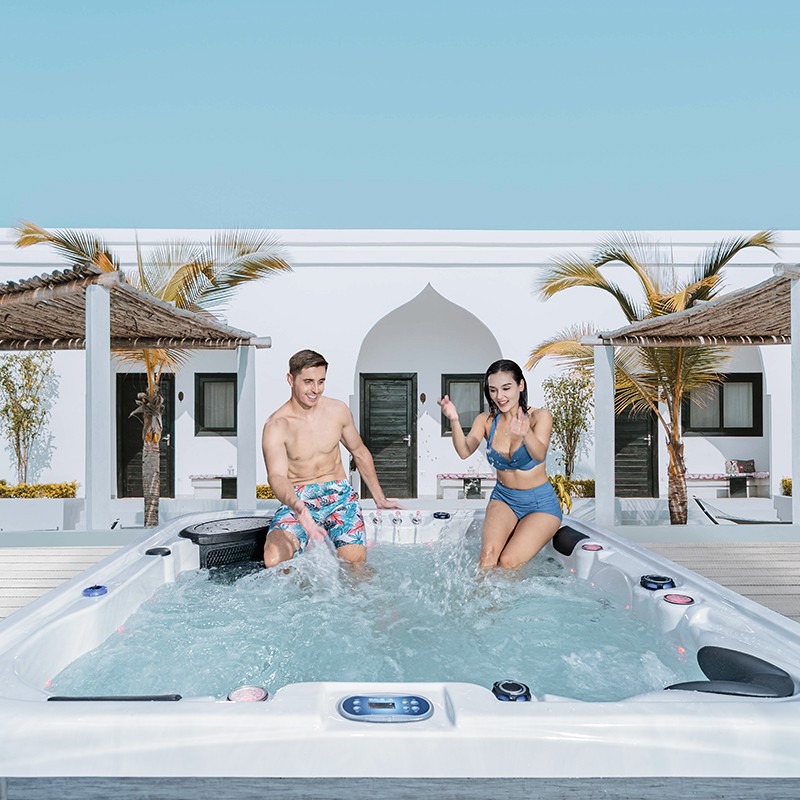
What Is an In-Ground Outdoor Swim Spa?
By definition, an in-ground outdoor swim spa hot tub is a large hydrotherapy unit installed below ground level or within a semi-recessed structure, combining the features of a traditional swimming pool and a hot tub. Unlike standard outdoor hot tubs, these units typically feature a longer vessel, a more powerful water propulsion system, and sophisticated water circulation and temperature control systems. This allows users to engage in stationary swimming, aquatic training, and full-body massage within a compact footprint.
"In-ground" is one of the most important keywords defining this category of products. Standard freestanding outdoor hot tubs are typically placed directly on the ground, whereas built-in outdoor swim spas require a dedicated installation space—such as within a patio, deck, or custom foundation—to position the unit flush or semi-flush with the ground. This approach significantly enhances visual harmony, allowing the unit to blend seamlessly into the architectural design rather than appearing as a bulky, retrofitted addition.
In terms of dimensions, standard outdoor hot tubs usually range from 1.8 to 2.4 meters in length, while built-in outdoor swim spas generally span 4 to 8 meters in length and 2.2 to 2.8 meters in width. Their water capacity is also far greater than that of standard units, typically ranging from 5,000 to 15,000 liters, with large models exceeding 20,000 liters. This difference in scale means they are not merely "larger hot tubs," but rather hybrid systems that bridge the gap between a swimming pool and a spa.
How do built-in outdoor swim spas work?
The core mechanism of a built-in outdoor swim spa involves a high-power propulsion jet system that generates a steady counter-current, allowing the user to swim continuously within a confined space. Simply put, although the swimmer remains stationary, the act of constantly swimming against the current simulates forward movement in a traditional pool.
While a conventional pool requires a length of at least 10 meters for effective training, a built-in outdoor swim spa uses artificial currents to condense the necessary training area to just a few meters. High-end models are typically equipped with two to six propulsion pumps, capable of delivering water flow rates of 5,000 to 25,000 liters per minute. Some professional-grade units offer adjustable flow speeds exceeding 8 kilometers per hour, sufficient to meet the needs of amateur swim training.
In addition to their swimming capabilities, built-in outdoor swim spas are usually equipped with multiple hydrotherapy massage jets. Strategically positioned to target the back, waist, legs, and feet, these jets deliver high-pressure water streams for deep-tissue massage. For athletes and fitness enthusiasts, this design effectively caters to both training and recovery needs. Research indicates that hydro-massage in warm water can improve muscle recovery efficiency by approximately 20% to 35% and significantly reduce delayed onset muscle soreness (DOMS).
The temperature control system is another core component. Most built-in outdoor swim spa hot tubs support temperature adjustments between 26°C and 40°C; lower temperatures are suitable for training, while higher temperatures are ideal for relaxation and hydrotherapy. This flexibility allows the unit to cater to a wider range of use cases.
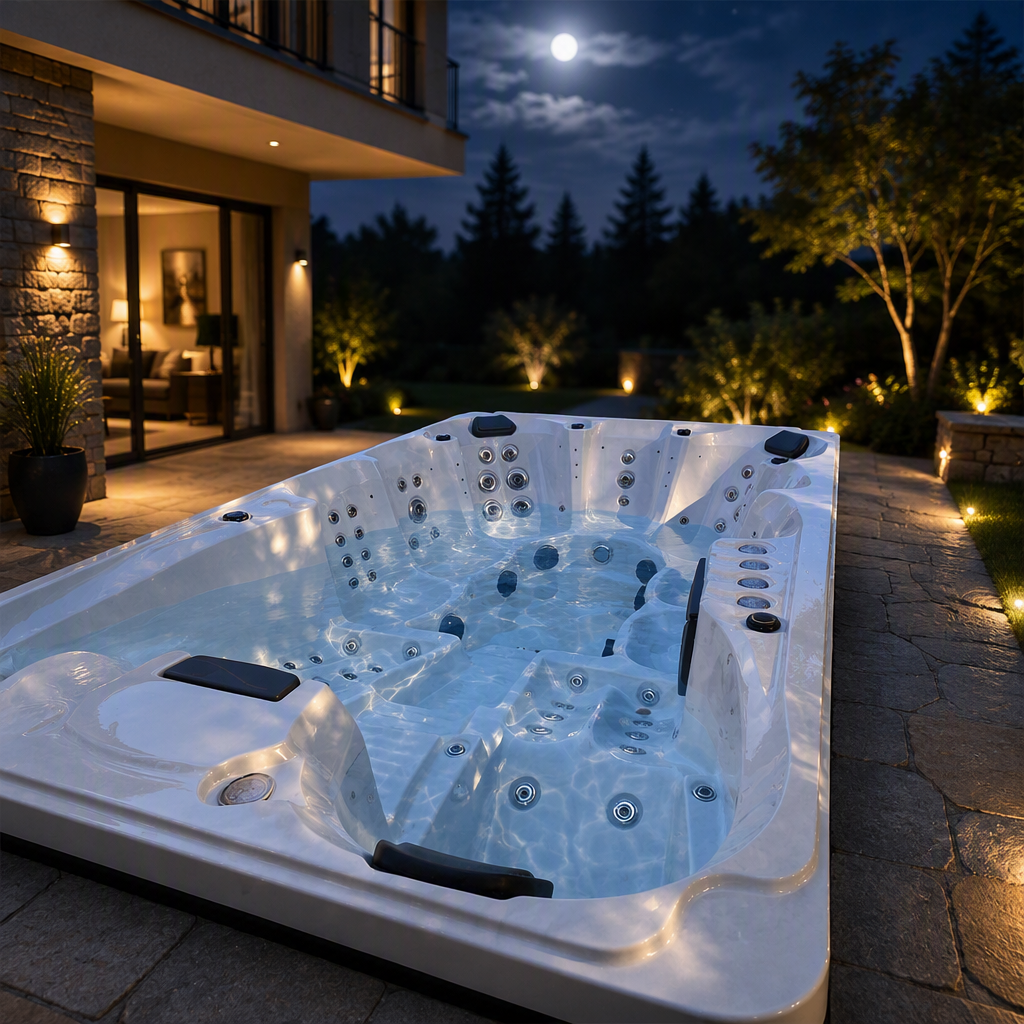
Why are more people choosing built-in outdoor swim spas?
The popularity of built-in outdoor swim spas stems not only from their premium appearance but, more importantly, from their high functional density. As land becomes increasingly expensive—particularly for high-end urban residences—many households find it impossible to accommodate both a swimming pool and a hot tub. Built-in outdoor swim spas offer the perfect solution to this dilemma.
First, they significantly improve space utilization.
A traditional residential pool typically requires 40 to 80 square meters of space, whereas a built-in outdoor swim spa often delivers both training and hydrotherapy capabilities within just 15 to 25 square meters. This means that even a medium-sized backyard can accommodate the complete system.
Second, they offer greater year-round usability.
Standard pools in cold regions are often limited to seasonal use, whereas built-in outdoor swim spa hot tubs feature heating capabilities that allow for operation even in winter. This is particularly important for areas with significant seasonal temperature fluctuations.
Third, maintenance costs are generally lower than those of large swimming pools.
Due to the smaller water volume and higher efficiency in heating and water treatment, long-term operating costs remain relatively manageable. Industry data shows that the annual maintenance cost for a standard residential pool typically ranges from $1,500 to $5,000, while that of a built-in outdoor swim spa hot tub usually falls between $1,000 and $3,000, depending on usage frequency and local energy prices.
Who is the built-in outdoor swim spa for?
While not everyone requires a built-in outdoor swim spa hot tub, it offers exceptional value for specific groups of people.
Fitness enthusiasts are among the most typical users. Aquatic exercise minimizes joint impact while providing high-resistance training. Studies show that energy expenditure during aquatic exercise can reach 1.2 to 1.5 times that of land-based exercise, while joint stress is significantly reduced. Consequently, an in-ground outdoor swim spa offers an ideal training environment for individuals with knee or lower back issues.
Rehabilitation patients constitute another key demographic. Warm water environments are frequently used in physical therapy to restore joint range of motion, alleviate pain, and improve circulation. In-ground outdoor swim spas provide stable temperatures and controllable resistance, making them highly suitable for rehabilitation training.
Additionally, they are an excellent choice for those seeking a high-quality home lifestyle. For homeowners who value their living environment, an in-ground outdoor swim spa serves not only as a functional amenity but also as an integral part of the landscape design.
What are the requirements for installing an in-ground outdoor swim spa?
Installation is a critical factor in the project's success. Installing an in-ground outdoor swim spa is far more complex than installing standard equipment, as it involves civil engineering, electrical work, plumbing, and landscaping.
First is the foundation structure. Since the unit can weigh between 6 and 20 tons when fully loaded, the foundation must be exceptionally solid. A reinforced concrete foundation—typically 15 to 30 centimeters or more in thickness—is usually required. Insufficient load-bearing capacity can lead to subsidence, cracking, or even structural damage.
Second is the drainage design. In-ground outdoor swim spa hot tubs require periodic water changes and cleaning; therefore, a drainage system—including floor drains, discharge outlets, or dedicated drainage lines—must be planned. Many users underestimate this aspect, leading to significant maintenance hassles later on.
Electrical configuration is equally crucial. High-end in-ground outdoor swim spas typically have power ratings between 5kW and 15kW (with some large models requiring even more), necessitating a dedicated power supply line and a ground-fault protection system.
Finally, maintenance access must be considered. While an in-ground design offers excellent visual appeal, completely sealing off maintenance panels can drastically increase future repair costs. Professional installations typically incorporate designated access space for equipment servicing.
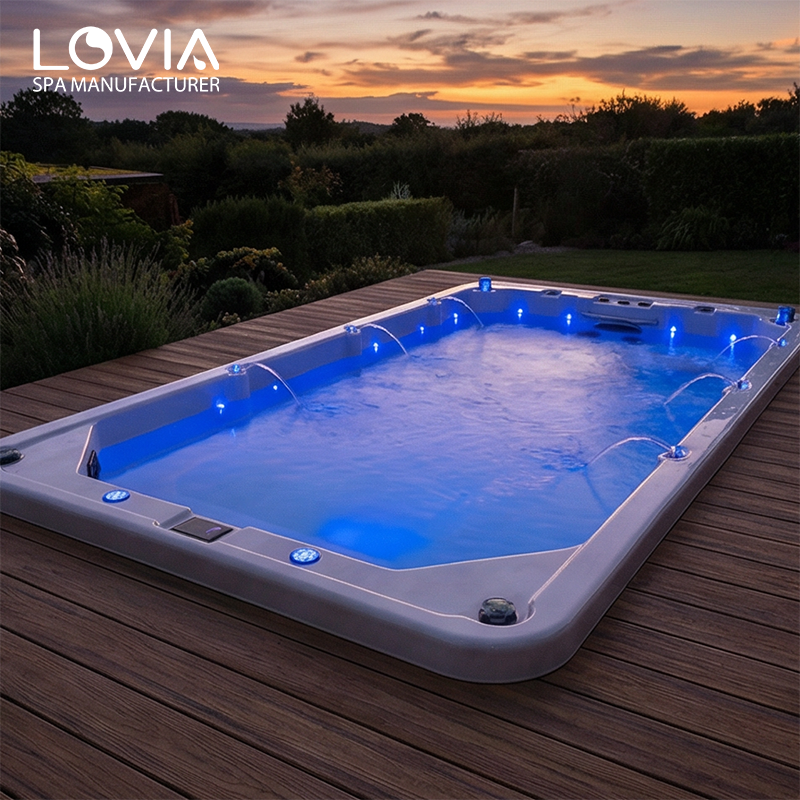
What specifications should be considered when purchasing an in-ground outdoor swim spa?
Many consumers focus solely on price, yet the actual user experience is determined by technical specifications.
First, consider the water flow system. The number of propulsion pumps, water flow stability, and the range of adjustability directly impact the swimming experience. High-end systems deliver smoother water flow without creating significant turbulence.
Next, consider the jet layout. Superior built-in outdoor swim spas feature ergonomically designed massage zones rather than simply maximizing the number of jets. More jets do not necessarily mean a better experience; the key lies in the rational distribution of water pressure.
Thermal insulation performance is also crucial. High-density foam insulation and a high-quality thermal cover can significantly reduce energy consumption. Data shows that premium insulation systems can cut heat loss by 20% to 40%.
The filtration system should not be overlooked either. High-quality filters and ozone sterilization systems can reduce the need for chemical disinfectants and improve water quality.
What is the cost of a built-in outdoor swim spa?
Costs generally consist of three components: equipment, installation, and long-term maintenance.
Equipment prices vary widely. Entry-level built-in outdoor swim spa hot tubs typically range from $15,000 to $30,000; mid-to-high-end models usually cost between $30,000 and $60,000; and luxury brands can exceed $100,000.
Installation costs are also significant. Civil works, hoisting, electrical connections, plumbing, and landscaping restoration typically range from $5,000 to $30,000, with complex projects costing even more.
Long-term maintenance costs include electricity, water treatment chemicals, filter replacements, and routine servicing. Depending on usage frequency, annual maintenance costs usually range from $1,000 to $4,000.
Although the initial investment is high, a built-in outdoor swim spa often offers better value for money than building a separate swimming pool and spa, thanks to its integrated functionality.
How do you maintain a built-in outdoor swim spa?
Maintenance determines the equipment's lifespan. With proper care, a high-quality built-in outdoor swim spa can last between 10 and 20 years.
Routine maintenance primarily involves monitoring water quality, cleaning filters, and inspecting jets. Ideally, the pH level should be maintained between 7.2 and 7.8, and alkalinity should be kept within the 80 to 120 ppm range. It is recommended to clean the filter every 1–2 weeks and replace it every 6–12 months. Regularly checking the condition of the pump and heater is also crucial, as circulation system malfunctions are among the most common issues.
Winter maintenance is equally important. In cold regions, you must activate the anti-freeze mode or keep the circulation system running to prevent pipe damage caused by freezing.
FAQ
What is the difference between an in-ground outdoor swim spa and a swimming pool?
An in-ground outdoor swim spa is more compact and uses a counter-current system to allow for stationary swimming; it also features massage and heating functions, whereas a traditional pool is primarily designed for swimming.
Can an in-ground outdoor swim spa be used year-round?
Generally, yes. Most units are equipped with heating and insulation features, allowing them to be used even in winter.
Is maintaining an in-ground outdoor swim spa hot tub difficult?
It is easier to maintain than a large swimming pool, though it still requires regular filter cleaning, water quality testing, and circulation system maintenance.
What is the lifespan of an in-ground outdoor swim spa hot tub?
With proper maintenance, it typically lasts between 10 and 20 years.
Is a small courtyard suitable for installing an in-ground outdoor swim spa?
Yes, many small courtyards can accommodate one, provided there is an available area of 15–25 square meters and the site meets load-bearing and power supply requirements.