


How to Use Calcium Chloride in Outdoor Hot Tubs?
2026-09-08 15:30Many users of outdoor spa hot tubs focus on chlorine, bromine, pH, and total alkalinity when maintaining water quality, but often overlook a crucial indicator affecting equipment lifespan and water quality stability—calcium hardness. Especially after using soft water, softened tap water, or replenishing with naturally low-hardness water sources, the calcium hardness in outdoor spa hot tubs may be significantly low. In this case, even if the water appears clear and the disinfectant concentration is normal, the water body may still be in an unbalanced chemical state, potentially leading to increased corrosion of metal components, surface erosion, foaming, and water quality fluctuations over long-term operation.
According to current professional water quality management recommendations, calcium hardness targets are not entirely the same for different outdoor spa hot tub brands, shell materials, water temperatures, and water treatment systems. For example, Taylor Technologies provides a reference range of 150–250 ppm for calcium hardness in outdoor hot tubs based on PHTA parameters, while CDC data indicates that 200–400 ppm can be considered a wider equilibrium reference range under many normal conditions; for whirlpool spa hot tub facilities with water temperatures exceeding 32°C, their data also suggests a reference range of 100–200 ppm.
Therefore, the truly professional approach is not to mechanically pursue a fixed number, but rather to first test the current calcium hardness of the outdoor spa hot tub, and then determine the target value by combining the manufacturer's instructions, shell material, heating system, water temperature, and local water source conditions.
The following is a systematic analysis of the two core questions: "How to use calcium chloride in outdoor spa hot tubs?" and "Under what circumstances is calcium chloride needed?"
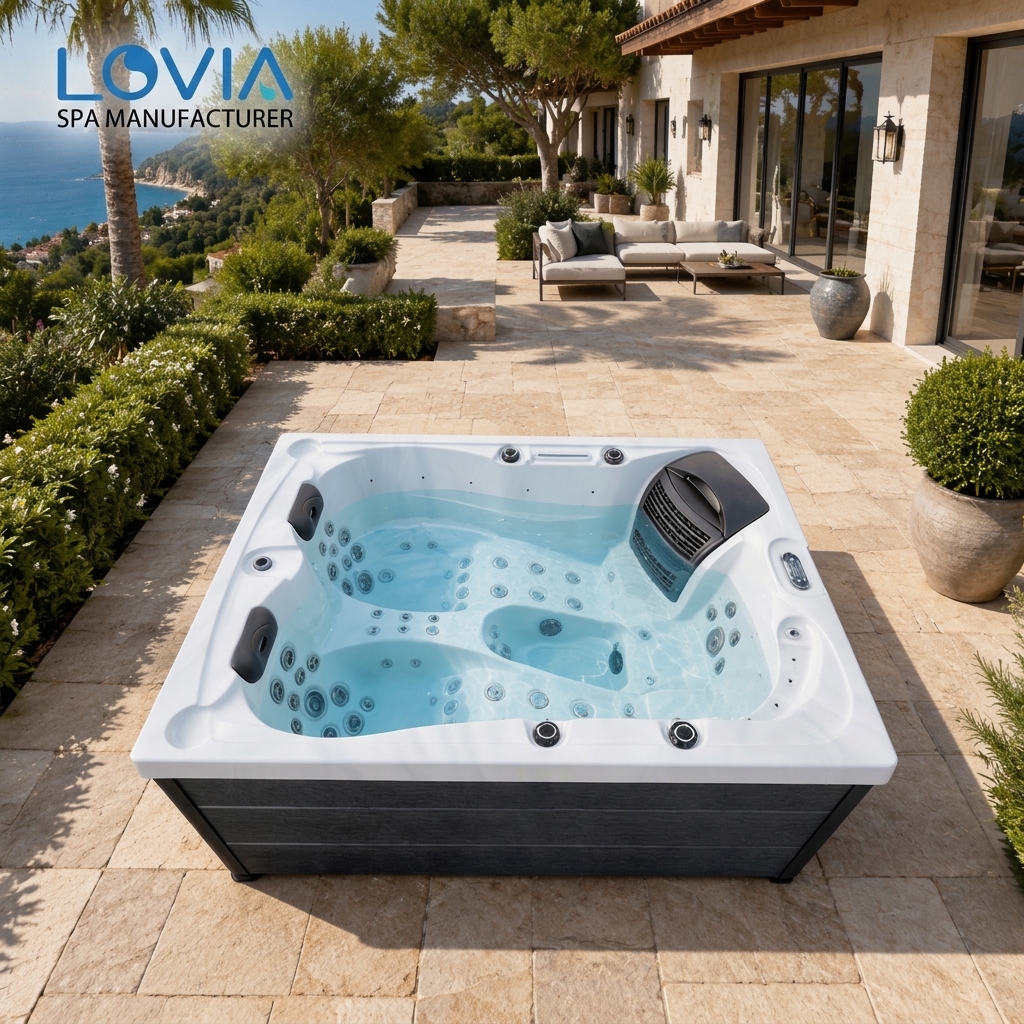
Why should calcium hardness be considered in outdoor hot tubs?
Outdoor whirlpool spa hot tubs are actually closed water treatment systems with relatively limited volume, high temperature, frequent circulation, and significant changes in user load. A typical swimming pool can hold tens of thousands or even hundreds of thousands of liters of water, while a typical household outdoor spa hot tub usually has a capacity of only 800–2,000 liters, although some large outdoor hot tubs or outdoor swimming/spa tubs can reach thousands of liters or even higher. The smaller the water volume, the more pronounced the changes in chemical concentrations per unit dose; therefore, water quality management for outdoor hot tubs is generally more sensitive than for large swimming pools.
Calcium hardness refers to the level of dissolved calcium ions in water, usually expressed in mg/L or ppm and measured as CaCO₃. Simply put, calcium hardness helps determine whether the water is "too soft" or "too hard." If the calcium hardness is too low, the water may exhibit strong corrosiveness; if the calcium hardness is too high, it may increase the risk of scaling and turbidity.
This issue is particularly important for outdoor whirlpool spa hot tubs because the water temperature is typically maintained at around 37–40°C or even higher for extended periods. Higher temperatures accelerate water chemical reactions and affect the calcium carbonate balance. Heaters, nozzles, piping, pumps, and other water-contact components are constantly in contact with the water. If water remains in an unbalanced state for an extended period, problems with equipment and water quality may gradually arise.
CDC data on spa facilities clearly indicates that excessively low calcium hardness, especially when pH and total alkalinity are also low, can create so-called "aggressive water," meaning water with strong corrosive properties, adversely affecting metal components; while excessively high calcium hardness increases the risk of turbidity and scaling.
Therefore, the real issue in maintaining outdoor spa hot tubs is not "whether to add calcium chloride," but rather "whether the current calcium hardness of the water is within an appropriate range."
What exactly is calcium chloride? How does it differ from chlorine disinfectants?
This is a crucial question to clarify before using calcium chloride.
Calcium chloride has the chemical formula CaCl₂. When it enters water, it dissociates to form calcium and chloride ions. Increasing calcium ion concentration is its primary purpose in adjusting the water quality of outdoor spa hot tubs. It is a "calcium hardness enhancer," not a traditional swimming pool or spa disinfectant.
Therefore, calcium chloride cannot replace the following products:
Calcium chloride cannot replace free chlorine; it cannot replace bromine; it cannot replace shock disinfectants; and it cannot directly solve water quality problems caused by bacteria, algae, human sweat, organic pollutants, etc.
CDC recommendations for spa hot tubs and spas emphasize that disinfectants and pH need to be managed independently. For example, their published information recommends maintaining at least 3 ppm of free chlorine in hot tubs while keeping the pH within the range of 7.2–7.8. This is completely different from the role of calcium chloride.
Therefore, when users find that the water quality in their outdoor whirlpool spa hot tubs is "poor," they should first determine the type of problem: if it is a bacterial and organic contamination problem, they need to focus on chlorine or bromine; if it is an unstable pH, they need to adjust the pH and total alkalinity; if it is a limescale problem, they need to control calcium hardness and pH; only if the calcium hardness is too low should they consider using calcium chloride.
When should calcium chloride be used in outdoor spa hot tubs?
The most typical situation is when test results show that the calcium hardness is below the range recommended by the equipment manufacturer.
For example, a 1,500 L outdoor whirlpool spa hot tub with a tested calcium hardness of only 70 ppm, while the recommended target is 150–250 ppm, indicates the water is significantly too soft. In this case, a specialized Calcium Hardness Increaser, which uses calcium chloride as its main active ingredient, can be used to adjust the water.
Another common scenario is using softened water to fill outdoor spa hot tubs.
Some households use water treated by a home water softener to fill their spas to reduce limescale. While this method can reduce the amount of calcium and magnesium minerals entering the tub, excessive softening can also lead to a lower final calcium hardness. Therefore, the statement that "soft water is always better for outdoor hot tubs" is inaccurate. Excessively hard water increases the risk of scale buildup, while excessively soft water may increase the risk of corrosion; what is truly needed is "balanced water."
Furthermore, newly installed outdoor whirlpool spa hot tubs may require calcium hardness testing during the initial filling. Tap water hardness varies greatly between regions. Some areas are soft water zones, where calcium hardness may be naturally low; while others are hard water zones, where calcium hardness may already meet or exceed the target range. In the latter case, not only should calcium chloride not be added, but measures such as dilution and water changes, and appropriate scale inhibition/chelation treatments should be considered.
If the user frequently performs partial water changes, the water should also be retested. This is because each addition of new water changes the overall calcium hardness of the outdoor spa hot tub. Assuming the tub initially contains 1,500 L of water with a calcium hardness of 200 ppm, but each time 500 L is drained and replaced with new water with a calcium hardness of only 50 ppm, the final mixed calcium hardness will significantly decrease. If multiple partial water changes are performed consecutively, the calcium hardness may gradually deviate from its original equilibrium value.
What is the appropriate calcium hardness for an outdoor hot tub?
There is no absolute number that applies to all outdoor spa hot tubs.
Currently, different manufacturers and industry sources provide varying ranges. Taylor Technologies lists a calcium hardness reference range for spas as 150–250 ppm, with a maximum of 800 ppm; FROG provides a reference range of 150–400 ppm; and CDC data suggests 200–400 ppm as a general reference range for spa and hot tub water quality balance, while also indicating that a range of 100–200 ppm can be considered when the water temperature exceeds 32°C.
This is why outdoor spa hot tub users cannot simply copy the "best values" from a single online article.
For example, some high-end acrylic outdoor spa hot tub manufacturers may recommend 75–150 ppm; others may recommend 150–250 ppm; and the operating standards of public spa facilities may differ. Hot Spring's current spa water quality recommendations specify a calcium hardness range of 75–150 ppm for standard equipment and 25–75 ppm for saline systems.
Therefore, the first priority should always be to consult the outdoor hot tub manufacturer's user manual. If the product manual explicitly specifies a certain calcium hardness range, maintenance should prioritize following the product's design parameters rather than mechanically applying parameters from other brands.
From a practical maintenance perspective for outdoor spa hot tubs, unless otherwise specified by the manufacturer, 150–250 ppm can be considered a common target range for management. Adjustments should be made based on specific water temperature, equipment materials, and water treatment systems, rather than pursuing extreme precision.
What are the correct steps for adding calcium chloride to an outdoor hot tub?
After determining that calcium chloride needs to be added, it is recommended to first turn off the outdoor spa hot tub's heating function and turn on the circulation pump to ensure sufficient water flow. Then, weigh the calcium chloride or calcium hardness enhancer according to the product label instructions.
For granular or flake products, it is generally not recommended to pour a large amount of dry powder directly into one spot in the outdoor whirlpool spa hot tub. Some manufacturers recommend pre-dissolving it in a clean container with a certain amount of warm water before slowly adding it to the circulating water. Some product instructions explicitly recommend pre-dissolving it in approximately 5 L of warm water, then slowly adding it while the circulation pump is running, and retesting after at least 4 hours of circulation.
It is important to emphasize the following: Do not interpret "pre-dissolving" as requiring all products to be handled using the same method. Different calcium chloride products have different particle sizes, purities, and usage instructions; therefore, refer to the product label. If the label explicitly instructs direct addition to outdoor spa hot tub water, follow the label; if pre-dissolving is required, then pre-dissolve.
After adding, do not take a bath immediately.
Allow the circulation system to run fully to ensure the calcium chloride is evenly dispersed, and wait for the water quality to stabilize before testing again. For outdoor whirlpool spa hot tubs requiring a significant increase in calcium hardness, it is recommended to add in stages. For example, adjust a portion initially, circulate fully, retest, and then decide whether to make a second adjustment.
This is primarily to prevent over-addition.
What problems will excessively low calcium hardness cause in outdoor hot tubs?
The first problem is increased water corrosivity.
Under certain chemical conditions, low-calcium water may seek soluble minerals from equipment and other materials, increasing the risk of corrosion to metal components.
The second problem is decreased long-term operational stability of the equipment.
The heater, pump, metal fittings, and nozzle assembly in an outdoor spa hot tub all come into contact with water. Prolonged exposure to an unbalanced water environment can increase the risk of material aging and corrosion.
The third type of problem is foaming.
Low calcium hardness isn't the only cause of foaming, but some spa information indicates that soft water can be accompanied by increased foaming, difficulty in managing pH and total alkalinity, and changes in the feel of the water. Therefore, if an outdoor spa hot tub consistently produces foam, the calcium hardness should be checked, but personal care product residue, detergent residue, organic matter, and filtration issues must also be investigated.
The fourth type of problem is decreased water quality stability.
Calcium hardness, total alkalinity, and pH are interconnected; excessively low calcium hardness can make maintaining overall water balance more difficult.
What should you do if the calcium hardness in your outdoor hot tub is too high?
First, do not try to "offset" calcium chloride by adding other chemicals.
Once the calcium hardness is significantly high, the most direct method is usually to partially drain the water and add fresh, low-hardness water to reduce the overall calcium concentration. Some water treatment solutions can use specialized scale inhibitors or chelating agents to reduce the impact of mineral deposits, but these products do not truly "eliminate" calcium ions from the water.
For example, assuming an outdoor spa hot tub has a capacity of 1,500 L and a calcium hardness of 500 ppm, while the local replenishment water has only 50 ppm, then proper water changes can significantly reduce the combined calcium hardness.
This also illustrates that the water source must be tested before using calcium chloride. If the local tap water is already hard water, then there is no need to add calcium chloride in the first place.
Why is water chemistry management important for LOVIA® outdoor hot tubs?
For outdoor hot tub manufacturers, water quality management is not just a consumer-level issue; it is also related to the overall structural design, circulation system, filtration system, heating system, and material selection.
In the design and manufacturing process of our LOVIA® outdoor hot tubs, we need to comprehensively consider the water pump circulation, filtration, nozzles, heating, acrylic tub body, and the matching relationships between different water treatment systems. For users, correctly understanding the relationship between calcium hardness, pH, total alkalinity, and disinfectants can reduce water quality fluctuations caused by incorrect chemical additions and also help extend the lifespan of related components in outdoor whirlpool spa hot tubs.
This is equally important for OEM and ODM outdoor hot tub projects. Water hardness varies across different countries and regions; therefore, the water quality maintenance instructions for export-grade outdoor whirlpool spa hot tubs should not simply state "add calcium chloride," but should further specify testing methods, target ranges, product dosage, and water change and filtration requirements. This ensures that end-users truly understand "why to add it, when to add it, how much to add, and when not to add it."
Six Common Mistakes When Using Calcium Chloride in Outdoor Hot Tubs
The first mistake is treating calcium chloride as a disinfectant. Calcium chloride does not replace free chlorine or bromine, and adding it should not reduce the normal disinfection process.
The second mistake is adding it without testing. If the calcium hardness in the outdoor hot bath has already reached or exceeded the target value, adding more calcium chloride will only increase the risk of scaling and turbidity.
The third mistake is estimating the dosage based on the size of the bathtub without checking the product label. Different calcium chloride products may have different purity and dosage rules, so even for the same "increase by 10 ppm," the required product weight may vary.
The fourth mistake is adding a large amount of product at once. The correct approach is to calculate the difference based on the dosage and add it in stages, testing again after sufficient circulation.
The fifth mistake is ignoring pH. Calcium hardness and pH both affect the risk of scaling and corrosion; controlling only one indicator cannot solve the water chemical balance problem.
The sixth mistake is assuming that all outdoor hot baths should use the same calcium hardness standard. Recommended ranges may differ between manufacturers, water treatment systems, and temperature conditions; therefore, the user manual for the specific equipment should be consulted first.

FAQ: Common Questions about Calcium Chloride in Outdoor Hot Tubs
FAQ 1: Can calcium chloride replace chlorine in outdoor hot baths?
No. Calcium chloride is primarily used to increase calcium hardness, not as a chlorine-based disinfectant. Outdoor hot baths still require the use of free chlorine, bromine, or other approved disinfection systems as per equipment requirements, and pH and disinfectant concentrations must be monitored independently.
FAQ 2: At what calcium hardness level should calcium chloride be added to an outdoor hot bath?
There is no uniform minimum value applicable to all products. Some SPA water quality data uses 150–250 ppm as a common reference range, while other manufacturers may require 75–150 ppm or 150–400 ppm. Therefore, you should first check the outdoor hot tub manufacturer's instructions. If the measured value is lower than the product requirement, then use calcium chloride or a calcium hardness enhancer based on the difference.
FAQ 3: Can calcium chloride be poured directly into an outdoor hot bath?
Whether pre-dissolving is required depends on the specific product label. Some products recommend pre-dissolving in a clean container before slowly adding them while the circulation pump is running; after adding, thorough circulation and retesting are necessary. Just because one chlorination product can be added directly does not mean all products are suitable for the same method.
FAQ 4: My outdoor hot tub water is very soft, is it necessary to add calcium chloride?
Not necessarily, but testing is recommended. Low calcium hardness can indeed lead to more corrosive water under certain pH and total alkalinity conditions, so adjustments are worthwhile; however, the specific target values should still be determined according to the outdoor whirlpool spa hot tub manufacturer's requirements, rather than simply assuming "the harder the better."
FAQ 5: How often should I test the calcium hardness of my outdoor spa hot tub?
Calcium hardness usually does not need to be tested daily like pH and free chlorine. Home users can test it periodically based on the water source, water change frequency, and equipment requirements, such as monthly; retesting should be done immediately after the first filling, large water change, use of softened water, or if abnormal water quality is detected. pH and disinfectants require more frequent monitoring; the specific frequency should be followed according to the equipment manual and local regulations.