


How can you stop plumbing leaks in an outdoor spa hot tub?
2026-06-24 15:30For many households, an outdoor jacuzzi hot tub is not only a feature that enhances quality of life but also a key element of their outdoor leisure space. However, plumbing leaks are a frequent issue that plagues many users during long-term operation. When noticing a continuous drop in water levels, users often initially attribute it to normal evaporation; it is only when the frequency of refilling increases and operating costs rise that they realize the problem may stem from the circulation plumbing system hidden within the spa tub.
In reality, the likelihood of encountering a leak over the lifespan of an outdoor spa hot tub is far higher than most users anticipate. Repair statistics from the spa industry indicate that over one-third of all repair cases are related to leaks, with the majority occurring in the plumbing system, around jet connections, and at connection points within the equipment compartment. Because modern outdoor hot tubs typically utilize foam insulation, much of the plumbing is concealed within this insulating layer; consequently, users often struggle to pinpoint the exact location of a leak, allowing the problem to worsen over time.
For any outdoor spa hot tub, a leak represents more than just a waste of water. Persistent leakage can reduce heating efficiency, increase electricity consumption, and compromise insulation performance; in severe cases, it can even damage the water pump, electrical systems, and the base structure. Therefore, understanding the causes, identification methods, and repair strategies for hot tub plumbing leaks is crucial for minimizing maintenance costs and extending the equipment's lifespan.
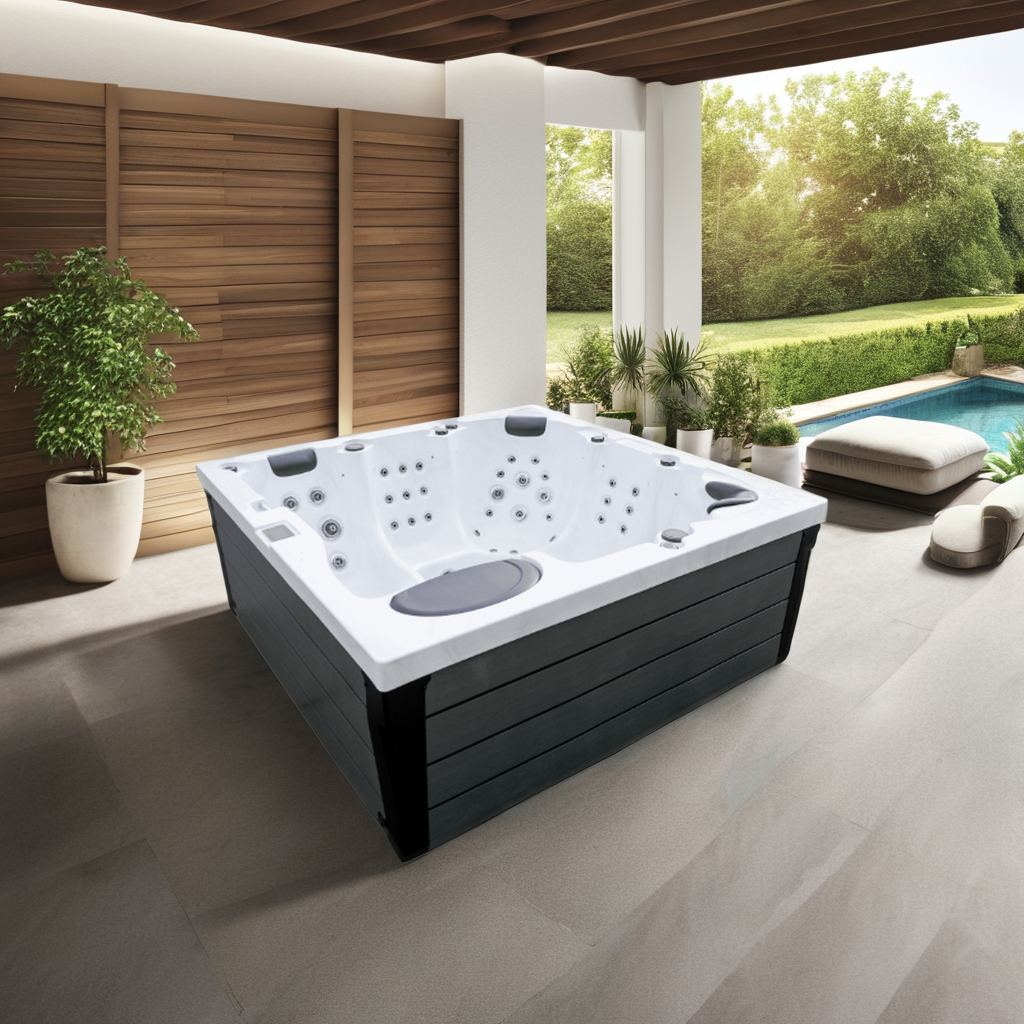
Why are outdoor jacuzzi hot tubs prone to plumbing leaks?
When purchasing an outdoor spa hot tub, many consumers focus on the number of jets, massage features, and aesthetic design, often overlooking the complex internal plumbing structure. In fact, a standard outdoor hot tub contains tens of meters of circulation piping and a multitude of connection points.
These systems encompass circulation pipes, massage jet lines, air-mixing lines, heater connections, filtration system piping, and drainage systems. Consider a mid-to-high-end hot tub with an 1,800-liter capacity and over 40 massage jets: it typically contains more than 100 internal connection points. The deterioration of any single connection point can become a potential source of a leak. Outdoor jacuzzi hot tubs are constantly exposed to the elements, enduring challenges such as UV radiation, diurnal temperature fluctuations, freezing winter temperatures, and the stress of continuous high-temperature operation. Compared to indoor spa equipment, outdoor spa hot tubs operate in harsher environments, which significantly accelerates the aging of their plumbing systems.
1. Thermal expansion and contraction caused by temperature fluctuations
Temperature fluctuations are a primary cause of plumbing damage in outdoor spa hot tubs.
Hot tubs typically operate at temperatures between 37°C and 40°C, whereas the external ambient temperature in winter can drop below 0°C—or even to -20°C in some cold regions. Such drastic temperature differences subject PVC pipes and fittings to repeated cycles of expansion and contraction.
Studies indicate that the likelihood of micro-cracks forming at connection points in PVC materials increases year by year under prolonged thermal cycling. Once the equipment has been in use for five to eight years, the plumbing joints often enter a phase where failure becomes increasingly likely.
2. Structural damage caused by freezing
For spa hot tub owners in North America, Europe, and northern China, freezing damage is a major cause of severe leaks.
If the plumbing is not thoroughly drained when the unit is shut down for the winter, any residual water expands by approximately 9% upon freezing. This expansion pressure is sufficient to crack PVC pipes, deform valves, and cause joints to separate.
Industry surveys show that in cold regions, over 40% of major plumbing rupture cases in outdoor spa hot tubs are linked to winter freezing damage.
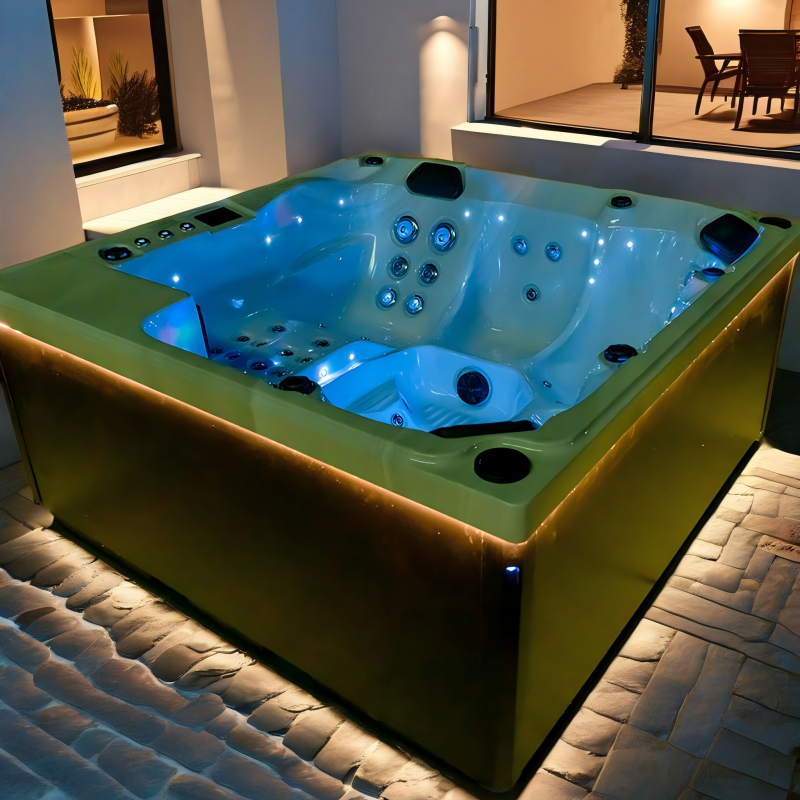
How can you determine if your outdoor hot tub is actually leaking?
Before attempting repairs, it is essential to confirm that the issue is indeed a leak rather than normal evaporation.
Many users mistakenly assume that any drop in water level indicates a malfunction; however, outdoor spa hot tubs naturally experience continuous evaporation. Evaporation rates increase significantly under conditions of high heat, low humidity, and strong winds.
For an outdoor spa hot tub maintained at approximately 38°C, a daily water loss of 5 to 15 liters due to evaporation is considered normal. If the spa tub is not covered with an insulating lid, this figure can exceed 20 liters.
Therefore, when diagnosing a potential leak, one must first rule out evaporation as the cause.
The Bucket Test: The Simplest and Most Effective Diagnostic Method
The bucket test is a fundamental diagnostic method widely used in the global spa repair industry.
The procedure is straightforward: place a water-filled plastic bucket inside the outdoor jacuzzi hot tub so that the water levels inside and outside the bucket are equal. Then, turn off the automatic water refill system and wait 24 to 48 hours.
If the water level in the jacuzzi hot tub drops significantly faster than the level in the bucket, it is highly likely that there is a leak.
This method effectively distinguishes between water loss due to evaporation and actual leakage, making it highly practical for homeowners.
Common Locations for Outdoor Hot Tub Plumbing Leaks
Once a leak in the outdoor jacuzzi hot tub is confirmed, the next step is to locate the source. Industry repair data indicates that most leaks occur in a few typical areas.
1. Jets and Jet Connection Areas
Jets are among the most numerous components in an outdoor spa hot tub and are also the most prone to leaking.
Because jets are constantly subjected to water pressure and vibration, their rear connectors, gaskets, and adhesive joints gradually age. As sealing performance deteriorates, water slowly seeps out from behind the jet and eventually accumulates in the bottom insulation layer.
Jet-related issues account for approximately 20% to 30% of all leak cases.
2. Pump and Heater Connection Points
The equipment compartment is another high-risk area.
Circulation pumps, massage pumps, and heaters are connected to the plumbing system via various flanges and flexible couplings. Over time, the rubber seals at these connection points harden, eventually leading to leaks.
Many users notice that the floor of the equipment compartment remains constantly damp; this is often caused by leaks in these specific areas.
3. Cracks in PVC Main Piping
For outdoor jacuzzi hot tubs that have been in use for more than eight years, the likelihood of cracks in the main piping increases significantly.
PVC material is particularly susceptible to developing hairline cracks after exposure to freezing temperatures or prolonged operation at very high temperatures. Initially, these cracks may only cause minor seepage, but they gradually widen over time, eventually resulting in a significant leak.
How to Effectively Stop Outdoor Hot Tub Plumbing Leaks?
Once the leak source is located, the actual repair work begins. Different types of leaks require different repair strategies.
1. Replacing aging seals
For leaks occurring at points such as jets, pumps, and heater connections, replacing the seal is usually the most cost-effective and efficient solution.
The rubber O-rings used in most outdoor spa hot tubs have a lifespan of approximately 3 to 5 years. Beyond this period, their elasticity and sealing performance deteriorate significantly, even if there is no visible damage.
Therefore, for older units, replacing seals preventively is often more cost-effective than waiting for a failure to occur.
2. Using specialized PVC repair techniques
For PVC piping with hairline cracks, specialized repair adhesives and epoxy resins can be used.
The repair process involves draining the leaking area, ensuring the surface is completely dry, sanding and degreasing the area, and finally applying the repair material evenly.
This method generally yields excellent results for cracks narrower than 1 millimeter.
3. Replacing damaged pipe sections
When pipe cracks are large or structural damage has occurred, the most reliable solution is to replace the entire damaged section.
Although this involves a more complex repair process, it is the solution most recommended by professionals for ensuring long-term stability.
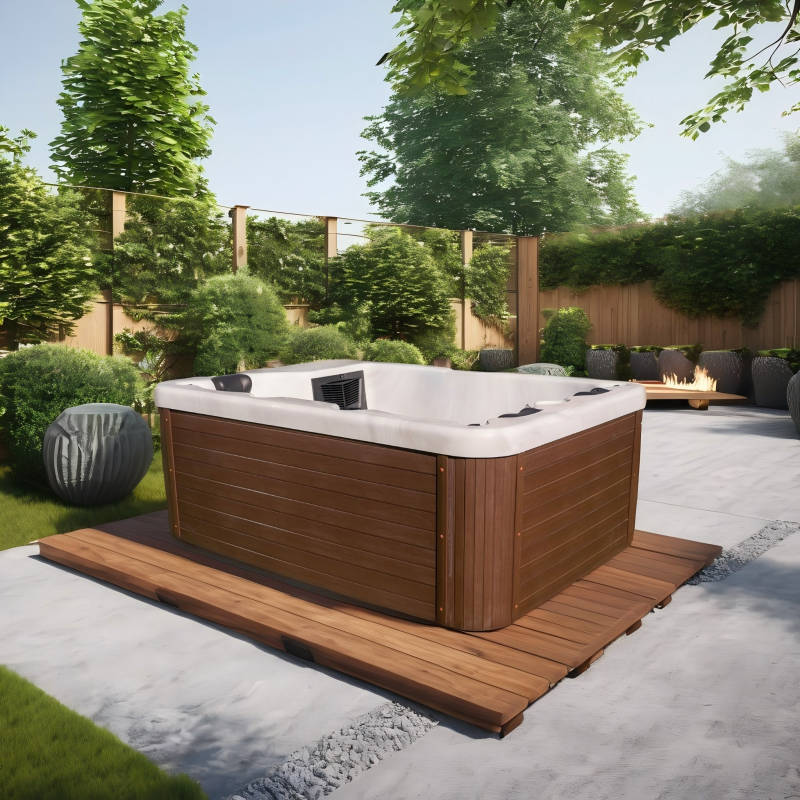
How can future leaks in outdoor spa hot tubs be prevented?
For outdoor spa hot tubs, prevention is always more valuable than repair.
Establishing a routine inspection schedule, monitoring water level fluctuations, maintaining proper water chemistry, and implementing winterization measures can significantly reduce the risk of future leaks. In cold regions, in particular, winter draining and freeze protection are critical factors determining the lifespan of the entire plumbing system.
Data from many high-end outdoor spa hot tub manufacturers indicate that units maintained according to standard guidelines can achieve a plumbing system lifespan of over 10 years, whereas units lacking maintenance often require major repairs within just 5 to 7 years.
FAQ
What amount of daily water loss due to evaporation is considered normal for an outdoor jacuzzi hot tub?
Generally, a daily evaporation loss of 5 to 15 liters is considered normal. If the loss significantly exceeds this amount, you should check for potential leaks.
Can an outdoor spa hot tub still be used if it has a leak?
Minor leaks can usually be tolerated for a short time, but if the leakage worsens, it may damage the water pump and electrical system; therefore, prompt repair is recommended.
Can leak repair sealants completely fix pipe leaks?
They may be effective for tiny cracks, but professional repair is still required for issues such as pipe fractures, damaged fittings, or degraded seals.
How can I prevent outdoor spa hot tub pipes from freezing and cracking in winter?
You should thoroughly drain the water from the pipes, activate the freeze-protection mode, and use a high-quality insulated cover to minimize the risk of freezing.
After how many years of use do outdoor jacuzzi hot tubs typically start developing leaks?
Most outdoor jacuzzi hot tubs begin to experience plumbing degradation after 5 to 8 years of use, significantly increasing the risk of leaks; regular inspection and maintenance are therefore recommended.