


Do chlorine tablets increase calcium hardness in outdoor hot tubs?
2026-09-03 15:30For outdoor whirlpool spa hot tub owners, the question "Why is my calcium hardness rising?" is often overlooked, yet it directly impacts equipment longevity and water stability. Many households routinely add chlorine tablets, granules, or shock treatments based on experience, assuming that as long as free chlorine levels remain within a reasonable range, water quality issues will be minimal. However, after weeks or months of use, some owners notice the water turning cloudy, white scale forming near jets and heaters, filters clogging frequently, and visible mineral deposits appearing on the water surface and tub walls. Testing at this stage often reveals calcium hardness levels significantly higher than the initial readings.
The issue lies in the common perception of "chlorine" as a single, uniform chemical substance. In reality, chlorine sanitizers used in outdoor whirlpool spa hot tubs come in various chemical forms, including sodium dichloroisocyanurate (Dichlor), trichloroisocyanuric acid (Trichlor), calcium hypochlorite, and sodium hypochlorite. While all provide effective chlorine, their impacts on calcium hardness, pH, cyanuric acid, and total dissolved solids (TDS) differ.
Therefore, the question "Do chlorine tablets increase calcium hardness in outdoor whirlpool spa hot tubs?" cannot be answered with a simple "yes" or "no." The accurate answer depends on the specific composition of the "chlorine tablets" being used. If calcium-based sanitizers (such as calcium hypochlorite) are used, long-term use can indeed raise calcium hardness; conversely, products based on Dichlor or Trichlor do not introduce large amounts of calcium ions into the water in the same way.
Furthermore, changes in calcium hardness in outdoor hot tubs depend not only on the sanitizer but also on the source of the refill water, concentration due to evaporation, water replacement cycles, pH levels, and total alkalinity.
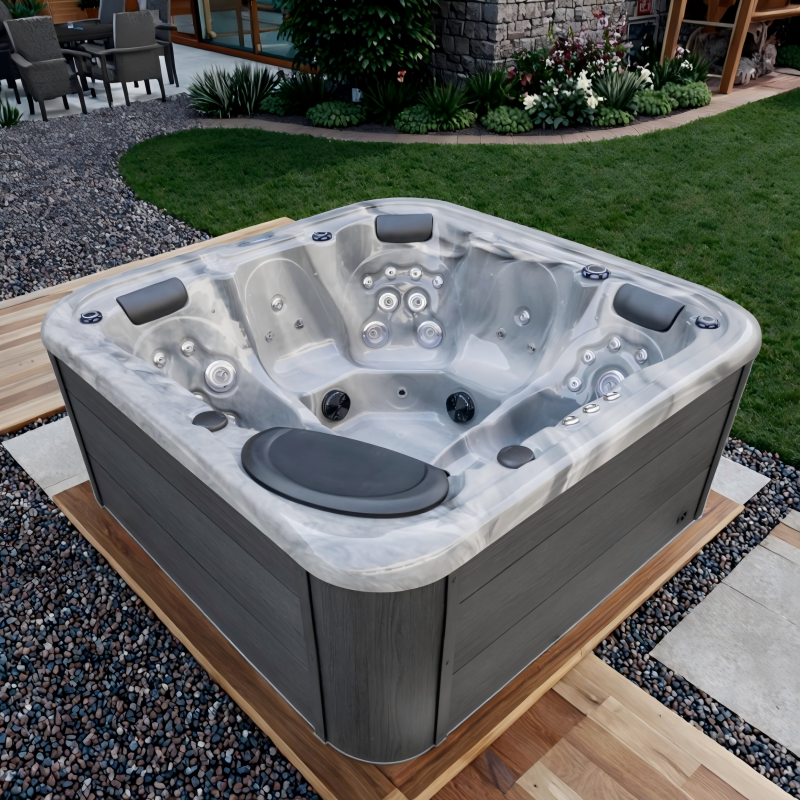
Why are outdoor hot tubs increasingly prone to "high calcium hardness" issues?
Water quality management for outdoor whirlpool spa hot tubs differs significantly from that of standard bathtubs. While a standard household bathtub is drained after a single use, an outdoor hot tub may remain in use for weeks or even months; consequently, factors such as water replenishment, chemical dosing, evaporation, and the introduction of bodily contaminants all impact the water's chemical balance.
One of the most frequently overlooked factors is that "water evaporates, but calcium does not."
Consider an outdoor whirlpool hot tub with a capacity of 1,500 L and an initial calcium hardness of 200 ppm (as CaCO₃). If 300 L of water is lost to evaporation and subsequently replaced with 300 L of fresh water, the total volume returns to 1,500 L, yet the calcium ions originally present remain in the tub. If the make-up water itself has high hardness, the calcium hardness level may gradually rise.
This is a primary reason why many outdoor whirlpool spa hot tubs experience a phenomenon where "hardness increases as more water is added."
Furthermore, the long-term use of calcium hypochlorite-based sanitizers continuously introduces additional calcium into the water. In other words, rising calcium hardness can be driven by a combination of three factors: hard make-up water, concentration due to evaporation, and the use of calcium-containing sanitizers.
As calcium hardness climbs—especially when pH and total alkalinity remain consistently high—calcium carbonate is more likely to precipitate. This manifests as white scale on the tub walls, mineral deposits near the jets, scale buildup on heater surfaces, and increasingly cloudy water. CDC guidelines on spas note that excessive hardness increases the risk of scaling; maintaining a balance between hardness and other water chemistry parameters is particularly critical in the high-temperature environment of a spa.
Thus, while the user may only notice "scale," the underlying issue could be that the whirlpool spa hot tub's entire water chemistry system has fallen out of balance.
First, clarify this: "Chlorine tablets" are not a single, uniform type of chemical
Before discussing whether chlorine tablets increase calcium hardness, it is essential to correct a common misconception: not all chlorine tablets contain calcium.
The "chlorine tablets," "chlorine granules," and "chlorine sanitizers" available on the market may contain vastly different active ingredients. Common chlorine-based systems for outdoor hot tubs include Dichlor, Trichlor, and calcium hypochlorite. "Dichlor," or Sodium Dichloroisocyanurate, is commonly used for treating spa and hot tub water because it dissolves quickly and is relatively easy to use for daily free chlorine adjustment.
"Trichlor," or Trichloroisocyanuric Acid, is also a chlorine-based disinfectant, but its chemical properties differ from those of Dichlor. Trichlor typically has a higher percentage of available chlorine; it introduces cyanuric acid (CYA) into the water and is distinctly acidic. For some outdoor whirlpool spa hot tubs, long-term use of Trichlor products can lead to management issues such as cyanuric acid accumulation and a drop in pH; therefore, one cannot assume it is identical to Dichlor simply because it is "also chlorine."
The third type is Calcium Hypochlorite (often referred to as "Cal-Hypo"). This is the key to the question discussed in this article: "Does chlorine increase calcium hardness?" Calcium Hypochlorite is a calcium-containing chlorine disinfectant; its chemical composition means that using it introduces calcium into the water.
Therefore, if your outdoor whirlpool spa hot tub uses Dichlor or Trichlor, you cannot simply say that "adding chlorine tablets increases calcium hardness." However, if you use Calcium Hypochlorite, you must account for the calcium load it introduces when managing water quality.
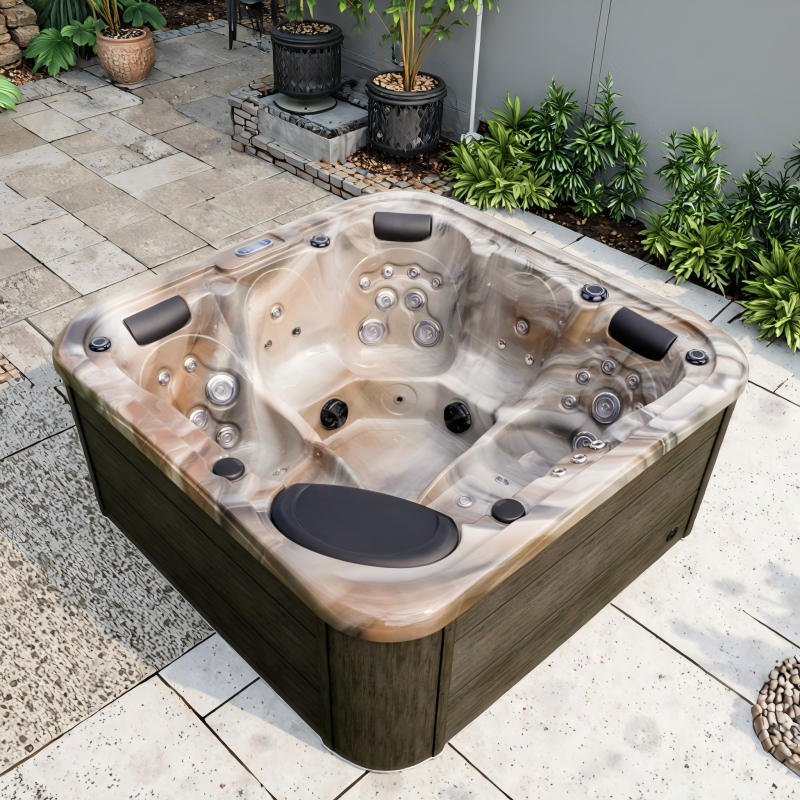
Why does Calcium Hypochlorite increase calcium hardness in outdoor hot tubs?
Chemically speaking, the formula for Calcium Hypochlorite is Ca(OCl)₂. When it dissolves in water, it provides disinfecting available chlorine while simultaneously releasing calcium into the water.
Simply put:
"Calcium Hypochlorite → Provides available chlorine + Increases calcium ions"
This explains the significant difference in water quality management between Calcium Hypochlorite and Dichlor or Trichlor.
Data from the CDC helps illustrate this point. The CDC lists the available chlorine content of Calcium Hypochlorite at approximately 65% to 70% and notes that it raises pH levels. In contrast, Dichlor has a relatively neutral effect on pH, whereas Trichlor tends to lower it.
We can perform a simplified calculation to look at the magnitude of the effect.
Assume the use of Calcium Hypochlorite with 65% available chlorine to raise the free chlorine level in an outdoor whirlpool spa hot tub by approximately 10 ppm. Theoretically, a dosage of approximately 15.4 ppm of the product is required. Based on the chemical composition of calcium hypochlorite, a significant portion of its mass contributes to the calcium load. A rough estimate suggests that a single treatment could increase elemental calcium levels by about 7–8 ppm, corresponding to an increase in calcium hardness of approximately 18–20 ppm (as CaCO₃).
This figure serves only to illustrate the chemical scale; the actual increase depends on factors such as product purity, available chlorine content, dosing method, water volume, and testing methodology, and thus cannot be used directly as a specific dosage rate.
However, it highlights a crucial point: if calcium hypochlorite is used repeatedly over the long term in an outdoor whirlpool spa hot tub (with a capacity of around 1,500 L), calcium hardness levels will not remain static.
While an increase of 10–20 ppm from a single treatment may seem minor, repeated use over dozens of cycles—combined with the initial water hardness and the concentration effect caused by evaporation—can gradually lead to significantly high hardness levels.
Do Dichlor tablets increase calcium hardness in outdoor whirlpool hot tubs?
Generally, they do not directly increase calcium hardness in the same way calcium hypochlorite does.
This is because the primary metal cation in sodium dichloroisocyanurate (Dichlor) is sodium, not calcium. Therefore, if you use standard Dichlor products, the chemical itself does not significantly raise the water's calcium hardness.
However, a key detail must be emphasized: the fact that "Dichlor does not directly increase calcium hardness" does not mean that calcium hardness will never rise after long-term use of Dichlor.
If the source water used to fill or top up the whirlpool hot tub is hard water, fresh calcium and magnesium are introduced with every refill. As water evaporates and is replenished, these minerals become increasingly concentrated. Consequently, measured calcium hardness levels may still rise.
In other words, the sanitizer is merely one variable affecting calcium hardness, not the only one.
Hot tub owners are advised to test calcium hardness regularly and to consider calcium hardness, pH, and total alkalinity as essential components of water chemistry balance. Some maintenance guidelines suggest a target calcium hardness range of approximately 175–275 ppm. Master Spas’ residential spa water quality guidelines recommend a calcium hardness range of 180–250 ppm, while also advising that free chlorine be maintained at 2–4 ppm, pH at 7.2–7.6, and total alkalinity at 80–150 ppm. Since different outdoor whirlpool spa hot tub brands and water treatment systems may utilize different target ranges, actual maintenance should prioritize the manufacturer's instructions.
Do Trichlor tablets increase calcium hardness in outdoor whirlpool hot tubs?
In terms of direct calcium addition, Trichlor does not raise calcium hardness the way calcium hypochlorite does.
However, Trichlor presents another significant issue: cyanuric acid (CYA).
Both Trichlor and Dichlor are part of chlorine-stabilized systems; long-term use can lead to a gradual accumulation of cyanuric acid. The appendix to the CDC’s 2024 Model Aquatic Health Code (MAHC) explicitly classifies Trichlor and Dichlor as products that trigger management requirements related to chlorine stabilizers, recommending CYA monitoring for water treated with these products.
Therefore, if an outdoor whirlpool hot tub user switches from calcium hypochlorite to Trichlor to avoid rising calcium hardness—and subsequently uses it in large quantities over the long term—it may not necessarily be an ideal solution.
The reason is simple: you might solve one problem only to create another.
Water treatment for outdoor whirlpool spa hot tubs is not a matter of "the lower a specific parameter, the better"; rather, it requires balancing disinfection efficacy, pH, total alkalinity, calcium hardness, CYA, TDS, and water temperature.
This is especially true for high-temperature water, where chemical reactions occur more rapidly, often leading to more pronounced changes in water quality compared to standard cold-water pools.
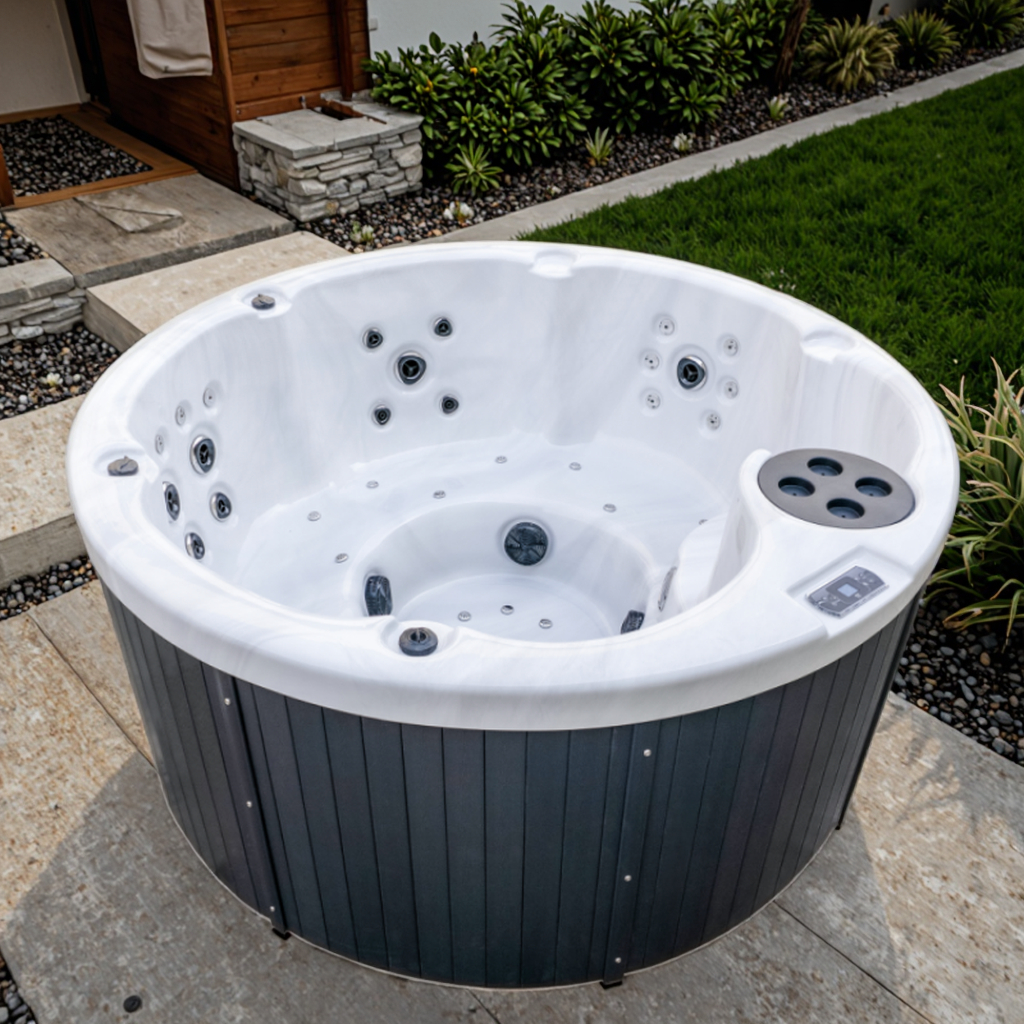
Why is high calcium hardness detrimental to outdoor whirlpool spa hot tubs?
Many users believe that "harder water contains more minerals and is therefore healthier," but this logic does not apply to outdoor whirlpool spa hot tub equipment.
While excessively low calcium hardness can indeed make the water corrosive—increasing the risk of damage to certain equipment materials over time—excessively high calcium hardness causes serious problems as well.
The most common issue is scale formation.
When calcium hardness is high in an outdoor whirlpool hot tub—and pH and total alkalinity levels are also elevated—the calcium in the water is more likely to react with carbonate ions to form calcium carbonate deposits (scale). These deposits gradually accumulate on the surfaces of jets, heaters, plumbing lines, and the whirlpool hot tub shell.
High calcium hardness can lead to scaling and shorten filter run times; Jacuzzi also notes that high calcium levels can cause cloudy water and scale formation.
For outdoor whirlpool spa hot tubs, the heater is a component that requires particular attention.
If a thick layer of mineral deposits forms on the heater surface, it can impair the efficiency of heat transfer from the heating element to the water. Meanwhile, deposits within jets and plumbing lines can increase flow resistance. When high alkalinity drives a continuous rise in pH, scale accumulates in pipes and fittings, potentially placing an increased burden on the circulation system.
Therefore, high calcium hardness implies more than just "unsightly water"; it can gradually translate into equipment maintenance costs.
What is the appropriate calcium hardness level for an outdoor hot tub?
There is no single figure that applies to every outdoor whirlpool spa hot tub.
This is because target ranges may vary depending on the brand, shell material, water treatment system, and operating water temperature.
Based on publicly available industry data, the common reference range for residential spas is roughly 150–275 ppm (as CaCO₃). Some Jacuzzi documentation specifies a range of 175–275 ppm, while other materials cite 150–250 ppm; Master Spas recommends a range of 180–250 ppm for residential spas.
CDC guidelines for spas indicate a reference range of 200–400 ppm for traditional spa water balance; however, for spas operating at temperatures above 90°F (approx. 32°C), the recommended range narrows to 100–200 ppm. This demonstrates that temperature and overall water chemistry influence optimal hardness management.
Therefore, if your outdoor whirlpool spa hot tub manual specifies a calcium hardness of 150–250 ppm, do not adjust the level to 400 ppm simply because you saw that figure online. The manufacturer's specifications for your specific equipment should take precedence.
Why does calcium hardness continue to rise even after adding fresh water to the hot tub?
This involves a significant phenomenon known as the "concentration effect." Suppose an outdoor whirlpool hot tub has an initial capacity of 1,500 L and a calcium hardness of 200 ppm. After some time, 300 L of water evaporates; most of the calcium from that 300 L remains in the tub, concentrated within the remaining 1,200 L. If 300 L of high-hardness tap water is then added to restore the volume to 1,500 L, the system contains the original calcium (now concentrated) plus the calcium introduced by the new water.
If the source water used for refilling has a calcium hardness of 300–400 ppm, every refill further increases the overall mineral load.
This is why simply "topping up frequently" does not necessarily solve water quality issues for hot tubs in hard-water areas.
A more sensible approach is to test the source water first.
If the source water has high calcium hardness, consider water softening or spa-appropriate pre-treatment methods based on the specific situation.
What should be done if the calcium hardness in the whirlpool spa hot tub is already too high?
If testing reveals that the calcium hardness significantly exceeds the manufacturer's recommended range, the most important step is to stop blindly adding calcium-containing products.
The first step is to verify the calcium hardness of the source water. If the source water itself is hard, treating the existing water in the tub will not solve the problem caused by future refills.
The second step is to check the pH and total alkalinity. If calcium hardness is high and pH and total alkalinity are also elevated, prioritize restoring overall water chemistry balance rather than simply adding large amounts of other chemicals.
The third step is to evaluate whether the water needs to be changed. Jacuzzi recommends draining and refilling standard hot tubs every 3–4 months, though the specific interval should be adjusted based on usage frequency and water quality; if maintaining balance becomes difficult, changing the water early may be more practical than continuously adding chemicals.
The fourth step is to address source water hardness when refilling. If the new water has high calcium hardness, the problem may quickly recur even after a water change.
The fifth step is to re-evaluate the type of sanitizer used. If the manufacturer permits various chlorine systems and long-term use of calcium hypochlorite is causing a cumulative calcium load, consult a water treatment professional or the manufacturer about switching to a different system, such as dichlor. You cannot simply alter your entire disinfection regimen just because "dichlor doesn't raise calcium levels," as different products vary significantly in terms of CYA content, pH, and application methods.
FAQ: Chlorine Tablets and Calcium Hardness in Outdoor Hot Tubs
FAQ 1: Do chlorine tablets always increase calcium hardness in outdoor whirlpool spa hot tubs?
Not necessarily. It depends on the active ingredient in the tablet. Calcium hypochlorite introduces calcium into the water, so long-term use may increase calcium hardness; however, Dichlor and Trichlor do not directly increase calcium hardness in the same way. Different chlorine products also have varying effects on parameters such as pH and CYA.
FAQ 2: Does calcium hypochlorite always cause a significant rise in calcium hardness?
A single standard dose usually does not cause a drastic change, but repeated long-term use creates a cumulative effect. The actual impact depends on the available chlorine content, dosage, water volume, and initial calcium hardness levels.
FAQ 3: Can using fewer chlorine tablets solve the problem of excessively high calcium hardness?
It cannot directly resolve existing high calcium hardness. Reducing the use of calcium-based sanitizers can lower future calcium input, but the calcium already present in the water will not disappear. In cases of severely high hardness, solutions typically require a combination of source water treatment, water replacement, and re-balancing water chemistry.
FAQ 4: What is the ideal calcium hardness level for an outdoor whirlpool spa hot tub?
Recommendations vary by manufacturer. Common reference ranges for residential spas are around 150–275 ppm; Master Spas recommends 180–250 ppm, while various Jacuzzi sources cite ranges such as 150–250 ppm or 175–275 ppm. In practice, you should prioritize the specific instructions provided by your whirlpool spa hot tub manufacturer.
FAQ 5: What are the signs of excessively high calcium hardness in an outdoor whirlpool hot tub?
Common symptoms include cloudy water, white scale deposits on the tub walls and near the jets, frequent filter clogging, mineral buildup on heater surfaces, and restricted water flow in the circulation system. The risk of scaling is particularly high when high hardness coincides with high pH and high alkalinity levels.