


Can Swim Spa Tubs Be Placed on Pavement?
2026-05-16 15:35When planning the installation location of a swim spa tub, many people prioritize the yard, aesthetics, and existing ground conditions. One very common question is: Can a swim spa tub be placed directly on pavement?
Pavement is very common in residential yards; it looks sturdy, flat, and has good drainage, so many people intuitively assume it "should be able to bear weight." However, whether a swim spa tub is suitable for pavement cannot be judged solely by appearance; it must be analyzed from the perspectives of structural stress, foundation stability, and long-term operation.
This article will systematically answer the question "Can a swim spa tub be placed on pavement?" from a professional perspective, helping you establish clear and rational judgment criteria.
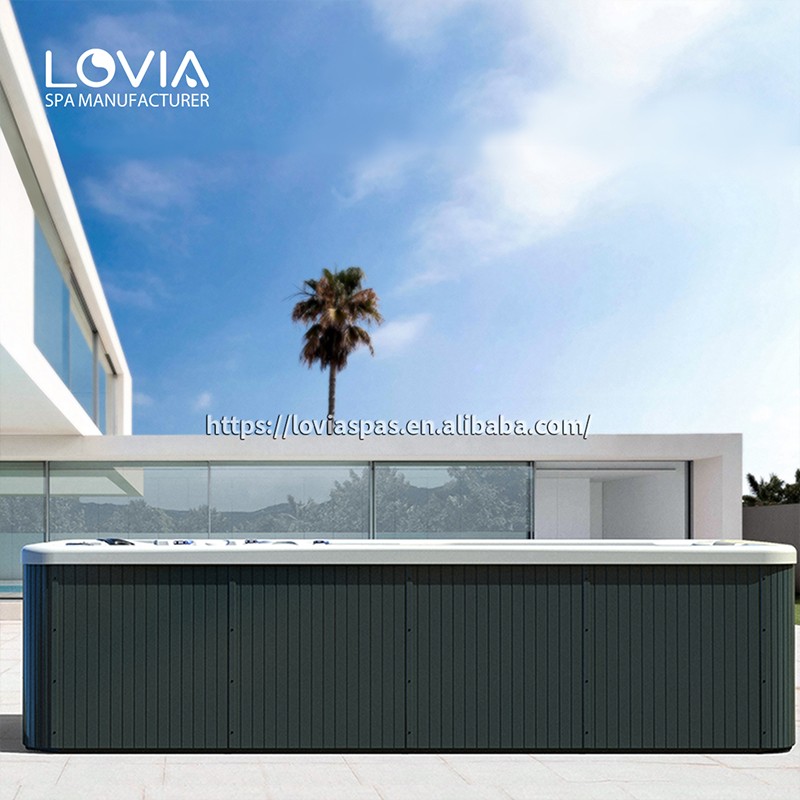
What are the basic requirements for the foundation of a swim spa tub?
To determine whether pavement is suitable, you must first understand the basic requirements for the foundation of a swim spa tub.
A fully loaded swim spa tub in normal use typically exhibits the following characteristics:
• Extremely high total weight (equipment body + water weight + operating load)
• Relatively fixed stress-bearing area
• Maintains high static load over a long period
• Requires extremely high levelness
Therefore, from a structural engineering perspective, swim spa tubs require a foundation that provides continuous, stable, and uniform load-bearing capacity, rather than simply a surface that appears solid.
Are the structural characteristics of paving stones suitable for supporting swim spa tubs?
Paving stones typically have the following structural characteristics:
• Constructed from individual stone blocks
• Supported by a layer of sand or a subbase
• Gaps exist between the blocks
• Relatively weak overall continuity
These characteristics determine that:
Paving stones are better suited to bearing "distributed, movable, and dynamic" loads, rather than long-term, concentrated, and unchanging extremely high static loads.
Swim spa tubs fall precisely into the latter category.
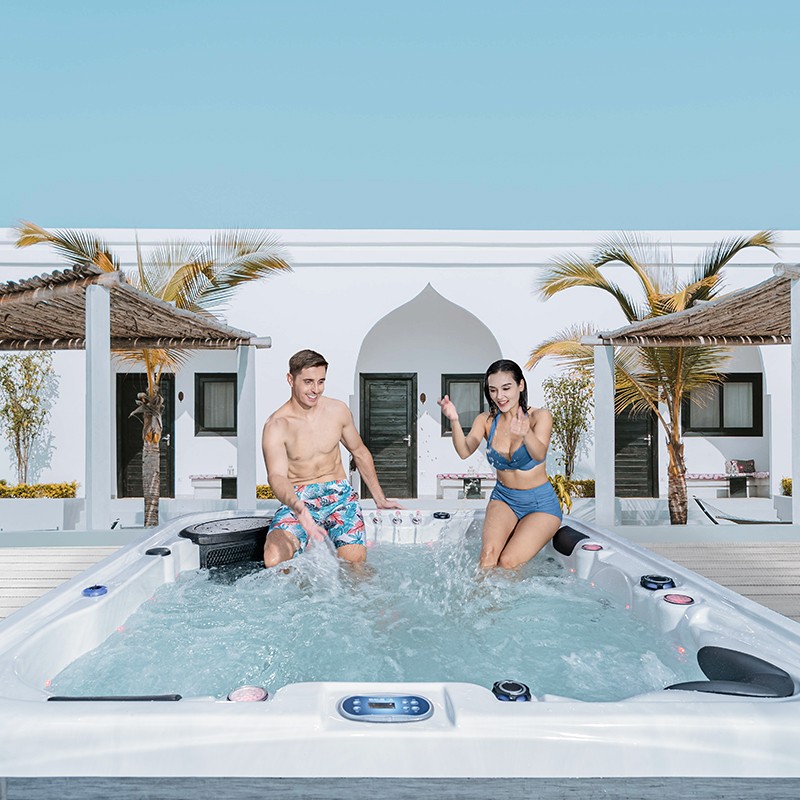
What impact does the weight of the swim spa tub have on the paving stones?
After the swim spa tub is installed and filled with water, its weight continuously acts on the ground. This weight has several significant characteristics:
• It remains stationary for an extended period
• It acts concentrated over a limited area
• It requires extremely high ground compaction
If the swim spa tub is placed directly on the paving stone, the following structural problems may occur (analyzed from a fundamental perspective):
• The underlying subgrade is gradually compacted
• Uneven settlement occurs in individual paving stones
• Excessive localized stress
• Changes in overall levelness
These changes do not occur instantaneously, but rather are a slow but continuous structural process.
Why are there still risks associated with paving stones that "appear very solid"?
The paving stone itself is indeed hard, but the problem lies not in the stone itself, but in: The paving stone system is not a monolithic, cast-in-place load-bearing structure.
In contrast, swim spa tubs are better suited for placement on:
• Continuous, monolithic structures
• Seamless load-bearing surfaces
• Foundations with predictable load-bearing capacity
The "interlocking structure" of paving stones means that their stability under long-term high loads depends on the underlying foundation, not the strength of the stone itself.
How important is the foundation beneath the paving stones for swim spa tubs?
Very important, even decisive.
The foundation beneath paving stones typically includes:
• A soil layer
• A sand cushion layer
• A simple compacted structure
These structures are designed more for walking, furniture placement, or light landscaping than for long-term support of heavy equipment like swim spa tubs.
If the underlying foundation is not sufficiently compacted, even if the paving stone surface appears smooth temporarily, it may slowly sink or shift under the long-term pressure of the swim spa tub.
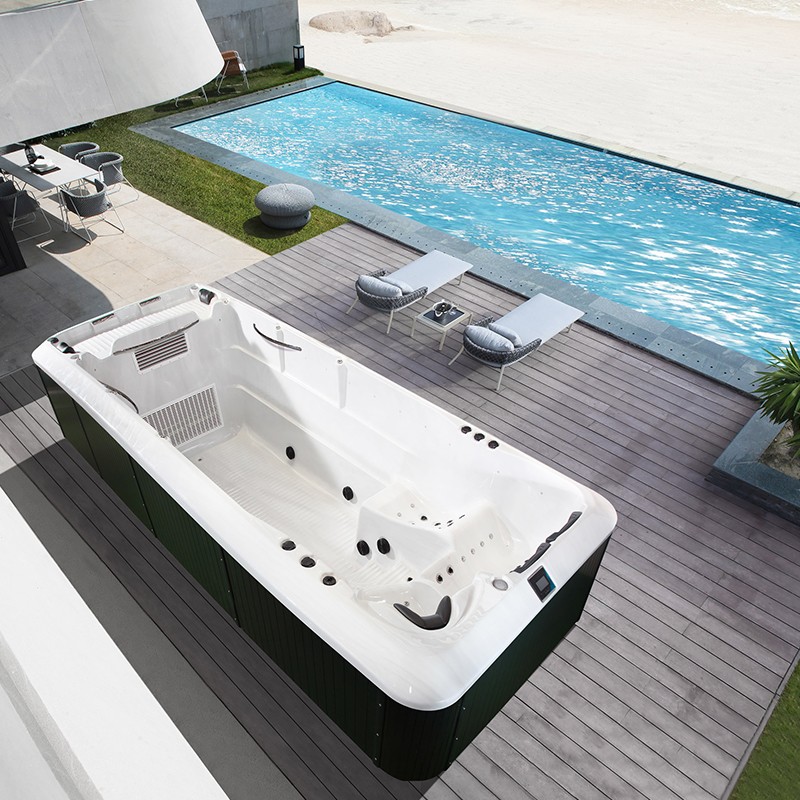
Will slight unevenness in the ground affect swim spa tubs?
Yes, and the impact is often underestimated.
Swim spa tubs require extremely high levelness due to the following reasons:
• Uniform water level is needed
• Balanced stress on the internal structure
• Long-term load-bearing capacity of the outer shell and frame
Slight localized subsidence or warping of the paving stones can lead to:
• Uneven water level
• Stress concentration in the structure
• Abnormal long-term stress on the equipment
These problems are not immediately apparent but represent long-term structural risks.
Do gaps between the paving stones affect the stability of the swim spa tub?
From a structural perspective, they can have potential impacts.
Gap between the paving stones means:
• Uncontinuous stress transmission
• Potential concentration of localized pressure points
• Uneven load distribution
For ordinary walking, this is not a problem;
However, for equipment like swim spa tubs that require uniform overall load-bearing capacity, this structural characteristic is not ideal.
Will placing a swim spa tub on paving stones definitely cause problems?
Not necessarily, but there is a structural risk.
It is important to emphasize that this is not a question of "absolutely not allowed," but rather a question of "whether it is recommended."
From a professional perspective:
• Paving stones are not designed as load-bearing foundations for swim spa tubs.
• Even if feasible in the short term, long-term stability remains uncertain.
• The risks primarily stem from the foundation and continuity, not the surface materials.
Therefore, suitability depends on the required risk tolerance and structural reliability.
Why are monolithic foundations more suitable for swim spa tubs?
This is determined by the characteristics of the equipment.
Monolithic foundations offer the following advantages:
• Continuous, seamless load bearing
• Uniform load distribution
• High long-term stability
• Easier leveling control
For high-load equipment like swim spa tubs, foundation stability is more important than aesthetics.
If paving stones are already in place, how should one rationally consider the installation of swim spa tubs?
From a rational and professional perspective, the following aspects should be emphasized:
• The foundation structure beneath the paving stones
• Sufficient compaction
• Risk of long-term settlement
• Overall horizontal stability
The key is not whether it can be placed, but rather:
Is the paving stone system designed to withstand the weight of a swim spa tub over a long period?
Why is the "foundation" more important than the "surface material" when installing a swim spa tub?
Surface materials (such as paving stones, concrete, etc.) are only the first layer of stress transfer; what truly determines safety and stability are:
• The underlying foundation
• The load-bearing structure
• Compaction and continuity
If the foundation is unsuitable, even the hardest surface material cannot reliably support the swim spa tub in the long term.
Can a swim spa tub be placed on paving stones?
Theoretically, a swim spa tub can be placed on paving stones, provided that the paving stones have a sufficiently stable, continuous foundation structure capable of supporting high weights over a long period; otherwise, it is not recommended to place the swim spa tub directly on a regular paving stone system.
Important points to remember:
• Swim spa tubs have extremely high requirements for their foundation.
• Paving stones themselves are not load-bearing structures.
• Long-term stability is more important than short-term feasibility.
When dealing with high-value, heavy equipment like swim spa tubs, the foundation conditions are always the most non-negotiable aspect.
What markets does Lovia Spa primarily serve?
Lovia Spa serves global markets, including North America, Europe, and other regions. As an international manufacturer, our company ensures that spa jacuzzi tubs and swim spa tub products meet different market standards and customer expectations.