


Can I Cut an Acrylic Hot Bathtub?
2026-05-08 15:30When installing, renovating, or redesigning bathroom spaces, many users encounter a seemingly straightforward but actually very complex question: Can I cut an acrylic hot bathtub?
On the surface, acrylic is a "processable" material, leading many to mistakenly believe that acrylic hot bathtubs can be cut like ordinary plastic sheets. However, an acrylic hot bathtub is not simply a sheet of acrylic; it is a functional product that has undergone structural design, stress calculations, and integral molding.
Whether or not an acrylic hot bathtub can be cut is not a simple question of "can or cannot," but a systemic issue involving material structure, safety, performance, and risk control.
This article will analyze in depth from a professional perspective whether acrylic hot bathtubs can be cut, in what sense "can," and why it is generally not recommended.
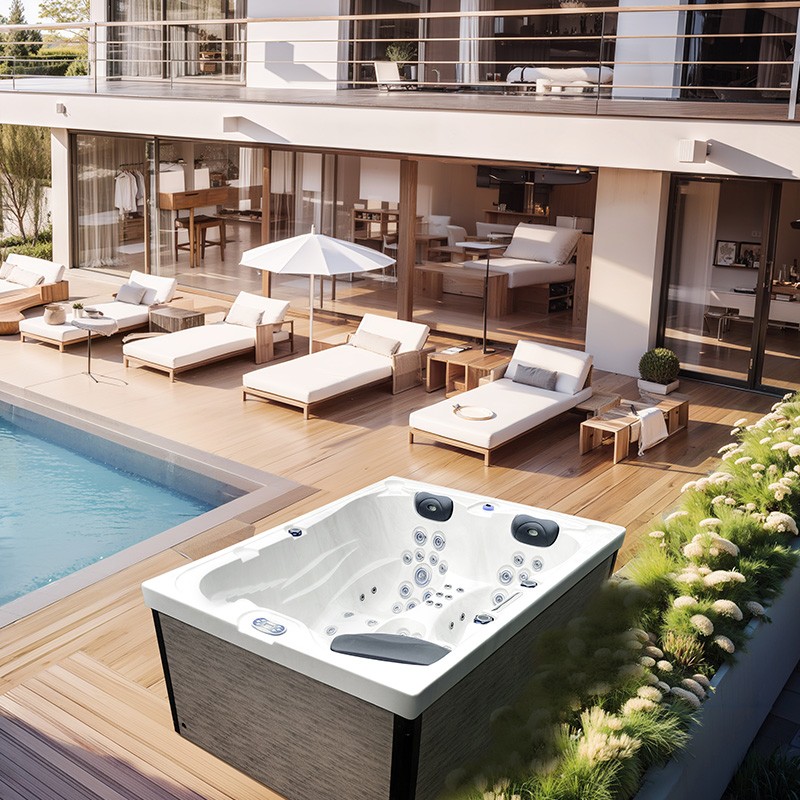
What exactly is the structure of an acrylic hot bathtub?
An acrylic hot bathtub is not just "acrylic" itself.
Structurally, a complete acrylic hot tub typically consists of the following parts:
• Surface acrylic sheet (PMMA)
• Backing reinforcement layer (such as a resin or fiberglass composite layer)
• Support structure (base or frame)
• Piping system and nozzle structure (if applicable)
In other words, an acrylic spa hot tub is a multi-layered composite structure, not a single material. Cutting not only affects the acrylic surface but also directly impacts the integrity of the internal structure.
From a material perspective, can acrylic itself be cut?
If we only consider "material workability," the answer is yes: Acrylic itself can be cut.
As a thermoplastic material, acrylic has the following properties:
• Can be sawed and drilled
• Can be processed mechanically
• Can maintain relatively smooth edges under controlled conditions
Because of this, many people would further infer:
Since acrylic can be cut, then acrylic spa hot tubs can certainly be cut as well.
However, this inference overlooks a crucial fact:
The fact that a material can be cut does not mean that the finished structure is suitable for cutting.
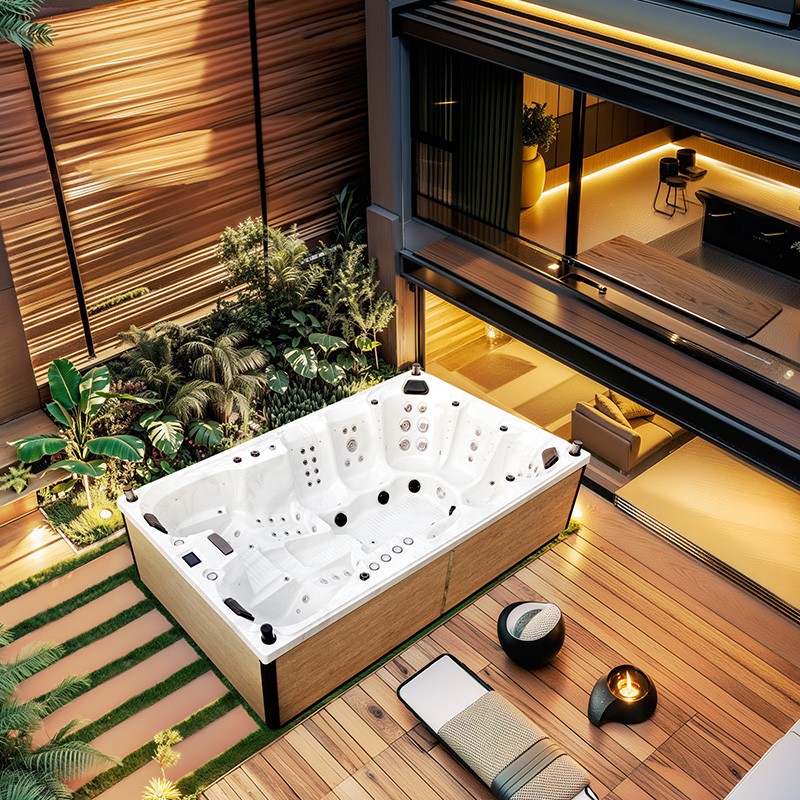
Why can't an acrylic hot tub be equated with an acrylic sheet?
There are fundamental differences between an acrylic hot tub and a regular acrylic sheet:
• Acrylic sheets are flat materials.
• Acrylic spa hot tubs are three-dimensional molded structures.
• The surface of the tub has curvature, stress distribution, and load-bearing design.
During the design phase, acrylic spa hot tubs undergo overall structural calculations based on water pressure, human weight, and temperature changes during use. Cutting it is equivalent to artificially altering the original stress path.
Therefore, even if a cutting tool can "cut" the material, it doesn't mean that the cut acrylic hot tub will remain safe and functionally intact.
Will cutting an acrylic hot tub affect its structural strength?
The answer is very clear: Cutting will almost certainly affect the structural strength of an acrylic hot tub.
The reasons are as follows:
• The strength of an acrylic spa hot tub comes from its integral molding.
• The back reinforcement layer is usually continuous.
• Cutting will disrupt the closed structure of the reinforcement layer.
Especially at the edges, bottom, or areas of concentrated stress, once cut, the originally evenly distributed stress will concentrate near the cut, significantly increasing the risk of cracking or deformation.
Will cutting an acrylic hot tub affect its waterproof performance?
The waterproof performance of an acrylic spa hot tub does not solely rely on the material's impermeability, but rather on the integrity of the overall structure.
The waterproof risks that cutting may bring include:
• Exposing the internal composite layer at the cut.
• Micro-cracks widening due to thermal expansion and contraction.
• Damage to the bond between the surface and back layers.
Even if the cut appears smooth, the risk of waterproofing will significantly increase after long-term exposure to hot water and pressure changes.
In what sense can we say "acrylic hot tubs can be cut"?
In professional discussions, it is necessary to strictly define "can be cut".
The phrase "can be cut" typically refers only to the following theoretical aspects:
• Acrylic material itself can be mechanically cut.
• It can be processed when not under load and in use.
This does not equate to:
• Safe use after cutting.
• Maintaining original performance after cutting.
In other words, "can be cut" does not equal "suitable for cutting," much less "no problems after cutting."
Why is it not recommended for users to cut acrylic hot tubs themselves?
From a professional maintenance and safety perspective, it is not recommended to cut acrylic hot tubs yourself. The main reasons include:
• Difficulty in determining the stress at the cut location.
• Inability to restore the original reinforcement structure.
• Extremely high difficulty in edge treatment.
• Irreversible risks.
If a cutting error occurs, the potential problems with the acrylic spa hot tub will not be immediately apparent but will gradually emerge during long-term use.
Will cutting an acrylic hot tub affect its lifespan?
The answer is yes.
The lifespan of an acrylic hot tub largely depends on:
• Surface integrity
• Continuity of the internal reinforcement layer
• Uniform stress distribution
Cutting disrupts these key lifespan factors. Even if no obvious problems are apparent in the short term, in the long run, cut acrylic spa hot tubs are more prone to aging, cracking, and structural fatigue.
Does cutting affect the safety of an acrylic hot tub?
Safety is a crucial factor.
Acrylic spa hot tubs are subjected to:
• The weight of a full tub of water
• The user's weight
• Material expansion due to temperature changes
Cutting alters the structure, and the combination of any of these factors can lead to safety hazards. Therefore, from a safety perspective, cutting an acrylic hot tub is a high-risk activity.
Are there any "relatively safe" cutting scenarios?
Strictly speaking, there is no completely "safe" cutting method.
Even in theory, any act of cutting implies:
• Damage to the original design
• Alteration of existing safety boundaries
Any so-called "partial cutting" or "minor cutting" is essentially just a difference in the degree of risk, not a difference in the existence of risk.
How should we rationally view the issue of cutting acrylic hot tubs?
From a professional perspective, a more reasonable approach is not "how to cut," but rather:
• Is cutting truly necessary?
• Can space or installation issues be resolved in other ways?
Acrylic spa hot tubs are highly molded products; their size, shape, and structure are designed around safety and performance.
Can I cut my acrylic hot tub?
A comprehensive analysis of material properties, structural logic, and safety leads to a clear and rational conclusion:
• Acrylic material itself can be cut.
• Acrylic hot tubs, as finished structures, are not suitable for cutting.
• Cutting will damage structural strength, waterproofing, and lifespan.
• The risks are irreversible.
• From a professional perspective, it is not recommended to cut acrylic spa hot tubs yourself or arbitrarily.
A correct understanding of the structural properties of acrylic spa hot tubs and respecting their overall molding design are key to ensuring long-term safe use.
How does Lovia Spa maintain consistency in product quality across large orders?
Lovia Spa operates with a well-structured production system that ensures consistency in every spa hot tub and swim tub we manufacture. As a professional factory, we apply standardized processes and strict inspections at each stage of production. Our company understands that wholesale buyers depend on uniform quality, so we focus on precision and reliability.