


An Analysis of the OEM Manufacturing Process for Outdoor Swim Spas
2026-07-23 15:30Outdoor swim spa tubs—which combine swimming training, hydrotherapy massage, and leisure—have increasingly become a key feature in high-end residences, resort hotels, wellness centers, fitness clubs, and villa gardens. Compared to traditional swimming pools, outdoor swim spa tubs require less space, offer shorter installation times, and are easier to maintain. They also provide multiple functions, such as year-round temperature control, counter-current swimming training, and hydrotherapy massage, driving sustained growth in global market demand in recent years.
According to public industry research data from sources like Grand View Research and Fortune Business Insights, the global spa and hot tub market is growing steadily; within this sector, outdoor swim spa tubs—which blend fitness and leisure attributes—have emerged as a rapidly growing category. While Europe and North America remain the primary consumer markets, demand is also rising in the high-end residential sectors of Australia, the Middle East, and Asia. As more international brands, importers, and project purchasers adopt the OEM (Original Equipment Manufacturer) model, Chinese manufacturers have become a vital force in the global supply chain, thanks to their comprehensive industrial ecosystems, mature manufacturing techniques, and excellent cost-performance ratios.
However, the journey of a high-quality outdoor swim hot tub combo from design and R&D to final delivery involves over a dozen core manufacturing steps. Each stage impacts the product's structural integrity, thermal insulation, massage performance, durability, and the ultimate user experience.
This article provides an in-depth analysis of the complete production process for outdoor swim hot tub combos from an OEM perspective, helping purchasers, brands, and industry professionals understand exactly how a high-quality outdoor swim hot tub combo is manufactured.
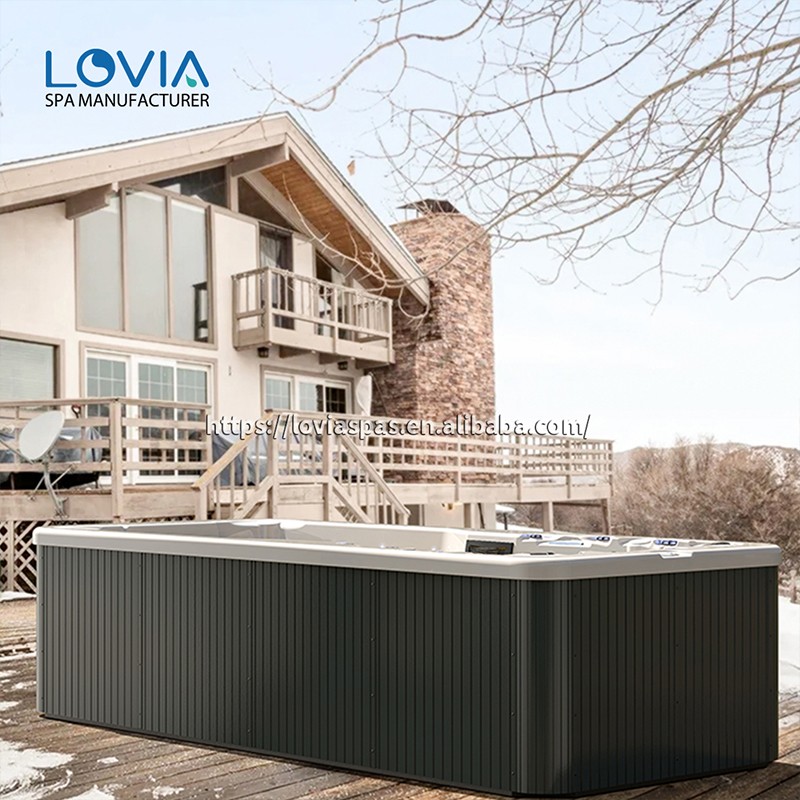
Why Are More Outdoor Swim Spas Being Manufactured via the OEM Model?
For international brands, building in-house manufacturing facilities requires not only significant capital investment but also the establishment of systems for R&D, procurement, quality control, certification, and supply chain management. Consequently, an increasing number of companies are opting for the OEM model.
Established OEM manufacturers typically possess comprehensive production systems capable of handling the entire process—from product R&D, mold development, acrylic thermoforming, and fiberglass reinforcement to plumbing installation, electrical system integration, final unit testing, and export packaging—under one roof. This allows purchasers to focus their energy on brand building, marketing, and channel operations, while leaving the manufacturing process to professional factories. For outdoor swim hot tub combos, technical expertise is crucial for OEM manufacturers due to the products' large size, complex structures, and the integrated operation of multiple systems—including plumbing, electrical, and mechanical components.
OEM Outdoor Swim Spa Manufacturing Process: Everything You Need to Know
Step 1: Product Design and OEM Specification Confirmation
The manufacturing process begins not with production, but with product planning.
OEM clients typically define product positioning based on the target market—such as home fitness, hospitality/resort use, or high-end residential applications. Manufacturers then design product dimensions, seating layouts, counter-current systems, hydrotherapy zones, and feature configurations to meet the specific market demands of the target country.
Common dimensions in the international market range from 4.5 to 6 meters in length, 2.2 to 2.4 meters in width, and 1.3 to 1.5 meters in depth. These dimensions accommodate adult swim training while also serving family recreation needs and fitting into typical backyard installations.
During this stage, specifications regarding control systems, voltage standards, certification requirements (e.g., CE, ETL), color schemes, and OEM branding are finalized to establish a unified standard for subsequent production.
Step 2: Acrylic Sheet Vacuum Forming
The shell is the core component of an outdoor swim hot tub combo, and its manufacturing quality directly determines the product's lifespan.
High-quality products typically utilize sanitary-grade PMMA acrylic sheets. Large-scale vacuum forming equipment heats the sheet to the optimal temperature; vacuum pressure then draws the material onto the mold surface, shaping it into the complete shell structure.
Because swim hot tub combos are significantly larger than standard outdoor hot tubs, the process demands higher standards for equipment size, temperature control, and mold precision. Production must ensure consistent overall dimensions and a flawless surface finish—free from bubbles or significant thickness variations—to enhance the product's weather resistance and aesthetic appeal.
Step 3: Fiberglass Reinforcement
Once vacuum forming is complete, the acrylic layer alone cannot withstand long-term structural loads; therefore, fiberglass reinforcement is required.
A composite process involving multiple layers of fiberglass and high-performance resin is typically used to reinforce the back of the shell layer by layer. Depending on product specifications, the thickness and number of reinforcement layers vary to ensure the large outdoor spa pool maintains structural stability even when filled with water for extended periods.
For instance, an outdoor spa pool with a capacity of 6,000 to 8,000 liters can weigh over 7 tons when fully loaded. Consequently, a high-strength fiberglass structure is crucial not only for safe transport but also for the product's long-term reliability.
Step 4: Base and Steel Frame System Installation
To further enhance overall strength, modern outdoor spa pools typically utilize high-strength galvanized steel or corrosion-resistant metal frames as the primary support structure.
The steel frame must precisely match the shell's underside while accommodating transport, installation, and long-term load-bearing requirements. For export products, the frame must also offer superior corrosion resistance to withstand coastal, high-humidity, and cold environments.
A stable support system effectively distributes the unit's weight, improves resistance to deformation, and provides a secure foundation for installing pumps, heaters, and circulation systems.
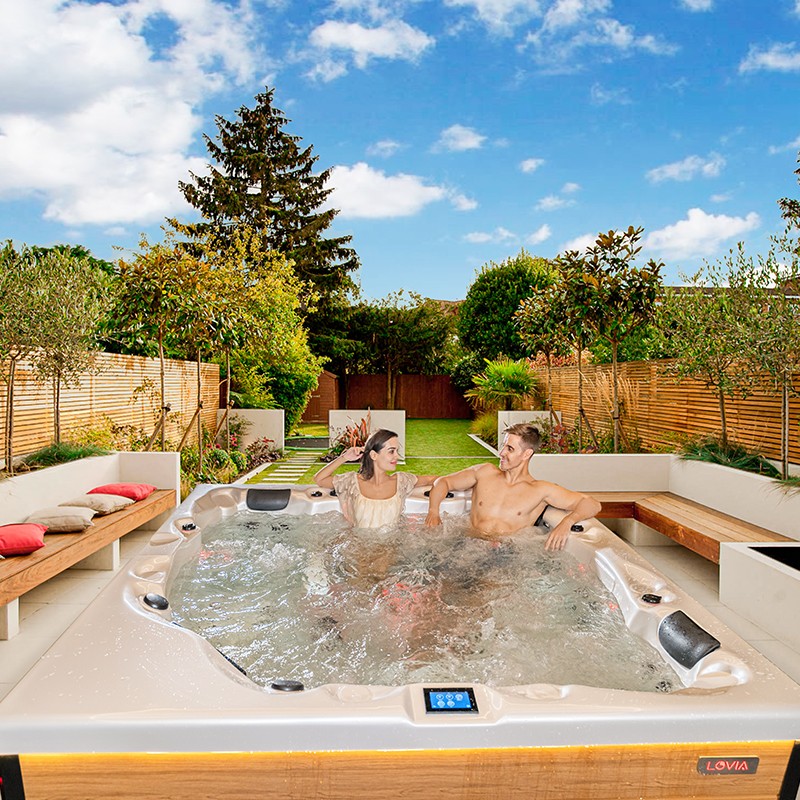
Step 5: Piping System Layout
Piping installation is one of the most experience-intensive stages of the OEM manufacturing process.
A standard outdoor spa pool contains tens to over a hundred meters of PVC piping, connecting jets, circulation filtration units, pumps, heaters, and counter-current propulsion systems.
During installation, technicians must execute a precise layout based on design blueprints and use professional adhesives and sealing techniques to ensure the system remains leak-free under long-term high-pressure operation.
Upon completion, pressure testing is conducted to verify the sealing integrity of the entire circulation system.
Step 6: Counter-Current Swim System Installation
Unlike standard outdoor spas, the defining feature of an outdoor spa pool is its counter-current swimming capability.
Mainstream swim hot tub combos typically feature two to five high-power counter-current jets paired with high-performance circulation pumps to generate a steady current, allowing users to engage in continuous swim training within a compact space.
Depending on the product's target market, the counter-current flow speed is usually adjustable across multiple levels to meet the needs of beginners, fitness enthusiasts, and professional athletes alike. OEM clients can also select different specifications for the counter-current system based on their target markets, enabling product differentiation.
Step 7: Hydrotherapy Massage System Integration
In addition to the swimming area, most outdoor spa pools feature a separate hydrotherapy massage zone.
The massage zone typically includes multiple ergonomically designed seats equipped with various types of massage jets, providing targeted massage for the shoulders, neck, back, waist, calves, and feet.
Mainstream products on the market generally feature between 40 and over 100 jets; multiple pumps control different massage zones independently to deliver a richer hydrotherapy experience.
Step 8: Control and Electrical System Installation
Modern outdoor spa pools increasingly emphasize a smart, user-friendly experience.
Control systems typically include functions such as constant temperature control, circulation management, LED lighting, heating and filtration systems, massage mode switching, and fault diagnostics.
Some high-end products support Wi-Fi remote control, allowing users to pre-set water temperatures, activate filtration, or schedule heating for greater convenience.
For OEM projects, control systems are adjusted to meet the voltage standards of different countries (e.g., 110V, 220V, or 380V configurations).
Step 9: Thermal Insulation System Installation
For outdoor spa pools intended for year-round use, thermal insulation performance directly impacts long-term operating costs.
Modern products often employ a combination of solutions—such as multi-layer polyurethane foam insulation, skirt insulation, base insulation, and high-seal thermal covers—to minimize heat loss.
Industry tests indicate that an effective insulation system not only improves temperature maintenance efficiency but also reduces reheating times, thereby lowering overall energy consumption—an advantage that is particularly significant in cold climates.
Step 10: Full-Unit Testing and Quality Inspection
Assembly of the complete unit does not mean the product is immediately ready for shipment.
Established OEM manufacturers typically conduct a series of quality inspections, including:
•Water-fill and sealing tests;
•Pipeline pressure tests;
•Pump operation tests;
•Heating system tests;
•Control system tests;
•LED lighting tests;
•Electrical safety inspections;
•Long-duration continuous operation tests.
The product proceeds to the packaging stage only after passing all inspection criteria. A robust quality management system effectively reduces post-sales failure rates and serves as a key benchmark for international buyers selecting OEM manufacturers.
Step 11: Export Packaging and Global Shipping
Given the large size of outdoor swim hot tub combos, safe transportation is paramount.
Export packaging typically employs scratch-resistant protective film, shock-absorbing cushioning materials, wooden skids, and steel strapping to ensure product stability during ocean freight.
Manufacturers also provide product manuals, certification documents, packing lists, and export paperwork tailored to specific national requirements, facilitating smooth customs clearance for clients.
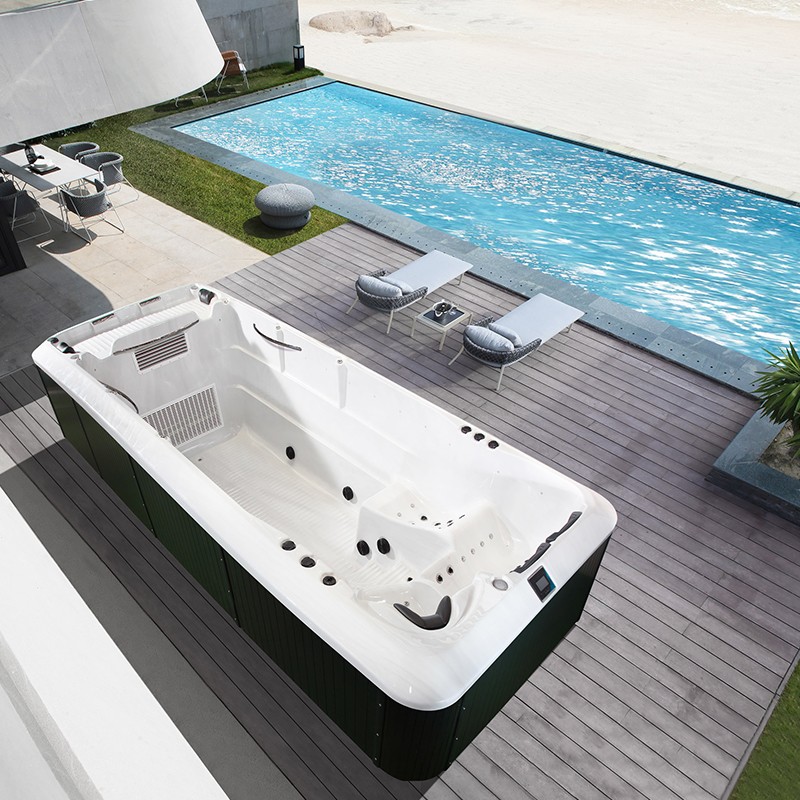
Why Do International Clients Choose Chinese OEM Manufacturing for Outdoor Swim Spas?
In recent years, China has continuously enhanced its overall competitiveness in the outdoor swim spa tub manufacturing sector.
On one hand, China boasts a mature supply chain for acrylic, fiberglass, water pumps, electronic controls, and insulation materials, enabling rapid production. On the other hand, the continuous improvement of automated production equipment and standardized quality management systems has led to consistent product quality and increased delivery efficiency.
For international brands, OEM partnerships not only reduce R&D and manufacturing costs but also leverage the experience of established manufacturers to accelerate the launch of new products that meet market demands.
LOVIA®’s Advantages in Outdoor Swim Spa Tub OEM Manufacturing
As an enterprise dedicated to the R&D and manufacturing of spa equipment, LOVIA® has long focused on outdoor swim spas, outdoor hot tubs, and cold therapy equipment, providing OEM and ODM solutions to global clients.
LOVIA® operates modern production facilities featuring multiple specialized production lines and a comprehensive R&D team, covering the entire manufacturing process—from product design and mold development to acrylic forming, full-unit assembly, quality testing, and export services. The company’s product portfolio includes residential swim hot tub combos, commercial spa pools, and various outdoor spa models, offering customization options for dimensions, control systems, colors, and branding to suit diverse market needs.
Furthermore, LOVIA® prioritizes energy efficiency, ergonomic design, and smart control experiences. The company continuously optimizes insulation systems, circulation filtration, hydro-massage functions, and counter-current swimming systems to meet the diverse demands of users across different countries and regions for high-quality outdoor swim hot tub combos. For brand owners and purchasers, this comprehensive capability—spanning R&D, manufacturing, quality management, and customization services—helps enhance product competitiveness and ensures a stable supply for long-term partnerships.
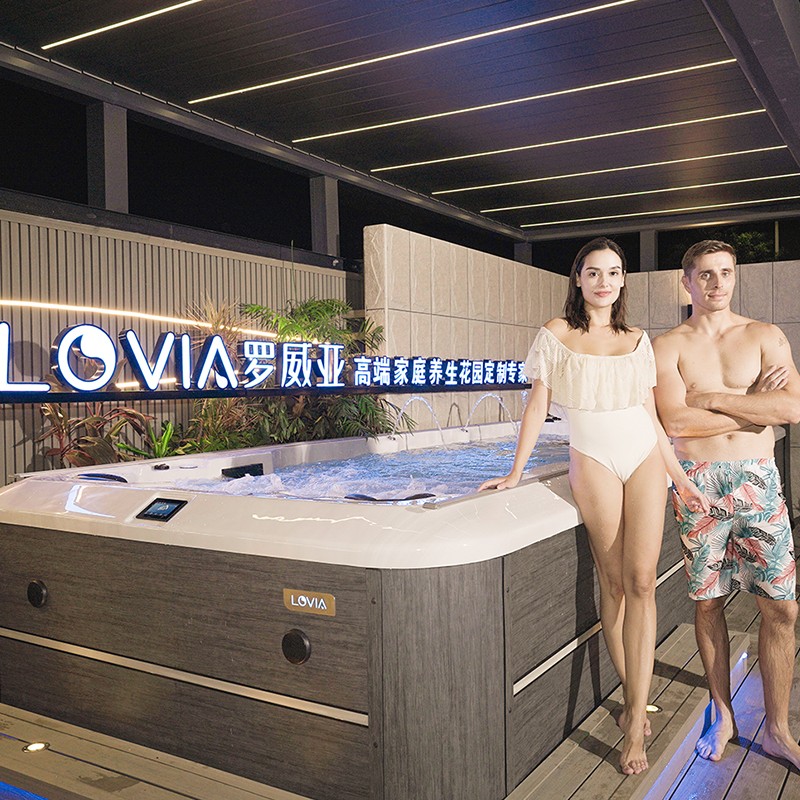
FAQ
Q1: What is an OEM outdoor swim hot tub combo?
An OEM outdoor swim hot tub combo is a product manufactured by a specialist producer according to a client's brand specifications, configurations, and market needs, and ultimately sold under the client's own brand. This allows clients to own products under their own brand without the need to build their own factories.
Q2: How long does it usually take to manufacture an outdoor swim hot tub combo?
Depending on product configuration and order volume, the OEM production cycle typically ranges from 30 to 60 days. If the project involves new mold development, special configurations, or specific certification requirements, the overall timeline may be extended accordingly.
Q3: What is the main difference between an outdoor swim spa and a standard outdoor spa tub?
Outdoor swim hot tub combos are generally larger in size and water capacity and feature a counter-current swimming system, catering to needs such as continuous swim training, hydrotherapy massage, and family entertainment. In contrast, standard outdoor spa tubs focus primarily on heated soaking and massage relaxation.
Q4: What aspects can be customized in outdoor swim spa OEM manufacturing?
Customization options generally include product dimensions, acrylic colors, skirt materials, control systems, voltage specifications, jet configurations, lighting systems, brand logos, packaging designs, and certification configurations required by different countries to meet diverse market and client needs.
Q5: Why is it important to choose an experienced OEM manufacturer for outdoor swim hot tub combos?
Outdoor swim hot tub combos involve complex manufacturing processes and integrate multiple systems, including structural, hydraulic, electrical, thermal insulation, and smart control components. An OEM manufacturer with mature R&D capabilities, a robust quality management system, and extensive export experience is better positioned to ensure product quality, delivery reliability, and long-term after-sales support, thereby reducing procurement risks and enhancing product competitiveness.